An old and worthy insight from the Nobel laureate and originator of cognitive psychology and artificial intelligence, Herb Simon: Don't spend 15 minutes figuring out a shortcut that will save you 10 minutes. Information-gathering and decision-making themselves have costs, so "satisfice" rather than seeking to optimize. This op-ed by David Epstein draws out implications for life decisions. https://t.co/7Hhgch0P1y
Human brains have been shrinking since prehistoric times, some studies suggest. Whether this is true and why it has happened are debated. https://t.co/QRjyywkcFK
Human brains have been shrinking since prehistoric times, some studies suggest. Whether this is true and why it has happened are debated. https://t.co/QRjyywkcFK
If humans are getting smarter, why are our brains shrinking? Human brains have been shrinking since prehistoric times, some studies suggest. Whether this is true and why it has happened are debated https://t.co/n91qcaGuQF
Mane Kara-Yakoubian provides a more clear and articulate overview of my recent research in her PsyPost article:
Evolution may have capped human brain size to balance energy costs and survival via @psypost https://t.co/eeBqPpOAcQ
7/
Read the paper:
📄 "Did increasing brain size place early humans at risk of extinction?"
Rethinking human extinction: Evolution, brain size, and the adaptive role of cognition
https://t.co/77mPSslleF
Tagging #HumanEvolution#ExtinctionRisk#Cognition#Anthropocene
6/
We argue that extinction risk should be framed through this evolutionary lens:
🧠 Not just biology
🧰 Not just technology
But the feedback loop between brains, symbols, and the environments they alter.
5/
What’s the risk?
By reducing our reliance on biological evolution, we may have become more dependent on symbolic systems to manage increasingly complex environments.
The question isn’t “Are we smart enough?”
The question is: "Are our tools resilient enough?"
4/
This isn’t a claim that cognition is a liability; rather, it may have saved humanity from collapse.
It marks a shift: from evolving bigger brains to building cognitive scaffolding—external tools that extend memory, reasoning, and coordination.
3/
Our new paper explores the idea that the rise of symbolic cognition—language, planning, shared knowledge—may have reduced the evolutionary pressure for bigger brains.
Tools didn't just shape the world—they reshaped the path of selection.
2/
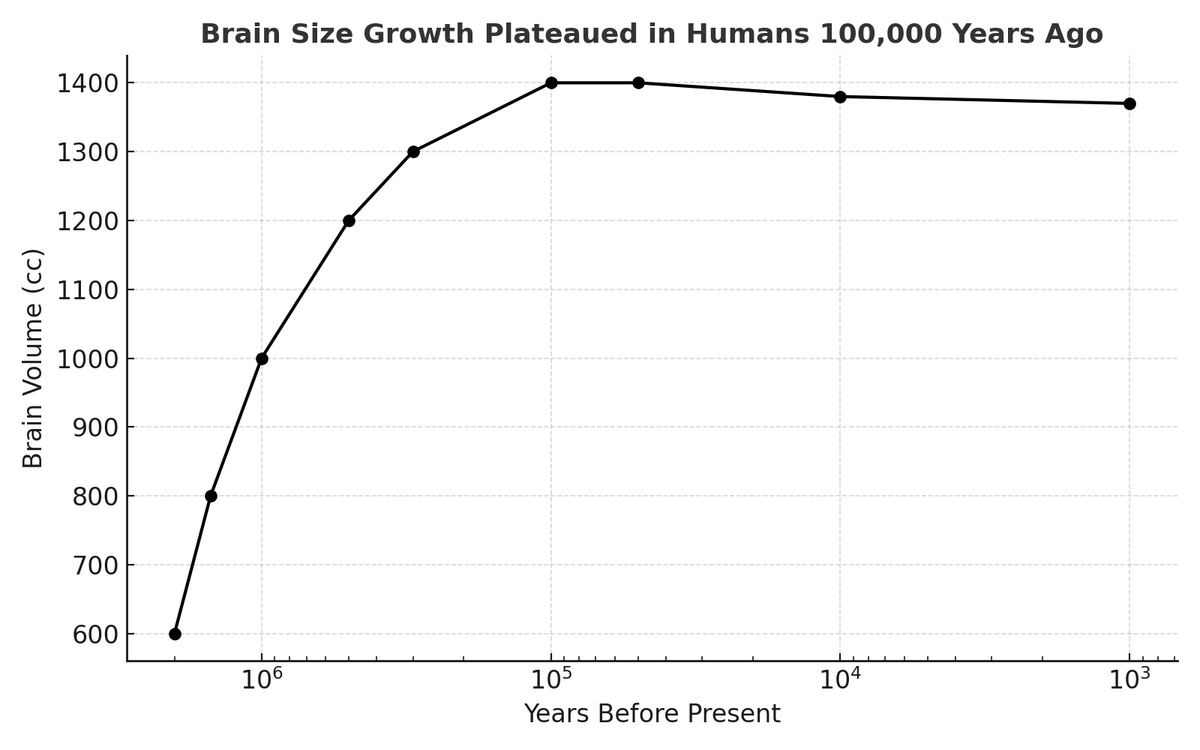
🧠 Human brain size tripled over 2 million years but, despite what you may have thought, brain size plateaued around 100,000 years ago.
Why did human brain size stop growing?
And what does it mean for our long-term survival as a species?
1/
🧠 Why did human brain size stop increasing 100,000 years ago?
And what does that mean for our future as a species?
Our new paper explores how changes in cognitionmay reshape how we think about extinction risk.
A thread.
https://t.co/77mPSslleF
The APA is saddened to note the passing of Professor Daniel Dennett (1942–2024). Dennett served as @APAEastern president in 2000–2001. He was professor emeritus of philosophy at @TuftsUniversity, where he had been on the faculty since 1971. https://t.co/wwMjgpw2lQ
"The secret of happiness is: Find something more important than you are and dedicate your life to it."
Daniel Dennett (March 28, 1942 - April 19, 2024)