I am the creator of Infinity Constraint Theory-IUC
This doesn’t mean I’m right. It means I never was comfortable with the stories of men. Even the divine ones
@chicfryrice It may not be the highest integrity but intelligent people sometimes get to the point where they stop correcting stupid people becuase stupid people don’t believe them, become hostile towards them and will actively sabotage them. Other moderately smart people mistake this
IN THE 1920S A YOUNG INDIAN PHYSICIST TOLD EINSTEIN THAT TWO IDENTICAL COINS HAVE THREE OUTCOMES NOT FOUR. EINSTEIN BELIEVED HIM. SEVENTY YEARS LATER THAT IDEA WON A NOBEL PRIZE AND CREATED AN ENTIRELY NEW STATE OF MATTER. THE SAME COUNTING PRINCIPLE THAT MADE IT POSSIBLE IS EXPLAINED IN THIS HARVARD LECTURE FOR FREE.
His name is Joe Blitzstein. He has won Harvard's Excellence in Teaching award multiple times. His course Statistics 110 has been taken by over 2 million people across 190 countries. Students who transfer to other universities say this is the one Harvard course they wish they could take again. It is the reason Statistics 110 has a three year waitlist.
This is lecture 2. It covers story proofs, counting, and the axioms of probability.
He starts with the hardest entry in the sampling table. You pick k objects from n with replacement and order does not matter. The answer is n plus k minus 1 choose k. Three of the four entries follow immediately from the multiplication rule. This one requires actual thinking.
The proof converts the problem into dots and separators. k indistinguishable particles in n distinguishable boxes. If n equals 4 and k equals 6 you draw 6 dots and 3 separators. You have 9 positions total and you choose which 6 are dots. The formula n plus k minus 1 choose k appears in one line and you never forget why.
Then Vandermonde's identity. m plus n choose k equals the sum from j equals 0 to k of m choose j times n choose k minus j. Half a page of factorial algebra to prove it the hard way. Two sentences to prove it the right way. You have m people and n people. You need k total. Count by how many you take from each group. Done.
Then the axioms. All of probability theory rests on exactly two rules. Probability of the empty set equals zero. Probability of disjoint union equals the sum of probabilities. Every theorem in the course follows from those two sentences alone.
Watch the moment he explains why Bose was laughed at for proposing three equally likely outcomes for two coins - and why he was right for quantum particles and wrong for coins.
Free on YouTube, Harvard, over 2 million views.
There's a $1,000,000 prize for solving this. The Riemann zeta function connects prime numbers, infinite sums, and complex analysis into one equation - and nobody fully understands it yet.
The same analytic continuation that makes 1+2+3+4... equal -1/12 is the mathematical backbone behind signal processing in every LLM. When GPT extends patterns beyond its training data, it's doing conceptually the same thing - finding the only consistent extension that preserves the underlying structure.
20 minutes. Bookmark & watch today. The unsolved problem behind the primes.
Every Mamba layer, every Neural ODE, and every Schrodinger simulation in quantum ML runs on matrix exponentiation - the operation Grant Sanderson walks through visually here.
A Stanford math grad just released a 27-minute visual breakdown of how to raise e to the power of a matrix. Publicly free.
Bookmark & watch this weekend. Same operation, from Romeo & Juliet dynamics to trillion-parameter LLMs.
Friends in Canada! 🇨🇦 This fall, I shall be journeying across your fine, frostbitten nation, hosting screenings of “Monty Python and the Holy Grail” followed by raucous Q&A sessions! Get your tickets at https://t.co/GbZZue03ct or https://t.co/cMOydyBZqC, before they’re gone and you’re left explaining to your grandchildren why you missed the tall, cranky Englishman. #montypython #comedyshow
"Hedge funds don't get rich by adding trades. They get rich by subtracting risks. Every position starts as a mess of exposures - the fund's job is to sell off ninety-nine of them and hold the one that pays."
John Geanakoplos - Yale economics professor and a founding partner of the hedge fund Ellington.
he strips hedging to its bone: "hedging is the idea that you want to cancel out some of your risks." you know a bond is worth 98, the market says 120 - but a rate move can bury you before you're proven right.
so he builds the machine that removes every risk you didn't want, one period at a time: "gain-by-gain or month-by-month, you can find someone else who'll always trade at fair odds with you." do it right and the trade transforms - from a bet you believe in, into a bet "you can't possibly lose."
so the edge was never the insight. the insight is common. the edge is the discipline to hold only the one risk you actually understand and shed the rest.
a Yale economist who ran real money, showing the machine - free, and almost nobody's watching. bookmark. being right is worthless until you survive to collect.
Choongbum Lee, the math genius who cracked one of the hardest unsolved puzzles in modern probability:
"There's a specific way of splitting any random, unpredictable process into two simple pieces, one predictable, one pure chaos, and understanding that split is the closest thing to a cheat code for thinking about uncertainty."
this is the exact structure hiding underneath every model that claims to price risk in continuous time, and it's the first thing worth checking before trusting any strategy built on one.
cut through the notation and the split is precise. a stochastic differential equation says the tiny change in something at any instant equals a drift term, the direction it's heading on average, plus a volatility term multiplied by pure randomness, the noise shaking it away from that average path.
every continuous-time model in finance, no matter how complicated it looks on the surface, is built from exactly these two pieces.
that decomposition matters because it separates two completely different questions that get blurred together constantly, where is something heading on average, and how much is randomness capable of shoving it off that path at any given moment. conflating those two questions is exactly how people misprice risk, and exactly how you can catch someone else doing it too.
most people looking at a backtest or a pitch deck judge a strategy by how well its overall returns fit the past, without ever asking the sharper question, is the edge actually coming from correctly predicting the drift, or is it just getting lucky on the noise.
zoom out to how this plays out evaluating any strategy or signal someone shows you today. ask which of the two pieces it's actually claiming to predict, the average direction or the size of the randomness around it, and you'll immediately see whether the claim is even coherent, because most weak pitches quietly blur the two together to sound more impressive than they are.
this is exactly what "the strategy has strong historical returns" claims skip.
strong returns and correctly separating drift from noise are different achievements, and a strategy can show great numbers while secretly just riding noise it never actually understood.
the edge was never in the overall number. it was always in knowing which of the two pieces, the drift or the noise, you were actually right about.
Bookmark this alpha and follow @mindarchx for more gems.
Euler's formula is not a formula. An MIT professor spent a whole lecture proving it is a definition, not a discovery.
This is 18.03, Lecture 6, Arthur Mattuck. Free on MIT OpenCourseWare.
The formula is e^(iθ) = cos θ + i sin θ. Most people memorize it and move on. Mattuck refused to.
He asked one thing. What gives that the right to be called an exponential at all? An exponential has to obey one law: e^a · e^b = e^(a+b).
So he checked it. He multiplied e^(iθ₁) by e^(iθ₂), expanded the sines and cosines, and looked at what fell out.
The angle-addition identities. cos(A+B) and sin(A+B), the two formulas you were forced to memorize in school.
They were never two formulas. They are one line: e^(iθ) obeying the law of exponents.
Then the payoff. An integral that normally needs integration by parts twice and a trick, ∫ e^(-x) cos x dx, drops out in a few lines once you let the numbers go complex. Nothing is easier to integrate than an exponential.
Someone once asked him what beauty in math looks like. He pointed at the board.
Something long became something short, and lost nothing.
"Every trader believes the edge is in the exit - knowing when to sell, when to quit. A theorem quietly proves the opposite: if the game is fair, no exit rule on Earth makes you money."
Jan Obłój - Oxford professor of mathematical finance.
this lecture is the martingale - the exact math of a fair game - and its brutal corollary, the optional sampling theorem. it says: take a fair game and any rule for when to stop - a signal, a stop-loss, a gut feeling - and your expected result is exactly where you started. every "strategy" averages to zero.
so the entire industry of exit signals is arguing with a proof. if there's no edge inside the game, the moment you choose to walk away cannot create one - the theorem shut that door before you sat down.
it's also the hidden engine of option pricing: find the measure that turns the discounted price into a martingale, a fair game, and the price is forced. no forecast, no opinion - just the math of fairness.
an Oxford probabilist laying out the one theorem every trading desk is quietly built on - free, and almost nobody's watching. bookmark. you can't out-time a fair game. you can only be the one who owns it.
Schrodinger's equation, Neural ODEs, and every LLM built on Mamba use one operation: raising a matrix to a power. Sounds like nonsense until you see it.
A Stanford math grad just released a 27-minute walkthrough starting from a mass on a spring and building up to quantum mechanics. Publicly free.
Bookmark & watch this weekend. Same operation, from 1926 to 2025.
In 2013 an MIT mathematician wrote one minus sign on a chalkboard and explained the exact trick hedge funds farm billions from in 2026.
MIT filmed it. it has been free for 13 years. it has fewer views than a phone unboxing.
his point: volatility is not a risk you survive. it is a crop you harvest.
every "volatility harvesting" thread charging you $500 in 2026 is reselling the one line Choongbum Lee derives for nothing.
he is a mathematician, not a guru. no thumbnail, no promise. just the term that makes a shaking portfolio beat a calm one.
skip to where he writes d(log S). out falls minus one-half sigma squared. that tiny term is the "$12.50 from nowhere" in the post above.
no black box. no signal. one piece of chalk.
a quant I know made his whole desk watch minute 40 before they could touch the rebalancer.
you are 13 years late. it is still free.
As someone who ships LLM systems in production, this 22-minute Laplace transform video is the closest thing to a "why Mamba solves what transformers can't" explainer I've ever seen released for free.
Everyone thinks scaling transformers is the only path forward. State space models beat them on long context using math Laplace built in 1785. This video shows the trick.
Bookmark & watch today. The math is older than the United States.
Andrew Lo has spent his entire career studying finance, and this is the blunt conclusion he keeps coming back to.
"It's amazing how bad we are as homo sapiens in managing our finances."
His OpenCourseWare lectures have been watched millions of times. He built an entire theory on that line, the adaptive markets hypothesis: efficient markets isn't wrong, it works most of the time, it's just not complete, and the gap is exactly where human behavior overwhelms the beautiful logic of the math.
His fix for that gap is almost embarrassingly simple. Before anything goes wrong, run the scenario now, while you're calm, so panic never writes the decision. In March 2020 the market fell 30% in days.
People who sold to escape the pain missed the rebound weeks later. Anyone who'd pre-committed to sit still wouldn't have noticed the dip.
Same fight as the article above, just off the trading desk. Expected value thinking stops you grading a decision by how it felt after. Lo's scenario analysis is that discipline run before the fact, pricing the drop while no fear is in the room to argue back.
The lectures are free on MIT OpenCourseWare and have been for years. What nobody hands you is the will to write the plan on a calm day for the day you won't feel calm at all.
Elon Musk identifies the root cause of Canada's decline
Canadian MP's in every political party exploiting the racist voting habits of foreigners
...through theft of income and hyper taxation.
The most influential mathematician of his generation stands in a German lecture hall and explains a foundation he is rebuilding from scratch. Almost nobody watches it.
This is Peter Scholze at Bielefeld University, November 2025, opening lecture of a new public series called Ars Mathematica.
Scholze became a full professor at 24 and won the Fields Medal at 30. His work on perfectoid spaces reorganized entire areas of arithmetic geometry inside a decade.
Condensed mathematics is his attempt to fix something deeper: the way analysis and algebra refuse to sit together properly. He is proposing new foundations for how mathematical objects carry topology.
Watch how he pitches it to a general audience. No prerequisites assumed, no dilution, a working mathematician showing why abstraction opens rooms you could not otherwise enter.
A researcher I know rewatched the middle section twice and said it was the first time condensed mathematics felt like an idea rather than a rumour.
Free on YouTube from a university channel, subtitles on.
Some people prove theorems. He is replacing the floor.
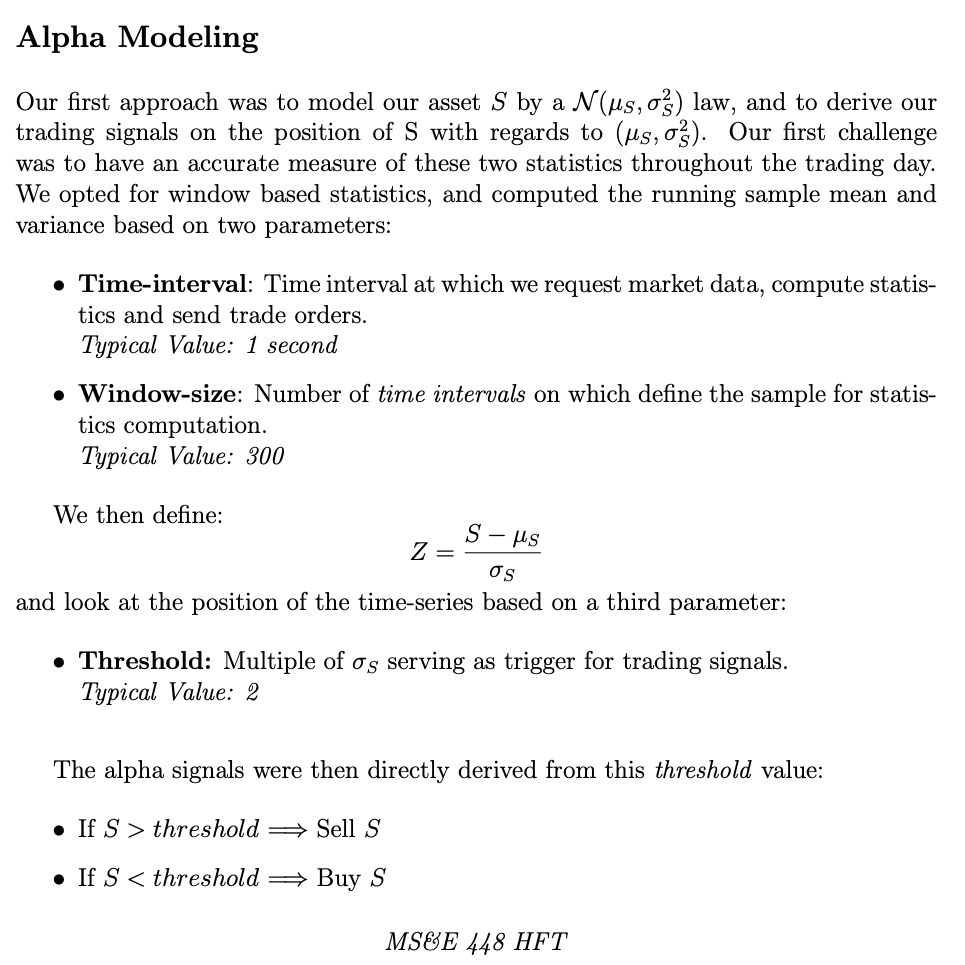
this Stanford paper is f*cking insane
built by someone running institutional-level quant systems, and this is the closest thing to a live trading playbook ever leaked into public.
19 pages. window size tuning that flips PnL on the exact same stock, same day, same code, nothing else changed.
the crazy part is it includes Hurst exponent universe selection, the exact filter that decides which stocks are even worth mean-reverting on.
most public resources teach you the strategy.
this one teaches you the tuning that decides if that strategy prints or bleeds.
bookmark, and if this helps you, pass it on.