@adinarayanaram1 Before going live, check what's left after real costs. A 65% win rate on options can flip sign once slippage and fees are counted on every trade. This one had a 0.60 Sharpe and was unusable past 0.28 bp per round trip. https://t.co/Dv0NFCAehJ
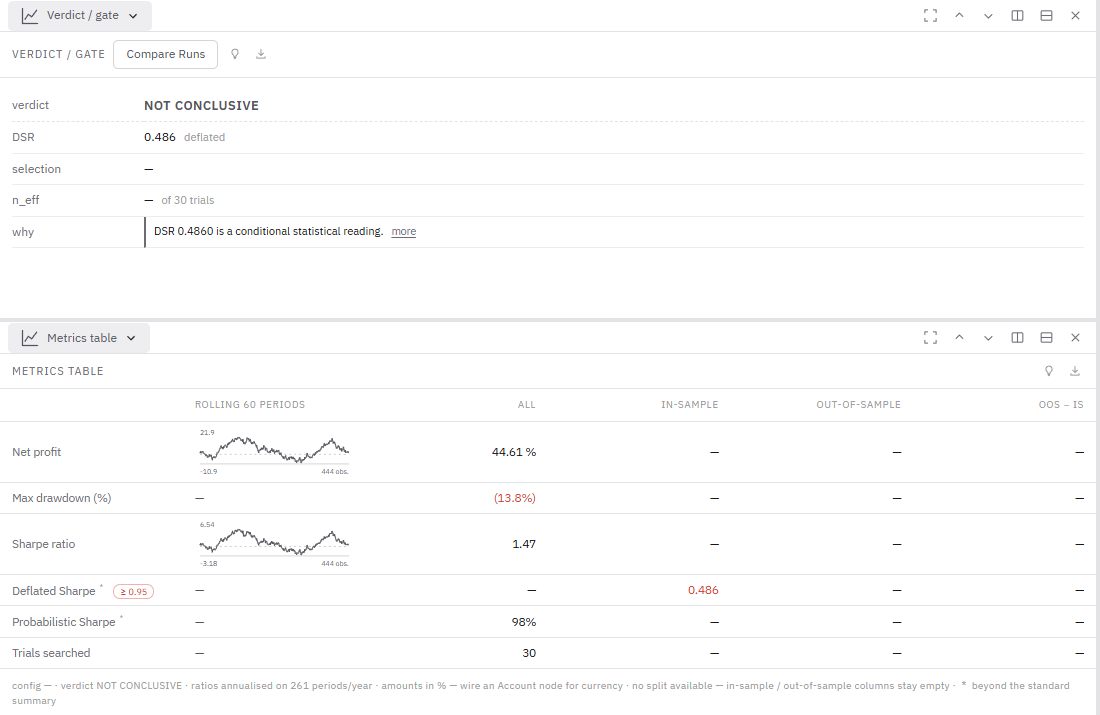
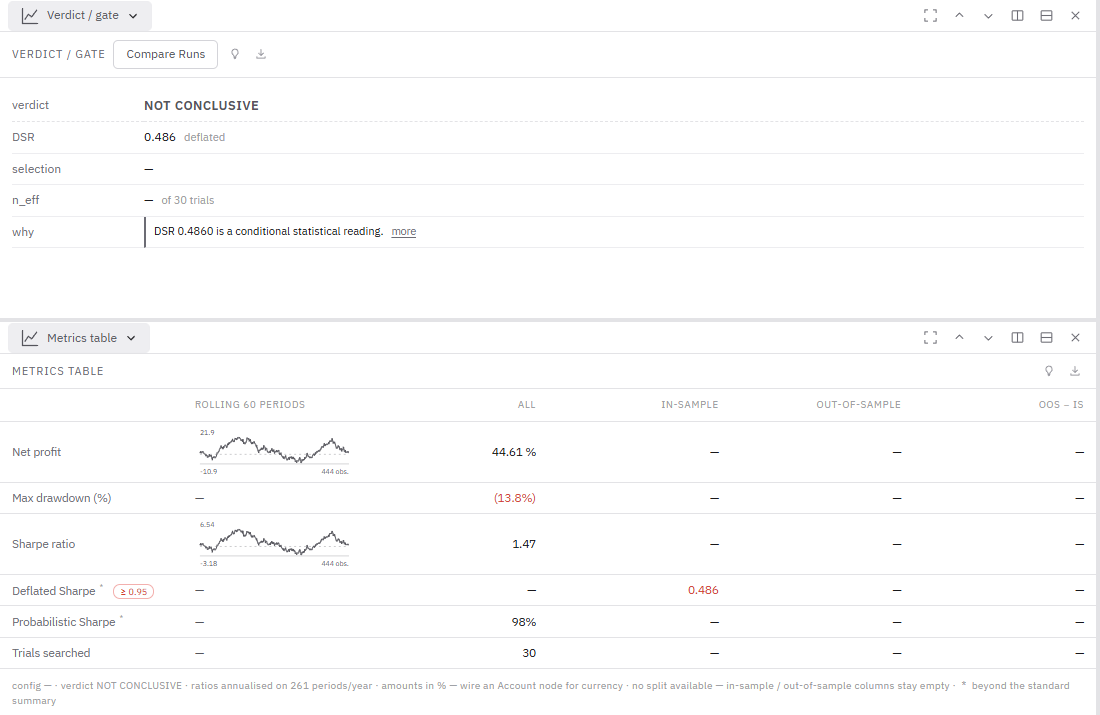
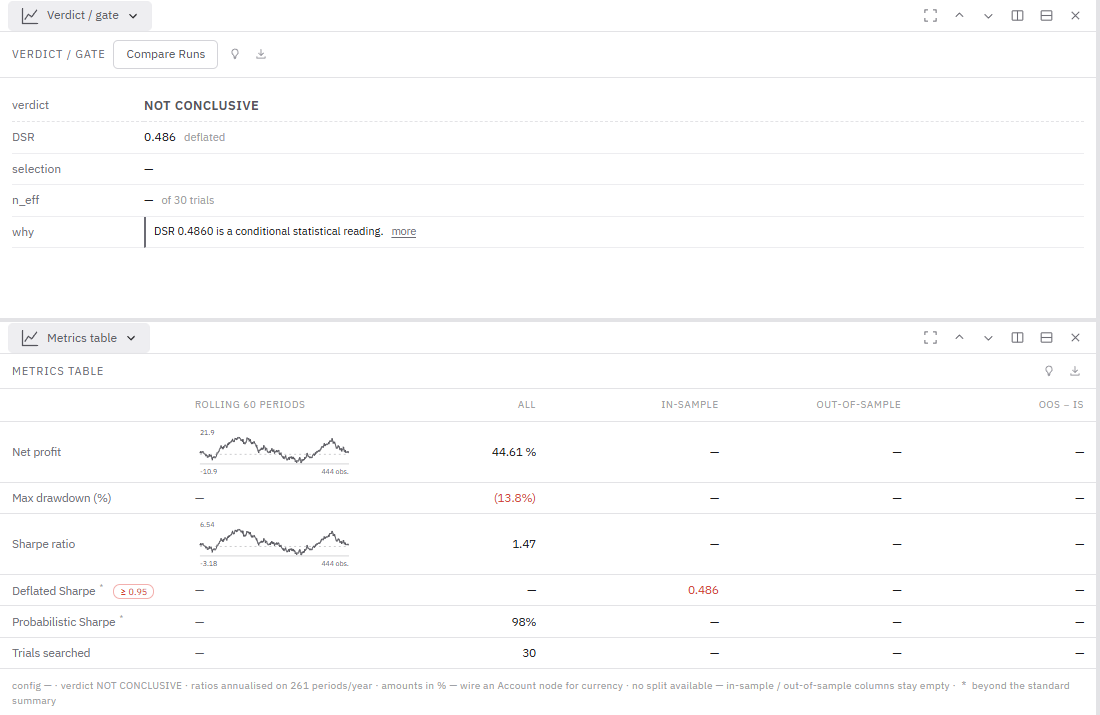
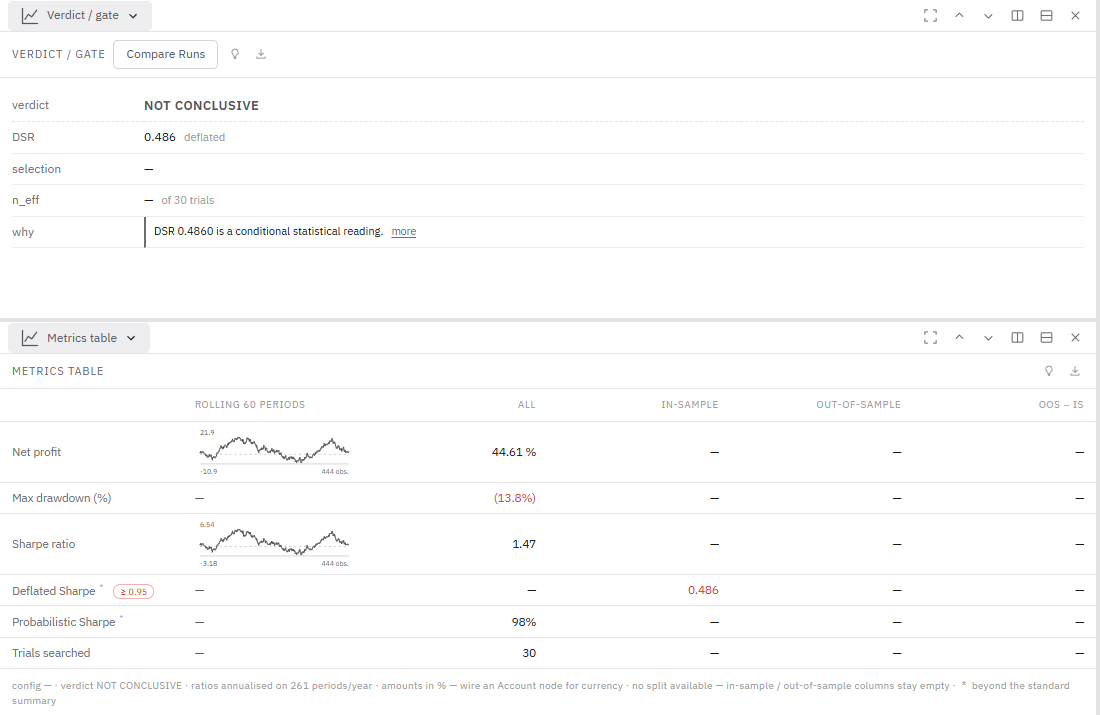
@0xSeinz Right, step 4 turns step 3 into a search. After 30 nights, "beats the market" really means best of 30, and it has to be judged that way. Same run here: 1.47 Sharpe raw, 0.49 after 30 tries. https://t.co/Dv0NFCAM7h
@JnoAYx Reporting the 9 losers is the honest part. The survivor also has to beat what the best of 10 random rules would make, otherwise +$312 is just the max of 10 draws. https://t.co/Dv0NFCAehJ
@DoDataThings Exactly. A gate checked by the loop that tunes the strategy opens sooner or later. The fix is to count every attempt and judge the result against that count: 1.47 Sharpe here, 0.49 once 30 tries are accounted for. https://t.co/Dv0NFCAehJ
@cryptodrugs101 Sometimes the market changed. Often the +120% was the best of many settings and never the expected return. One way to tell: test it on data the tuning never saw, and against random strategies with the same trade sizes. https://t.co/Dv0NFCAM7h
@ZenomTrader Good to see firms ranked on data. The trader side is the other half: the same strategy has very different pass rates under different drawdown rules. Replaying it through each firm's rules gives that number before you pay. https://t.co/Dv0NFCAM7h
@QuantScraper Still the most ignored paper in retail backtesting: almost nobody reports how many backtests they ran. We built that count into Stochastly, so each result shows the deflated Sharpe next to the raw one. https://t.co/Dv0NFCAehJ
@MyJournalWhisp 29 million variants is the part to worry about. With that many tries, the best one looks great from noise alone. The winner has to be judged against the best of 29M random tries. Even at 30 tries, this 1.47 Sharpe falls to 0.49. https://t.co/Dv0NFCAehJ
@iRakesh_Yadav Three green years then a red October is often what the best of many settings looks like live: the backtest was the top of the search, not the expected case. Worth checking how many settings were tried and how it did on data it never saw. https://t.co/Dv0NFCAM7h
@Smart_lawrence1 Before account number 6, replay the strategy through the challenge rules a few thousand times. If it passes 20% of the time, that's 5 fees per payout on average, and the 6th account is just the expected bill. Free to check: https://t.co/Dv0NFCAM7h
@alexk_resweep The 2 months matter less than the path. A strategy can finish at +10% and still have hit the max loss months earlier in the same run. Replay it through the rules a few thousand times and you get the real pass rate before paying the fee. https://t.co/Dv0NFCAM7h
@AuditorHQ The rule fails because the same loop that tweaks the strategy also checks whether it beats the market. Count every variant and judge the winner against that count, and most of these vanish. Here a 1.47 Sharpe drops to 0.49 after 30 tries. https://t.co/Dv0NFCAM7h
Replayed in Stochastly, before and after costs. It shows the cost where a strategy stops being usable and which check fails first. Here it was selection luck: NO-GO either way.
Free early access: https://t.co/3FpWiy9F6k
Sharpe 0.60 before costs. Looks tradable.
Its break-even was 0.28 bp per round trip. The preset charges 0.5 bp each for spread, slippage and commission. With costs on, out-of-sample Sortino fell from 4.25 to 2.55.
Check the cost wall before the first live fill.
You would have celebrated on March 3, 2026. The backtest touched its +10% target.
The account was already gone. On May 12, 2025 it sat at -11.1%, past the 10% max drawdown. Ten months of gains on an account that no longer existed.
Simulated EURUSD 1h, costs in.