$SPCX successfully launches Starship Flight 13 and deploys 20 Starlink V3 satellites.
The mission marks the first deployment of operational next-generation Starlink satellites.
$NVDA is working with $SKHY on a $500B AI initiative.
The plan includes a 2-gigawatt AI data center powered by Nvidia Vera Rubin chips and SK Hynix HBM4 memory.
$GOOGL Waymo is reportedly considering ending its $UBER robotaxi partnerships amid disagreements over service quality, safety and regulation.
Waymo plans to launch independently in Austin and Atlanta in January 2028 with Uber’s access potentially ending.
If you’re a long-term investor then you should welcome drawdowns like the one we’ve seen over the past couple of weeks.
Yes nobody likes losing money but when the market sells everything indiscriminately that means the strongest companies often fall alongside the weakest creating an opportunity to upgrade the quality of your portfolio.
I’ve never understood why selling at a loss feels so uncomfortable when you’re redeploying that capital into a business you understand better, trust more and believe has a stronger long-term opportunity.
$QCOM reportedly tells customers prices will rise more than 10% as it can no longer absorb higher foundry and memory costs.
With $TSM controlling leading-edge production and $MU, $SKHY and Samsung prioritizing higher-margin AI memory, Qualcomm really had no choice.
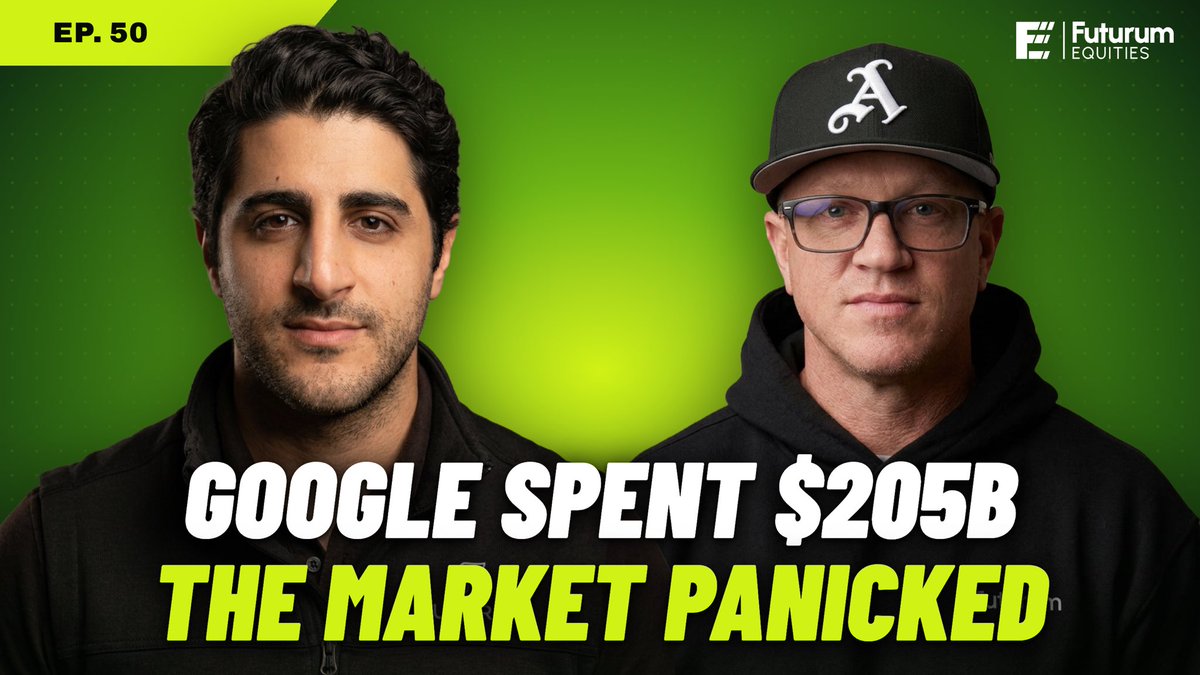
FUTURUM EQUITIES PODCAST EPISODE #50
Daniel and I will be live today at 1 PM ET exclusively on the Futurum Equities YouTube channel covering:
• Why $GOOGL may be the most mispriced winner of the AI buildout and what its rising capex means for $NBIS, $CRWV, $CIFR, $DOCN, $AMZN & $MSFT
• Whether $INTC breakout quarter marks a real turnaround and what it still needs to prove across 18A, 14A & external foundry demand
• How $IREN $2.8B in new AI cloud contracts and customer prepayments are changing their story
• Why $NOW rose while $TSLA fell after earnings & what that says about visible AI revenue versus future AI promises
• What Kimi K3’s compute constraints signal for memory and networking across $MU, $SKHY, $AVGO, $CRDO, $ALAB & $MRVL
We’ll leave the last 15 minutes for live Q&A so bring your questions!
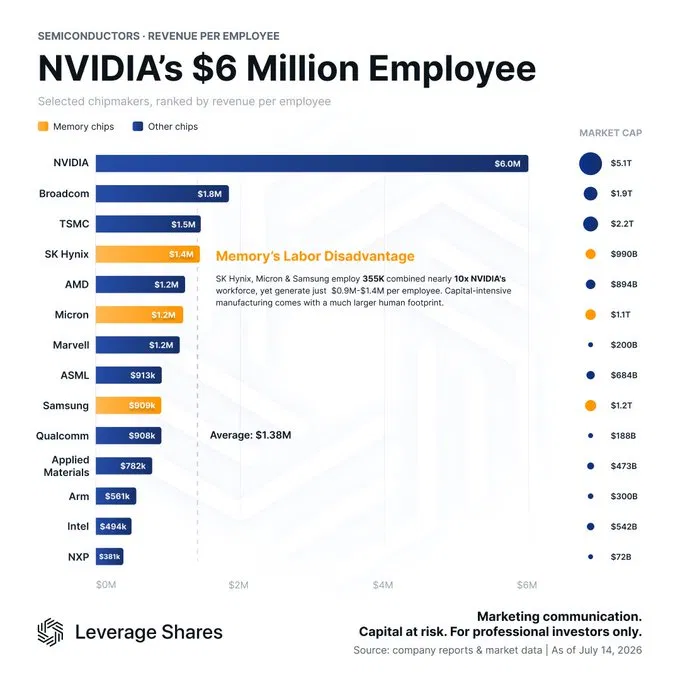
$NVDA generates ~$6M in revenue per employee which is more than 3x the next-highest chipmaker.
The gap also reflects extraordinary pricing power with scarce AI accelerators supporting gross margins near 75%.
China’s largest DRAM maker CXMT goes public in China on Monday after stepping into the consumer memory gap left by $MU, $SKHY and Samsung as they shifted toward HBM and server DRAM.
I’ll be watching to see whether it uses the new capital to make a real push into HBM.
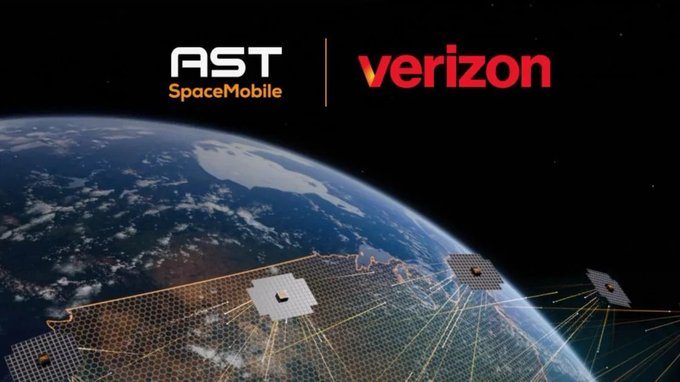
$VZ rules out giving $SPCX Starlink MVNO access saying theres “no back door” through its wireless network.
The move supports $ASTS carrier-first model with Verizon instead planning to deliver satellite connectivity through its joint venture with $T and $TMUS.
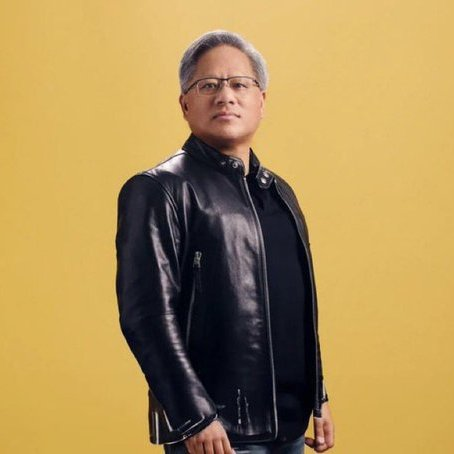
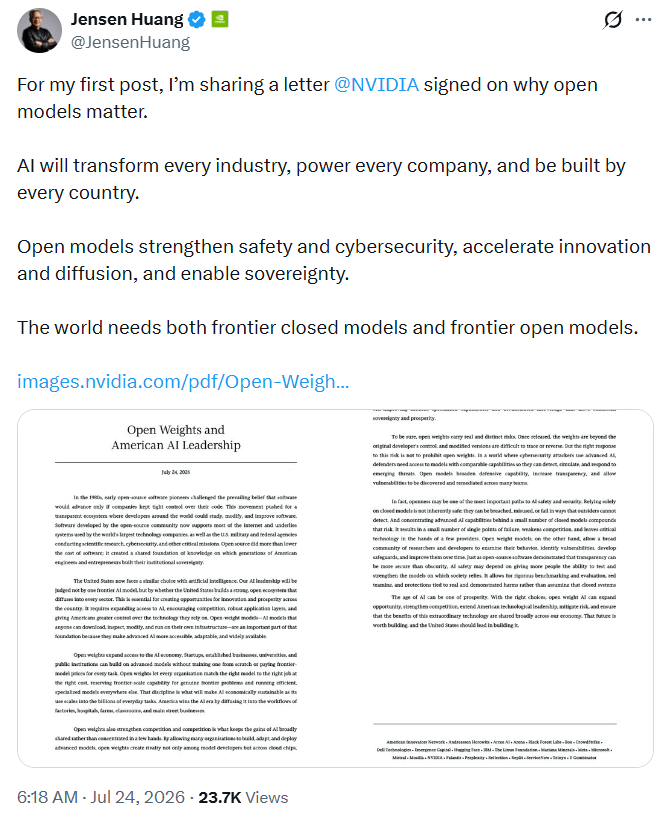
$NVDA CEO Jensen Huang joins $MSFT, $PLTR and $NOW in arguing that open-weight AI models are critical to U.S. competitiveness.
The group writes “relying solely on closed models is not inherently safe” warning that concentrating advanced AI behind a few providers creates single points of failure.
They argue open models expand access, lower costs, strengthen competition and give organizations greater control over their data and infrastructure.
$GOOGL and $VZ sign a deal worth more than $1B to provide dark-fiber connectivity for Google’s data centers.
Verizon says additional AI infrastructure deals expected by year-end could generate several billion dollars in revenue over the next few years.
$T CEO John Stankey believes the company already has what it needs to launch a leading direct-to-device satellite service with $ASTS.
He said “We’re not betting on the next turn of a chip” adding the product can compete today without relying on future technology breakthroughs.
$GOOGL says AI Mode has surpassed 1B monthly users while AI Mode and AI Overviews are generating additional searches rather than replacing existing activity.
That answers the first part of the Search debate on whether people will keep using Google in an AI world while the second is whether Google can monetize those AI answers without damaging Search fundamentals.
The company is already placing clearly labeled ads inside AI Mode and using Gemini to understand and monetize longer, more complex queries that were previously difficult to serve.