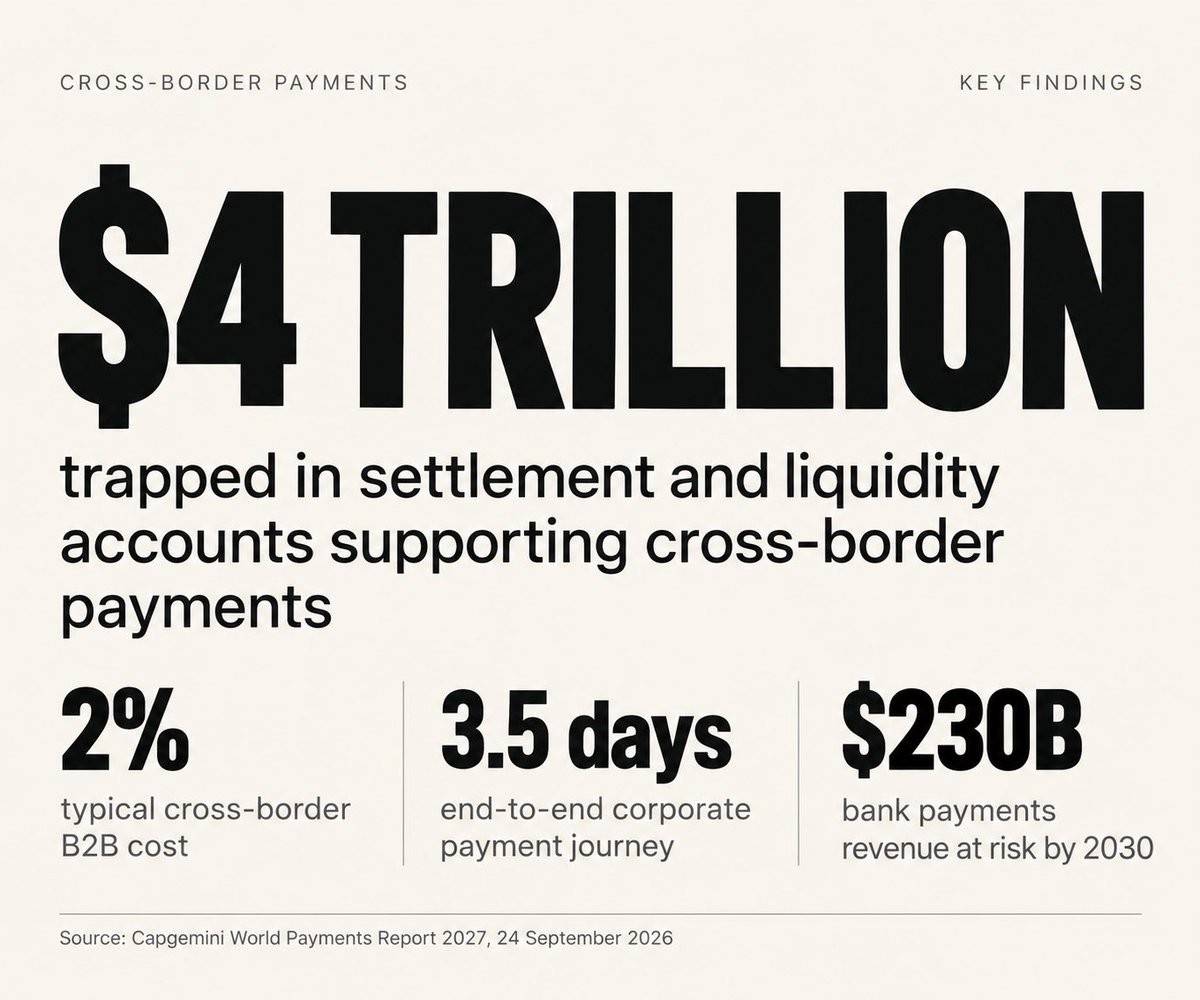
- @Capgemini’s new World Payments Report puts some numbers around how broken cross-border B2B payments still are.
A typical cross-border B2B payment costs about 2% of transaction value.
The full corporate payment journey takes roughly 3.5 days.
And an estimated $4 trillion sits trapped in settlement and liquidity accounts just to keep the system working.
That is an extraordinary amount of friction for something that is fundamentally moving numbers between ledgers.
Capgemini estimates $230 billion of bank payments revenue could be at risk by 2030 as stablecoins, tokenised deposits and other new forms of money reach just ~4% of global payments volume.
That last number is the interesting one.
We do not need stablecoins to replace the banking system for the economics of cross-border payments to change dramatically. They only need to take enough volume from the most expensive and inefficient parts of the stack.
The incumbent system has correspondent banks, prefunding, nostro accounts, cut-off times, reconciliation and several intermediaries all earning something along the way.
Stablecoins collapse a lot of that into software.
The opportunity is removing 200 basis points, 3.5 days and trillions of dollars of idle liquidity from global payments.
Washington is starting to understand something important: stablecoins are a distribution rail for the dollar.
The US is reportedly looking at using Treasury, State and DFC to push dollar stablecoins deeper into developing markets. The incentive is obvious. Stablecoin issuers already hold roughly $200B in US Treasuries. More dollar stablecoins in circulation means more structural demand for T-bills.
But the interesting part for Africa is that dollar liquidity stops being the scarce asset.
If Washington helps subsidise the distribution of digital dollars across emerging markets, there will be plenty of USDC/USDT-equivalent liquidity looking for somewhere to go.
The scarce infrastructure becomes the last mile: local licences, bank and mobile-money integrations, compliance, FX, liquidity management and reliable off-ramps into local currency.
In other words, the value moves downstream.
No need to issue another stablecoin.
Rather own the rails that turn a dollar stablecoin into spendable money.
Maybe now I’ll spend some time on X and doing other company building things instead of building. Until Monday.
Never buy AI usage credits. $100 used in minutes. I’m retiring from AI work until Monday.
Anthropic’s Economics team is sharing a new model of how AI might affect economic growth, jobs, wages, and more by 2030.
Explore the scenarios, tell us what you think will happen, and see how your answers compare to more than 10,000 Americans. https://t.co/AvQlEZNxR0
And watching that video, what struck me wasn’t the profanity.
It was presence.
He commanded the space. His teammates listened. He demanded more from them. He made them believe.
Call me old fashioned, but that sounds rather King-like to me.
The outrage over a future King of Tooro using F-bombs in a football dressing room says something interesting about us.
We often confuse respectability with character, and ignore context completely.
So I’m not particularly interested in whether a prospective King has ever said “f*ck”.
I’m interested in whether he has judgement.
Can he be fierce with his warriors, dignified with his people, gentle with children and measured when representing the Kingdom?
Ugandans are scandalised by a few F-bombs. I’m more interested in what the video actually shows: leadership.
A captain firing up his team and demanding more from his men. On a football pitch, that language is hardly extraordinary.
Frankly, the whole thing felt rather King-like to me.
That’s the warrior I’d want as King.
Claude Code Review just isn’t affordable. I burnt through $637 just today. Once I finish building money sensitive code, I’ll turn it off and use Codex review and Copilot.