One of my goals this year was to organize my long form writing in a better way and to that end, I'm starting a substack publication I'm calling The Long Tail.
I'll be primarily covering African venture investing and tech trends in the AI era with broader thoughts on frontier markets as applicable.
I hope it drives conversation about our ecosystem, highlights under-appreciated teams, and challenges me to update my priors.
Link to subscribe in the comments.
@ALeKaizer I still don't follow. How did BPO become 'designed in China?'
Assuming you don't literally mean China (i.e.. most of BPO went to India/Philippines), the U.S. firms may have lost more of the training/execution value, but moved upstream further because of that.
In every wave of tech that hits Africa, there's a set of companies that make the same mistake: they respond to the need for trust-led resilience with tech-led efficiency.
fintech: neobanks vs. agent banking
ecomm: consumer marketplace vs. global supply chain
AI: BPO vs. ?
@RonMargalit@dfsventures I'm sure there's a ton of impact capital piling into 2w EVs as it checks the climate mandate.
I'm not privy to how concessionary their terms are.
Spiro raised another $215m in equity. They've now raised over $500m in disclosed capital across equity & debt; $350m of that since my last post.
Compared to other 2-wheeler EV competitors, they have raised from 10x to 90x more.
They have raised a multiple of their peer group combined and now represent ~80% of the core disclosed capital.
When I say we believe African venture is trending towards neo-infrastructure, this is what that might look like. Fundamental solutions, concentrated & blended capital, underwriting enormous platforms.
Forget unicorn valuations, we're talking billion+ in funding.
Spiro is not an example of a traditional VC play in Africa. It is closer to the OPay 'brute force' playbook.
They might say their competition is gas bikes, but it's been known for a while that they're crushing the competition. How? They were literally built differently:
Spiro was previously M Auto in India, founded in 2019 then bought by parent company Equitane in 2022. Numbers vary, but Equitane had put in ~$65m in equity to unlock another ~$100m+ in debt.
There is no world where a company that (at the time) had less than 6k bikes on the road and 130 swap stations would raise 9 figures in debt if not for a parent company with $4 billion in AUM and the resulting deep personal network into infrastructure funds.
To put this into perspective, they raised $165m+ in debt/equity to put 6k bikes out there or ~$25k per bike. But this allowed them to eat enough of the market to now target 100k bikes for $250m capital, a 10x reduction to $2.5k per bike.
Meanwhile, their competitors were trying to do this on $5m seed raises and have 10x less the number of bikes on the road; a gap that keeps increasing as verticalization and economies of scale start to crush the hard asset cost floor even further in favor of Spiro.
Now, what will be built on top of this new infra is a different matter entirely.
@jabclari The infrastructure path for commerce will almost always run into physical footprint and connection to global trade.
Diverges tremendously depending on the seller segment.
We're investors in Bumpa, love what Kelvin is building towards.
@anteneh Efficiency is a mirage without scale. The levers for efficiency here aren't so much around technical advantage or GTM discipline, it's pure asset management + getting to enough users to amortize fixed costs like local manufacturing.
1/ Our Q1 ‘26 Lux LP letter is about two forces hiding in plain sight: ASYMMETRY + ENTROPY
they govern markets, militaries, machines + more
the central Q: What did you choose to build and protect—and did you understand what it cost? 🧵
It seems to me that we're seeing a new generation of African startup that can only be described as 'neo-infrastructure."
They aren't laying roads or powerlines, but alongside a renewed shift towards sovereignty by governments and industrialization-as-impact by the global development regime, there's a set of AI-native teams out there building the intelligence on top of this next gen of infra.
We've seen several real signals towards this trend. Neo-remittance startups like @NALAmoney growing into full-stack payments with an intelligent treasury layer.
Neo-prime startups like @terraindustries hardening critical infra security across the continent with AI-first hardware during a time of unstable geopolitics.
Neo-procurement startups like @matta_trade stabilizing critical material supply chains with systems-level coordination driven by data discipline.
Like we saw with real-world stablecoin usage, it's very likely that African markets offer some of the most significant wedge opportunities for these kinds of solutions given how existential and unsolved the problems are.
In a world where global trade is increasingly fragile, I am increasingly bullish on teams that bring stability to Africa's industrialization efforts; those who buffer productivity against volatility.
More on this soon.
I’m excited to announce that NALA has secured a $50M facility from LIQUIDITY and MUFG-backed Mars Growth Capital 🚀
Over the past year, demand for faster, compliant global stablecoin payments infrastructure has accelerated significantly across the US, Europe, Africa, and Asia.
As we’ve scaled, we’ve continued investing deeply in regulation, infrastructure, and gross profit margins:
- 17 regulatory approvals and licenses globally, making NALA one of the most licensed fintechs at our stage. (we just got a new license yesterday!)
- Nearly 50% of capital from our last fundraise still in the bank
- Consumer business reached 64% gross profit margins last month
- Rafiki, our B2B infrastructure business, reached 80% gross profit margins
- Signed some of the largest banks and global remittance companies, including MoneyGram who are live customers. (some major new ones will be announced soon!)
This facility gives us the ability to continue scaling our global payments infrastructure with long-term alignment and flexibility as demand continues to grow.
The next era of payments will be real-time, programmable, and borderless.
I’ve never been more excited about where NALA will be in the next 24 months.
we've got some big plans and we’re just getting started.
Building Payments for #TheNextBillion ⚡️
As of now, this is an announcement of a pilot fund with a $15m target. Seems like the article was revised but this post was inaccurate.
Interesting initiative to track.
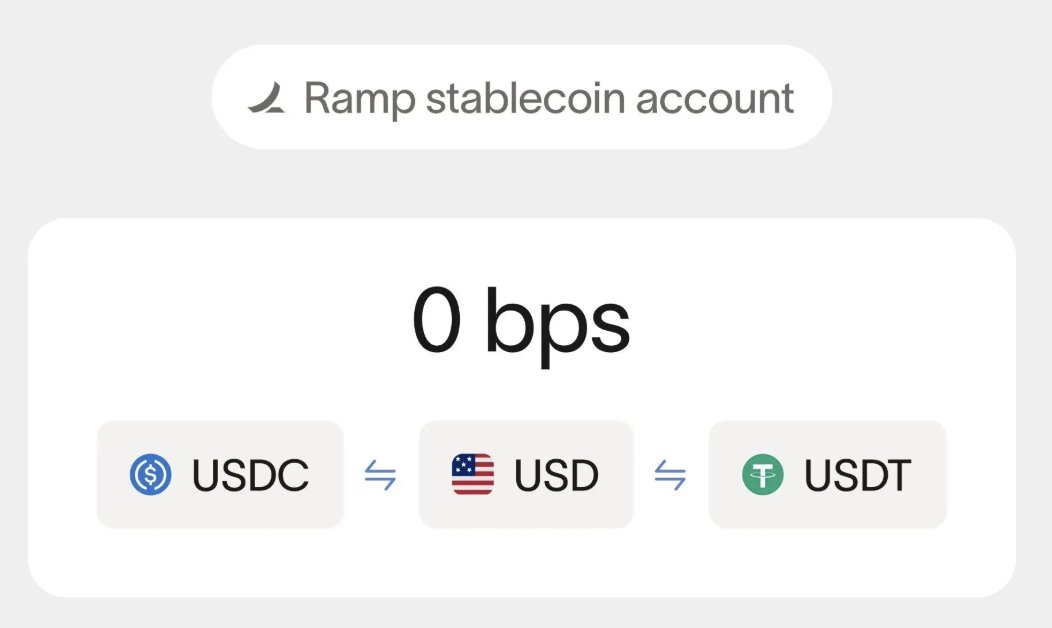
Of all the stablecoin features we've built at Ramp over the past few months - letting businesses convert 1:1 between USD, USDC, and USDT has by far been the most positively received one.
My personal view is that this is table stakes for any kind of B2B remittance, treasury, or bill pay product - and that we'll soon see this as the status quo.
Businesses shouldn't have to worry about how much USDC will ultimately land in their account when they get paid - or need to send 10,001.13 USDC so that their vendor will gets paid exactly 10,000 USDT.
A dollar is a dollar.