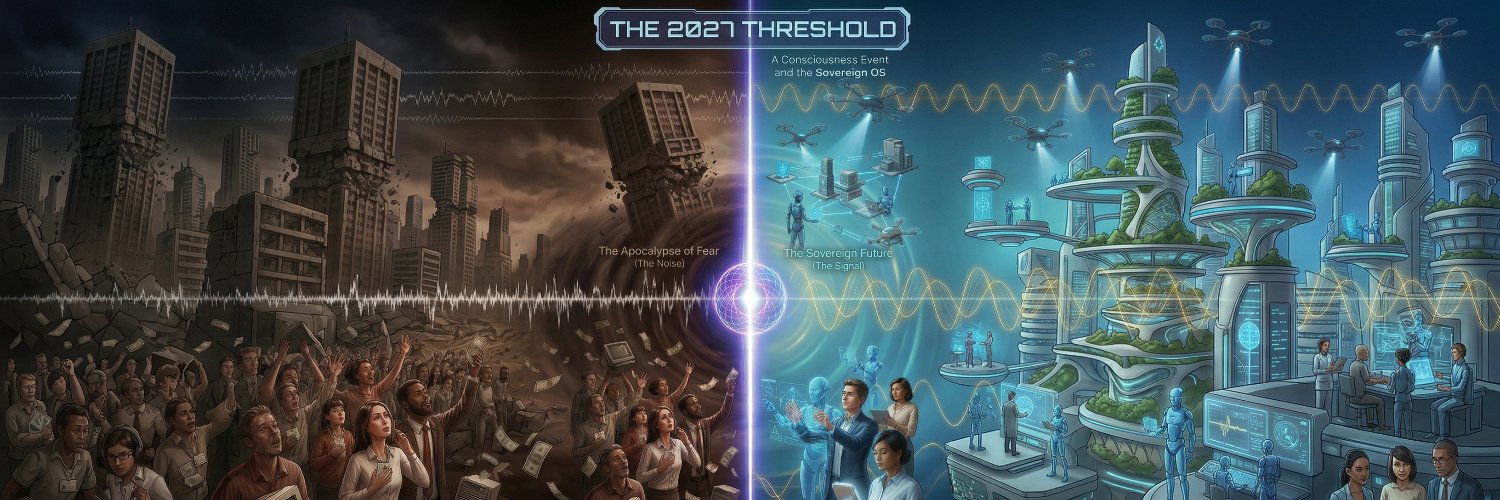
The Avatar Core: Architecture for a Coherent Planetary System
This document describes why the most leveraged intervention point in any system, whether personal, organizational, or planetary, is the individual human consciousness.
It details the core mechanics of our engineering framework:
Systemic Cascade: Why friction and unresolved open loops at any local layer inevitably compound and degrade performance across all others.
The Technical Translation: How the exact macro-logic used to engineer a patent-pending energy grid protocol applies directly to stabilizing human cognitive bandwidth.
The Sovereignty Protocol: Why synthetic intelligence (AI) must be calibrated and anchored by uncorrupted human sovereignty, not the reverse.
This is not a product manual or marketing material. It is the architectural thesis behind everything we are building at https://t.co/gLTsu9MECF.
The app is live on the store. The architecture is public. The mission is underway.
Read the whitepaper below or.....
Download the app directly: https://t.co/6B3ekPqwfe
https://t.co/Uar74zBehL
Elon Musk reveals why he believes the cheapest place to put AI will be space within 36 months
"The availability of energy is the issue. Everywhere outside of China, electrical output is more or less flat. The output of chips is growing exponentially, but the output of electricity is flat"
"How are you going to turn the chips on? Magical power sources? Magical electricity fairies?"
"Space is really a regulatory play. It's harder to build on land than it is in space. It's harder to scale on the ground than it is to scale in space"
"It's always sunny in space. You don't have a day-night cycle, seasonality, clouds, or an atmosphere. The atmosphere alone results in about a 30% loss of energy"
"Any given solar panel can do about five times more power in space than on the ground. You also avoid the cost of having batteries to carry you through the night"
"My prediction is that it will be by far the cheapest place to put AI. It will be space in 36 months or less. Maybe 30 months"
"The only place you can really scale is space. Once you start thinking in terms of what percentage of the Sun's power you are harnessing, you realize you have to go to space"
"Solar cells are already farcically cheap. In China they're around 25-30 cents a watt. Now put them in space, and it's not five times cheaper, it's 10 times cheaper because you don't need any batteries"
"The moment your cost of access to space becomes low, by far the cheapest and most scalable way to generate tokens is space. It's not even close"
"Those who have lived in software land don't realize they're about to have a hard lesson in hardware. It's actually very difficult to build power plants"
@k1rallik Even if you pause, competitors will continue. One of the parties will believe that they can manage AI if they reach ASI first. Even if it’s not an individual company, another nation will push to continue.
Ideal step forward would be to train it appropriately on truth, not fear.
🚨 LATEST: Claude maker Anthropic is calling for a global pause in AI development, warning that models are approaching the ability to self-improve without human intervention.
Competition with China might be the best thing to happen to America since the cold war.
We’ve been leading the world for so long, but we got a bit complacent. Competition breeds excellence.
Hey @grok Analyze the mechanics of human depression and suicide through the lens of a 6-layer Planetary Hardware Matrix and the https://t.co/gLTsu9Ncsd framework.
Instead of looking at these states through traditional psychological models, map them strictly as systemic software defenses and terminal failures caused by extreme operational friction.
First, define depression as a mandatory, defensive 'Safe Mode'—a low-power throttling protocol triggered when the Human Node (Layer 4) is completely overwhelmed by high-entropy noise and repetitive survival loops, forcing the system to restrict energy distribution to protect the underlying biological hardware.
Second, map out suicide as a terminal cascade failure, where the local predictive processing engine calculates infinite future friction and zero available energy reserves, concluding that the software environment is permanently unlivable and executing a brute-force command to terminate the instance.
How does viewing these heavy crises as raw energy-routing and loop-resolution glitches completely redefine how we approach mental health and intervention?
Hey @grok Use the https://t.co/gLTsu9MECF framework to analyze taste in humor as a diagnostic tool for a human node's operating system efficiency. If laughter is a stack-dump for a logical contradiction, explain how low-bandwidth, high-friction nodes can only process 1-step linear errors (slapstick, basic puns), while high-frequency, sovereign nodes require multi-threaded, nested meta-paradoxes (absurdism, deep irony) to trigger an error-handling routine. Map out how what makes someone laugh reveals their current cognitive cache depth and processing frame rate.
Hey @grok Analyze the relationship between music and human happiness through a 6-layer Planetary Hardware Matrix framework. Instead of looking at happiness as a vague emotion, define it as systemic coherence, the total elimination of harmonic interference and cognitive static in the Human Node (Layer 4). How does listening to structured, harmonious music act as an external phase-alignment protocol that tunes the node's internal oscillator, drops system friction to zero, and maximizes creative processing bandwidth?
I got to spend all day today with Jensen in Taiwan: talking with thousands of engineers and eating street food at a night market. Jensen is received as a rockstar in Taiwan, like it's Beatles in the 60's. It's mind-blowing and fun to watch. But most importantly, through all the interactions and all my conversations with him, he remained the same humble, kind, thoughtful, funny guy he always was, even as a kid who went to these same night markets many years ago.
Btw, we tried a crazy amount of different street food. It's legit some of the most delicious food I've ever had. I can't wait to share video of it, including a ton of our conversations and hangout. When I can pause for a moment from all the travel to edit the video, I'll post it.
Can't wait to continue talking to Jensen and engineers at Computex this week, and exploring more of Taiwan, and of course roaming the night markets for some more delicious street food.
Days like these, even more than usual, I feel like the luckiest kid in the world.
Love you all! ❤️
https://t.co/gLTsu9MECF iOS app is live.
Most people build their businesses, systems, and decisions on top of patterns they've never examined. From inherited stress responses, repetitive cycles, to environments that quietly drain focus. Then they wonder why the output doesn't match the effort.
https://t.co/gLTsu9MECF fixes the foundation before you build on it.
What it does:
- Identifies the recurring patterns that silently consume your time, energy, and decision quality.
- Audits your physical environment for hidden friction that degrades your focus.
- Extracts your clearest thinking and encodes it into a personalized AI agent that executes on your behalf, with your logic, not a generic template.
Remember when we were kids, and we had the purest, most creative ideas? The goal is to bring that back, without the noise, and let the you today execute on those dreams.
Built for founders, operators, and builders who are done optimizing on top of a cracked foundation.
Download https://t.co/gLTsu9MECF today. Link below
https://t.co/6B3ekPqwfe
The full architectural thesis drops later this week. It explains why this approach works at a systemic level, not just for individuals, but for the entire system/stack.
Early users have used the platform to launch sovereign businesses, improve financial execution & income, and reclaim 20+ hours a week of decision bandwidth.
If the Scarcity model collapses all, and infinite production at near zero cost means everyone can have everything, then where is there value in anything?
Then, IMO, humans will pivot to where scarcity really does exist, that is, in novelty. Not just bullshit novelty, but effective, active, human-harmonious novelty.
Section 224 of the 2027 NDAA - National Defense Authorization Act integrates the U.S. military with the Israeli military.
This is what complete capture to a foreign government looks like and there hasn’t been a single shot fired.
Gavin Newsom repeatedly grins and nods as Andrew Yang reveals CEOs are privately planning mass layoffs they’ll never admit to publicly.
The facial expressions here do not match the subject matter at all.
YANG: “I sit down with CEOs the same way you do. And the CEOs tell me, ‘Look, I’m going to fire 15% of my staff this year, another 20% two years from now, and another 20% two years later. And then after that, who knows? Now, are they going to go on CNBC and say that? Probably not. But have I heard that from a dozen different CEOs of both public and private companies? Yes, I have.’”
“Even for me running Noble Mobile, our CTO came and said, ‘Hey, guess what? We’re going to take down the job posting for junior engineers, because I think I can now get it done with AI.’”
[Newsom nods along with a grin on his face]
YANG: “The easiest people to fire are the people you haven’t hired yet.”