The developing world’s cancer burden: practical solutions needed , not just statistics.
The way forward requires action across the entire cancer care continuum:
Prevent: Control tobacco use and expand HPV vaccination.
Detect early: Build awareness, expand evidence-based screening, and speed diagnosis.
Make treatment affordable: Stronger public coverage, transparent pricing and access to essential medicines.
Bring care closer: Strengthen district services and referral networks.
Support beyond treatment: Rehabilitation, palliative care, mental-health support and survivorship plans.
Cancer care must be timely, affordable and continuous, not a financial crisis for families.
What should we prioritise first? Join the conversation.
#CancerCare #CancerControl #PublicHealth #India
Your chair might be raising your cancer risk!
'Emerging research suggests extended sedentary time, in and of itself, could increase certain cancer risks -regardless of your weight or physical activity level.'
Sitting for hours may be quietly raising cancer risk — even if you exercise. A large 2015 ACS study of 77,000+ women found those who sat ≥6 hours a day had a 10% higher risk of any cancer (and invasive breast cancer) than women who sat under 3 hours. The link held after accounting for body weight and physical activity.
Observational study for now, but highly plausible
https://t.co/c1mEqh5soG
Not many people know that life beyond cancer is about more than follow-up visits. It means continued care, emotional support, rehabilitation, healthy living and staying connected.
Every survivor deserves the support to live well, not just longer. What are your thoughts on this?
#CancerSurvivorship #CancerCare #LifeBeyondCancer #India
'A comprehensive personal health agent that reasons over multimodal data from consumer wellness devices and medical records to provide personalized health support.' https://t.co/477TMS0l6b
Why does the time of day you get immunotherapy matter?
Early studies suggested morning infusions drastically improve survival for cancer patients. But the field still lacks definitive randomized evidence—and a recent major retraction highlights why.
The Catch with Retrospective Data
•Frailty Bias: Healthier patients get morning slots; frailer patients often face delays into the afternoon.
•Drug Half-Life: Immune checkpoint inhibitors stay active in the body for weeks. Does the exact hour of infusion really change the long-term outcome?
The Randomized Reality
•Major Retraction: The phase III LungTIME-C01 trial initially showed a massive advantage for morning dosing but was retracted in June 2026 due to protocol and data discrepancies.
•Conflicting Data: Large pooled analyses (like i-TIMES) show no meaningful survival difference between early and late infusions.
•Logistics: Standardizing morning-only dosing would create massive bottlenecks in oncology clinics worldwide.
Chronotherapy holds immense biological promise, but we need bulletproof, prospective randomized trials before rewriting clinical guidelines.
#CancerResearch #Immunotherapy #Oncology #MedEd
Time-of-Day Immunotherapy: Why the Field Still Needs Randomized Evidence | Journal of Clinical Oncology https://t.co/u8VJMkQYUi
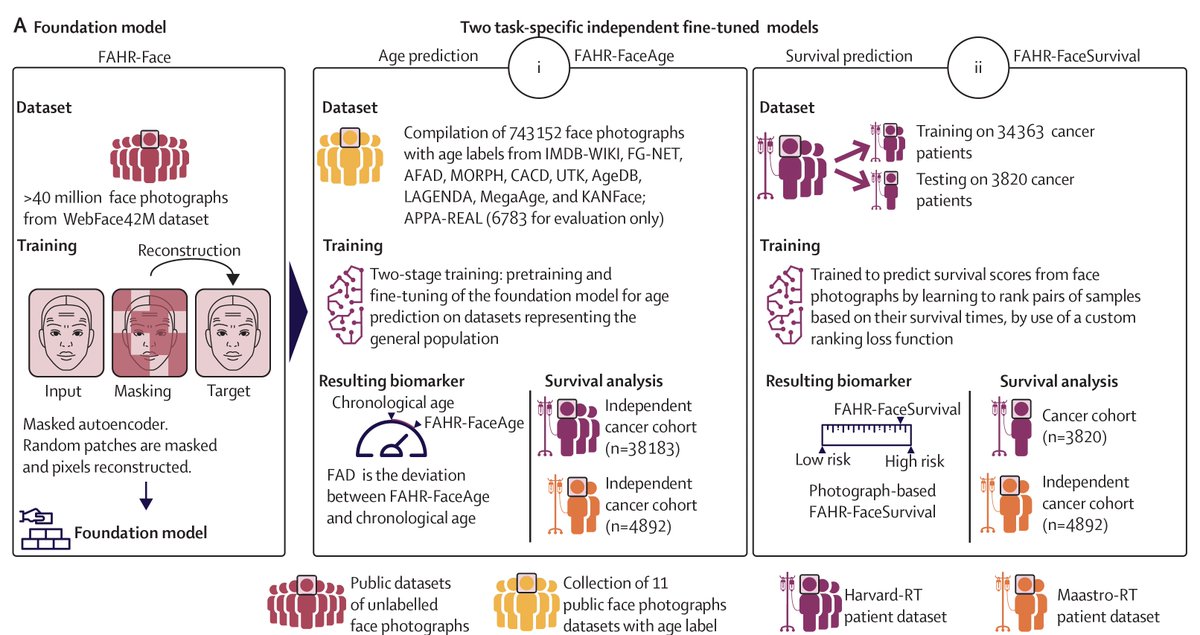
DYK? Facial imaging and AI could work together for predicting cancer outcomes.
Researchers have developed an AI model, FAHR-FaceSurvival, that analyses facial images to estimate mortality risk in people with cancer.
The model builds on AI-based biological age estimation, potentially detecting subtle features associated with ageing and physical resilience that may not be apparent to the naked eye.
Could this non-invasive approach one day help clinicians personalise cancer treatment?
Promising science—but not yet ready for routine clinical use. Further validation across diverse populations is essential to establish accuracy, fairness and clinical value.
#CancerResearch #ArtificialIntelligence #DigitalHealth #PrecisionOncology
There's a lot in a face photograph about health that AI can detect, as seen in this foundation model of >40 million face images, including outcomes from cancer, biological age, influence of lifestyle factors, and survival @LancetDigitalH
https://t.co/l4AqDfl0s3
AI & Digital Pathways: Making Technology Work for Everyone
AI is transforming how we live, work and access services. But the real opportunity lies not just in adopting technology, but in making it accessible, trusted and meaningful for everyone.
The future of digital transformation must be inclusive, human-centred and driven by real-world impact.
#AI #DigitalTransformation #DigitalInclusion #Innovation #India
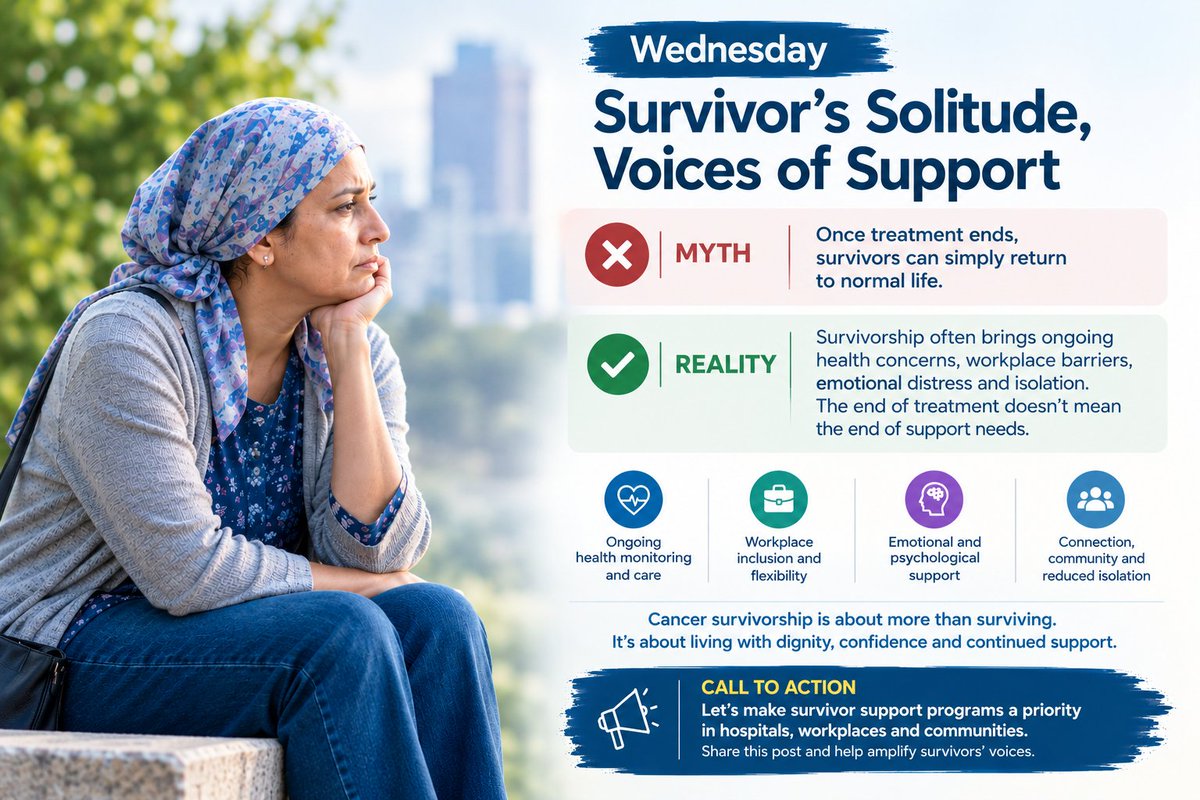
Wednesday Myth Buster | Survivor’s Solitude, Voices of Support
MYTH: Once cancer treatment ends, survivors can return to normal life.
REALITY: After treatment, survivors may face ongoing health concerns, workplace barriers, emotional distress, and isolation. They need support—not just sympathy.
Cancer survivorship is about more than surviving. It’s about living with dignity, confidence, and connection.
Let’s make cancer survivor support programs a priority in hospitals, workplaces, and communities. Share this post and help amplify survivors’ voices.
#MondayMythBuster #CancerSurvivorship #CancerCare #SurvivorSupport.
Tuesday Myth Buster | Survivor’s Solitude, Voices of Support
MYTH: Once cancer treatment ends, survivors return to normal life.
REALITY: The end of treatment doesn't always mean the end of challenges. Survivors may face ongoing health concerns, workplace barriers, emotional distress, and isolation.
Cancer survivorship is more than survival—it’s about living with dignity, confidence, and support.
Let’s make survivor support programs a priority in hospitals, workplaces, and communities. Share this post and help amplify survivors’ voices.
#MondayMythBuster #CancerSurvivorship #CancerCare #SurvivorSupport
Monday Myth Buster | Survivor’s Solitude, Voices of Support
MYTH: Once cancer treatment ends, survivors can return to normal life.
REALITY: Survivorship can bring lasting challenges—health concerns, workplace barriers, emotional distress, and isolation. The end of treatment doesn't mean the end of support needs.
Cancer survivors deserve more than congratulations. They deserve care, understanding, and ongoing support.
CALL TO ACTION: Let’s make cancer survivor support programs a priority—in hospitals, workplaces, and communities. Share this post and help amplify survivors’ voices.
#MondayMythBuster #CancerSurvivorship #CancerCare #SurvivorSupport
The Rising Burden of Cancer Care in India
With 1.56 million new cases and 900,000 deaths annually, cancer remains one of India's most urgent health and economic challenges.
Key figures from recent coverage: • 60 people per 1 lakh affected by cancer • ₹7.5 lakh average treatment cost per patient • 70%–80% paid directly out-of-pocket • Hospital markups on non-scheduled drugs reaching up to 700%
Proposed 30% trade margin caps aim to curb excessive markups, but experts emphasize that broader pricing policies are needed to address high base costs for essential life-saving therapies.
#HealthPolicy #CancerCare #HealthcareIndia #PublicHealth #AffordableCare
.
India has already achieved a 21% drop in TB incidence and a 92% treatment coverage rate, outpacing global averages.
Joint Squad for Health (JOSH) initiative has been launched. This massive grassroots mobilization under the TB Mukt Bharat Abhiyaan unites thousands of MY Bharat volunteers and NCC cadets to eliminate TB once and for all.
The Power of JOSH:
58,000+ youth volunteers activated
55 districts covered in 11 states/UTs in Phase 1
Jointly driven by Health, Youth Affairs, and Defence ministries
Together, our youth are leading the charge toward a healthier tomorrow.
https://t.co/Rd1p4z4Sek
It's myth-bust Monday. Myth: Dairy foods like milk can cause cancer. Truth: Research shows that dairy foods such as milk, yogurt and cheese may actually help lower the risk of certain cancers, such as colorectal. It's likely due to calcium and protein. https://t.co/U6S9rvRKSX
Cervavac vaccine for HPV-caused cancers is approved by the Drugs Controller General of India (DCGI) and prequalified by the World Health Organization (WHO), but it is officially licensed and recommended for a multi-dose schedule rather than a single dose.
Approved Dosing Schedules for Cervavac:
Ages 9 to 14 years: Administered in a 2-dose schedule (at 0 and 6 months).
Ages 15 to 26 years: Administered in a 3-dose schedule (at 0, 2, and 6 months).
Regulatory Status: DCGI Approval: The official Summary of Product Characteristics (SmPC) approved by India's regulatory authority specifies either a 2-dose or 3-dose regimen depending on age.
While the WHO has broader global guidelines acknowledging single-dose options for certain HPV vaccines, Cervavac itself is formally evaluated and indicated for 2 or 3 doses by the manufacturer (Serum Institute of India) and regulators.
WHO Prequalification: WHO prequalification allows the vaccine to be procured globally through UN agencies, and global discussions on single-dose efficacy continue, but standard clinical and national guidelines still mandate completing the full 2-dose or 3-dose course. @chipfoundation
A cancer survivor's journey after completing treatment involves physical healing, emotional adjustment, and establishing a new normal.
Phases of Survivorship
Extended Survivorship: Begins immediately after treatment ends. Focuses on adjusting to life post-cancer, managing side effects, and attending ongoing medical monitoring.
Permanent Survivorship: Continues for the rest of the survivor's life as long-term wellness and periodic screenings take priority.#Cancer #Survivorship #Familysupport
@chipfoundation