Bringing, We the People, Access to Financial Privacy and Security Through Hard Assets. Buy/Sell/Trade Gold & Silver @ STORE OF VALUE in Crivitz Wisconsin
There's a lot of civil rights reforms needed in the "American system" but near the top of that list:
-The US Coast Guard (and state level LE agencies) should 100% be prohibited from boarding a vessel without probable cause of a crime / warrant
-Game wardens need to be prohibited from trespassing on your property without probable cause of a crime / warrant.
The king doesn't own the deer in America
There's a 0%, literally 0%, that any of our founding fathers thought this would be the outcome after writing the Bill Of Rights.
It's a simple fix and could be fixed today but it won't be because the government *almost never* gives up power without being physically forced to do so (see Bundy ranch standoff as a recent historical example).
Plan accordingly...
#CivilRights #USCG #CoastGuard #GameWarden #KingsDeer #4thAmendment #BillOfRights #citizen #Title14 #search #warrant #5thAmendment #1stAmendment
This hits harder as you think of the deeper issues.
On Sept 5, 2003, Ron Paul delivered a speech titled “Paper Money and Tyranny” on the floor of the U.S. House of Reps.
“The Founders were well aware of the biblical admonitions against dishonest weights and measures, debased silver, and watered-down wine. The issue of sound money throughout history has been as much a moral issue as an economic or political issue.”
Why are so many women sooo angry? They won. They got everything they wanted. Men have never been doing this badly, and women have never been doing this well. They make more, they have the majority of jobs, they are the majority of college graduates, (UCLA undergrad is 60% female), they make more money, have much lower rates of suicide, addiction, and alcoholism, and live longer. They won: they took over all men-only spaces, they took over the Boy Scouts, they ended men’s bathrooms, they can fly fighter planes and be in combat. Marriage is optional, divorce is no-fault, they win 99% of the custody battles, they can control fertility at will, and they can’t get drafted. We are all living in the female future they promised.
The whole world is waking up to gold because of this global debt issue.
The sad part about all of this?
Many central bankers publicly mocked gold; meanwhile, they have been its biggest buyers.
Now citizens are learning why it is the ultimate form of money. @judyshel
The Gold Goes Home
People forget how quickly the world can change.
In February 1965, Charles de Gaulle stood in front of hundreds of journalists at the Élysée Palace and said the one thing no Western leader was allowed to say.
He called for the world to return to gold.
Not to the dollar. Not to promises.
To the one asset, he said, that "has no nationality" and is "eternally and universally accepted."
Washington laughed at the old general.
Then France stopped laughing and started converting.
Through the mid-1960s, the Banque de France redeemed hundreds of millions of American dollars for American gold, ship after ship, drawdown after drawdown.
And de Gaulle's economist, Jacques Rueff, kept telling the world exactly what the game was:
America could spend more than it earned, forever, without consequence… a "deficit without tears," he called it, because it paid its bills in paper only it could print.
Finance minister Valéry Giscard d'Estaing gave the arrangement the name that stuck:
America's "exorbitant privilege."
The pressure worked too well.
On August 15, 1971, President Nixon closed the gold window rather than keep paying out metal.
The last link between the dollar and gold was severed on a Sunday night, on television, precipitating a period of confusion and shock.
France asked for its gold.
The world got the fiat era instead.
Keep that story in mind. Because sixty years later, France just did it again and almost nobody noticed.
The quietest repatriation in history
Starting in July 2025, the Banque de France began unwinding its position at the Federal Reserve Bank of New York.
But there were no armoured convoys.
No transatlantic flights.
No diplomatic incident.
Instead, across 26 separate transactions over seven months, France sold 129 tonnes of old bullion sitting in the New York Fed's vault, bars so old some dated to the late 1920s, cast before modern purity standards existed and bought back the identical tonnage in Europe.
Newer bars. Higher standard. Stored in Paris.
Repatriation without a single bar crossing the Atlantic.
And here's the part that should make every treasury official weep:
They got paid to do it. By selling old New York stock at record prices and repurchasing in Europe, the Banque de France booked a realized gain of roughly €11–13 billion, nearly $15 billion, enough to swing the entire central bank back to profit for the year.
All 2,437 tonnes of French gold, the fourth-largest hoard on Earth, now sit in La Souterraine, the vault carved into the rock beneath Paris.
Governor Villeroy de Galhau insists the move was "not politically motivated."
Of course he does.
Central bankers always say that.
France is not alone.
Watch what they do, not what they say.
Germany repatriated 674 tonnes from Paris and New York, a program announced in 2013 after German politicians grew tired of being told their gold was fine, trust us, no you can't audit it.
Turkey pulled 220 tonnes out of the Federal Reserve.
The Netherlands brought home 122 tonnes.
Poland repatriated 100 tonnes from vaults in England.
And the vaults themselves tell the story in aggregate.
The share of central bank reserve gold stored in London has fallen from 64% to 57%.
The New York Fed's share has dropped from 17% to 14%.
Percentage point by percentage point, decade by decade, the metal is migrating home.
Onto sovereign soil.
The bigger picture
This is not happening in isolation. It's happening inside the largest shift in reserve behaviour in a generation.
Gold now exceeds US Treasuries as a share of global reserves for the first time since 1996.
Read that again.
The world's central banks, the issuers of fiat currency, the operators of the printing presses, collectively hold more of their reserves in a 5,000-year-old metal than in the debt of the United States government.
And a record 45% of them say they plan to buy more gold in the next twelve months.
Ask them why, and you'll get the paragraph about diversification.
But diversification doesn't explain the geography.
You don't move gold out of London and New York to diversify.
You move it because possession has started to matter again.
Because you watched $300 billion of Russian reserves get frozen with a keystroke.
Because you've realized that gold in someone else's vault is not gold. It's a claim on gold.
And a claim is just another word for credit.
The lesson?
Countries are beginning to think differently, not only about how much gold they own, but where they hold it and in what form.
Old bars are being upgraded to modern standards. Foreign custody is being converted to domestic possession. Claims are being converted to metal.
But strip away the financial engineering, and it's the same instinct that sent French ships across the Atlantic in the 1960s.
The same instinct that has moved men and nations for five thousand years.
When nations lose confidence...
They ask for their gold.
The last time France asked, the entire monetary system broke within six years.
This time, nobody's even pretending the window is open.
If you enjoy stories like this, please share it. Last week I wrote a story about JPMorgan. I will continue writing stories like this every weekend.
— GT
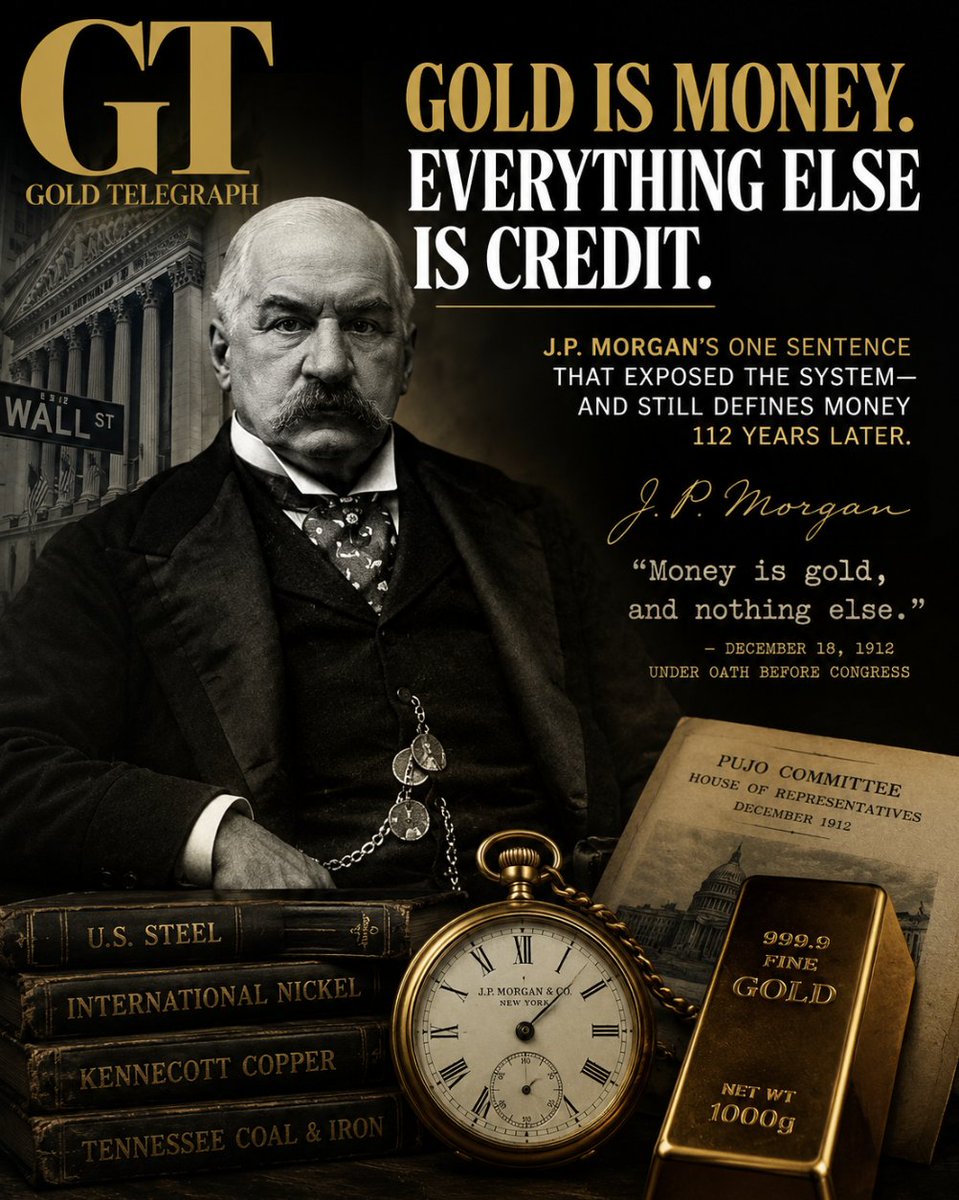
Gold Is Money. Everything Else Is Credit.
One of the most iconic quotes in gold?
“Gold is money. Everything else is credit.” — J.P. Morgan.
He said it under oath, testifying before Congress in December 1912, a few months before he died. The exact words in the transcript were “Money is gold, and nothing else.”
The old man was 75, half the country hated him, and a congressional committee was trying to prove he secretly controlled American finance.
They asked him to explain money. He gave them one sentence. It has outlived everyone in that room.
Many forget it was Morgan, personally, who coordinated the leading bankers, trust companies, and financiers to inject liquidity into the system during the Panic of 1907.
No Federal Reserve existed.
There was no lender of last resort, no bailout mechanism, no printing press to fire up at 2 a.m.
There was one man in a library on Madison Avenue, locking the presidents of New York’s biggest trusts in a room and refusing to open the door until they pledged the money to stop the run.
He effectively acted as the central bank of the United States, and he prevented a complete collapse of the financial system with little more than his own credibility and a pocket watch.
But here’s the part almost everyone forgets.
Morgan wasn’t a paper man.
The empire underneath all that credibility was built on the gifts of Mother Nature...
Rock, ore, and metal.
He financed things you could drop on your foot.
Start with iron.
In 1901, Morgan assembled U.S. Steel, the first billion-dollar corporation in history and buried inside that deal was control of the Mesabi Range, the greatest iron ore district in America. The world saw a steel company.
Morgan saw the dirt it stood on.
Then came nickel. In 1902, Morgan merged the Sudbury miners and the Orford refinery into the International Nickel Company.
The Sudbury Basin, a deposit seeded by a meteorite strike nearly two billion years ago held most of the nickel on Earth, and nickel-steel armor plate had just become the most strategic material of the naval arms race.
Orford’s owner was given a simple choice by his largest customer: cooperate or lose everything. He cooperated.
Inco would control the nickel market for the next forty years and armor the fleets of the First World War.
Then copper. In 1906, the House of Morgan joined the Guggenheims to form the Alaska Syndicate and develop Kennecott, a mountain in the Alaskan wilderness where the ore assayed as high as 70% copper, so rich it was shoveled straight into sacks without milling.
Getting it out required building 196 miles of railroad across canyons and living glaciers, in temperatures of forty below, to a port that barely existed.
Serious money said it was impossible. Morgan money built it anyway.
Grade attracts capital to the end of the earth.
It always has.
And in the panic year itself, 1907, while Morgan was saving the banking system with one hand, he was absorbing Tennessee Coal, Iron & Railroad into U.S. Steel with the other, with the personal blessing of a president desperate enough to look past his own antitrust crusade.
A coal and iron empire, acquired over a weekend, to stop a financial fire.
Even his rescues were made of rock.
See the pattern. The man who defined money as gold did not spend his life shuffling abstractions.
He spent it financing iron, nickel, copper, coal and settling the ledger in metal.
He understood something that has been carefully unlearned over the past century:
Credit is a promise, and promises are only as good as the collateral and the character behind them.
Gold asks for neither. Gold simply is.
Now consider the timing, because history has a savage sense of humor.
Morgan died in March 1913.
The Federal Reserve was born that same year.
The private lender of last resort was replaced by an institutional one and the institutional one came with a printing press.
In 1913, gold was $20.67 an ounce.
Today it trades over $4,000.
Measured against the metal Morgan called money, the dollar has surrendered more than 99% of its value in the years since the man died and the machine took over.
And the punchline?
The machine knows it.
Central banks, the issuers of the credit, have been buying gold at a record pace, quietly, year after year, vault by vault.
Ask them why and you’ll get a paragraph about diversification.
Morgan answered the same question in one sentence, under oath, in 1912.
Gold is money. Everything else is credit.
The old pirate has been dead for 113 years, and he’s still the most honest central banker we ever had.
If you enjoy stories like this, because share it. I will start writing stories like this every Saturday.
Thank you for reading.
- GT
@dankerz_oO@intlmandotcom Greshams law is a good clue. Another one is buy precious metals or other cash flowing assets that must at least hold their inherent value, while the value that the assets are priced in, become worth less per unit (Fiat, US Dollar).
In a fiat currency system, the benefits of deflationary technology primarily accrue to asset holders, because the forced inflation created by central banks pumps up asset values.
If we were living under an honest, hard-money monetary system, where the benefits of technology would not be offset by central banks debasing the currency, those gains would accrue more evenly across the population.
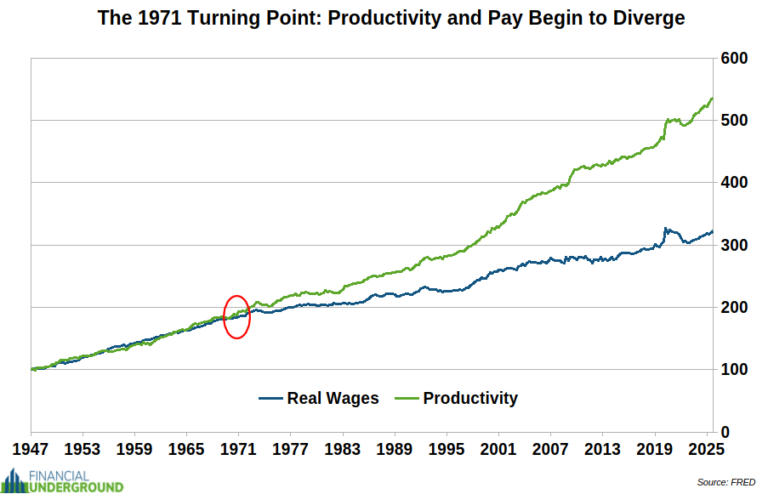
That is why we think the chart below is instructive.
It is a long-term view of real wages versus productivity.
The two tracked together well for decades, showing that as productivity increased, real wages did too. In other words, most people benefited from increases in productivity through higher real wages.
Then something changed around 1971, when that strong positive correlation broke. It was the year the US government cut the dollar’s last link to gold and the dollar became a pure fiat currency.
Since 1971, there has been a growing gap between productivity and real wages.
If you could transport yourself back to the early 1970s, just as the divergence between productivity and real wages began, and ask people what they thought 2026 would look like, they might have said something like The Jetsons—flying cars, advanced technology, and a society in which everyone was better off.
They probably would not have believed you if you told them that, in reality, people would be worse off in many ways in 2026 than they were in the early 1970s, despite enormous technological progress. We may not have flying cars or The Jetsons, but there have still been significant advances. Yet people’s standard of living has declined in many ways.
Today, many people are bewildered by how people could be worse off now than they were then. The answer is in this chart, which shows that the fiat system and currency debasement are the problem.
Despite advances in technology, the shocking level of currency debasement has not merely kept pace with the natural deflation that comes from increased productivity, but has vastly outpaced it… which is why people are, in many ways, worse off today than they were in the early 1970s. That prosperity has been stolen by inflation and fiat currency.
Since 1971, productivity has continued to increase, largely thanks to advances in technology, but those gains have not translated into growth in real wages as they had in the past under an honest money system. That is because under a fiat currency system, the central bank—the Federal Reserve—has created significantly more inflation than the gains in productivity, which meant real wages did not keep up.
However, those productivity gains from advancing technology did not just disappear. They were redirected somewhere else. They accrued primarily to asset holders, as wage earners chased rapidly depreciating fiat currency.
In short, the fiat currency system is a mechanism for transferring wealth created by technological productivity gains to asset holders and politically connected insiders closest to the money printer.
Frankly, it is a disgusting, dishonest system that operates at the expense of honest people.
But that is the nature of the monetary system we are all forced to live under. And it is wise to acknowledge it, understand it, and take action to protect yourself.
And now, with AI bringing a mind-bending level of productivity gains, this dynamic is about to go into overdrive.
Former BlackRock fund manager Ed Dowd on mass tokenization and "The Great Taking"
"Tokenization... gives a central planner the ability to veto... transactions"
"It's a massive land grab and power grab"
"[But] I think [it's] a bridge too far and people will get very agitated"
This clip of Dowd (@DowdEdward), a former BlackRock fund manager and co-founder of Phinance Technologies, is taken from a discussion with Brannon Howse (@HowseLive) posted to YouTube on May 27, 2026.
----------------Partial transcription of clip---------------
"Well, we need to stop it. And I don't know what we can do, but it's certainly alarming.
"And this tokenization of everything, basically the way Catherine Austin Fitts describes it, and I agree with her, right now, currently, when you have a sale, or a purchase, there are two parties. There's me and there's the company. Tokenization introduces a third person in the party who gets to approve that transaction.
"Right now, I can interact with someone and buy something, and someone can interact with me and buy something that I offer. You get tokenization involved, it gives a central planner the ability to veto the transaction. And I think that is definitely anti-humanity, anti-freedom, anti-capitalism. It's a massive land grab and power grab.
"And look, tokenization would introduce the ability of someone to a third party to approve or not approve the transaction. I mean, you want to go to the dystopian end of this. Let's say central planners decided they wanted meat quotas. And you go to the, the grocery store and you, I guess you've already had your meat quota for the month. They would be able to block that transaction at the register.
"So the person at the register couldn't do anything and would tell you to return the meat. And if you try to take it out of there, you'd be stealing even though you had the money.
"[And] I will say this. If they try the Great Taking or they try this mass tokenization, I think that's a bridge too far and people will get very agitated. And if you really want to inflame and enrage the populace, especially in America, try taking their assets or telling them they're worth— Try telling someone their stock portfolio is worth one tenth of what it was because we needed to bail out the system. That's not going to go over very well."
This is horrifying and every American needs to hear this
California resident exposes what’s really going on with Flock Cameras in America
“I want to be clear what these cameras actually are, and I say that with somebody with 20 years of experience in IT. I've served as the chief network architect for Fortune 500 companies, I've designed data centers, and today I work on cloud infrastructure for one of the largest loan origination companies in the country. I'm not speculating on how this technology works. I've read their patents and I know how it works.
Flock advertises these cameras as simple license plate readers. But their own patents tell a different story.
They're AI-powered surveillance machines that capture every passing vehicle and person and transmit that data to a private corporate cloud, making it queryable by a multitude of state and federal agencies. The city of Corona does not control that database, and Corona residents have no public record rights against a private company's servers. Our daily movements are being harvested by a $7.5 billion corporation, that only answers to venture capital investors, not to us. Flock did not reach that valuation on their per-camera subscription fees. That math doesn't add up
The city council should also understand who they're doing business with. Flock CEO was asked whether the company had any federal contracts. He said no. That was a lie.
Public records revealed that Flock had been secretly running a pilot program giving the US Border Patrol access to local police camera data without the knowledge of the cities that paid for the cameras.
Now consider who's behind the company and where your data flows. Flock integrates directly with Palantir, a data fusion platform, with a $30 million contract with ICE. Peter Thiel, the founder of Palantir, is also one of Flock's primary investors. These are not separate companies with separate agendas. They are connected actors that are building a connected infrastructure.
Palantir's own CEO stated publicly just this month that his technology is being used as a political instrument, designed to reduce the political power of certain voters. And that's the ecosystem that our Corona cameras are feeding into.
We're not anti-police at all. We're against mass surveillance of innocent residents by a company with a documented record of deception, built by investors with a stated political agenda. We're asking the City Council to start auditing the queries made against Flock's database, to disclose any data sharing agreements, and to take a vote to cancel the Flock safety contract”
I looked more into this and he is 100% right
Patents describe broader object detection, including tracking people and pedestrians, patents like US11416545B1. The system uses a centralized cloud database for nationwide queries
Data goes to Flock’s private cloud, AWS-based, encrypted. Nationwide lookup is common, 75%+ of customers are enrolled enabling cross-jurisdictional searches. Residents have no direct public records access to the corporate servers.
This creates a mass surveillance network feeding a private company’s infrastructure
If you ask me this is laying the infrastructure for a mass surveillance network in America. We are being lied to. Cancel all contracts nationwide
Why am I stacking physical silver?
Because I don’t trust paper promises.
Debt is exploding. Dollars keep getting weaker. Banks, brokers, ETFs, and politicians all want you to believe their numbers on a screen are the same as real wealth.
They’re not.
Physical silver has no password.
No counterparty.
No banker permission slip.
No app outage.
No “trust us.”
You either have the ounces or you don’t.
Silver is real money, real metal, and real insurance against a fake system built on debt.
I’m not stacking because I think silver moons tomorrow.
I’m stacking because one day people are going to realize paper was the gamble.
The ounces are the exit.
The bigs own everything. - @geraldcelente
📍WATCH the full video:
https://t.co/JNydS1uaIM
📍SUBSCRIBE to The Trends Journal:
https://t.co/Rrzvn5EeH4
#GeraldCelente