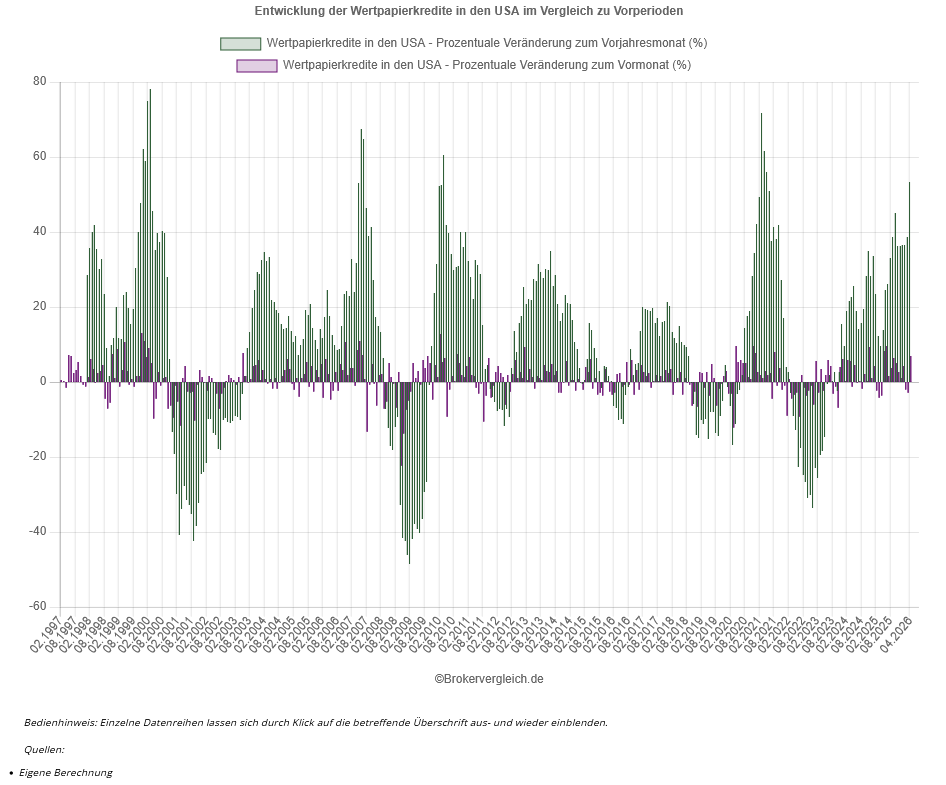
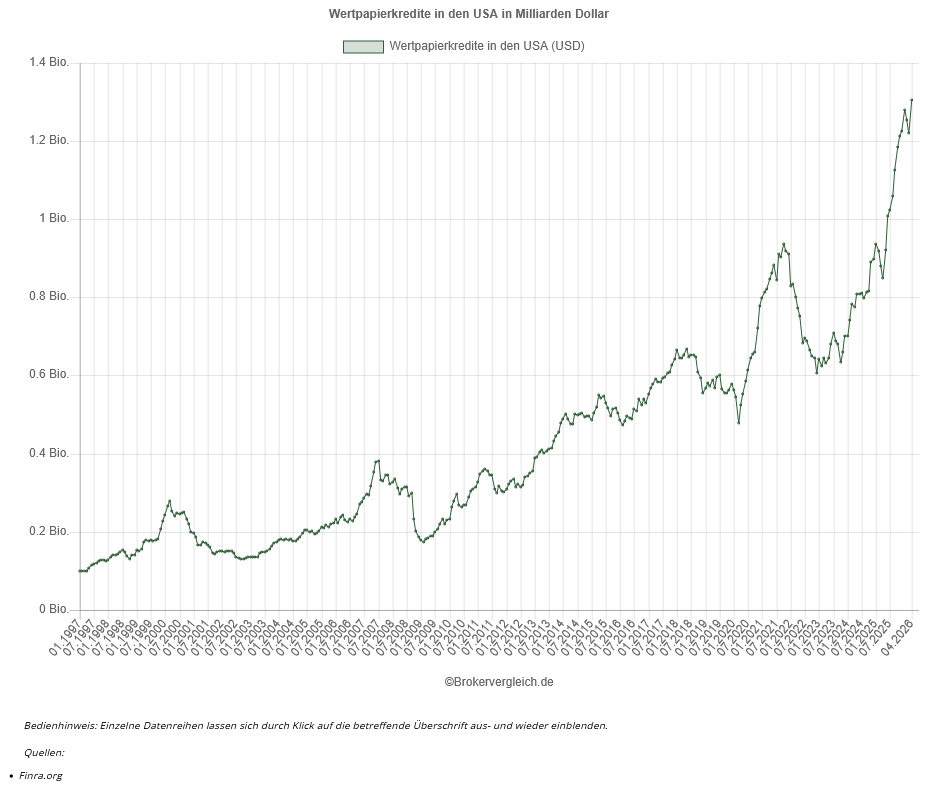
Anleger in den USA investieren immer mehr auf Kredit: Um 6,83 Prozent auf 1.304,281 Mrd. USD ist das Volumen der Wertpapierkredite in den USA im April gegenüber dem Vormonat gestiegen - ein rekordhoher Wert in unserer bis 1997 zurückreichenden Zeitreihe basierend auf Daten der Finra. Der Zuwachs gegenüber dem Vorjahresmonat betrug übrigens 453,72 Mrd. USD bzw. 53,34 Prozent und war damit laut unseren Berechnungen auf https://t.co/I5bQCDi84g in absoluten Zahlen der größte jemals gemessene Zuwachs und prozentual der größte Zuwachs seit Mai 2021.
Die USA 🇺🇸 haben jetzt:
1. Eine Rekordverschuldung der privaten Haushalte in Höhe von 17,1 Billionen Dollar
2. Rekordhöhe von 12,0 Billionen Dollar an Hypotheken
3. Rekord von 1,6 Billionen Dollar bei Autokrediten
4. Rekord von 1,6 Billionen Dollar an Studentenkrediten
5. Rekordwert von 1,0 Billionen Dollar an Kreditkartenschulden
Die Gesamthypothekenverschuldung ist inzwischen mehr als doppelt so hoch wie der Höchststand von 2006.
Inzwischen haben 36% der Amerikaner mehr Kreditkartenschulden als Ersparnisse, während die Zahlungen für Studentendarlehen zum ersten Mal seit 2020 wieder aufgenommen werden sollen.
Und das alles, während die Hypothekenzinsen gerade auf 7,1% und die Kreditkartenschulden auf ein Rekordniveau von 25% gestiegen sind.
Wir "bekämpfen" die Inflation mit Schulden.
Das kann nicht gut enden.
H/t @KobeissiLetter
🇺🇸 WARNING: THE U.S. STOCK MARKET IS ABOUT TO CRASH ENTIRELY.
The S&P-500 is about to enter the final phase of the psychological cycle.
The U.S. stock market has ignored key metrics such as high inflation, yields, oil, and sentiment.
This happens because the market is in a state of delusion.
What comes next is the new paradigm.
That's where it gets ugly.
🚨 HAS THE GOLD EXPRESS CRASHED INTO A BEAR TECHNICAL MARKET?
A hawkish Fed pivot and blowout U.S. jobs data just sabotaged the multi-year precious metals rally.
With prices decisively snapping the 200-day moving average and plummeting 20% to $4,300, the high-speed gold locomotive has careened off the tracks as investors jump to higher-yielding alternatives.
Is this the end of the line or just a temporary detour before the next big run?
🚨SpaceX has launched its IPO process.
• IPO Price: $135/share
• Capital Raised: $75 Billion
• Valuation: $1.75 Trillion
• Trading Begins: June 12
This will be the largest IPO in history, instantly making @SpaceX one of the most valuable companies on Earth.
The countdown starts now. 🚀 $SPCX
🎧 ¿Has escuchado el último tema de @calumscott junto a #Leony ?
Si aún no lo has hecho… ¿a qué estás esperando? 🔥
Un auténtico temazo para empezar la semana con energía 💥
¡Feliz lunes!
I literally can’t stop rewatching this launch. It’s indescribably beautiful. There are not enough words in the English language to properly convey how much I enjoy watching this.
This animation shows NASA’s Artemis II mission path, a journey of nearly 685,000 miles. The crew will travel in a figure-eight trajectory, looping out from Earth, around the Moon, and back again.
Follow live updates: https://t.co/PikF0FNlO9
The Magnificent 7 is getting ready for at least a relief bounce short-term, (possibly next week).
Here's exactly what to expect and when to buy moving forward.
1. $AMZN
2. $AAPL
3. $GOOGL
4. $META
5. $MSFT
6. $NVDA
7. $TSLA
All my exact buy and sell signals in Discord @ https://t.co/GaBnArAAKe.
Wie man sieht, steigt die Marktkapitalisierung der größten Unternehmen immer weiter an. Es ist also nur eine Frage der Zeit bis wir 10 Billionen Dollar Companies sehen.
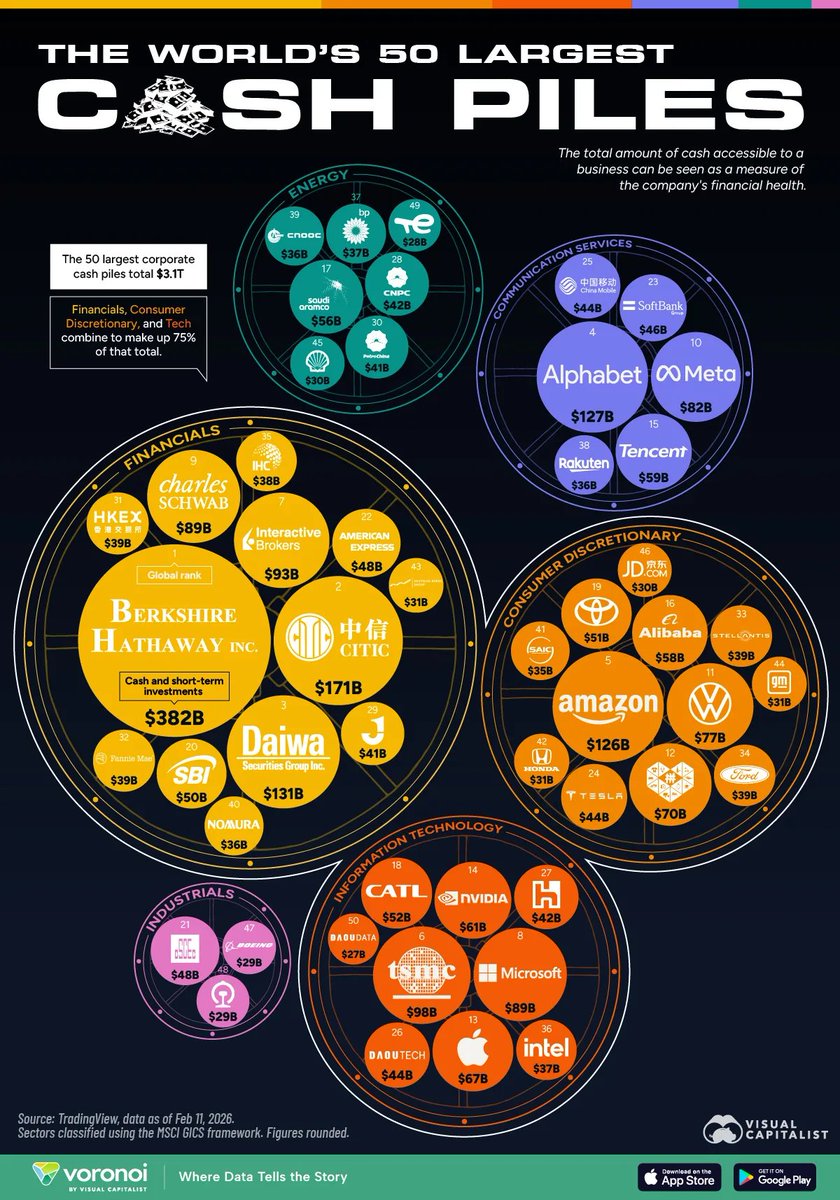
According to Visual Capitalist, the world’s largest corporations are holding record levels of cash. Big Tech alone (Apple, Microsoft, Alphabet, Amazon, Meta, etc.) holds around $600B in cash, while Berkshire Hathaway holds roughly $300–380B.
In the short term, this signals caution: companies are not rushing to buy assets, so market pressure and corrections may continue.
But long term, this is a strong bullish factor. Massive liquidity already exists — it’s just waiting for the right moment. Once conditions stabilize, these hundreds of billions can start flowing back into the markets and support growth.
Simply put: the money is on the sidelines now — later it will move the markets.