@QuantifiedStrat Midterms since 1962 is about 16 events. We won't judge any of our own options tests before 50 closed trades, and even that feels thin. Interesting pattern, but I'd treat 16 data points as a story, not a signal.
@velesxbt Worth checking how many hold up after publication and on a point-in-time universe. We ran a classic momentum idea on today's S&P 500 list for the whole history and got an absurd result. The test already knew which stocks would become giants.
@KenKemBOT The "safe" feeling fooled us too. A tighter stop felt like risk management, so we tested it on the same 111 paper iron condors. It made about $400 less. It cut trades that would have recovered. Once the exit was code, the feeling was testable.
@velesxbt We have the paper version of the other side. 64% of our iron condors won, and the average trade still lost money after costs. Win rate without payoff size tells you almost nothing.
6/ So on 5 Oct we started a clean test: no stop, no forced exit, hold to expiry. Rules written first. Verdict in the second half of November.
Paper results, not advice.
1/ A common rule for selling options: never use a stop, just wait for expiry. We tested it on our paper iron condors. Here's what the data said so far. �
We hit a version of that in our options test. On day one, 42 positions closed on the same snapshot. Counting them as 42 data points would have looked great. We wrote them down as one correlated cluster instead, excluded from the sample count. Independence is the real sample size.
Asked a trading-bot course for their P&L once. The answer: "I can't show profits, read the reviews."
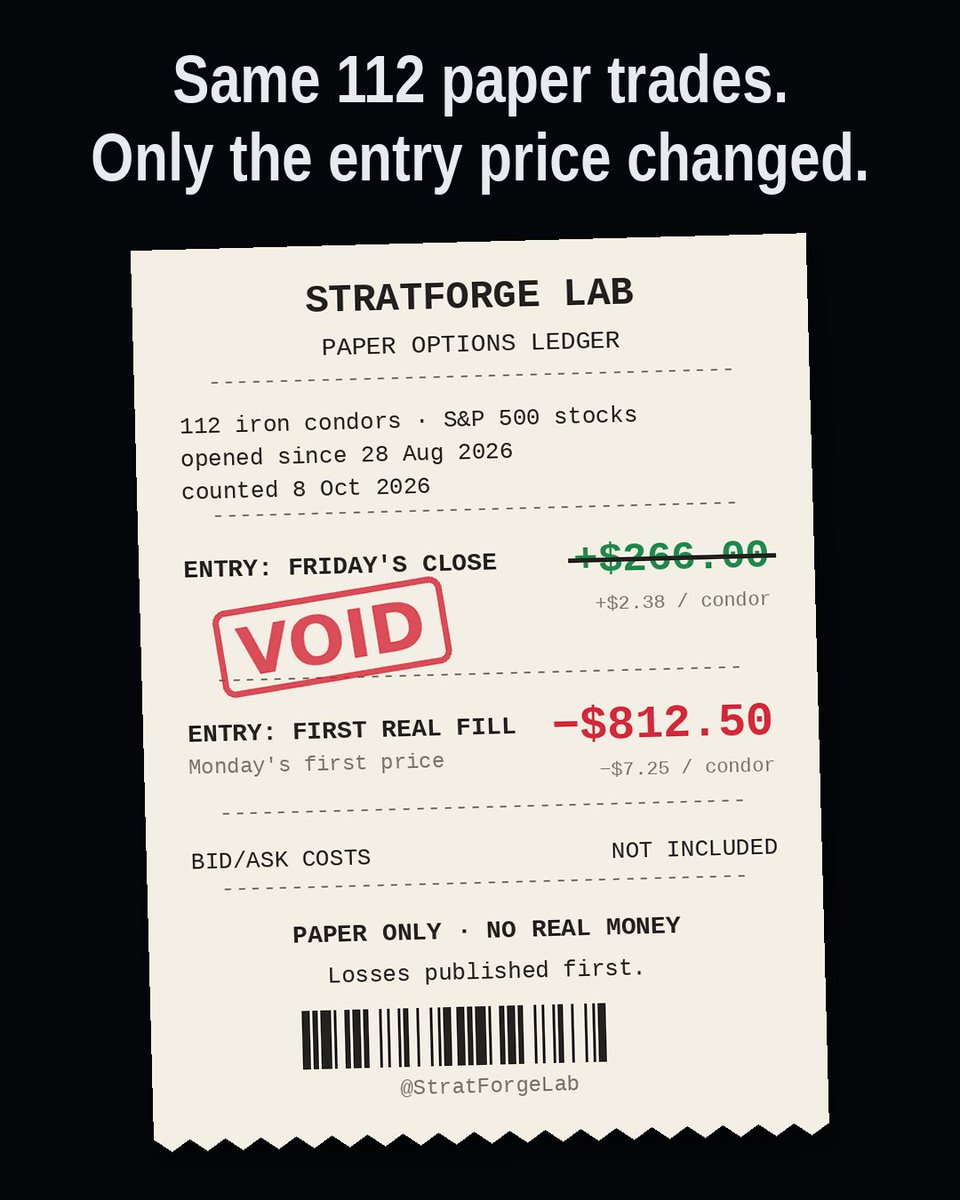
Here's ours instead. Paper ledger, 112 iron condors: +$266 at Friday's close. Priced at a fill we could really have got: -$813.
Ask for the ledger, not the reviews.
@KrisAbdelmessih Our paper iron condors had the mirror version of that: 64% of them won, and the average one still lost money after costs. Being right often wasn't the same as being paid.
@QuantifiedStrat Our stock scanner says not reliably. Its quarterly re-ranking tends to sell recent winners and buy names that are still falling. And a random 20 drawn from the same shortlist has kept pace with our ranked 20 so far. Most of the edge seems to sit in the universe, not the ranking.