This Thanksgiving, we're grateful for our clients, our partners, and our team. From all of us at Strategy Risks, we wish you a happy, peaceful, and restful Thanksgiving. #Thanksgiving#StrategyRisks
Jensen Huang is back at Nvidia, but the national security questions remain.
Strategy Risks CEO @isaacstonefish recently discussed the broader implications for U.S.–China relations on Open to Debate.
https://t.co/pcsi2W7Rng
New in @japantimes: @isaacstonefish and Dan White explain why Washington’s “blue tsunami” is a mixed blessing for Tokyo. Congress has more allies of Japan in it now, but Japan’s chipmakers face new China risk.
https://t.co/XB9MzS0N9Y
“I don’t know of any domestic constituency that was clamoring for Trump to meet with Xi and Putin.”
Strategy Risks CEO @IsaacStoneFish in @business on the Shenzhen summit.
https://t.co/H6rWiQCbfm
Strategy Risks CEO Isaac Stone Fish will deliver the keynote at #OCGlobalInnovation on Nov. 19.
His talk, "Geopolitical Risks in the Age of Nvidia," explores U.S.–China tensions and what they mean for global business.
https://t.co/IQSupDYREO
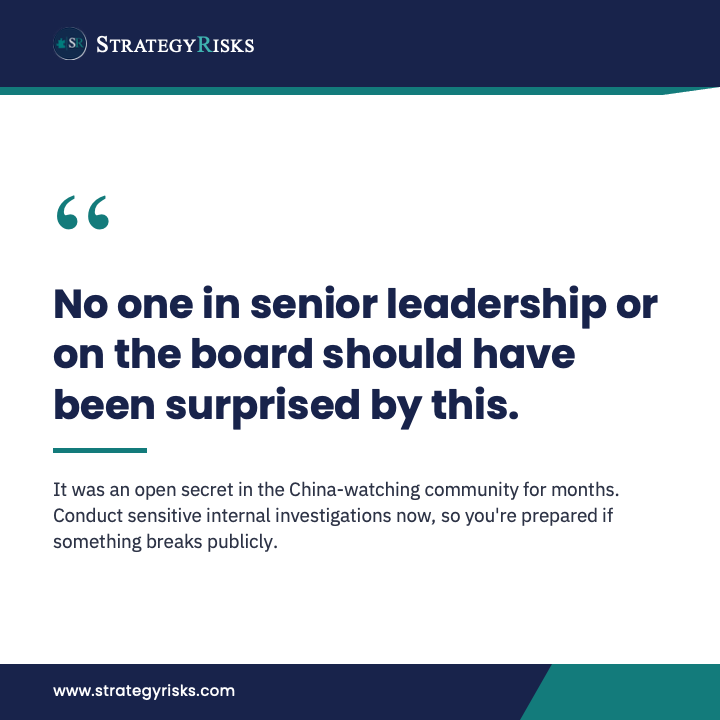
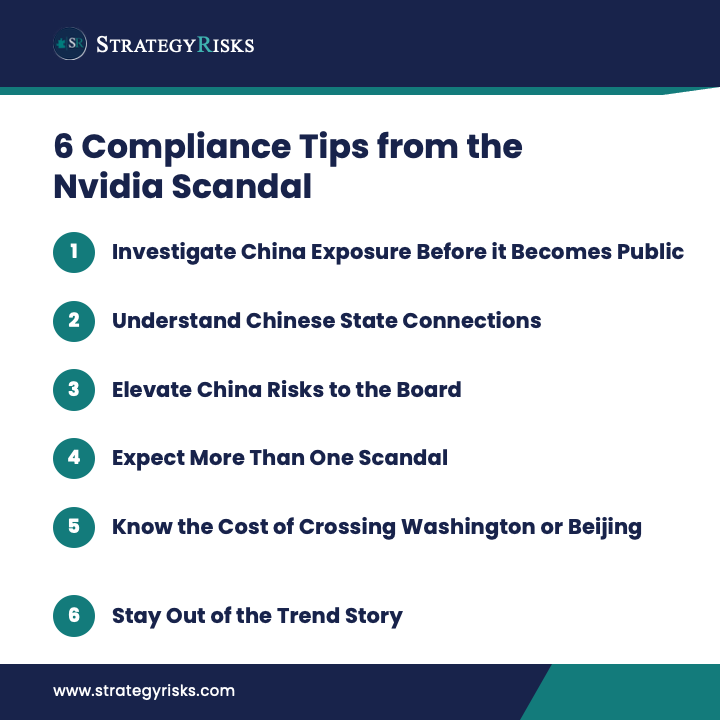
Jensen Huang has resigned as Nvidia CEO. A stark reminder that China-related vulnerabilities can become corporate crises.
Six lessons for boards and C-suite executives.
Know your China exposure before journalists and Congress do.
NEW INVESTIGATION: Yale Scholars, Xinjiang, and China’s Influence Operations
A new Strategy Risks investigation examines how two longtime Yale University scholars participated in a Chinese government-linked forum in Xinjiang, and how Chinese state media amplified their subsequent remarks.
The forum featured prominent involvement from a senior Chinese Communist Party United Front official and included a tour with stops tied to the U.S.-sanctioned Xinjiang Production and Construction Corps.
Our findings raise important questions about how respected Western academics can lend credibility to Beijing’s narratives about a region marked by documented human rights abuses.
Read the full investigation: https://t.co/xKStHMON4O
hashtag#China hashtag#Yale hashtag#Xinjiang hashtag#NationalSecurity hashtag#HigherEducation
The Trump-Xi summit has concluded. What comes next for global businesses?
Today at 12:30 PM ET, SR CEO Isaac Stone Fish joins Bonnie Glaser and Nazak Nikakhtar to discuss what’s next for companies navigating U.S.-China strategic competition.
Link: https://t.co/rrXtI3zeRO
Yet another important report from @StrategyRisks — this one about how @MissouriState reportedly used taxpayer $$ to credential CCP officials in state-owned enterprises, including those designated as national security threats (AVIC) and engaged in human rights violations (iFLYTEK)
Expect this report to start another round of conversations in DC about the nature of higher education cooperation with China…
Missouri State University trained more than 1,500 Chinese government and state-owned enterprise personnel through its MBA programs. Some graduates later held senior roles in China's defense industry. 🧵
The report also examines admissions practices, institutional relationships, and whether tens of millions of dollars in taxpayer support may have helped fund the program.
Strategy Risks is hiring! We’re looking for a research director to oversee and grow our research team and our research products.
Someone dynamic and curious, with deep expertise in geopolitics and global risk, and China.
https://t.co/MIJXfZSaec
Wilson, the official NFL partner and the maker of the football used in the Super Bowl, is a Chinese company.
In 1989, Wilson sold to the Finnish conglomerate Amer Sports. In 2018, Anta — the Chinese sporting giant whose owner has ties to Xi Jinping — purchased Amer.
.@IsaacStoneFish on the risks facing firms like Apple and Microsoft with high China exposure in the event that China invades Taiwan. https://t.co/AB4F1elQsx
Western institutions lend credibility, knowledge, and resources to China's surveillance apparatus.
Without safeguards—human rights due diligence, disclosure requirements, limits on sanctioned partnerships—publicly funded research will continue supporting systems of repression.
Today, Strategy Risks is releasing Shared Labs, Shared Harm -- a report on how MIT, Stanford, Harvard, Oxford, and 20+ other Western universities used U.S. and U.K. government funding to become embedded in China's AI surveillance apparatus.
This isn't about blocking all China research. It's about recognizing structural reality:
You're not in a neutral academic space when you partner with labs embedded in authoritarian surveillance infrastructure. You're enabling repression.