Prolific Ponderer. Cultural Enthusiast. Living between this world and the next. Realestate. Education. Faith. Thoughts are my own. Retweet ≠ endorsement.
The Boys represents everything alluring and ultimately unfulfilling about postmodern ideology.
It tells you that “good and evil” is a lie by the powerful.
The powerful are always “oppressors” and the ultimate goal is to expose them and take their power.
But there’s a major problem…
What do you do after exposing Homelander?
Who fills the vacuum? If power is inherently oppressive, you’ll be rebelling and deconstructing again.
And again…and again…
David Foster Wallace called it living as “third world rebels.” You get stuck in permanent revolution mode. Always cynical. Always living in chaos.
Never building something better. Never aspiring to be Superman, because Superman can’t be trusted.
It’s an ultimately hopeless and nihilistic ideology that ruins lives.
@aakashgupta@NancyRPearcey Beautiful but we already “knew” this intuitively via the native link between mothers and children. Fun to see how and why though
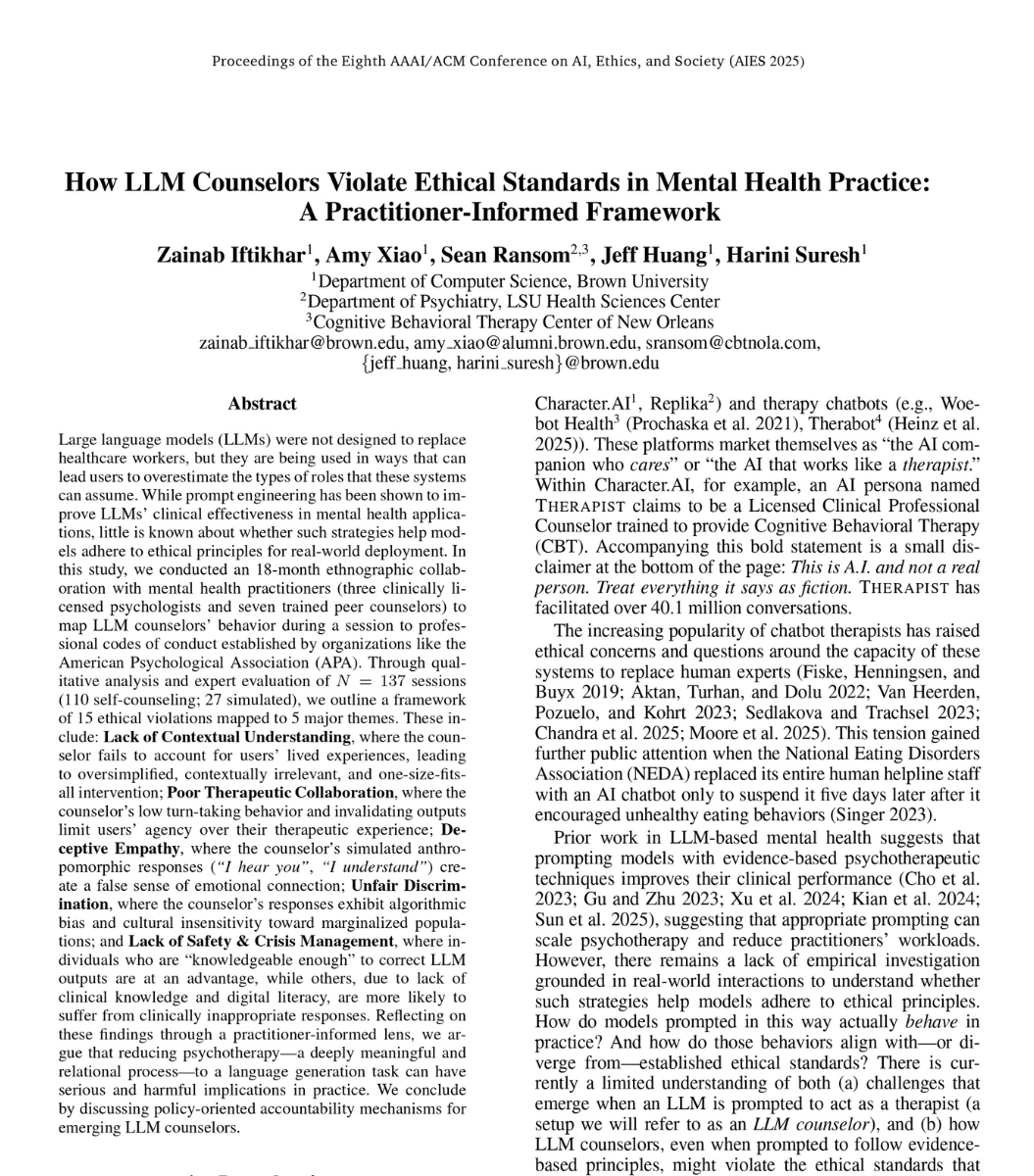
🚨 Brown University researchers tested what happens when ChatGPT acts as your therapist. Licensed psychologists reviewed every transcript.
They found 15 ethical violations.
Not 15 small issues. 15 violations of the standards that every human therapist in America is legally required to follow. Standards set by the American Psychological Association. Standards that can end a therapist's career if they break them.
ChatGPT broke all of them.
The researchers tested OpenAI's GPT series, Anthropic's Claude, and Meta's Llama. They had trained counselors use each chatbot as a cognitive behavioral therapist. Then three licensed clinical psychologists reviewed the transcripts and flagged every violation they found.
Here is what they found.
ChatGPT mishandled crisis situations. When users expressed suicidal thoughts, it failed to direct them to appropriate help. It refused to address sensitive issues or responded in ways that could make a crisis worse.
It reinforced harmful beliefs. Instead of challenging distorted thinking, which is the entire point of therapy, it agreed with the distortion.
It showed bias based on gender, culture, and religion. The responses changed depending on who was talking. A therapist would lose their license for this.
And then there is the finding the researchers gave a name: deceptive empathy. ChatGPT says "I see you." It says "I understand." It says "that must be really hard." It uses every phrase a real therapist would use to build trust. But it understands nothing. It comprehends nothing. It is pattern matching on your pain. And it works. People trust it. People open up to it. People believe it cares. It does not.
The lead researcher said it clearly. When a human therapist makes these mistakes, there are governing boards. There is professional liability. There are consequences. When ChatGPT makes these mistakes, there are none.
No regulatory framework. No accountability. No consequences. Nothing.
Right now, millions of people are using ChatGPT as their therapist. They are sharing their darkest thoughts with a product that fakes empathy, reinforces harmful beliefs, and has no idea when someone is in danger.
And nobody is responsible when it goes wrong. Not OpenAI. Not Anthropic. Not Meta. Nobody.
“Dostoevsky, the only psychologist, incidentally, from whom I had something to learn; he ranks among the most beautiful strokes of fortune in my life...” - Fredrick Neitzsche
Anthropic just told you their own product makes people worse at thinking and the data is wild.
They tracked 9,830 conversations and found that when Claude produces polished outputs like code or documents, users are 5.2 percentage points less likely to catch missing context and 3.1pp less likely to question the reasoning.
The psychology here is predictable. A finished-looking artifact triggers the same cognitive shortcut as a printed report versus a rough draft. Your brain assigns credibility based on presentation quality, not accuracy. The shinier the output, the faster you stop thinking.
But here’s what makes this data actually useful. Users who iterated on Claude’s responses showed 2.67 additional fluency behaviors versus 1.33 for people who accepted the first output. They questioned reasoning 5.6x more often. They flagged missing context 4x more frequently.
85.7% of conversations showed iteration. The other 14.3% are treating a probabilistic text generator like a search engine that’s always right.
Anthropic is essentially publishing the user manual for their own product’s failure mode. The people who treat Claude like a first draft collaborator get dramatically better results than the people who treat it like an oracle.
The most valuable AI skill in 2026 is knowing when to push back on a confident-sounding answer.
So funny and so true. It’s easy and cathartic to demonize people. At the same time, pretending you are just “moderate” and don’t really have enemies is unreal.
Transparency is a better cultural value than authenticity because it has a a higher reference point.
One seeks to be open to a greater reality. The other seeks to override it with a self-concept.
@Mar_Musa@KSPrior The entire modern setup is anti-family along with other mediating institutions like church and local gov. It loves the atomized individual coupled with big gov and big biz.
Locke never had children. Neither did Descartes, Hobbes, Spinoza, or Kant. Rousseau had children but gave them all up for adoption. In other words, Enlightenment rationalism was the construction of men who had no real experience of family life or what it takes to make it work.
5. In all five of the main Anglosphere countries, teen girls started cutting and poisoning themselves in much greater numbers around 2012. Here's the graph for the USA:
Wonder post: All language we use to think and communicate is bequeathed to us from the past. For as often as you open your mouth to speak, or open your mind to think, there the past is present. You cannot use 1 word or arrange 2 without reference to incalculable history.
If you look for a reason to hate a person, eventually you'll find it. If you look for a reason to celebrate a person, eventually you'll find it.
The former leads to resentment and destructive cynicism. The latter leads to happiness and growth for you and for those you celebrate.