Biocontrol technology for sub-Saharan African smallholder farmers to control Striga weed in maize, sorghum, millet (increasing yield by 50% in Gates trials).
Every country has its own approval process. BUT, the East Africa Community has harmonized biocontrol protocol. Once we have three EAC country approvals, we get auto approval in all other EAC member states (DRC, S. Sudan). We are in trials in Tanzania...to secure the trifecta.
We achieved a major milestone for The Toothpick Project, benefitting East Africa farmers and global sustainable agriculture:
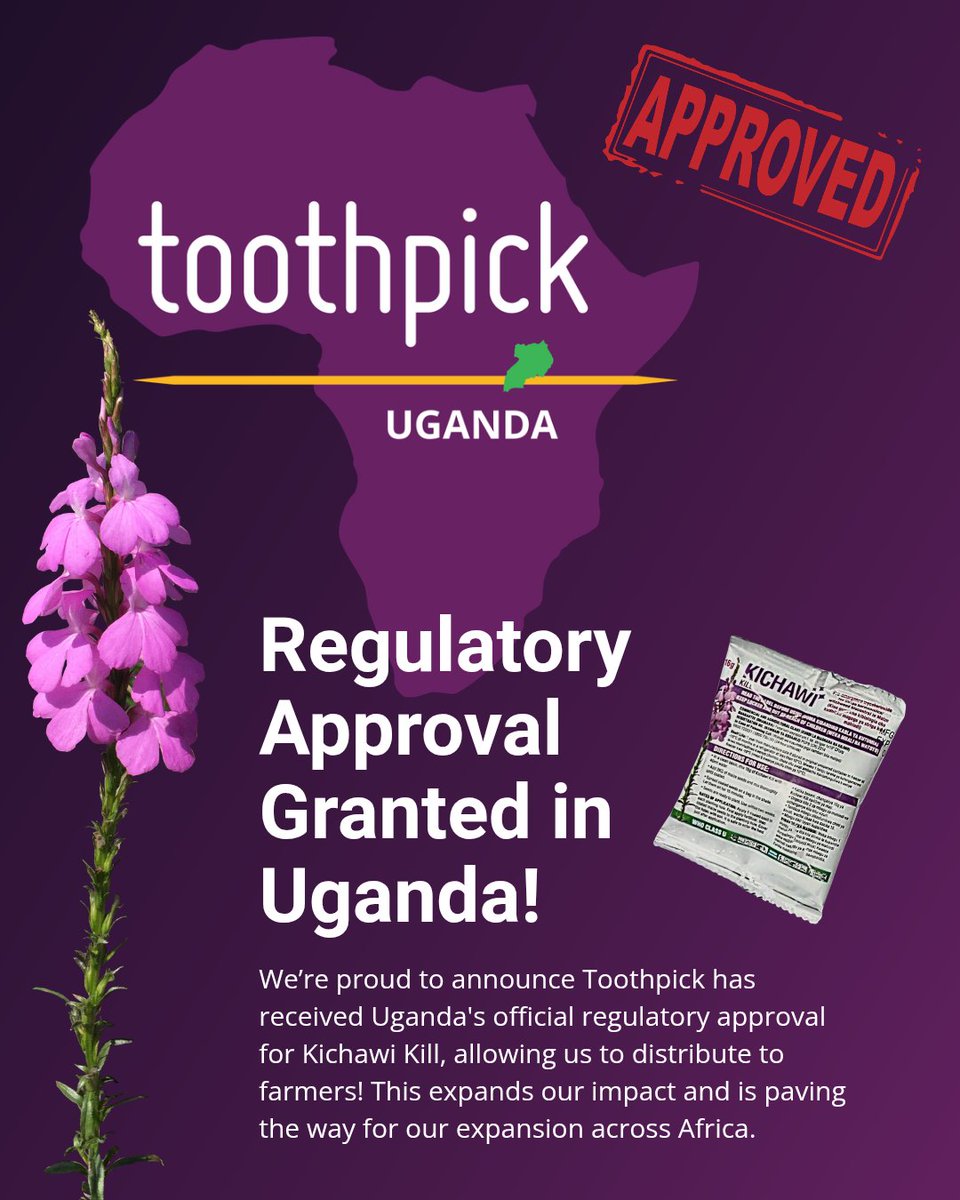
We are proud to announce that Kichawi Kill, our Striga biocontrol seed coating, has officially received regulatory approval in Uganda. 🇺🇬
continue➡️
Does this make Toothpick the world's only microbial herbicide with multinational approval. Is that true?
Our 3rd party regulatory trials are in the ground in Tanzania (thanks, Global Innovation Fund), with hopes that we can make another similar announcement in the next year. 🇹🇿
@Striga_Steve Final skirmish seems like suitable American English to define a battle that is 99% won. But, it is concerning that this article is from 15 years ago...they still haven't achieved the final 1%. We gave a presentation on our tech a few weeks ago regarding the 2500 acres in the US.
Has the Striga problem been solved? JGressel's newest: “to critically evaluate whether the results of recent basic research are applicable in their present form for use in the field, and if not, what needs to be done to attain effective Striga management."
https://t.co/fhGbM4rT9N
Thank you to @Welthungerhilfe and Seeding the Future Foundation for facilitating our participation at @TheAGRF in #Dakar this week! We came, we pitched, we attended many many informative and inspirational sessions, and we connected with ministries (Uganda, Tanzania, Ethiopia)!
We have wrapped up the week at @TheAGRF in #Dakar#Senegal. I'm grateful my presentation was in the morning on day two so I could focus my energy on sessions and meetings with stakeholders, funders, and ministries. Missions accomplished!
#AFSForum2025#AFSF2025#foodsecurity
@Striga_Steve@citizentvkenya Exploited how? We have over 80 full-time and seasonal employees (all Kenyan and Ugandan) and no funding leaves East Africa. 100% of our contracted scientists are African. Only one team member lives in the US and is only paid if included in grants, not revenue. You are uninformed.
@Striga_Steve Your behavior in this thread is incredibly disrespectful and naive.
If you ever have a solution that reduces striga by over 90%, reduces the seed bank, boosts maize yield by over an average of 450kgs per acre, has a practical application, and is approved by PCPB, let us know.
@Striga_Steve Tried to source your seeds for regulatory trials and you wouldn't give/sell them to us. If they work so well and are free, why is Striga a problem?
You have a salary (I don't). You are part of a team that has received over $10 M from the Gates Fndt...yet no application yet?!
@Striga_Steve Every grant proposal we write asks about our IP. We have a patent (which costs money) that protects our technology. But, I always note that if someone can figure out how to do it for less $ than us, they should do it. Nobody has.
FYI We couldn't find your seeds on the market.
@Striga_Steve Would you ask all the trainers to volunteer their time? How would you travel from farmer to farmer? How would you pay rent for the laboratory and cover lab expenses? You should probably stay in the lab and away from business.
@Striga_Steve You know of farmers in Busia...hilarious. In 2024, our first full year with the seed coating, around 13,000 farmers used Kichawi Kill. They paid for it. The ROI for the farmer is about 20x.
@Striga_Steve You will be hard pressed to find an agtech company with more humanity than Toothpick.
Please remember that we have offered to provide Kichawi Kill to your team whenever you are ready to test compatibility with your research.
@Striga_Steve We are NOT profiteering! We are a social enterprise supported by an NGO until we can reach enough farmers to break even. Our margin is low in an effort to keep the price as low as possible for farmers. We have taken zero investments and shareholders take no dividends.