Curriculum leadership takeaway for CIC planning: spacing beats cramming, but whether gaps grow or stay equal matters little. Our job is to decide how long pupils need to remember key knowledge, then build revisits into long-term plans. Very insightful article @XpatEducator#CIC
Successive relearning is the term for retrieving the same content correctly two or three times, spaced days apart. Research found expanding the gap each time showed no real advantage over keeping it the same. What drives retention is banking successful retrievals, not stretching out the calendar between them. Includes free planning tool.
https://t.co/R6CFliZcMV
@SimonBreakspear Like the specificity. I’m curious about the role of language with the structure
How important is how we say it? Is the aim to be both direct and caring, or does that balance change with context? Can being too direct undermine the message, just as being too careful can dilute it?
This really struck a chord with me. I catch myself getting distracted way too easily these days. Time to change that. I’m committing to building healthier habits and a couch to 5k reading edition is a great idea 💡👏🏻 tough with a 2&5 year old though 👦🏼👧🏻 @NaomiAllthenews
“There is so much joy in books, and it’s all still there waiting for us. All we have to do is take it back from the technology billionaires, one day of reading at a time,” says @NaomiAllthenews, suggesting her Couch-to-5K approach: https://t.co/wgXV8Mwlum
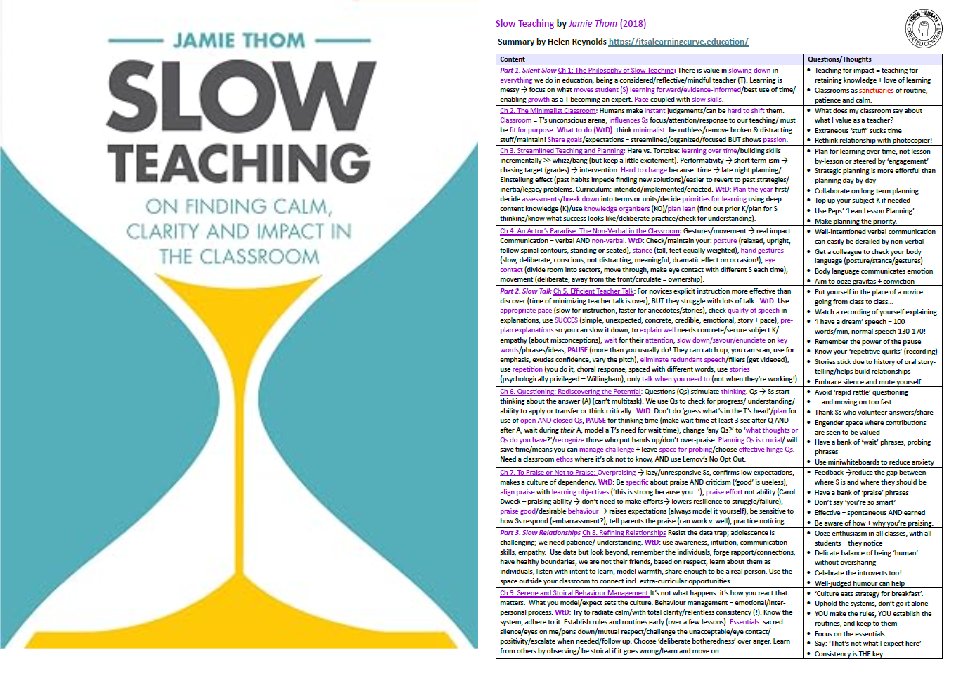
Are you going back to school soon thinking 'last year was hard, can I do something different?'
Look no further!
Try SLOW teaching - excellent workable solutions that won't cost/take time & bring joy!
EXCELLENT book from Jamie Thom, summary here:
https://t.co/AhZjDIm5LJ
🔔 ATTENTION! Attention is the prerequisite for learning. As Daniel Willingham puts it — "memory is the residue of thought." In other words, students will remember what they think about.
📼 NEW VIDEO EXPLAINER! The first DistillED Explainer unpacks what the science tells us about securing attention and five practical strategies you can use straight away.
👉 https://t.co/hhrfs23lM5
Another excellent academy week completed at Banks O Dee with Axten Sport Academy. Weather was superb and the players were fantastic.
Although, I’ve been thinking about sport vs school practice as we wrapped up another successful week:
https://t.co/RVjfKp2exU
11 years on and Making Every Lesson Count still holds up. Six principles, no gimmicks, just genuinely good T&L. Some omissions in behaviour management, relationship-building and subject knowledge requirements. But, every NQT should read this. Keep it simple. Do it brilliantly.
@tombennett71 Boundaries do need consequences. A rule nobody enforces isn’t a rule. But it’s not just consequence vs no consequence. Sanction alone often just teaches “don’t get caught.” Sanction + relationship + understanding why the kid ran teaches the actual lesson.
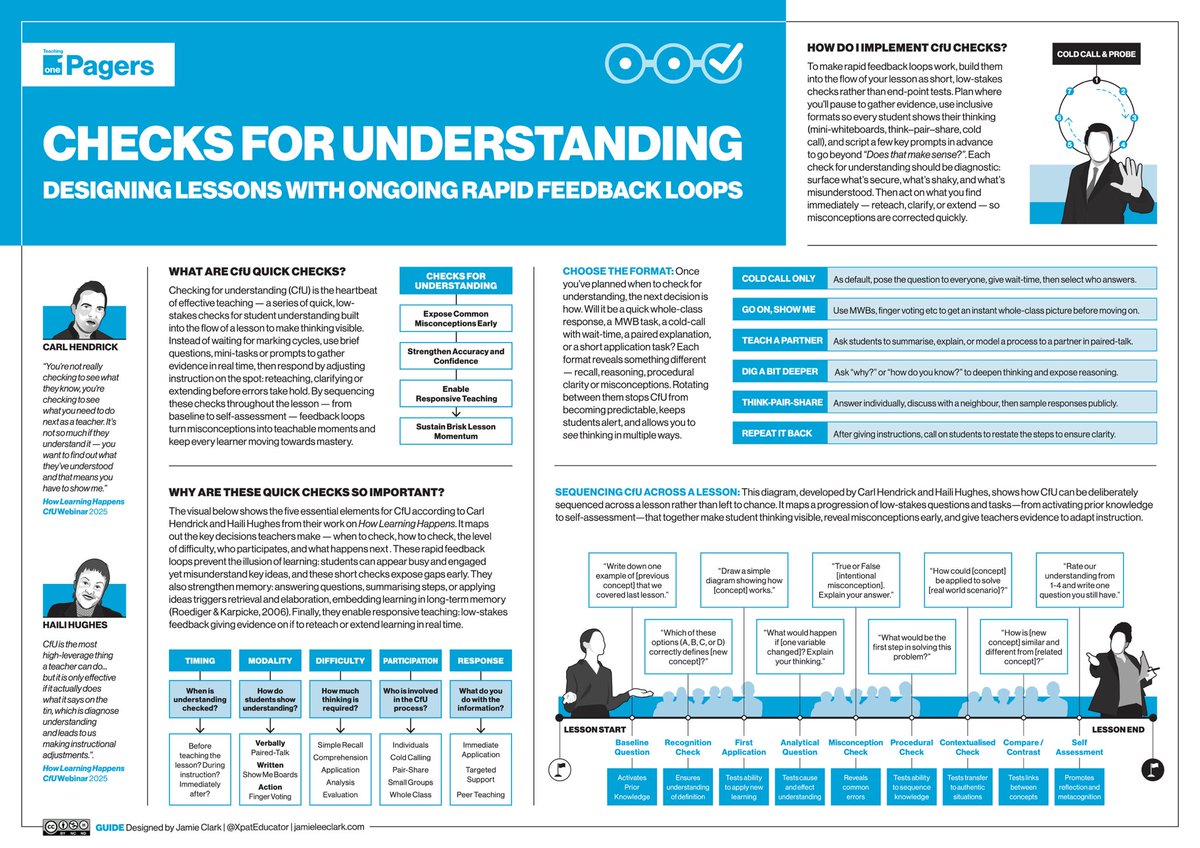
📣 CHECKING FOR UNDERSTANDING! “If there’s one thing to get right in teaching, it’s checking for understanding.” This one-page guide breaks down how to thread CfU checks into every lesson — inspired by the ‘How Learning Happens’ work by @C_Hendrick and @HughesHaili
Read and download free: https://t.co/7NvPGRaMIK
@shaun_allison All is good thanks, Shaun. Two and half years into an exciting school transformation project. I enjoy keeping an eye on the huge progress you’ve all made at Durrington. Would love a visit when down next 👍🏻
This is an excellent piece on adaptive teaching. Having trained in the era of “three lesson plans for one lesson” and differentiation grids, it’s refreshing to see the conversation grounded in what actually makes the biggest difference in classrooms. Nice summary @shaun_allison
The new EEF Guide to Inclusive Teaching is published today.
It's worth checking out. It contains guidance, summaries, myth busting & scenario based training plus more.
https://t.co/ugPZKi5NMN
Reading education blogs changed my practice, so I always want to try take the opportunity to share the love.
Here are a few free blogs I've read recently that I thought were super, please share if you can!
I work at a school that doesn't have merit points or rewards or anything like that, so this piece by @msrebeccabirch on intrinsic motivation really appealed to me: https://t.co/gEMMUmpfla
We are in the midst of an SEND crisis, and part of the problem is outlined by @head_teach: that some schools have astonishingly higher numbers of students with SEND than others: https://t.co/WgKKA9qLF6
@joel120193 is smashing out hit after hit on his blog, and this piece on the sheer amount of things teachers have to do resonated: https://t.co/mLZJbExzxy
@mpershan wrote a typically scholarly, wide-ranging and sophisticated piece on implicit vs explicit learning, the memorisation of maths facts and much more. https://t.co/wzdja56EhE
Next up are two posts on AI:
@alex_crossman has written an excellent piece on the risks of AI to education. Our job is to get students' thinking hard, and AI's job is to get people thinking less hard. These aren't compatible, and we need to pull the brakes hard. https://t.co/KlbPPvalW6
Whilst not strictly about education, Gary Marcus's entry here about the security risks of OpenClaw and other weird things is vital if we are to take internet and AI security seriously. https://t.co/qSHAIfEQEO
Of course, I've been blogging too, and you can check out my entries here: https://t.co/ybu2w6TiD9
As stated at the outset, please share if you can!
Most school leaders are not chasing perfection.
They are chasing progress.
Quietly. Relentlessly. Under pressure.
That is why Better by Atul Gawande resonates so deeply with leadership in schools.
It is not about brilliance.
It is about systems, habits and the discipline of improvement.
In surgery, failure costs lives.
In education, it costs opportunity.
The lesson is the same in both fields:
Care is not enough. Systems matter.
That simple truth sits at the heart of Better: A Surgeon’s Notes on Performance by Atul Gawande. Although written through the lens of medicine, it may be one of the most quietly powerful leadership books a leader can read.
Because it strips performance back to its essentials.
Not vision statements. Not slogans.
But habits, systems, humility and the relentless pursuit of improvement.
In schools, as in surgery, we often celebrate individual excellence.
The outstanding teacher. The inspirational leader. The charismatic head.
Gawande dismantles this myth with precision.
He shows that even the most talented professionals fail without:
•Clear systems
•Consistent routines
•Feedback that is acted upon
•A culture that allows challenge and learning
The lesson is uncomfortable but necessary. Performance does not improve because people care more. It improves because systems make the right actions more likely and the wrong ones harder to repeat.
One of Gawande’s central arguments is that improvement rarely comes from dramatic breakthroughs. It comes from marginal gains applied consistently.
This is profoundly relevant to school leadership.
Better attendance rarely comes from one assembly.
Better behaviour rarely comes from one policy rewrite.
Better teaching rarely comes from one INSET day.
It comes from leaders who:
•Clarify expectations
•Remove ambiguity
•Build routines that survive pressure
•Accept that good intentions are not enough
In Gawande’s world, checklists save lives.
In ours, systems save learning time.
Perhaps the most striking section of Better is Gawande’s exploration of coaching. Even elite surgeons, at the top of their profession, actively seek feedback from others who can see what they cannot.
This is where leadership in schools is often tested.
Senior leaders are expected to have answers.
Yet the most effective leaders are those who remain open to scrutiny.
The parallel is clear. Schools improve fastest when leaders:
Invite challenge rather than defend practice
Use evidence to refine decisions
Model learning rather than certainty
Leadership is not diminished by coaching. It is strengthened by it.
What makes Better resonate so strongly with education is its realism.
Gawande does not argue that failure can be eliminated. He argues that it can be reduced. He does not promise excellence overnight. He commits to progress, relentlessly pursued.
This mirrors the reality of schools.
We work in complex systems, serving diverse communities, under constant pressure. Improvement is rarely neat. But it is possible.
The leaders who make the biggest difference are those who ask, repeatedly:
What worked today?
What did not?
What one thing can we do better tomorrow?
That mindset is not glamorous.
It is transformative.
Better is not a book about medicine.
It is a book about responsibility.
Responsibility to design systems that protect people.
Responsibility to reflect honestly on performance.
Responsibility to keep improving even when progress feels slow.
For school leaders, that message could not be more relevant.
Because the work is not about being flawless.
It is about being better.
Every day.
A new post from 100% Assessment (one that'll be particularly helpful for those working in MATs...)
The Curriculum Ghost in the Data Machine https://t.co/7FM5Xt2mZV
@head_teach
@StuartLock@neilhumphreyUoM Does the paper outline the impact on the students that don’t misbehave and are exposed to the behaviours of those that want to cause disruption in classes?
I know exclusions don’t work, but without proper funding for these “alternative provisions”, what chance do schools have?