*New Blog Series on Belonging*
For those of you who like to catch up over half term, I have been publishing a series of blogs on Belonging over on Substack.
Pretty sure twitter will absolutely nuke this thread but oh well.
👇
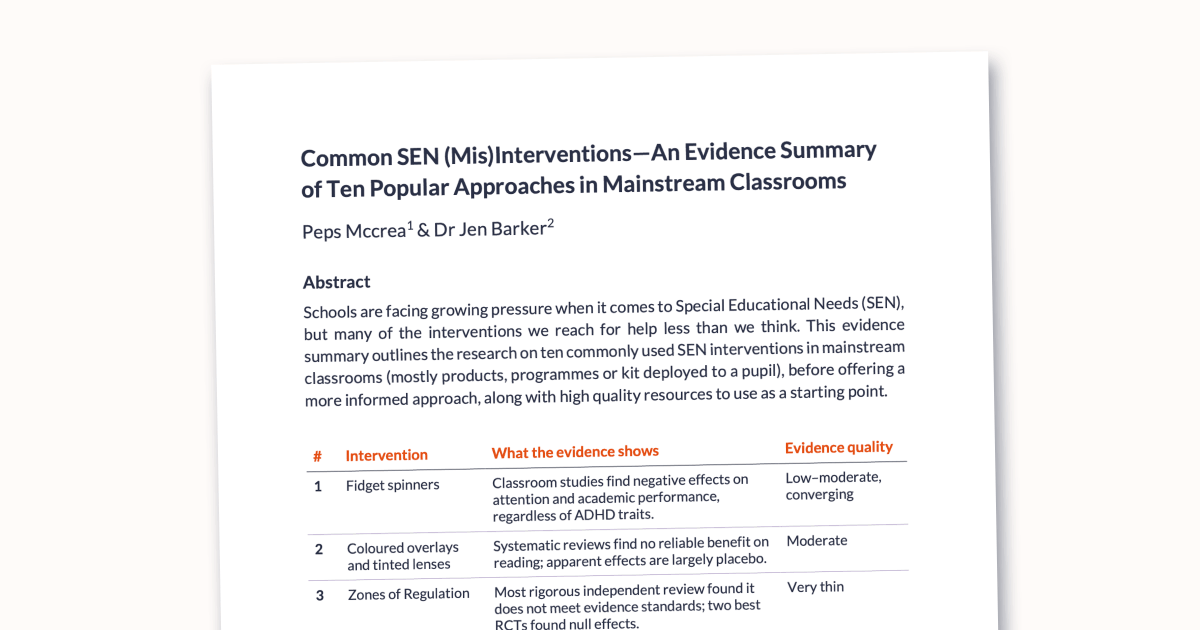
🚨New paper released today:
10 Common SEN Mis(Interventions)—An Evidence Summary
https://t.co/8lQNH00Co4
Supporting students with Special Educational Needs (SEN) is a vital and growing challenge for schools. But it’s not straightforward. Learning is complex, marketing claims are confident, and the evidence is often hard to access. As a result, we can sometimes end up adopting approaches which are less effective than we initially think.
For some, this may well be uncomfortable reading. As a profession, many of us have put time, effort and belief into these things, and lots will have seen students who looked like they were getting something from it. However, it’s essential that we temper our intuition with evidence, because ultimately: our most vulnerable students deserve it.
This new paper co-authored with @Barker_J is an attempt to raise the visibility of the best available evidence around several commonly used SEN interventions. For each, we provide an overview of what the research says, offer a more informed approach, and provide a suite of rigorous links to help you get started.
We hope it will serve as a useful resource and over time: push us to be even more 'evidence demanding' as a profession.
As ever, let me know what you think. If you have pushes or suggestions for how this paper could be better, hit reply and give it to me straight.
👊
The DfE needs to monitor the distribution of pupils with SEND across schools because some are facing ‘unsustainable’ pressure while others are not developing their inclusive practice, says @TheNFER research
https://t.co/DhiVlncX0B
The elephant in the room is surely whether or not Ofsted can/should inspect something we do in our spare time as unpaid volunteers.
Would a school be judged as Causing Concern or Attention Needed if not enough staff volunteer to run enrichments in their spare time?
Great stuff. I’ve been banging this drum for a while. There is a ninth zombie leadership claim; that there even is such a thing!
https://t.co/d0bjjDYqax
Considerable progress has been made in the field of leadership in recent years. However, this is undermined by a strong commitment to outdated ideas which have been repeatedly debunked but which nevertheless resolutely refuse to die--called "Zombie Leadership"
Zombie leadership lives on not because it has empirical support but because it flatters and appeals to elites, to the leadership industrial complex that supports them, and also to the anxieties of ordinary people in a world seemingly beyond their control. It is propagated in everyday discourse surrounding leadership but also by the media, popular books, consultants, HR
practices, policy makers, and academics who are adept at catering to the tastes of the powerful and telling them what they like to hear.
This review paper outlines eight core claims (axioms) of zombie leadership and how to finally put them to rest:
https://t.co/iojSAmJLaa
Considerable progress has been made in the field of leadership in recent years. However, this is undermined by a strong commitment to outdated ideas which have been repeatedly debunked but which nevertheless resolutely refuse to die--called "Zombie Leadership"
Zombie leadership lives on not because it has empirical support but because it flatters and appeals to elites, to the leadership industrial complex that supports them, and also to the anxieties of ordinary people in a world seemingly beyond their control. It is propagated in everyday discourse surrounding leadership but also by the media, popular books, consultants, HR
practices, policy makers, and academics who are adept at catering to the tastes of the powerful and telling them what they like to hear.
This review paper outlines eight core claims (axioms) of zombie leadership and how to finally put them to rest:
https://t.co/iojSAmJLaa
A strange thing is going on right now: Both cognitive science traditionalists and constructivist progressives now seem to be both arguing for learning as primarily a social enterprise.
For example, I don't know who Dan Meyer is but I gather he has largely progressive views and this conversation he had with @mrbartonmaths is symptomatic of this thing I mean where the emergence of AI in education is creating a weird kind of alliance where both camps now seem to be saying: learning has to happen between humans in real time. I disagree and this is why I think the Alpha model is potentially so powerful. 🧵https://t.co/q8AwHezbra
Great paper from @PepsMccrea@Josh_CPD & @Barker_J.
Key phrase: Embrace Cognitive Similarity
“While every student brings unique experiences, strengths, and needs to the classroom, understanding the fundamental similarities in how we all learn provides a powerful foundation for inclusive teaching. This principle recognizes that the core mental processes involved in learning—how we pay attention, process information, and build understanding—are remarkably consistent across individuals. In short, how we learn is more similar than it is different (Willingham, 2012). Focusing on these shared mechanisms doesn't ignore individual differences; rather, it allows us to design core instruction that is effective for the widest possible range of students from the start.”
https://t.co/SYl40cdY6N
Exclusive: The ‘accountability risk’ of being inclusive has been revealed by new research highlighting that most ‘SEND magnet’ schools achieve negative Progress 8 scores
https://t.co/9PAJKo7BpB
I’ve published a new book! 🥳
It is pitched at new teachers. Short. Easy reading. Helps make sense of what goes on in schools.
Check it out.
https://t.co/s1b48EypaA
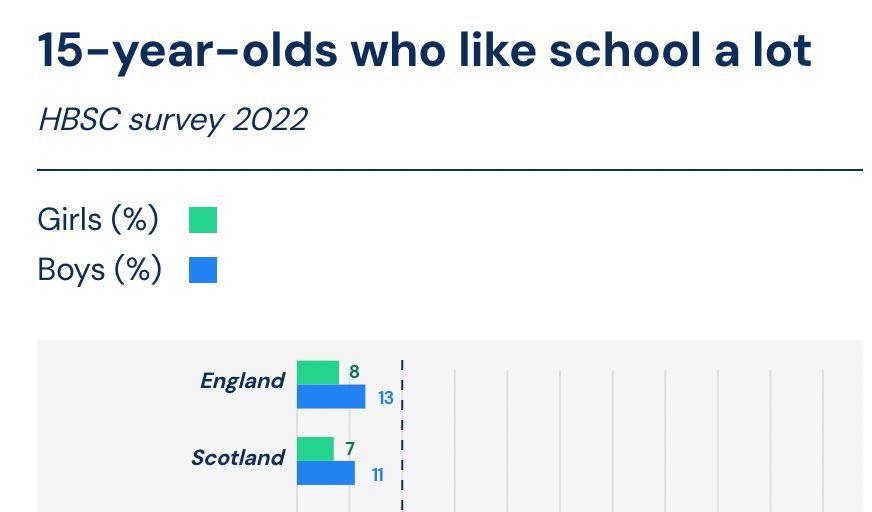
It's become common lately to hear people say that rising attainment in English schools has been bought at a terrible cost - that of rising mental health problems.
How true is this? Is it fair to blame Gove-era curriculum & exam reforms for increased anxiety & unhappiness?
I dig into the international data to see what it can tell us...
https://t.co/Qv5s2uXUwS
I’ve published a new book! 🥳
It is pitched at new teachers. Short. Easy reading. Helps make sense of what goes on in schools.
Check it out.
https://t.co/s1b48EypaA
‘Inclusion at scale isn’t about intent – it’s about intentional system design’: Amanda Goldthorpe-Hall shares the findings from her research into inclusion bases in mainstream schools
https://t.co/dd8fYgLThH
Dangerous false beliefs might seem foolish, but they actually serve an social important function.
Believing in something that can actually hurt you (e.g., denying covid) is a desirable feature of a belief, not a bug. This costly signal effectively communicates a social identity to others, and it also signals that someone values this identity so much that they are willing to take personal risks to obtain the social benefits of group membership.
https://t.co/JzxaYDBsmQ