@Nucleocapsoid@LongDesertTrain It’s primarily why JN.1s spit out their FCS is real-time, as the only way to restore virion Spike in VeroE6 cultures is to have S1/S2 uncleaved. https://t.co/aWZZxwfFia
@Nucleocapsoid@LongDesertTrain We have observed spike stripping from the membranes of primary isolates but not through TMPRSS2. It’s an Omicron phenotype and appears in VeroE6s and other cells with and without TMPRSS2. Spike loss is ranked JN.1=XBB>Ba.2>Delta>Ancestral.
@BioSRP@SolidEvidence@gadboit@sanewman1@KIR_Film_Prod@emilyakopp@rowanjacobsen@DrEricDing A better understanding of its original tropism (how Ancestral virus infected cells and tissues initially) is often a good starting point. Then with that knowledge, looking in the tissue/cells of suspected animals would be the next. In that setting data on cats is of interest.
How are host proteases promoting coronavirus entry into cells? Find out by reading our latest manuscript led by Matt McCallum Brett Case Jack Brown @YoungjunPark11 in collaboration with @msdiamondlab
1/19
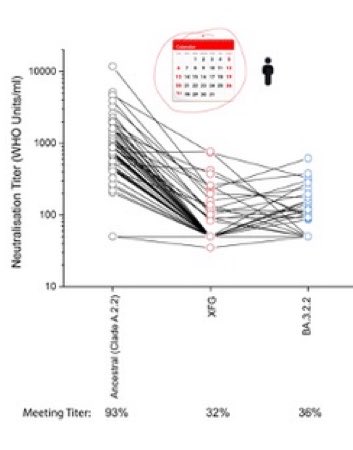
@LongDesertTrain@Nucleocapsoid@danwalker9999 BA.3.2 is an example where we often scratch our heads about how and why it is competitive. In a perfect world we would be tuning skills in the lab to generate better and better assays and datasets to know why. Alas politics of the day often doesn’t support this fundamental work
@LongDesertTrain@Nucleocapsoid@danwalker9999 Jurisdictions will influence data. So will time. In late 2025 we saw those with good responses to XFG had poor responses to BA.3.2. Poor responses to XFG then had good responses. That equation might be changing now as BA.3.2 is starting to dominate…but it took a while here.
@Nucleocapsoid@SolidEvidence Changes at 685 do. What is the FCS sequence now? Do you see the FCS spit out or changed like people see in Veros for cryptics? Entry into enterocytes you’d expect to retain TMPRSS2 use. Could be another cellular reservoir we haven’t mapped.
@ZdenekVrozina@Jjjjjjjjjjg@Nucleocapsoid Chp has high levels of Collectrin and that would consume the solute carriers that ACE2 would potentially chaperone. In that setting… lack of ACE2-solute complexes, Omicrons would be heavily attenuated….. that’s a prediction though that would need to be confirmed in vivo.
I haven't posted in a while as we've been scratching our heads for the last year trying to understand a virus that spreads amongst. For us it was to understand how a virus that caused our most recent pandemic changed. It was also crucial to resolve for continued surveillance.
New article by @kakape on GISAID, data sharing, & apps being cut off.
It's not about COVID - it's about *all* viral data, it's about data sharing being step 1 for preparedness, response, & treatment/vaccines.
So we should ensure our DBs live up that.
https://t.co/tafmF7jlZh
@CovidSafeNZ@Tuliodna Others have looked at this specifically with KP.2 based formulations. Eg. https://t.co/GA9xWTeRKf
Any booster will help with increasing breadth across all variants. Some a little better when matched well.
@Tuliodna 15. As for other tissue and transmissibility, it may need a few more changes to establish better ACE2 binding and then TMPRSS2 to get to levels like we saw with JN.1. But this lineage and many others are still with us and worth monitoring for key phenotypic changes in the future
@Tuliodna 14. The complications of lower respiratory infections observed with earlier pre-omicron variants may indeed not transpire as the requirements for replication are not favourable in that tissue. i.e. RAS-ACE2 attenuates BA.3.2.2 and other Omicrons as it reduces TMPRSS2 use.