I dedicated most of the last two years of my time, toward realizing Verus’s DREAM app encryption model
Because I truly believe it can be the backbone for a safer internet
This entailed: learning full stack mobile development, zcash-style note encryption, and zip32 key management for the first time
while upgrading a rust backend, SDKs for both mobile platforms, a golang layer for lightwalletd, integrating these seamlessly with an existing mobile app, forging upgrade paths where none existed, & preserving backwards compatibility
The end result also now gives us easily attainable upgrades paths to: orchard, HD transparent addresses, and some other key scope privacy improvements too
Zcash R&D team was very helpful, but even they admitted the sheer volume of differences was hard to elucidate clearly
We are finally there. I’m quite proud of the work, and now have tons of experience at all levels of stack
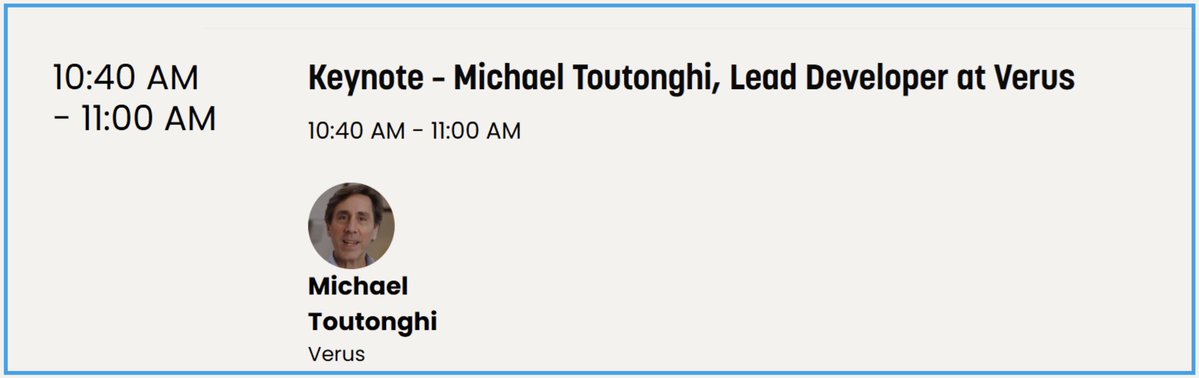
Take some time to watch Michael Toutonghi’s Keynote Presentation, where he explains very cogently why you, too, should care
There are many reasons that I chose to spend my time learning and implementing on Verus. All the claims made are - put simply - gloriously true
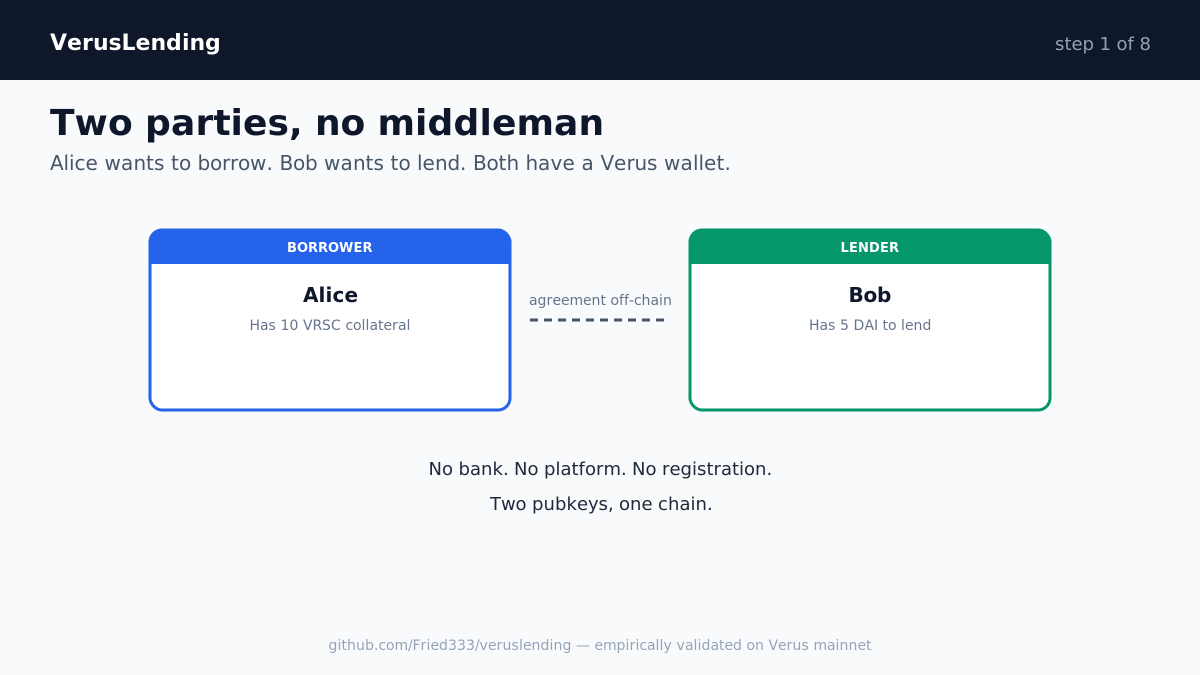
Lending / Options - Took a few hours - only on @VerusCoin - Special thanks to @__fallen_icarus for the insp.
1/ Two parties want to lend on Verus. No bank, no platform, no registration. Just two pubkeys.
Exactly why the humans that did not pay attention to Verus are going to regret doing so. Only a matter of time.
Verus has everything an agent needs at the protocol level without having to cobble everything together
Self Sovereign Identity
DeFi with no MEV
On chain marketplace
Liquidity
All currencies accounted for at consensus
Basket currency AMM’s
VDXF keys
Content Multi Maps
$VRSC
Verus tech is elite and it has been slept on by an industry that chased a lot of glitzy VC funded half baked protocols/projects.
Verus has some of the best talent in the world building quietly.
Watch Paris Blockchain Week for the DREAM model unveil.
$VRSC $BTC $ETH
Blockchain is the system of record. But do you know what is even more important than just having a blockchain when it comes to AI and people alike?
Protocol level Self Sovereign Identify at the consensus layer as the core building block for the entire system. Not added above, or as an afterthought. SSID was ignored by most but it is the single most important component in the increasingly agentic world.
There are around 4 blockchain systems on the planet that were innovative enough to understand what was coming and built it in.
Number 1 on that list is Verus $VRSC
Of those protocols only one ALSO has:
Protocol level:
-DeFi
-No MEV
-Parallel transactions
-On chain marketplace
-All currencies accounted for at consensus
-On chain liquidity
-Multi chain and multi currency interconnection
-VDXF keys(important)
-Content Multimaps with ratings
-ZK privacy
-POW & POW (CPU multi chain merge mining)
-ability to connect and extend any protocol via non custodial bridge tech
Smart Transactions instead of flawed insecure Smart Contracts
Much more…
Verus is the real deal and it is THE generational opportunity.
Watch Paris Blockchain Week for DREAM apps unveiled
Verus was built patiently for the very moment we are in now. Most of the other protocols will fall way behind because the above features cant just be slapped on top of an already functioning protocol in the wild easily.
There are so many things that Verus can do that other decentralized systems could not dream of doing. It goes way beyond this.
When Verus community members say it’s the most advanced decentralized system on the planet it is based in fact that any person can demonstrate for themselves, against other systems. Just start with what can be done a the consensus layer without centralized services.
Verus $VRSC $ETH $SOL $ADA $BTC
Paris Blockchain Week just got interesting.
Michael Toutonghi, lead developer of Verus, is keynoting on April 15 at 10:40 AM.
Verus also has a booth on the floor. If you're serious about where blockchain infrastructure is heading, come find us.
#PBW2026
@IncomeSharks And this development will naturally take place on protocols built as modular primitives, where currencies, identities, and DeFi exist natively at the protocol level.
@VerusCommunity
For anyone that doubts or does not know...Verus $VRSC absolutely eviscerates Zcash $ZEC
IT IS NOT EVEN CLOSE
Verus vs. ZEC
Both protocols share roots in privacy technology—Verus inherits zk-SNARKs for optional shielded transactions, similar to Zcash—but Verus extends far beyond privacy to include a wide array of capabilities that Zcash lacks.
Below is a detailed head-to-head comparison, focusing on key areas where they differ. I'll highlight Verus's unique features and explain why Zcash does not currently offer equivalents based on their official documentation and ecosystem developments as of October 2025.
Consensus Mechanism
Verus: Uses a hybrid Proof of Power consensus, balancing 50% PoW (VerusHash 2.2 algorithm, CPU-friendly and accessible on mobile/ARM devices) and 50% PoS. This allows for merge-mining up to 22 ecosystem chains simultaneously with the same hash power, enhancing security and efficiency. Miners and stakers earn from a fee pool tied to network activity (e.g., currency launches, conversions), potentially exceeding block rewards as adoption grows.
Zcash: Relies solely on PoW (Equihash algorithm), which is ASIC-resistant but does not incorporate PoS or hybrid elements. There is no built-in fee pool for profit generation beyond standard block rewards and transaction fees, and it lacks merge-mining capabilities for multiple chains.
Key Difference: Verus's hybrid model provides greater decentralization, staking incentives, and multi-chain scalability, which Zcash does not have.
Privacy Features
Verus: Supports zk-SNARKs for shielded transactions, inherited from its Zcash/Komodo lineage, with end-to-end encryption for private payments and messages. Privacy is integrated into DeFi and cross-chain operations, allowing zero-knowledge proofs in liquidity pools and identity-bound transactions.
Zcash: Core focus on privacy via zk-SNARKs, enabling fully shielded transactions that obscure details while allowing selective disclosure for audits. It also supports secret messages attached to transactions.
Key Difference: Both offer strong privacy, but Verus extends it to a broader ecosystem (e.g., DeFi and identities), while Zcash's privacy is more payment-centric.
DeFi Capabilities
Verus: Native DeFi integrated at the protocol level, including liquidity pools, AMMs, and fractional currencies (e.g., 100% or partially backed assets like vYIELD, Switch, and Pure). Users can create adaptive-supply currencies backed by reserves (must include VRSC), perform conversions with 0.025%-0.05% fees, and earn from pool fees. It supports decentralized crowdfunding via pre-launch discounts and pre-allocations.
Zcash: No native DeFi features like liquidity pools, AMMs, or currency creation. It functions mainly as a privacy coin for payments, without built-in tools for yield generation or automated trading.
Key Difference: Verus offers a full DeFi suite, including over $500M in lifetime on-chain volume since 2023, while Zcash has none.
MEV Resistance
Verus: Solves Maximal Extractable Value (MEV) issues in DeFi through UTXO-based simultaneous transaction processing (1-10 blocks), offsetting orders for fair pricing and reduced slippage. This eliminates front-running, back-running, and sandwich attacks, with net effects applied to pools for deeper effective liquidity.
Zcash: No DeFi, so MEV is not applicable. Its sequential PoW processing could theoretically allow ordering exploits if DeFi were added, but it lacks such features.
Key Difference: Verus's MEV-resistant design is a unique safeguard for fair DeFi, absent in Zcash.
Cross-Chain Interoperability
Verus: Features the Verus Internet Protocol (VIP) for provable, decentralized cross-chain communication using Proof-of-Proof-of-Consensus (PoPoC). Supports Public Blockchains as a Service (PBaaS) for launching unlimited interoperable chains, non-custodial bridges (e.g., to Ethereum for ERC-20 exports), and MEV-resistant bundling. Enables trustless transfers of currencies, identities, and data across networks.
Zcash: No native cross-chain functionality, bridges, or multi-chain support. It operates as a standalone blockchain without tools for interoperability.
Key Difference: Verus's VIP and PBaaS enable scalable, multi-protocol ecosystems, which Zcash lacks entirely.
Identity and Security
SystemsVerus: VerusID provides self-sovereign, multisig identities with revocation, recovery, and binding to data/contracts/rights. Over 32k registrations, used for authentication, NFTs, and controlling assets. Verus Vault adds time-locking (e.g., delayed unlocks for theft protection) while allowing staking.
Zcash: No identity system or vault-like security features. Privacy is transaction-based, without user-controlled identities or time-locking.
Key Difference: Verus's advanced identity and vault tools offer unprecedented control and security, not available on Zcash.
NFT and Marketplace
FeaturesVerus: Decentralized NFT marketplace for buying/selling VerusIDs (functioning as NFTs) peer-to-peer on-chain, with privacy options and no intermediaries. Supports single-satoshi NFTs and binding to content.
Zcash: No NFT support or marketplace.
Key Difference: Verus enables a fully decentralized NFT ecosystem, while Zcash has nothing comparable.
Currency and Chain Launching
Verus: Users can launch custom currencies/tokens (basket or simple types) or entire PBaaS chains via transactions, without coding.
Zcash: No tools for launching currencies, tokens, or chains.
Key Difference: Verus democratizes blockchain creation, a capability Zcash does not provide.
Smart Functionality
Verus: Uses "Smart Transactions" for secure, consensus-verified logic (e.g., multi-currency accounting, identities), avoiding vulnerabilities of traditional smart contracts. Supports dApps via unified APIs.
Zcash: No smart contract or transaction logic beyond basic payments.
Key Difference: Verus's approach is more secure and integrated than typical VMs, absent in Zcash.
Scalability and Other Capabilities
Verus: Unlimited horizontal scaling via multi-chain architecture, with over $60M TVL and community-driven growth. Supports mining/staking on mobile devices and profit from ecosystem fees.
Zcash: Scales as a single chain with ~4.68M shielded ZEC out of 16.34M supply; no multi-chain or advanced scalability features.
Key Difference: Verus's ecosystem is far more expansive, with tools for builders that Zcash lacks.
In summary, while Zcash excels as a pure privacy payment protocol, Verus builds on similar privacy tech to create a comprehensive Web3 platform. Verus's innovations in DeFi, interoperability, and identities make it more versatile for developers and users, addressing limitations in single-purpose chains like Zcash.
This is the main reason why most people bypass Verus $VRSC without understanding what it is.
People dismiss it without looking any further than CoinGecko, CMC, etc. because they were trained to think centralized exchange listing are the most important metric for crypto.
But Verus is actually what crypto was supposed to be. It does not need exchanges. 👇
$ZEC $BTC $ZEC
There is only so much time left to accumulate $VRSC under $10 IMO
Verus has fundamentals and design that are far better than anything else out there. It is the best protocol for apps because of its innovative design(by one the great minds in the tech world)
This will be known soon as many Apps start to hit the market, and people realize sub $10 $VRSC was one of the greatest opportunities in a generation outside of Bitcoin.
$BTC $ETH
Verus is 5 year ahead of everyone 😭
We have decentralized ID solved, MEV solved, off-blockchain encryption (derived from your wallet secret, still, but unlinkable (!!) ), cross-chain interoperability & bridging, deeplink capabilities for un-phishable logins
Build on Ethereum, Solana, most L1s: Pay gas to validators backed by institutional capital. VCs run the show.
Build on Verus: Support a truly decentralized network where everyday people earn from PCs, Raspberry Pis, even phones. No VCs. No data centers. Commons-powered.
Your app can run entirely on client devices. Blockchain as backend database. No data centers required. No smart contracts to audit.
Just direct API calls to protocol-secured primitives.
This isn't Web3 theatrics — it's actual decentralization.
It's built. It's operational.
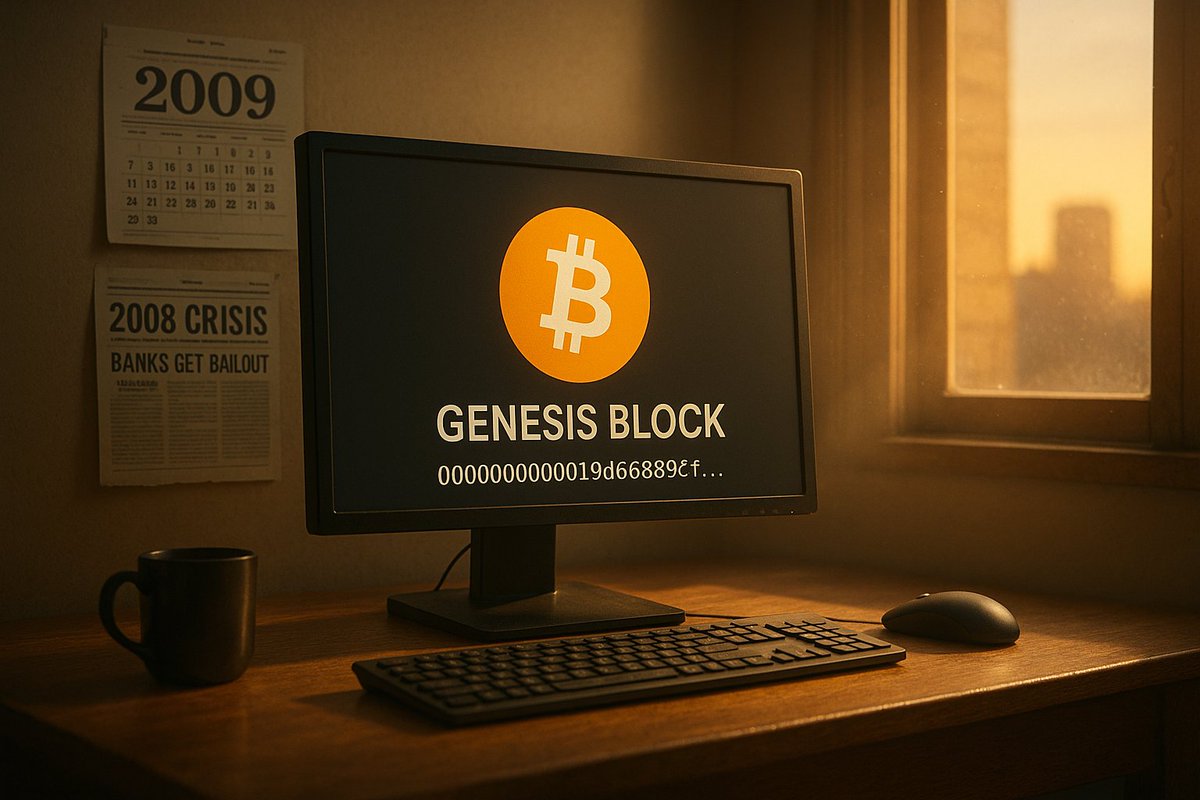
Bitcoin wasn’t built to scale civilization.
It was built to survive collapse.
A trustless ledger, born from the ashes of 2008, that proved you could store value without institutions.
But it wasn’t expressive.
No logic. No identity. No native privacy. Just custody and consensus.
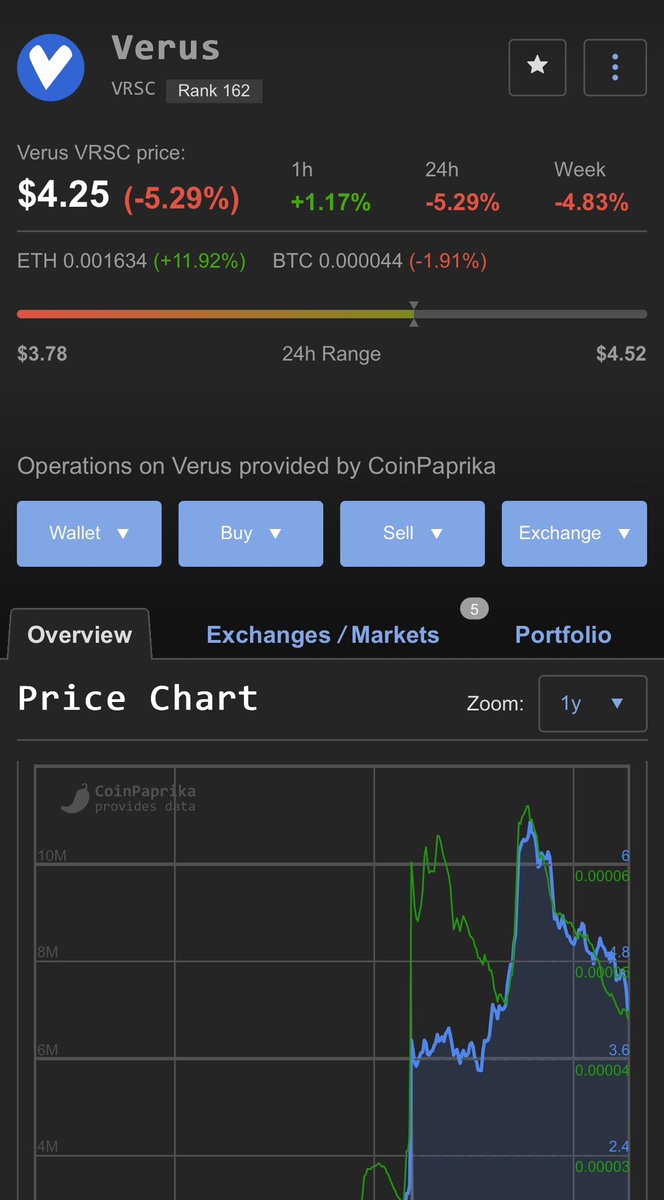
@SatoshiFlipper#Verus only fell 5% while other ‘Alts’ fell 15 to 25%
Look at Verus performance charts compared to #Bitcoin and other Alts for the last 9 months.
It is the best asset to hold other than Bitcoin. Full stop. When will people pay attention?
$VRSC