America 250 Concert revised performers roster:
• Lady Maga
• Red Hat Chili Peppers
• Magadeth
• Impeaches & Herb
• the Magas and the Papas
• Earth Wind & You’re Fired
• Supertrump
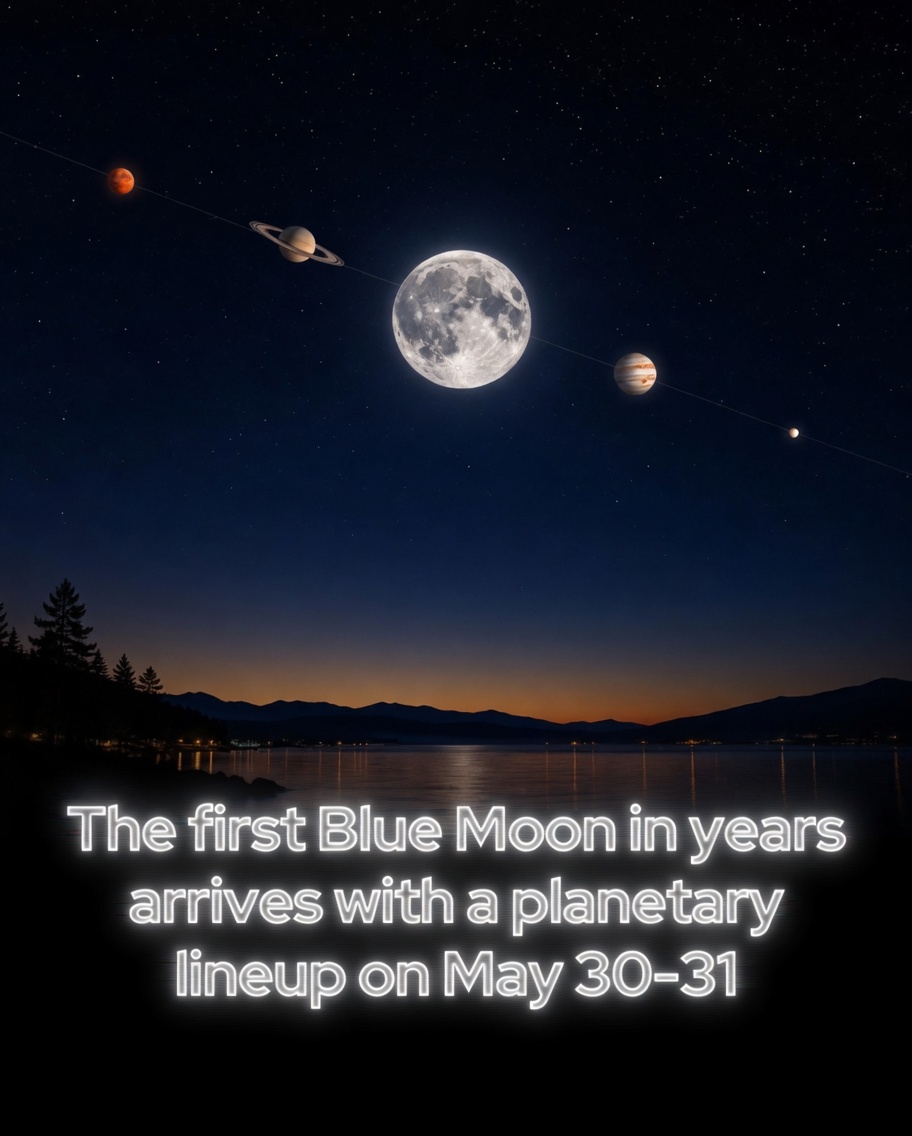
May is closing with one of the most captivating celestial events visible to the naked eye. On the night of May 30–31, the second full moon of the month will rise, creating what is known as a Blue Moon.
This will be the first Blue Moon since August 2023, with the next not occurring until December 2028. But this year’s event is especially memorable because it coincides with a beautiful alignment of planets.
As the Blue Moon shines, all four of the brightest planets visible from Earth, Venus, Jupiter, Mars, and Saturn, will also be on display. Before sunrise on May 31, Mars and Saturn will glow low in the eastern sky. After sunset, Venus and Jupiter will shine brightly in the western sky, with the full moon dominating the night.
Despite the name, a Blue Moon is not actually blue in color. The term simply describes the second full moon within a single calendar month. Because the lunar cycle is approximately 29.5 days, two full moons rarely fit inside the same month. On average, a Blue Moon occurs only once every 2.5 years.
The planetary “lineup” is an impressive sight created by perspective. While the planets are separated by hundreds of millions of miles in space, from our viewpoint on Earth they appear to line up across the sky alongside the brilliant Blue Moon.
A perfect opportunity to look up this weekend and enjoy one of nature’s rarest sky shows.
🚨BREAKING:
Tesla has been authorized by the State of Texas to operate driverless vehicles commercially under the new law that took effect today, May 28th, 2026. Tesla has officially self-certified the software running on its robotaxis as Level 4. $TSLA