Markets have a funny habit of repeating themselves.
If the cycle rhymes again, Bitcoin probably doesn’t need to go far beyond ~$135K before anticipation convinces everyone to hold “just a little longer.”
That’s usually when smart money quietly starts doing the opposite. 📌
Cycles don’t punish the uninformed —
they punish the greedy.
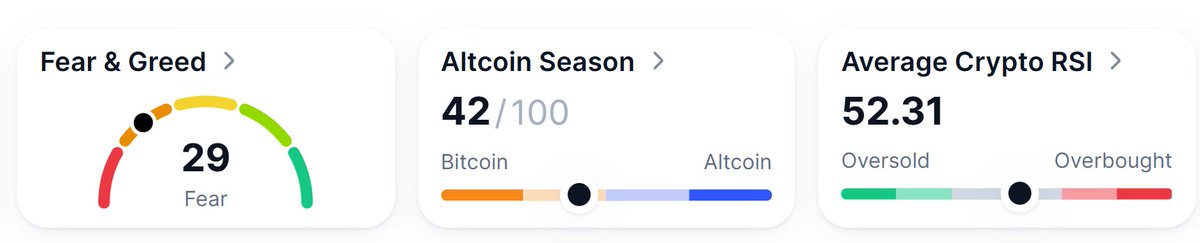
A small move in Bitcoin and the fear & greed index swings dramatically.
Meanwhile most alts barely move… or drift lower.
Usually that’s a sign the market is entering BTC’s “snail phase” — where Bitcoin goes sideways and attention slowly rotates elsewhere.
That’s typically when altcoins start trying to remind everyone they exist.
The best investors don't write founders off after one bad idea.
I know someone who pitched a terrible idea in 2011. Truly awful. The kind of pitch that makes you wonder if they understand their own market.
More >>
Delphi Ventures is extremely excited to lead the seed round for @tori_finance
Most crypto yield is reflexive and collapses when markets cool. Tori fixes this by packaging institutional delta-neutral strategies into a composable, yield-bearing token: strUSD
The yield comes from real trading revenue across global markets, not emissions, not incentive programs, not single-strategy dependency. Completely uncorrelated to crypto market direction
These are time tested strategies that have generated consistent returns for decades, but were locked behind accreditation and seven figure minimums. Tori makes them accessible to anyone with a wallet.
The real unlock is what DeFi adds. strUSD is a low-volatility, exogenous asset you can use as collateral, borrow stables against, and loop for recursive leverage without high liquidation risk. That's not possible with a traditional fund share.
If spreads compress in one region, capital rotates globally. Cryptographic proof of reserves verifies every position in real time. No black boxes
Follow @tori_finance and @0xNox_eth.
This is something a lot of founders underestimate.
You can have a solid product, but without a clear ICP and a repeatable go-to-market, it’s just noise in the market.
The shift usually isn’t about doing more — it’s about doing less, but with precision. Once that clicks, things start to compound quickly.
A founder I backed 2 years ago is now doing $30M in revenue and raising a Series B.
6 months in, he almost didn’t make it.
Not because the product was bad.
Because his go to market was broken.
He was selling to everyone. No clear ICP. No focused channel. No repeatable motion.
We spent 6 months fixing it together.
Narrowed the target. Picked one channel. Built a repeatable process.
Revenue started compounding.
Bad go to market kills more companies than bad products, bad hires, and bad timing combined.
Fix it before you run out of runway.
@404flipped still has real user adoption — active users, volume, and constant on-chain activity.
As long as people are using it just like bitcoin, it has every reason it exists😹.
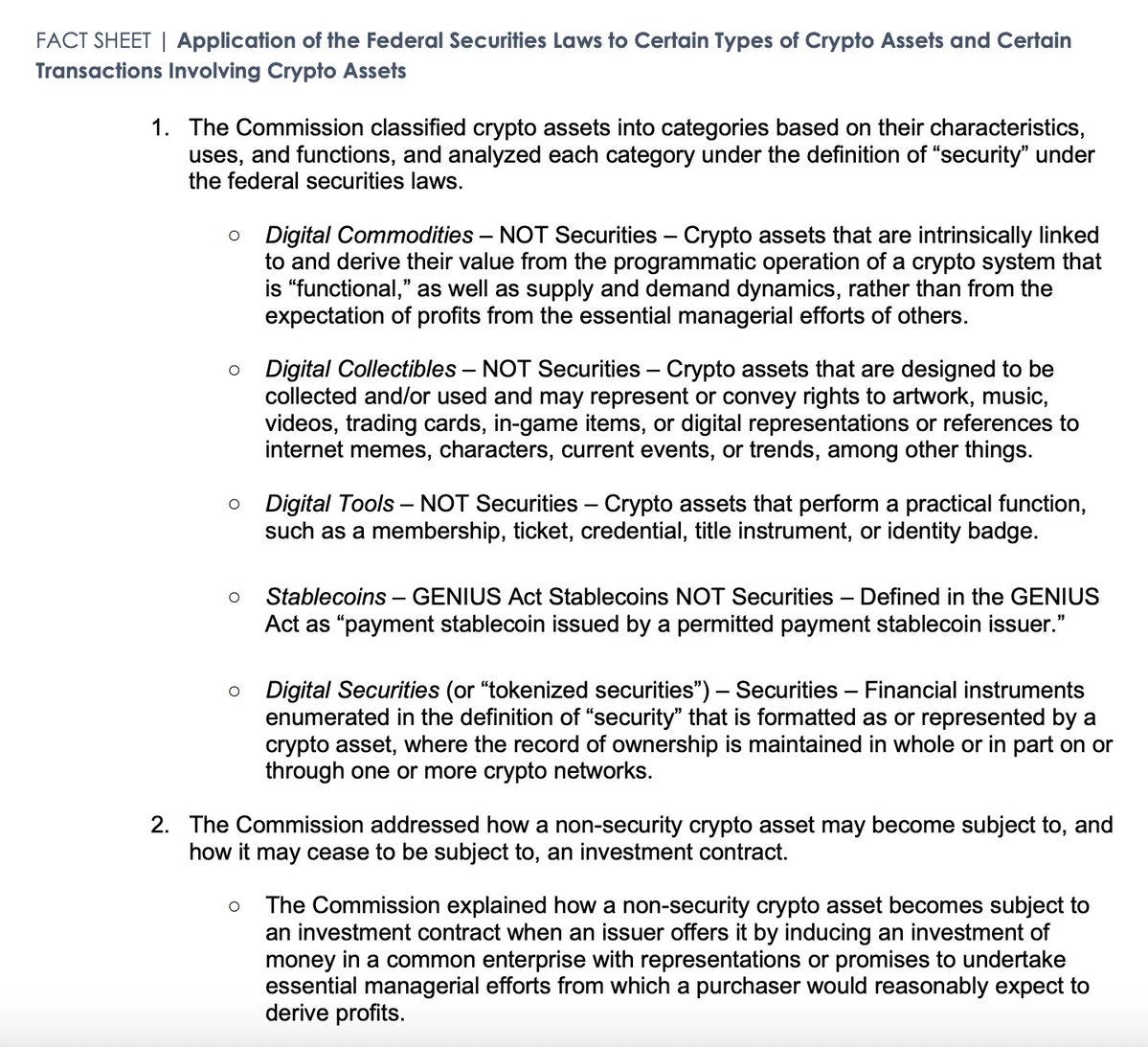
🚨 SEC & CFTC DEFINE DIGITAL ASSET TAXONOMY
U.S. regulators have introduced a new framework classifying digital assets into five categories:
• Digital commodities
• Stablecoins
• Tokenized securities
• NFTs
• Digital tools
The market never runs out of opportunities — people just run out of capital and patience.
Many over buy into a few altcoins because of fomo, expect big returns, then sit and wait instead of making more liquid. When it doesn’t play out, they get frustrated, start blaming the market, and miss the next opportunity simply because they’re already all-in.
The real edge in crypto is simple:
stay liquid, stay patient, and be ready to make moves when new opportunities appear
Calling everything a “VC scam” ignores how the industry actually gets built.
Several of those ecosystems are still actively developing:
Avalanche continues expanding subnets and institutional experiments.
Cosmos remains one of the most widely used interoperability frameworks.
Injective has built strong on-chain derivatives infrastructure.
Sui is pushing development around Move-based applications.
TON benefits from massive distribution through Telegram.
Also worth remembering: early capital funds the experimentation phase of new technology. Without it, most of these networks wouldn’t exist in the first place.
And like in any market, early participants are allowed to take profits when their vesting and agreements allow it. That’s not a scam — that’s how risk capital works.
A bitter truth many memecoin traders eventually learn:
If your favorite crypto influencer is primarily a memecoin degen, the odds of building meaningful long-term wealth in crypto are extremely low.
Speculation may generate noise and short bursts of excitement, but durable outcomes in this industry usually come from discipline, patience, and understanding real fundamentals.
Made around:
$80k in NFTs by 2022
$105k in memecoins by 2024
NFTs were always a great idea — just applied in the wrong places.
They make far more sense in gaming economies, digital identity, and platforms like Telegram collectibles than overpriced JPEGs driven by hype.
Last cycle priced them like finished assets.
Reality: they were just early infrastructure.
I always saw most of it as narrative-driven hype, which is why positioning as a creator/early participant made more sense than chasing the secondary market.
Same pattern with memecoins — narrative first, fundamentals later.
That’s usually what happens when capital is used to chase hype instead of fundamentals.
In every cycle, narratives drive prices far beyond sustainable demand.
Once the excitement fades, the market simply reprices reality.