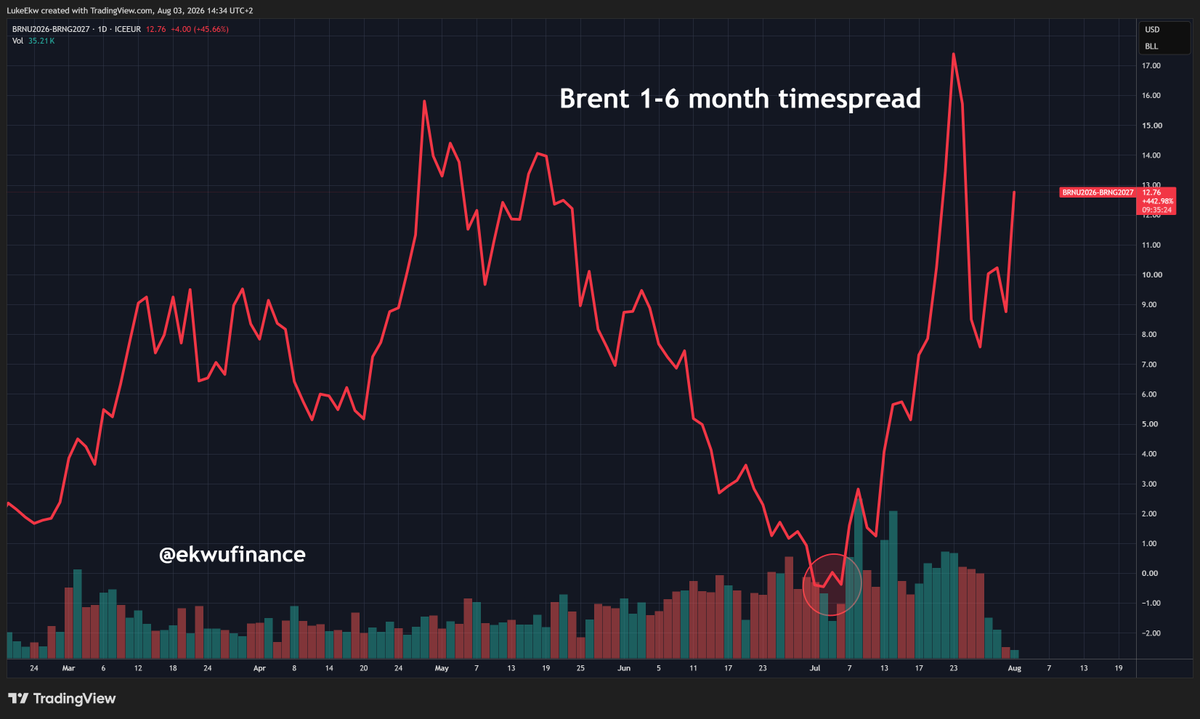
Oil prices might be down 9%... but Brent for prompt delivery is up 20%.
The market is paying a ~$13 premium for oil right now rather than 6 months from now.
In other words, they are flooding the market with paper barrels while physical barrels remain in short supply.
💥Translation -
The first family will make the maximum money in the upcoming financial crisis and reset. They are not yet satisfied with what they are making in the stocks every weekend with Trump tweets since January 2025.
India Macro dashboard
The big picture
India’s domestic economy remains resilient, supported by policy measures, liquidity, and ongoing investment. However, some of the current stability reflects pressure being managed rather than resolved. The next two quarters will be critical in determining whether growth remains durable or these underlying stresses begin to surface
First order reads
Manufacturing activity is slowing. PMI has fallen to 53.9, a four-year low. The impact of the West Asia conflict is now visible through weaker new orders and export uncertainty. Services activity has also moderated, with PMI at a 14-month low of 57.5.
Consumption remains steady. GST collections grew 8.8% year-on-year to a record high. This indicates resilient domestic demand and continued formalisation of the economy..
System liquidity has risen sharply to over Rs 5.5 lakh crore. RBI is maintaining easy financial conditions, which could support credit growth and potentially open the door for rate cuts.
Employment trends are improving. FY26 closed with 8 % growth in jobs, with non-IT sectors contributing meaningfully to hiring momentum.
Second order reads
Rail freight and PMI are diverging. Freight remains strong as it reflects past orders and ongoing movement of goods, while PMI captures future demand. If PMI remains weak, freight momentum may moderate over the coming quarters.
Inflation appears contained, but cost pressures are building. CPI stands at 3.4%, while WPI is higher at 3.88%. This suggests input costs are rising faster than consumer prices. Companies may be absorbing these pressures, which could impact margins and reflect in earnings, particularly in sectors such as FMCG, logistics and manufacturing.
If you’re wondering why Indian markets are not re-rating, look at nominal GDP growth.
It averaged close to 12% in 2013-2023. Now it is more like 8-9%. That is a very different earnings environment.
Nominal GDP can improve in two ways:
Better government spending, especially a shift toward capex.
Currency depreciation, which lifts rupee GDP mechanically.
But the second is not the same as genuine domestic strength. Markets can support a higher multiple only when growth is healthy, broad-based, and policy-backed.
I think India can get back to 10%.
12%? Much tougher unless capex spending becomes a much bigger part of the mix.
(chart courtesy Nuvama)
Last week, Luke Gromen appeared on Grant Williams’ podcast, and the insights were quite compelling. Key takeaways are summarized below:
Key Points
1. A US-Iran ceasefire was announced, with both sides claiming total victory. Gromen's base case is that it will not hold, but he acknowledges it cannot be ruled out as the beginning of a permanent structural shift.
2. Market reaction on the day exactly matched what Gromen expected from a US Suez moment: gold up, yields down, dollar down, risk assets up, oil down.
3. The US had significantly more to lose from the conflict continuing than Iran did, both economically and in terms of global perception of military dominance.
4. Ground level intelligence suggested the war was going far worse for the US than media reported. The CIA evacuated the Middle East entirely, the US Embassy in Riyadh was hit accurately, and 1,500 military personnel plus families were rushed out of Bahrain with nowhere to house them.
5. The US lost more fixed-wing aircraft in five weeks over Iran than in eleven years in Iraq, raising serious questions about the value of expensive platforms like the F-35 against peer adversaries.
6. The Mahan Doctrine, the centuries-old principle that controlling naval choke points means controlling the world, has been fundamentally broken. Cheap missiles, drones, and satellites now allow land powers and poorer countries to deny access to naval choke points previously controlled by expensive carrier battle groups.
7. US carriers retreated 750 to 1,000 kilometers deeper into the Indian Ocean when missiles started flying, making bombing sorties less efficient. This signals that carriers have been effectively devalued in near-peer conflict.
8. China appears to have played a quiet but decisive role in brokering the ceasefire, having reached out to both Vance and Iran behind the scenes while also reportedly cutting off rare earth magnet exports to the US during the conflict.
9. Chinese ships were the only vessels moving freely through the Gulf throughout the conflict, with the US Navy taking no action against them. This points either to a tacit US acceptance of a parallel yuan-gold oil settlement system, or to China having enough leverage that the US simply did not dare interfere.
10. A parallel yuan-gold oil settlement system appears to be operationally functioning already, built quietly over 14 years since Iran was cut off from SWIFT in 2012. The idea that this would take another decade to set up no longer holds.
11. The three policy options for the US remain: let free markets work and crush the bond market while saving the currency, print and inject liquidity to save the bond market while crushing the currency, or accept a weaker dollar and parallel system as a strategic choice to enable reindustrialisation.
12. A potentially forced but useful outcome for the US is that the conflict discredits the neocons' doctrine of unlimited power projection, provides political cover for a major domestic defense spending increase of around $500 billion, and allows reindustrialization to be funded through defense channels since Congress cannot pass it otherwise.
13. The Middle East is now caught between a devalued US security umbrella and China as its dominant commercial partner. This elevates the commercial relationship over the security relationship, which structurally favors China and multicurrency energy pricing.
14. Data centers in the Middle East became a critical pressure point late in the conflict. Iran threatened to destroy them, and their destruction would hand China a decisive and possibly permanent lead in AI. This may have been a genuine accelerant toward the ceasefire.
15. The "whoosh down" scenario in markets was driven by the prospect of sustained Hormuz closure. Taking 7 to 10 percent of global oil supply offline would have broken sovereign debt markets rapidly. With the ceasefire, this risk recedes in the short term, but the bond market remains fragile and the situation volatile.
16. Gromen believes confidence is the key variable Bessent has been managing throughout, and that once confidence in oil supply stability and bond market stability breaks, it cannot easily be restored. The ceasefire buys time but does not resolve the underlying structural problems.
🚨 ₹44 Crore Skywalk to Nowhere
Noida built a skywalk linking Metro 51 & 52. It runs straight into a pillar. Can’t be used.
₹44 crore spent. To be dismantled by 2029.
Public money burned.
India doesn’t lack funds. It lacks accountability and intent. 💥
They are turning bengal into Bangladesh into 10x speed.Still hindus are going to vote for mamta.
Then they cry that they are living in fear,don't even feel pity for them anymore.What do you think these people will be doing in the next 10 years?
BJP minister Piyush Goyal attended an event at Galgotias university last year and called it Center of excellence
Most importantly he was the one who inaugurated the AI lab 😭😭
This is peak clownery
Her 23-yr-old son Sahil killed by speeding Scorpio driven by a minor.
Minor taken before Delhi Juvenile Board, then given bail to take 10th Board Exam.
The Scorpio had 13 challans for overspeeding.
Sahil’s grieving mother @inna_makan joined me live:
This is WIPRO.
It is one of India's largest IT services companies.
Its market capitalization is ₹2.2 lakh crore
They also shamelessly presented Chinese Unitree Go2 robot as their innovation at AI summit in Delhi.😭😭