Indian cyber, telecom, banking & finance firms get access to Mythos; IT left out
By @Subhayan_ET & @SurabhiA_ET
Read more at:
https://t.co/nF9Bux7QJU
भोपाल में बरकतुल्लाह विश्वविद्यालय का नाम वाग्देवी भोजपाल विश्वविद्यालय करने का प्रस्ताव कार्य परिषद की बैठक में पास हुआ है,बस जानकारी के लिये मौलाना बरकतुल्लाह भोपाली भारत की पहली निर्वासित सरकार के प्रधानमंत्री थे 8 भाषाओं के जानकार निर्भीक पत्रकार, प्रभावशाली वक्ता, और प्रखर राष्ट्रवादी
RBI issued this clarification to refute Bloomberg's hypothesis that it may have sold some gold.
The clarification breaks down and raises more questions than it answers.
1/5🧵
लालच बुरी बला है , आज साबित हो गया
उड़ीसा के एक माइनिंग अधिकारी को 30000 की रिश्वत लेना भारी पड़ गया , 30000 की रिश्वत के चक्कर में उसका 4 करोड़ की रिश्वत का भांडाफोड हो गया ।
दरअसल जांच सिर्फ 30000 की रिश्वत की थी , एंटी करप्शन वालों ने खोला तो अधिकारी बड़ी मछली निकला
India captured the global smartphone market share.
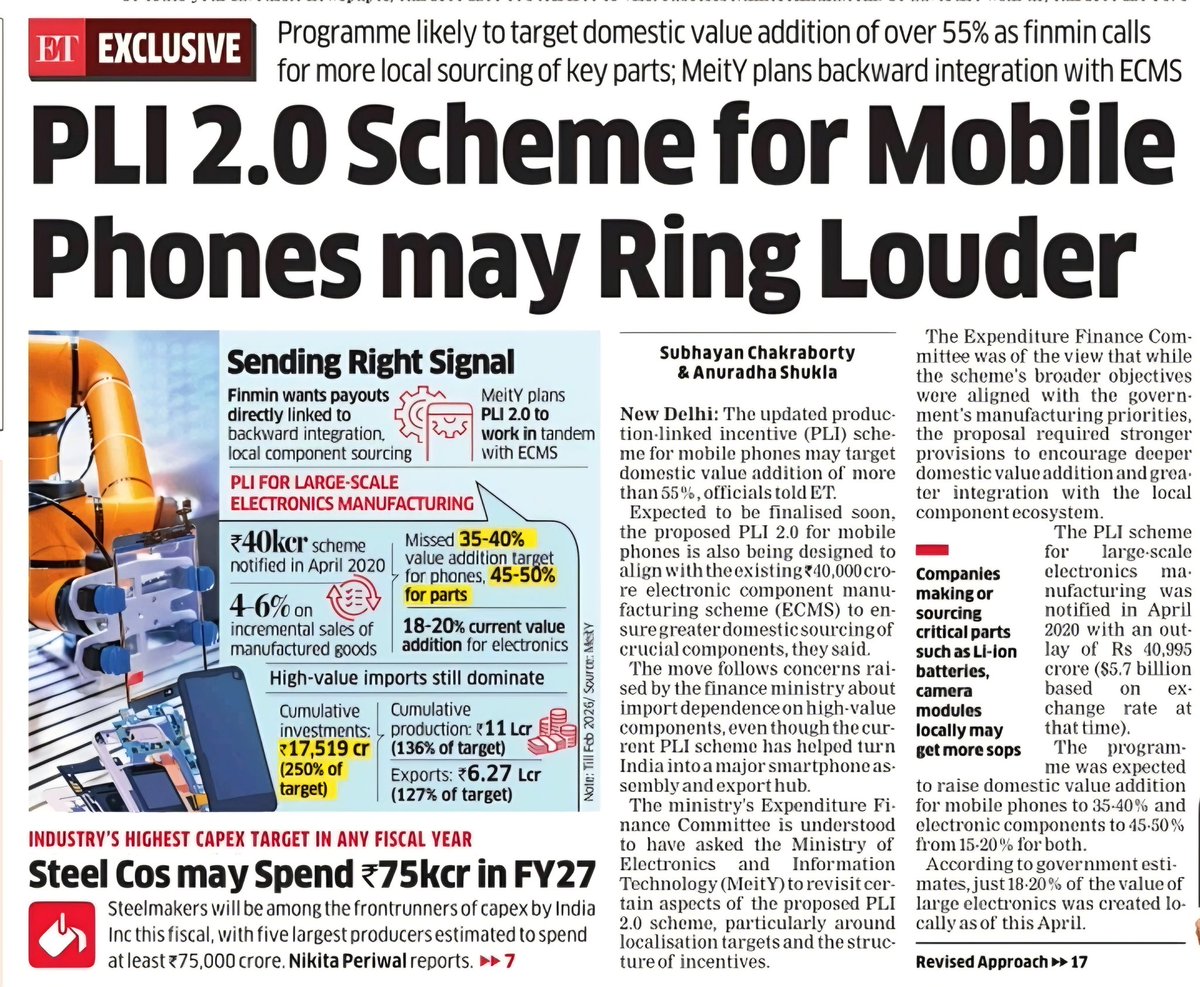
Now, PLI 2.0 is about winning the supply chain. Time to push local value addition past 55%. 📲
With PLI 1.0 wrapping up, the Finance Ministry and MeitY are tightening the screws for the next phase. The Expenditure Finance Committee is demanding stricter localization thresholds.
The Core Blueprint:
📍 PLI 2.0 will aggressively subsidize companies localizing high-value components (display assemblies, camera modules, batteries). It aligns perfectly with the 75 component manufacturing facilities currently being built under the ₹40,000 Cr ECMS umbrella.
📍 The Numbers: India is aiming to leapfrog from 18-20% local value addition to over 55%. This sits on top of a massive foundation: the previous scheme generated ₹11.01 Lakh Cr in total production, exceeding it's initial benchmark at 136%.
📍 While ratings firms like ICRA note that a 55% target is highly ambitious for a still-developing ecosystem, this is a necessary structural play.
By linking cash payouts strictly to domestic sourcing rather than raw sales volumes, India is building a sticky, self-sustaining silicon and electronics ecosystem that cannot be easily displaced by regional competitors.
#MakeInIndia
By @Subhayan_ET@anu1122
A new peer-reviewed article estimates that a single day of extreme heat causes 3,400 excess deaths across India. Extreme heat events are especially bad for UP, Bihar, and Madhya Pradesh, since these states have underlying socioeconomic vulnerabilities. https://t.co/cBHeHe6Rsd
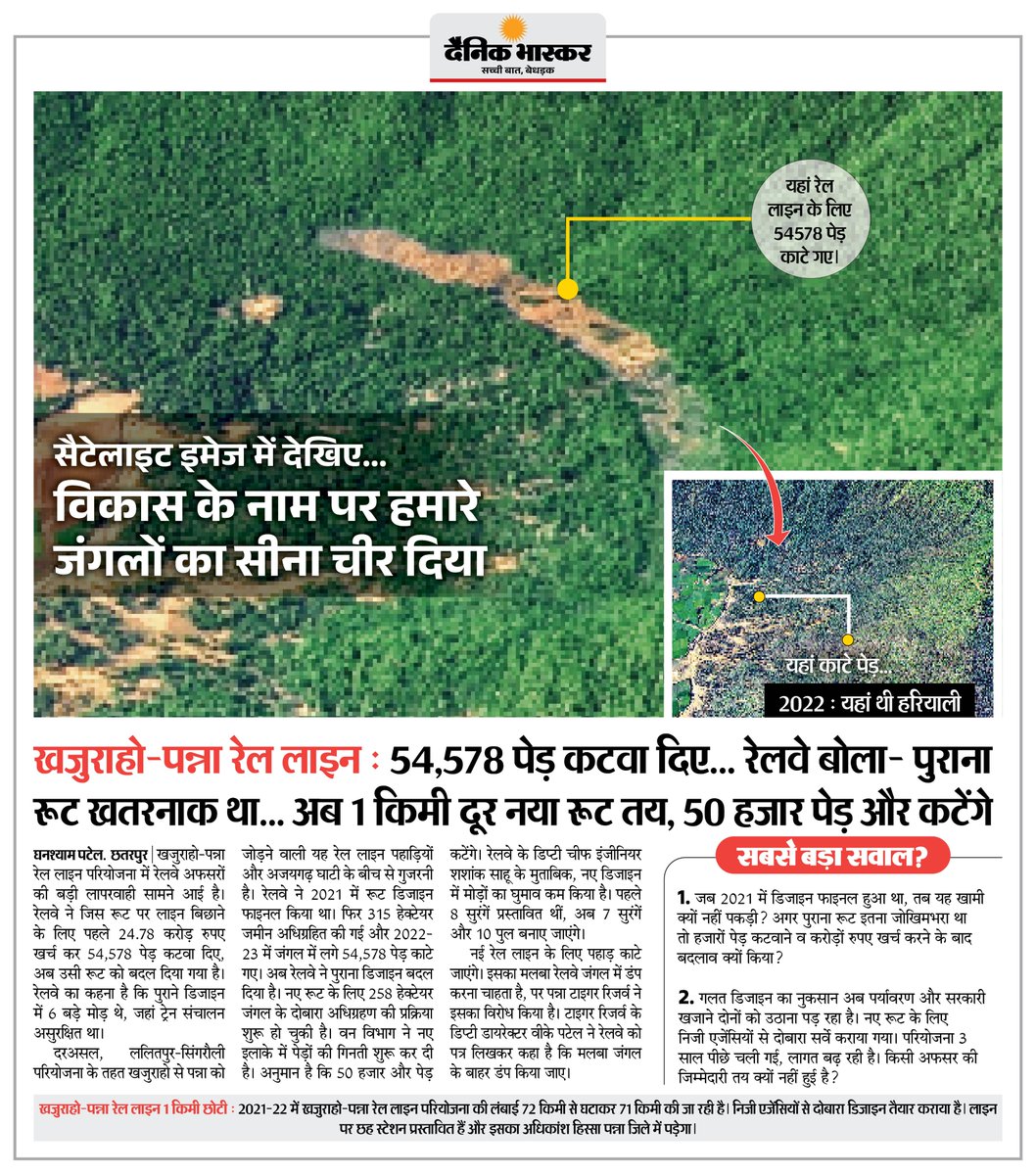
खजुराहो-पन्ना रेलवे लाइन के लिए पहले 54,578 पेड़ काटे, अब उस डिजाइन को गलत बताकर नया रूट तय किया, 50 हजार पेड़ और कटेंगे
#Deforestation#Panna#Khajuraho#Environment#RailProject
अधिक खबरें और ई-पेपर पढ़ने के लिए दैनिक भास्कर एप इंस्टॉल करें - https://t.co/uXrhGpuirk
🚨 Delhi’s toxic air isn’t just choking people. It’s cutting pregnancies short.
Nearly 1 in 8 babies in Delhi are now born premature.
In just 5 years, the preterm birth rate has shot up by 21%.
Doctors are increasingly linking it to toxic air pollution. Behind the smog are babies in NICUs, mothers struggling through pregnancy, and a public health crisis hiding in plain sight.
@AkankhyaAk72623 and I report for @newslaundry -
https://t.co/Hbj97xUZe9
Policymakers are increasingly worried about the emergence of powerful AI models such as Anthropic’s Mythos and their potential impact on businesses’ ability to comply with India’s newly operationalised data protection law.
AI models like Mythos are now capable of discovering security flaws and system loopholes that decades of human expertise may have failed to detect. This exposes enterprise systems to rapid and real-time cyberattacks which would be impossible to governed by human-controlled systems.
This dramatically raises the risk of large-scale breaches involving personal and sensitive data, hence, exposing enterprises to hefty punitive consequences under the Digital Personal Data Protection Act, 2023.
MeitY is considering a technological solution to counter these new-age threats: it's called “Law-to-Code.” It is the practice of translating legal rules into machine-executable algorithms such as a Python code.
Countries like France and New Zealand have previously applied the solution to calculation-heavy administrative laws such as taxes, welfare and immigration eligibility. But it hasn't yet been applied to abstract, rights-based laws like data privacy, which also carries hefty punitive consequences.
With @Subhayan_ET in @EconomicTimes Times | ETtech
ET makes AI unmissable! Check it out in today's newspaper with a unique perspective on each page and the special Eye on AI edition every Tuesdays! Stay tuned! @EconomicTimes
1987. A room in New Delhi is thick with the smell of old files & cold tea. The United States has just delivered a stinging slap to the face of the Indian Republic. They have officially refused to sell India the 'Cray X-MP' Supercomputer, the most powerful machine on Earth, claiming that India would use it for nuclear weapons.
The American officials mockingly suggest that India does not even have the electricity to keep such a machine running. In the middle of this national humiliation, a young, soft-spoken engineer named Vijay Bhatkar is asked by then Prime Minister Rajiv Gandhi: "Can we build our own?" Bhatkar does not hesitate. He looks at the No of the West & says: "We will not just build it; we will build it faster than you can ship it."
The Americans did not just stop at refusing the sale; they actively lobbied other nations to ensure India remained digitally blind. They believed that w/o their Logic Gates, India would remain a 3rd world backwater.
Bhatkar realized he could not replicate the Single-Processor behemoth of the Cray. Instead, he turned to Parallel Processing. He decided to stitch together 1000s of low-cost, off-the-shelf microprocessors. It was like building a giant's brain out of the neurons of ants.
In 1991, while the West was still celebrating its monopoly, Bhatkar unveiled the PARAM 8000. It was not just a computer; it was a Gigaflop monster.
To prove the PARAM was real, Bhatkar ran a standard global benchmark test. The results were sent to an international conference in Zurich. The PARAM 8000 was ranked as the 2nd most powerful supercomputer in the world, behind only the American machines. But there was a twist: the PARAM cost a fraction of the Cray, performed better in tropical heat, & was built in just 3 years.
When the PARAM 8000 was 1st turned on, the team did not have a high-tech cooling system like the Americans. They used industrial-grade desert coolers & adjusted the airflow manually. It was the ultimate Jugaad that defeated the most sophisticated tech embargo in history.
A major US newspaper ran a story with the headline: "Denied supercomputer, Angry India does it!" The ghost of the Native Engineer had officially entered the silicon temple. Vijay Bhatkar’s history is the story of how India became the IT Capital of the world.
Bhatkar founded the Centre for Development of Advanced Computing (C-DAC). He did not just build a machine; he built an ecosystem. Every software engineer in India today stands on the shoulders of the man who proved we did not need the West's permission to compute. Bhatkar was the 1 who realized that if computers only spoke English, 90% of India would be left behind. He led the development of GIST (Graphics & Intelligence Based Script Technology), allowing computers to work in Indian languages. He gave the Machine a local tongue.
Today, Bhatkar is a Padma Bhushan awardee, but he lives a life of deep spirituality & simplicity. He vanished from the corporate headlines to become a philosopher of the digital age.
The West thought they could freeze India’s future by withholding a single machine. They forgot that the Indian mind does not need a 'Cray' to think; it only needs a 'No' to ignite. Forget building a supercomputer; Bhatkar built a mirror, & for the 1st time, the West had to look into it & see that the primitive colony had become the master of the code.
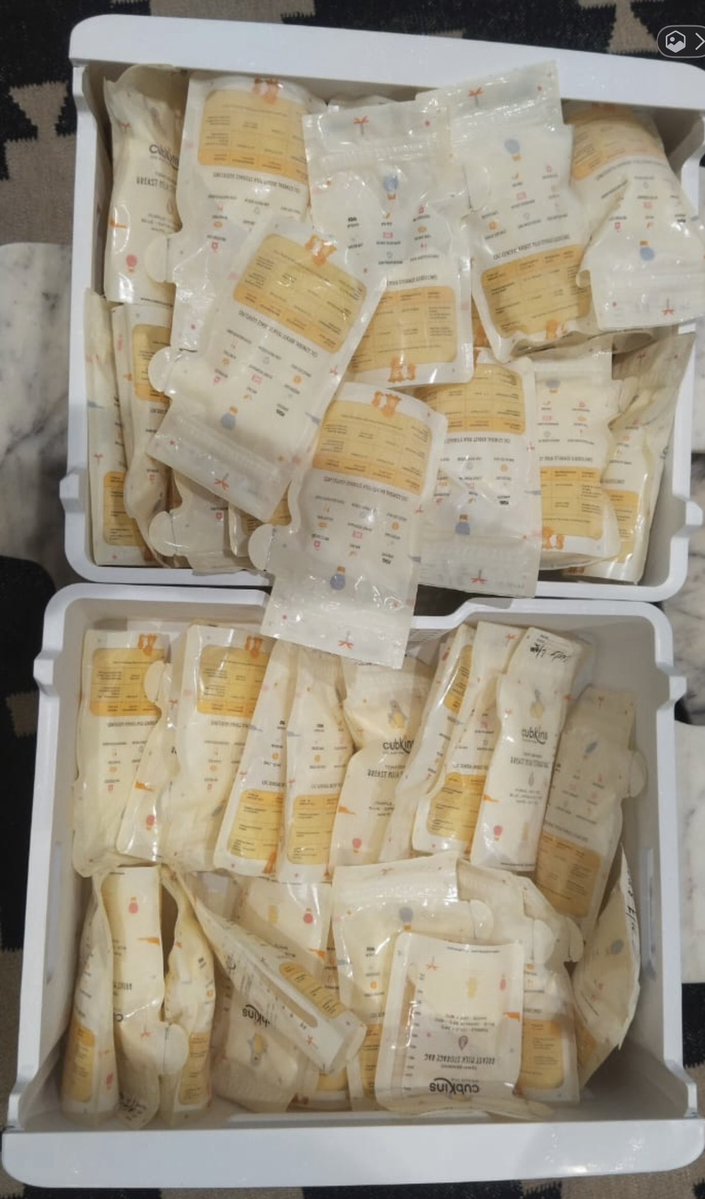
I donated around 60 litres of breast milk to the government hospital in Hyderabad and Chennai during my first year of post partum!!
Why does it matter? Just 100ml of donor milk can feed a tiny 1kg baby for several days. This donation could potentially support dozens of infants in the NICU. Donating is safe, screened, and desperately needed. Many NICU babies don't have immediate access to their mother's own milk due to medical complications. Donor milk acts as a vital bridge, providing immunity and nutrition during those critical first days.
It serves as a bridge for mothers whose milk may be delayed due to stress, illness,malnutrition or premature birth.
Donor human milk is proven to significantly reduce the incidence of Necrotizing Enterocolitis (a life-threatening gut condition) in premature infants!!!
Check your local govt hospital to see how you can help! #MilkBank #SavingLives #MaternalHealth
Anthropic’s latest AI model Claude Opus 4.7 is one of the best bets for organisations to plug cybersecurity vulnerabilities as the company’s most powerful cyber-focused model Mythos continues to remain inaccessible for most companies, cybersecurity experts and analysts told ET, writes @TanyaPandey_ET
https://t.co/Oh3ibOdIwW