Dear Christopher Nolan,
My name is Herod Priovolos and I want to tell you what #TheOdyssey truly means to me and to generations of Greeks who grew up with Homer’s story.
Homer did not sing of Odysseus simply to entertain us with ships, storms, gods and monsters. He told the story because he understood what war, time, distance and loss can do to the human soul.
Odysseus leaves Ithaca as a king, a husband and a father. He returns twenty years later alone, exhausted and disguised as a beggar, carrying the memory of every companion who never made it home.
The monsters are not merely creatures created for spectacle.
The Cyclops is power without justice. The Sirens are the beautiful voices that tempt a person to abandon their purpose. Circe represents the danger of losing our humanity. Calypso offers Odysseus immortality, but even eternal life becomes a prison when the price is forgetting his wife, his son, his homeland and his own identity.
And Ithaca is not merely an island.
Ithaca is the place that remembers you when the world no longer recognizes your face. It is the home that remains alive inside you after everything else has been taken away. It is Penelope growing older while she waits. It is Telemachus becoming a man without his father. It is Argos surviving long enough to recognize his master one final time.
Odysseus is not great simply because he defeats monsters. He is great because he is proud, frightened, wounded, clever, imperfect and deeply human. He loses his companions, his youth, his name and twenty years of his life, yet he refuses to forget who he is.
When he finally returns, Penelope does not recognize him through strength, glory or appearance. She tests him. Odysseus proves his identity by remembering the bed they built together around the roots of a living olive tree.
That is the heart of The Odyssey.
Not the battles. Not the ships. Not the monsters.
Two people standing before each other after twenty years, asking whether love, memory and identity can survive everything time has done to them.
That is why this poem has survived for almost 3,000 years. Every human being is trying to return to something: a home, a person, a lost part of themselves, or the life they had before the world changed them.
So use Homer’s seas, gods, heroes and monsters. But please understand what you are touching.
The Odyssey was never truly about how far a man could travel.
It was about how much the world could take from him before he stopped being himself, and whether, after losing almost everything, he could still find his way home.
The old university was socially narrow but publicly ambitious; the contemporary university is socially larger but increasingly governed by market incentives and bureaucratic measurement.
What are the limits of markets? What moral responsibilities do businesses have? To what extent is individual economic success shaped by personal effort versus social factors? In 'Social Economies,' Lester Hadsell examines these questions across twenty clear chapters, analyzing the connections between economies and society. https://t.co/H7rt5uXyFo
Economics has never been, and never will be, a value-free science.
At its core, economics is shaped by ideologies, value judgements, competing interests, social norms, and political priorities.
Adam Smith and Karl Marx — two of the most important figures in the history of economics — both treated it as an inherently political subject. They didn't even call it "economics." They called it political economy.
For Smith, the study of wealth creation was inseparable from questions about the state, social class, and moral philosophy. For Marx, the economy was a system of power relations.
Yet most introductory economics textbooks relegate politics, power, and history to footnotes. Technical models fill the space instead, abstractions that describe an imaginary economy more than the real one.
My newsletter's most popular piece is on how economics became a discipline detached from politics — despite the fact that it is intrinsically and unavoidably political.
Link to the full piece in the comments.
New review just published online in the Marx and Philosophy Review of Books:
Matt McManus on David Harvey's The Story of Capital: What Everyone Should Know About How Capital Works
https://t.co/alnYBfwtRw
Short post on the two traditions in the history of economic ideas. The central divide is between classical political economy, reproduction, surplus, accumulation, and the Benthamite/marginalist tradition of utility, exchange, scarcity, and individual choice /1
my gut reaction to ai in math is i'm excited about getting access to an infinitely patient teacher that's near expert in every area of math.
this is possibly the best time in history to be doing math as a hobby.
Dismissing Indian Knowledge Systems is a serious intellectual and political mistake. It is a cultural disaster to raise generations cut off from the knowledge resources of the land where they were born. Recovery and reconstruction of our knowledges must be integral to Swaraj ideas. #IKS #Swaraj
Read: https://t.co/iCojOCC5tG
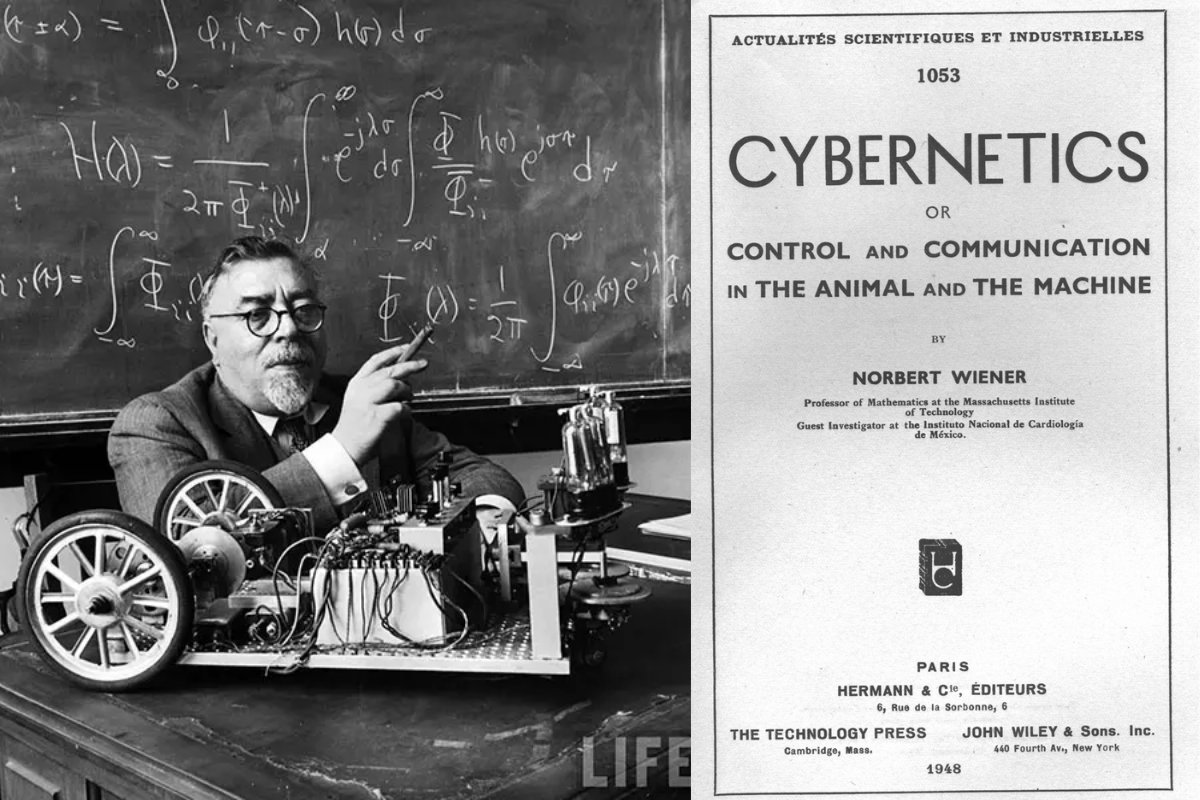
A child prodigy who finished his Harvard degree at 14 and his PhD at 17 sat down in 1948 and wrote a single book that invented the entire conceptual vocabulary we still use to talk about AI, robotics, self-driving cars, and reinforcement learning.
He never got the credit. Most people have never heard his name.
His name was Norbert Wiener. The book was called Cybernetics.
Every feedback loop running inside every system you interact with today traces back to one problem he was handed during World War II.
The problem was this: how do you aim a gun at a fast-moving airplane?
By the time your shell arrives, the plane is somewhere else. You cannot aim at where the plane is. You have to aim at where the plane will be. And the plane's pilot, knowing this, is constantly changing course to make that prediction wrong.
Wiener spent years on this. What he built to solve it was not a better gun. It was a new science.
He noticed something that nobody had formally described before. The gun system and the human nervous system were solving the same problem using the same method. You observe where the target is. You compare it to where you want to hit. You calculate the gap. You correct. You observe again.
He called that loop feedback.
Not in the casual sense people use it today. In the precise mathematical sense. A signal goes out. The result comes back. The system compares the result to the goal. The gap between them drives the next action. The loop closes.
That mechanism, exactly as Wiener described it in 1948, is what runs inside every thermostat, every autopilot, every cruise control system, and every AI training loop on the planet right now.
When GPT-4 learned to answer questions better, it was doing feedback. When AlphaGo learned to play Go, it was doing feedback. When a self-driving car adjusts its steering because it drifted two inches toward the curb, it is doing feedback.
The word they all use, the concept underneath the word, the mathematics formalizing the concept, all of it came from one book written by a child prodigy in 1948 who was trying to figure out how to shoot down a plane.
The deeper insight was what he proved about living systems and machines.
Before Wiener, biology and engineering were treated as completely separate domains. Organisms adapted. Machines calculated. The idea that you could describe both using the same mathematical framework was not just unusual. It was considered a category error.
Wiener proved it anyway.
He showed that a brain correcting a reaching movement and a missile correcting its trajectory were running mathematically identical control loops. The hardware was different. The math was the same. Living systems and engineered systems obeyed the same laws once you understood what those laws actually were.
He named the field after the Greek word for steersman. Kubernetes. Cybernetics. The person who holds the rudder, reads the water, and adjusts constantly to hold a course through a current that is always pushing the ship somewhere else.
That is the mental image he wanted. Not a machine that executes instructions. A system that responds to its own results.
The third thing he did is the part almost nobody connects to modern AI.
In 1948, Wiener spent an entire chapter of Cybernetics warning about what would happen when machines that learn from feedback were given control over consequential decisions.
He described the displacement of workers not as a distant possibility but as a near-term certainty. He wrote about the ethical risks of building systems that optimize for measurable proxies of human values rather than actual human values.
He described in plain language what alignment researchers today call Goodhart's Law without using that name, 25 years before Charles Goodhart published anything.
He was a mathematician in 1948 writing about problems that AI safety researchers are still trying to solve in 2026.
The book is dense in places. The equations are real and the sections on statistical mechanics require actual attention. But Wiener knew this, which is why in 1950 he published The Human Use of Human Beings, which is the same book with all the math removed. Same ideas. Same warnings. Written for anyone who reads English.
That second book has been in print for 75 years and almost nobody in tech has read it.
Wiener died in 1964 at a conference in Stockholm. He collapsed mid-conversation between sessions. He was 69.
He did not live to see a personal computer. He did not live to see the internet. He never saw reinforcement learning, neural networks, or the AI systems that run almost entirely on the mathematical architecture he designed while trying to solve a World War II gunnery problem.
Every AI lab in the world today is building systems that run on his framework. Almost none of the people building those systems know his name.
The field he founded, cybernetics, mostly disappeared as a word. The ideas did not disappear. They dissolved into every other field. Control theory. Cognitive science. Computer science. Neuroscience. AI. They each took a piece of what he built and called it their own terminology.
The word that survived is the one that proves he invented it.
Feedback.
You use it every day. You use it in code reviews, in meetings, in conversations about AI performance. Every time you use it in the technical sense, meaning a signal that closes a loop between output and goal, you are using the exact definition Wiener wrote down in 1948.
He gave the word its meaning. Most people using it have never heard of him.
The Human Use of Human Beings is free on archive. Cybernetics is in print and available anywhere books are sold. His major essays are in academic archives at no cost.
The man who built the foundation of modern AI was writing about its dangers before the first commercial computer existed.
Most people building AI today have never read a word he wrote.