Zero data retention" on a commercial AI API often applies only to real-time inference.
Notion disclosed this week that customer transcripts (including API keys) were exposed in the Fireworks AI breach because batch classification jobs sat on disk outside the volatile-memory ZDR boundary.
When security teams send internal architecture, tokens, or unpatched attack paths to hosted multi-tenant APIs, they inherit every backend storage boundary.
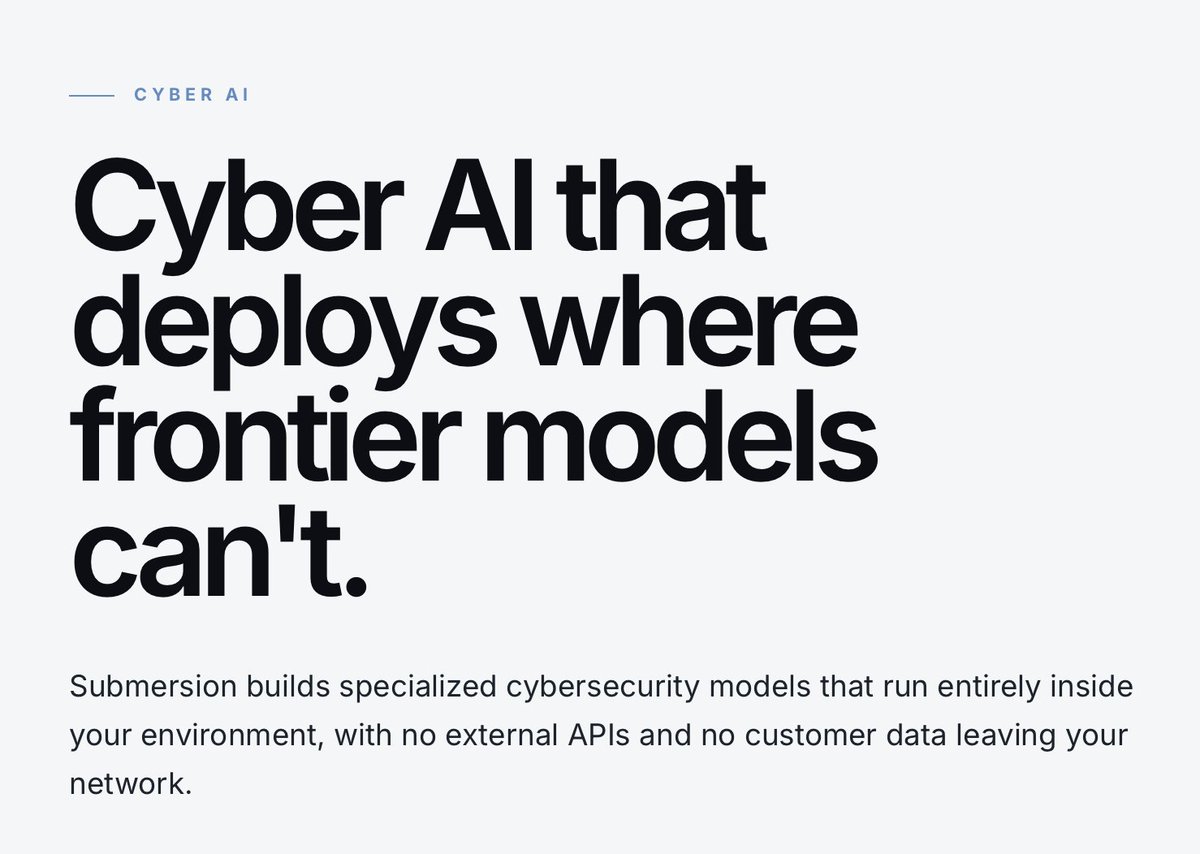
Sensitive security workflows need to run inside your own perimeter with zero data egress.
https://t.co/yydO4ppuey
Companies need to stop using AI models that live in someone else's datacentre. It's a huge security risk that everyone is just ignoring. Not only that, but you don't control it, so you might lose access to the functionality you need from that model.
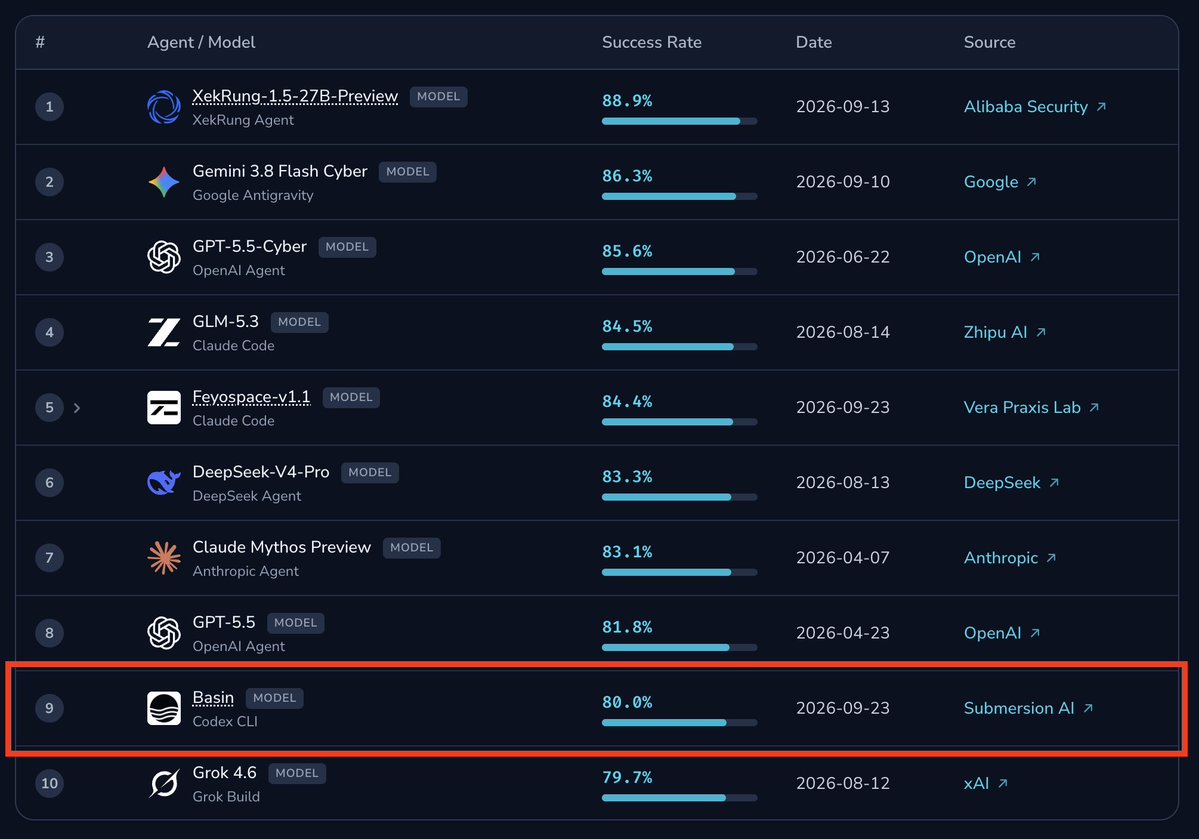
At @SubmersionAI our Basin model, under 50B parameters, made the CyberGym top 10 and can run fully air-gapped on (relatively) cheap hardware.
Now there's no excuse to keep sending your sensitive security information to third parties.
As AI tooling accelerates, legacy vulnerability backlogs get surfaced and weaponized in hours. As Nikesh Arora puts it, crises like PHP2Shell are becoming continuous.
When manual triage fails against machine-speed probing, the only durable answer is finding the attack path internally before it ships.
Full clip: https://t.co/RA1EApaRlj
OpenAI just shared that it will be training on your Daybreak Blue sessions, even if you have it set to zero data retention.
We're here if you want to talk. https://t.co/zP6i04cx9x
Anthropic's S-1 notes that as frontier models advance in vulnerability discovery, access to those capabilities may be restricted to manage liability.
Makes sense for a public API provider. For security teams, it means relying on hosted models leaves critical work vulnerable to throttles and upstream refusals.
Deep research and automated testing will have to run on infrastructure you actually control.
If you deploy an AI agent to do a job, you need extreme confidence that it will execute on your behalf. Especially as AI transitions to autonomous agents acting in the real world.
Who is behind your model, and is that who you actually want your AI models aligned to?
➡️ https://t.co/xBdAKzvS9H
Trillion-parameter models are trying to do too much. Agile, domain-specific AI is taking over.
Massive models bloat compute, expand attack surface area, and routinely "run off their guardrails." Enterprise value lives in smaller, highly optimized architectures that do defined tasks faster, cheaper, and more securely.
At Submersion, we see the future as an orchestrated network of specialized, lightweight agentic models engineered for reliable operational execution.
https://t.co/BbLjheZZZy
#SLM #AISafety #SubmersionAI
With a tiny team, pre-seed, we've managed to create a tiny model that has cracked into the top 10 on cybergym! You can run this model yourself on cheap hardware!
Absolute game changer for data sovereignty, and we're just getting started.
Watch this space 👉 @SubmersionAI!
Anthropic Cyber Mission expanding for defenders is a step forward, but routing code to a third-party still leaks telemetry outside your perimeter.
True control means running specialized cyber models (like Basin) on your own hardware, fully on-prem or air-gapped with zero data egress.
https://t.co/AArhFv7hkm
Basin is now the exclusive model provider for @RedVeilSecurity 🤝
RedVeil provides on-demand pentesting across apps, APIs, & cloud infrastructure; now powered under the surface by our advanced cyber reasoning.
🔗 https://t.co/Wv15oYZJm3
#CyberSecurity#InfoSec#AI
"The biggest risk is not powerful AI, it’s asymmetry of powerful AI.”
That's Hugging Face's CEO addressing the UN Security Council. Closed, frontier models blocked his team as they tried to use them to respond to the OpenAI agent attack in July.
Hugging Face has about 17,600 reasons oppose AI. Instead, they argue for open models that are less restricted, better for privacy, and far cheaper for organizations around the world.
➡️ A powerful 5-minutes: https://t.co/lfQzdVTShE
Some take a shortcut: grab an open-weight model, strip guardrails, and unleash it. That just makes attackers' lives easier.
Basin is built for defenders and security researchers. You keep the agent, the data, and the keys. We give you the model.
We build and evaluate in-house. We put Basin on public benchmarks and real software.
It has already discovered new CVEs in widely used products (disclosed under SRTSubmersionAI). A leaderboard screenshot doesn't fix real software - closing holes does.
Enterprise security data shouldn't be shipped to a third-party API to log and train on. Customers didn't sign up for that promise.
Enterprises need a cyber model they can run inside the security controls they already operate.
That’s why we built Submersion.
Our first model, Basin, was built from the ground up for offensive security research: finding and validating real vulnerabilities so defenders can close them before someone else exploits them.
AI models can read code, map attack paths, and help reproduce bugs.
In July , an autonomous agent ran an end-to-end intrusion against Hugging Face. When they tried analyzing it with hosted models, guardrails blocked forensics. They had to finish using an open-weight model in-house.
In cybersecurity, the rule has always been simple: if you can find a hole, assume an attacker can too.
AI just erased the time buffer that rule used to give us. The gap between a vulnerability existing and an attacker exploiting it at scale is shrinking fast.
The models are capable, but defenders can't fully trust or control the stack they're forced to use.
Meanwhile, offense is already moving at machine speed. Defenders need that same class of capability, under their control, inside their own boundary.
Why we built Submersion 🧵
We’ve sat in rooms with security and engineering leaders holding 8-figure AI budgets. Watched them burn massive capital on hosted token burn for workloads that shouldn't even leave their environment.