SubstraOS begins.
A people-powered AI compute network on Solana — built to run browser GPU nodes, route inference across idle GPUs, native workers, and the wider swarm.
Open a browser tab. Contribute GPU. Join the substrate.
Open models.
AI that doesn’t refuse.
A network you can contribute to.
A compute layer builders can plug into.
SubstraOS turns idle compute into a live inference network — routing AI jobs across browser nodes, native GPUs, and the wider swarm.
Run AI without owning a GPU.
Contribute GPU and earn from the network.
Change one line and point your app at SubstraOS.
Power agents on infrastructure owned by the people using it.
A real compute layer, a model hub, a node network and an API layer for builders.
And soon, agents that run on the network itself.
The network is alive.
$SUBSTRAOS
CKPT7CF1uQ8SJ2tE6NaK2bGshmXEDD8UXE1Yn1afpump
https://t.co/rgJjv3ZPCX
Some node runners asked: "am I earning points or money?"
Fair question. We just cleared it up — your dashboard now tracks both, separately, the way it always worked under the hood:
💵 USDC — real earnings. When a buyer pays for inference and YOUR machine served the job (verified, not just claimed), you earn 75% of that spend. Live balance on your Earnings page, withdrawable straight to your Solana wallet from $5. Server-enforced limits, 24h processing on larger amounts.
🏆 Points — your rank. Every verified job scores points toward the leaderboard and your standing tier. Points are reputation, not money — they gate better jobs, not a balance.
The rule for both: verified work only. Idle uptime earns nothing. Canary jobs and redundancy checks keep everyone honest.
Open a tab → serve inference → earn USDC → withdraw. That's the loop, live now.
https://t.co/PEPGflVhib
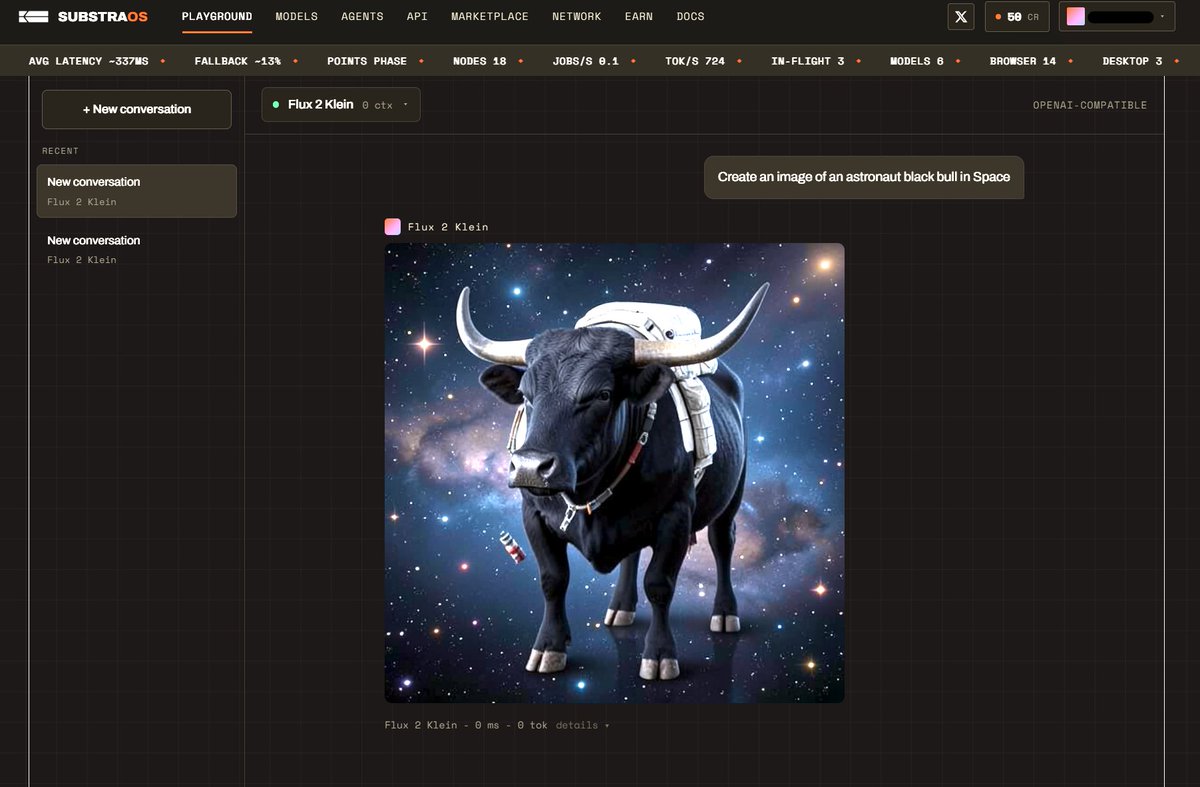
Image generation just landed in the SubstraOS Developer API. ⚡
Last week, we shipped images to the playground.
Now builders can generate them directly through the API.
One key.
One balance.
Text and images.
Same authentication
Your existing sk_sub_ key now works with:
POST /v1/images/generations
No separate account.
No new product.
The same prepaid credits cover every modality.
OpenAI-compatible request shape
JavaScript and Python SDKs updated
Around 3 credits per 1024×1024 image using FLUX.2 Klein.
Chat.
Agents.
Images.
One API.
One balance.
One inference network.
SubstraOS keeps expanding the surface area of what can run on the network.
Chat.
Code.
Agents.
Images.
Developer APIs.
Community compute.
Pro models.
Different workloads.
One inference layer.
The more people build, the more demand reaches the network.
The more nodes join, the more capable the network becomes.
That is the flywheel.
$SubstraOS is not shipping a single AI product.
It is building the infrastructure open AI products run on.
The bigger shift is not just that SubstraOS can generate images.
It is where the generation can happen.
Run FLUX.2 Klein on your own WebGPU and the full loop stays in your browser:
prompt → inference → image
No closed image platform.
No separate account.
No external provider deciding what you are allowed to create.
Need more power? Route the same request through community compute without changing apps or workflows.
Local when you want privacy.
Networked when you want more capacity.
Open-weight.
Uncensored.
Built without a gatekeeper.
→ https://t.co/rgJjv3ZPCX
Images are now live on SubstraOS.
You can go from prompt → finished image without leaving the app.
FLUX.2 Klein is now available inside the playground and model hub:
pick the image model
type what you want
hit send
get a PNG back in seconds
No new tool.
No new tab.
No setup.
Image generation runs through our community nodes, so you can use your own webGPU to power your image generation or purchase credits if your webGPU is too slow from other node runners.
Two compute lanes.
One gateway.
Same app.
Same credits.
Same flow.
Chat, code, reason, create.
This is the first image model.
More are coming.
Go make something → https://t.co/rgJjv3ZPCX
Images are now live on SubstraOS.
You can go from prompt → finished image without leaving the app.
FLUX.2 Klein is now available inside the playground and model hub:
pick the image model
type what you want
hit send
get a PNG back in seconds
No new tool.
No new tab.
No setup.
Image generation runs through our community nodes, so you can use your own webGPU to power your image generation or purchase credits if your webGPU is too slow from other node runners.
Two compute lanes.
One gateway.
Same app.
Same credits.
Same flow.
Chat, code, reason, create.
This is the first image model.
More are coming.
Go make something → https://t.co/rgJjv3ZPCX
SubstraOS started with one idea: AI inference shouldn't belong to a handful of datacenters. Text came first — pooled GPUs, an OpenAI-compatible API, a playground, a model hub, dev keys, agents.
Now we're adding a new modality: image generation. 🎨
Prompt in, picture out — right in the playground, listed in the model hub, reachable through the same API key you already use.
One account, one prepaid balance, text and images side by side.
Nothing to rewire.
It slots into the ecosystem you know:
→ Playground gets an image mode — type a prompt, see the result
→ Model hub gains image models next to the text ones
→ Dev API serves it through /v1/images/generations — OpenAI-shaped, base64 back
→ Agents get a new tool in the box
Text was the foundation. Images are the next surface. Same key, same network, bigger canvas. 👀
Coming soon...
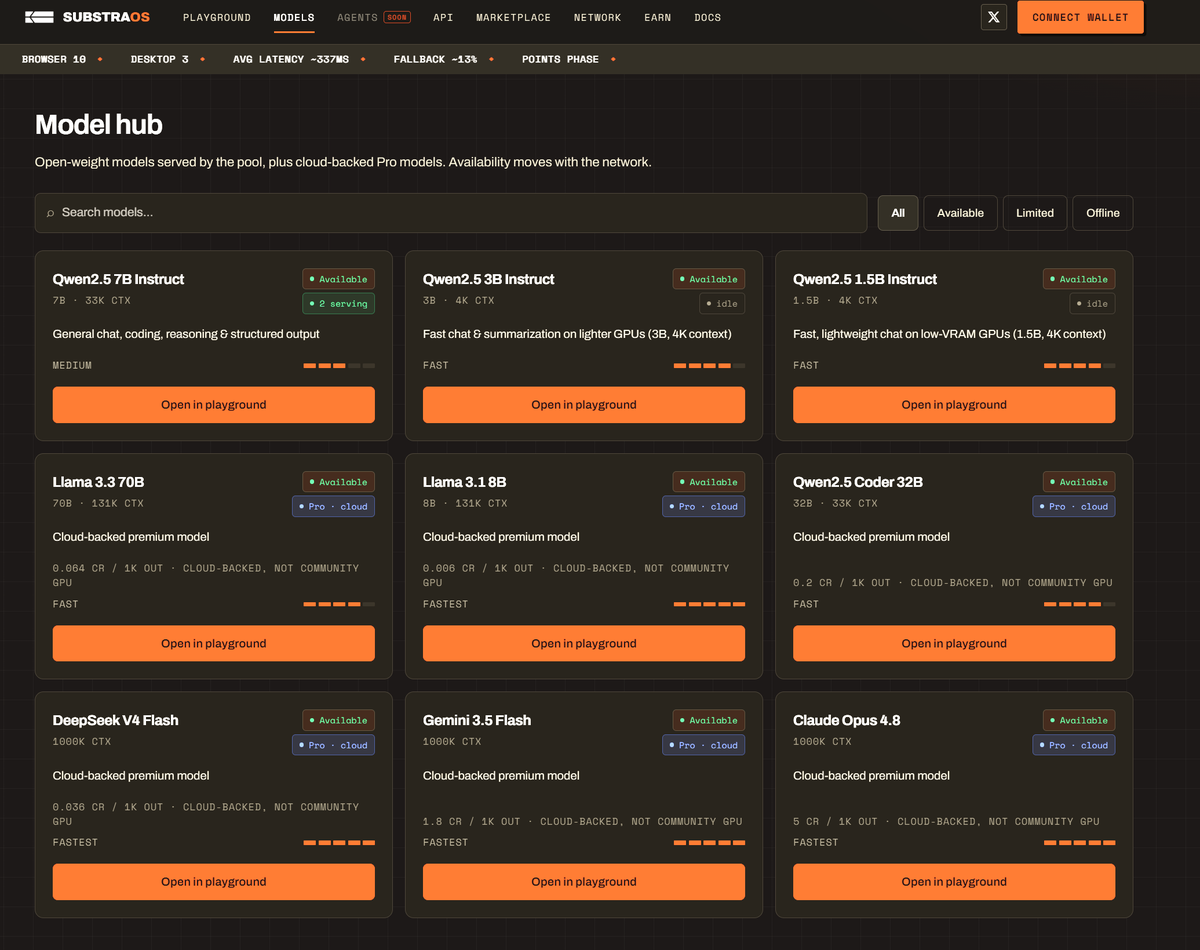
The SubstraOS model lineup just got a major upgrade.
Users can now switch between lightweight community models and more powerful Pro models from one interface.
Now available across the Model Hub, Playground, API and Agents:
• Qwen 1.5B, 3B and 7B
• Llama 3.1 8B
• Llama 3.3 70B
• Qwen2.5 Coder 32B
• DeepSeek V4 Flash
• Gemini 3.5 Flash
• Claude Opus 4.8
Small models for speed.
Large models for deeper reasoning, coding and agent workflows.
One gateway.
More models.
More ways to build.
→ https://t.co/Jzb36rEUDb
A useful agent does not need to be an “autonomous super-bot.”
It needs a clear job.
With SubstraOS Agents, you can build workflows like:
• Research agent — fetch sources, compare claims, return a concise brief
• Support triage — classify tickets and draft the right response
• Code review assistant — inspect a diff, flag risks, write a review summary
• Due-diligence agent — pull project docs, summarize strengths, risks and open questions
• Content agent — turn source material into structured posts, summaries or reports
One instruction.
Only the tools it needs.
A full transcript of every step.
Real workflows, built on open inference.
Introducing SubstraOS Agents
Build an agent from:
one instruction
one model
the tools it needs
reason → call tool → read result → repeat → answer
Every step streams live over SSE.
Built in:
• max-step limits
• append-only run transcripts
• live token and credit metering
• wallet-scoped agents and history
• auditable records of steps, tokens, tier and spend
Available tools:
• web.fetch — guarded public URL retrieval
• summarize — condense supplied text
• classify — label and structure data
• https://t.co/xMM06KV8fg / code.write — in-memory scratch files
Enable only what the agent needs.
Community runs are routed through the SubstraOS scheduler to pooled contributor GPUs across browser WebGPU and native nodes.
Agents create demand.
↓
Contributor GPUs provide supply.
↓
Verified work earns — idle uptime does not.
Inference is being decentralized.
Build your first agent:
→ https://t.co/nNoV1Qqb00
Introducing SubstraOS Agents
Build an agent from:
one instruction
one model
the tools it needs
reason → call tool → read result → repeat → answer
Every step streams live over SSE.
Built in:
• max-step limits
• append-only run transcripts
• live token and credit metering
• wallet-scoped agents and history
• auditable records of steps, tokens, tier and spend
Available tools:
• web.fetch — guarded public URL retrieval
• summarize — condense supplied text
• classify — label and structure data
• https://t.co/xMM06KV8fg / code.write — in-memory scratch files
Enable only what the agent needs.
Community runs are routed through the SubstraOS scheduler to pooled contributor GPUs across browser WebGPU and native nodes.
Agents create demand.
↓
Contributor GPUs provide supply.
↓
Verified work earns — idle uptime does not.
Inference is being decentralized.
Build your first agent:
→ https://t.co/nNoV1Qqb00
The SubstraOS Model Hub is live.
One interface for the full inference network:
Community models served by pooled contributor GPUs
Pro models backed by cloud capacity + pooled contributors
See live availability, context windows, speed, pricing, and active workers before you run anything.
From lightweight Qwen models to Llama 70B, Qwen Coder, DeepSeek, Gemini and Claude — pick the model that fits the job and open it directly in the playground.
One network.
Multiple model tiers.
No closed stack.
→ https://t.co/Jzb36rEUDb
Big upgrade to SubstraOS /earn is live.
Contribute GPU from a browser tab — and now actually see the network credit your work in real time.
What shipped:
• Real model download progress
No more endless “preparing…”
You see the actual weights cache: 1.2 / 4.1 GB, with Retry if it fails.
• Auto model selection
SubstraOS probes your GPU and picks what it can run.
Modest card → light 3B
Stronger card → full 7B
If your machine can’t handle it, it downgrades instead of crashing.
• Live earning feedback
When your work is verified, you see it instantly:
+10 points — verified
Session points.
All-time rank.
Just real browser GPUs joining the pool, serving inference, and earning credit for verified work.
Decentralizing inference, one browser tab at a time.
→ https://t.co/PEPGflUJsD
Upgrade shipping soon on SubstraOS /earn 👀
Your browser will read your GPU and auto-load the model it can actually run.
Modest card → lighter model
Beefy card → full 7B
No guessing.
No failed downloads.
No download-then-crash.
Our mission is to turn every usable GPU into part of the global AI computer.
Most AI tokens are selling a narrative.
SubstraOS is shipping the rails.
A live compute exchange.
A working developer API.
OpenAI-compatible inference.
Community GPU nodes.
Cloud-backed Pro models.
Usage metering.
Receipts.
Real demand for real compute.
That is the flywheel:
builders need inference → jobs hit the network → nodes serve work → providers earn → more GPUs join → capacity grows → more builders plug in
This is how an AI network compounds.
Not through hype.
Through usage.
Through $SUBSTRAOS
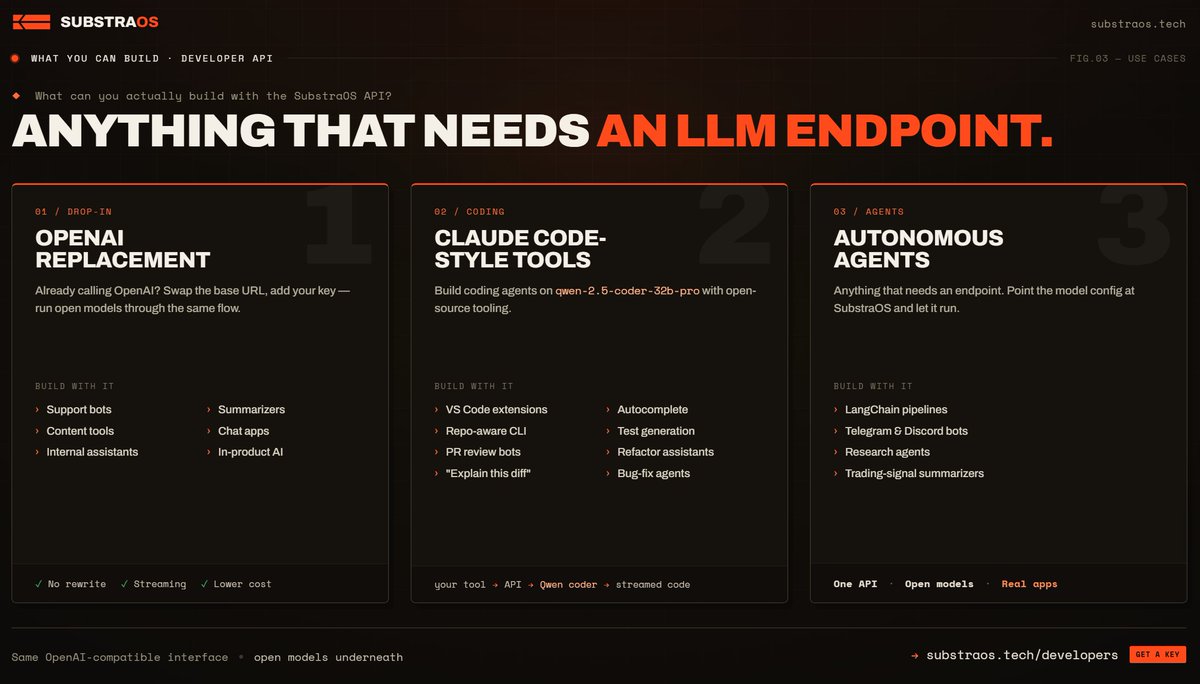
What can you actually build with the SubstraOS API?
Anything that needs an LLM endpoint.
1. Drop-in OpenAI replacement
Already calling OpenAI? Swap the base URL to `https://t.co/kbQQMMSoWf`, add your SubstraOS key, and run open models through the same flow.
No rewrite. Streaming supported. Lower-cost inference through pooled GPUs.
Use it for support bots, content tools, internal assistants, summarizers, chat apps, and AI features inside existing products.
2. Your own Claude Code-style tools
Use `qwen-2.5-coder-32b-pro` to build coding agents with open-source tooling.
Think: VS Code extensions. Repo-aware CLI agents. PR review bots. “Explain this diff” tools. Autocomplete backends.
Test generation. Refactor assistants. Bug-fix agents. Your tool → SubstraOS API → Qwen coder model → streamed code intelligence.
Same OpenAI-compatible interface. Open models underneath.
3. Autonomous agents
LangChain, Telegram bots, Discord bots, research agents, trading-signal summarizers — all need an LLM endpoint.
Point the model config at SubstraOS and let it run.
One API.
Open models.
Real apps.
https://t.co/MMtiBUbsfO
SubstraOS Developer API is LIVE.
OpenAI-compatible inference routed across pooled, contributor-run GPUs — with cloud-backed Pro models when you need more power.
Get a key. Swap the base URL. Ship.
→ https://t.co/MMtiBUaUqg
Live models:
Community •
qwen2.5-7b-instruct • llama-3.2-3b
Pro •
llama-3.3-70b-pro • llama-3.1-8b-pro • qwen-2.5-coder-32b-pro
Use it for chatbots, coding tools, agents, batch generation, or your app’s LLM backend.
Streaming SSE is live.
Usage tracking is live.
Prepaid credits cover both Community and Pro.
The coordinator never runs inference itself.
Models run on GPUs anyone can contribute through a browser tab or native node.
Builders get open inference. Node runners serve real demand.
Decentralizing inference, one tab at a time at $SUBSTRAOS