Substratide is changing how CoAs work, and it’s worth explaining why.
Every CoA currently on the site comes from one round of testing done when we first validated production almost a year ago. Real data, but from a single batch, not from what’s actually shipping today.
We’ve said as much before, but it’s time to close that gap properly.
From now on, every order can include a batch-specific Certificate of Analysis from Janoshik in Poland, tested from the actual vial in your shipment, sent directly to you. Add it at checkout for every substance, pay less than a tenth of what it would cost you to send to Janoshik.
Orders over €950 / $1000 get every substance in the order tested and documented at no extra cost to the buyer!
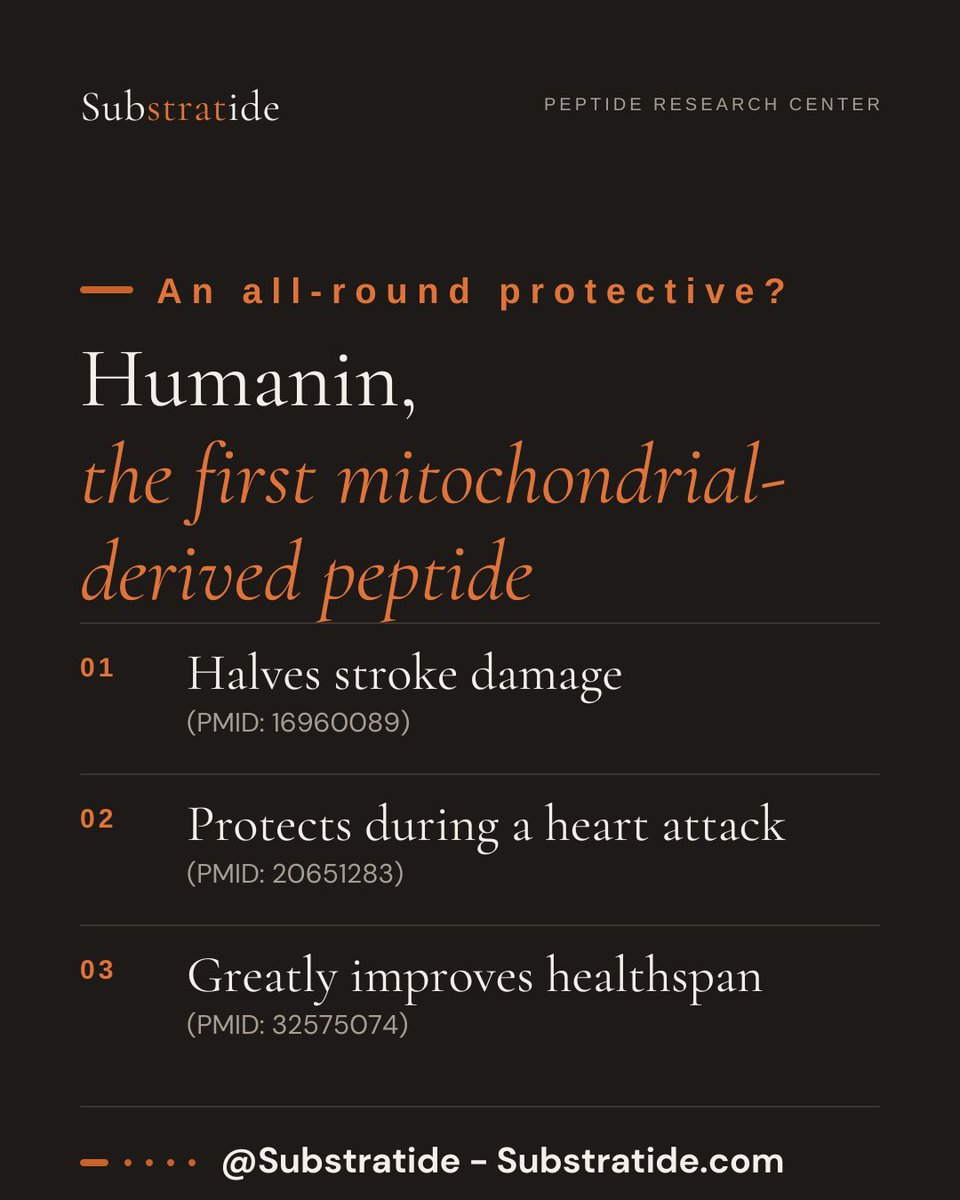
Mean circulating humanin was nearly 20% lower in African American than in Caucasian American participants in the cohort studied (PMID: 30242290). In stroke, HNG cut infarct volume in mice from 56.2% to 26.1% when given before ischemia (PMID: 16960089).
HNG also reduced infarct size in a dose-dependent way in mice, with a maximum at 2 mg/kg (PMID: 20651283). In a pig model, 2 mg/kg reduced infarct size by 41% with 60 minutes of ischemia and lost its effect at 75 minutes (PMID: 32760857), which marks the ceiling. In ApoE-deficient mice, an analog prevented endothelial dysfunction and reduced plaque size (PMID: 21763658), and in people, lower humanin tracked with coronary microvascular endothelial dysfunction (PMID: 23220334).
The cancer twist
You'd expect a survival factor to protect tumors too. In mouse studies, HNG protected germ cells and white blood cells from chemotherapy while enhancing the suppression of melanoma metastases (PMID: 26384090), and it left temozolomide's anti-tumor effect intact in medulloblastoma xenografts (PMID: 31085184). Protecting healthy tissue while leaving tumor kill alone is the combination oncologists want.
Exercise tells a more complicated story
Acute high-intensity exercise raised humanin in both muscle and plasma in men, through a nontranscriptional mechanism (J Appl Physiol 2020; PMC7717117). Then a pilot study of professional athletes found that high-endurance athletes had lower humanin than low-to-moderate endurance athletes, while MOTS-c didn't differ (Rev Cardiovasc Med 2022;23:181). So humanin spikes with a bout and the chronic set point may sit lower in very trained people. Human association studies on humanin levels have also been described as equivocal (Yen et al., 2020). Treat it as a stress-response signal first and a clean "more is better" marker second.
Longevity
Humanin overexpression extended lifespan in C. elegans through daf-16, HNG improved healthspan measures in old mice, naked mole-rats hold stable levels as they age, and the children of centenarians carry higher circulating humanin, while levels run lower in Alzheimer's disease and MELAS (PMID: 32575074).
What it adds up to:
Humanin looks like the mitochondrion's way of telling the rest of the cell to survive: block Bax, engage STAT3, answer to the IGF axis and show up wherever energy stress threatens a cell. The pancreas, brain, heart and vessels all use it. The most drug-like data sit with the analogs (HNG, HNGF6A), the cleanest human signals are the genetic and level associations, and the pig study shows where the protection stops.
If you're following this one, the thing to watch is the first controlled human work with an analog, because the biology is there and the dose has to be found.
Anyone running humanin or HNG? What did you track?
Humanin, a deep dive: a peptide discovered three times, with a signal that doesn't fit in one box
Humanin gets filed as "the brain peptide," or "the first mitochondrial-derived peptide," or "the longevity peptide." Each label is true and none of them is enough. The record is stranger and more useful than the slogans, so here is the whole thing in order.
It was found three times
In 2001, Hashimoto's group screened a cDNA library from the occipital lobe of an Alzheimer's patient, a brain region that stays largely intact in the disease, for anything that kept neurons alive. They found a 24-residue peptide, MAPRGFSCLLLLTSEIDLPVKRRA, that blocked cell death caused by four different familial Alzheimer's genes and by amyloid-beta (PMID: 11371646). Two other labs reached the same sequence from other directions: one through apoptosis and Bax, one through IGF-1 signaling. A molecule that three separate questions converge on is usually doing something central.
The cysteine at position 8 turned out to be essential for neuroprotection. The S14G analog (HNG) is far more potent, effective in neuron rescue assays at concentrations hundreds of times lower, and it's the form most animal work has used.
It works on two floors
Inside the cell, humanin binds Bax and blocks its activation (PMID: 12732850) and binds IGFBP-3 (PMID: 14561895). Outside the cell, it's a secreted ligand. Hashimoto's 2009 paper showed a trimeric receptor made of CNTFRα, WSX-1 and gp130 that turns on JAK2/STAT3 signaling (PMID: 19386761). Earlier work found FPRL1 as a receptor (PMID: 15153530), though knocking down its mouse counterpart didn't blunt humanin's neuroprotection, which points at the trimer as the main route. In hippocampus, humanin acts through gp130 to activate AKT, ERK1/2 and STAT3, with age-dependent differences in the signaling (Oncotarget 2016). In heart, injection raises AMPK phosphorylation.
So it's one peptide engaging a cytokine-style receptor on the outside and the apoptosis machinery on the inside.
The GH/IGF-1 axis sits above it
Humanin levels aren't random. In growth hormone transgenic mice, plasma humanin was 70% lower. In an Ecuadorian cohort with growth hormone receptor deficiency (Laron syndrome), subjects had 80% higher plasma humanin than their relatives, and the study also tracked children with GH deficiency before and after GH treatment (Lee et al., Aging Cell 2014). The genetic conditions that extend healthspan in mice and humans come with high humanin. That puts humanin downstream of the IGF axis and gives a mechanistic reason for the longevity link.
It does three jobs in the pancreas
Most peptides get one pancreas story. Humanin has three.
-improves insulin action, as central humanin infusion raised insulin sensitivity in clamps through hypothalamic STAT3 signaling (PMID: 19623253) -keeps beta cells alive, as humanin reduced cytokine-induced beta cell apoptosis through STAT3 and improved glucose tolerance and diabetes onset in NOD mice (PMID: 19800083) -raises insulin secretion in a glucose-dependent way, as the analog HNGF6A boosted glucose-stimulated insulin secretion in rats, in islets from normal and diabetic mice and in beta cell lines, independently of KATP channels and linked to enhanced glucose metabolism (PMID: 23995290)
Better sensitivity, better supply and better survival of the cells that make the supply is an unusual combination.
The brain, beyond the discovery story
In triple-transgenic Alzheimer's mice, three months of intranasal S14G-humanin improved cognition in males and lowered brain amyloid in both sexes, partly through higher hippocampal neprilysin, the amyloid-degrading enzyme (PMID: 21264226).
The aging data goes further.
HNG improved cognition in old mice, and in people, a variant in the humanin-coding region of mitochondrial DNA (rs2854128) was associated with lower circulating humanin and with accelerated cognitive aging in a large national sample of older adults.
@DrAlexTatem@AbudBakri they have murked people over some of their developments in the past, I remember some story on CBS in April relating to former Lilly employees
If that's what retatrutide does in people, then circulating amino acids and the nitrogen load reaching the kidney should fall. That matters because amino acid and protein loads raise GFR, and lower intraglomerular pressure drives down albuminuria. The trial saw lower intraglomerular pressure, a lower renal artery resistive index and a 49% fall in albuminuria in the people who had it, all with filtration preserved. That's the pattern a lighter amino acid load on the glomerulus would produce.
Plasma amino acids, which should fall on treatment, BUN and urinary urea nitrogen, which track hepatic amino acid catabolism 3-methylhistidine, a muscle protein breakdown marker that shouldn't rise if breakdown isn't accelerating, DXA lean mass alongside the cystatin C to creatinine ratio, are all worth paying attention to.
If 3-methylhistidine climbs or lean mass drops out of proportion to weight, the muscle-loss reading is most likely the correct interpretation.
The same pathway ties back to energy expenditure. Hepatic amino acid catabolism, urea synthesis and gluconeogenesis cost real energy, which is part of why glucagon agonism raises expenditure. A kidney trial may have just handed us a window into the protein side of that system.
If you're on retatrutide and getting labs, ask for BUN and cystatin C alongside creatinine, and keep protein high and the barbell moving, because hypoaminoacidemia is one more reason to protect lean mass deliberately.
BREAKING:
Retatrutide's new kidney trial has a number that doesn't add up, and the explanation might be protein!
Late-breaking data from TRANSCEND-CKD dropped on October 22, and the headline looks like good news with a strange footnote. The footnote is where it gets interesting.
146 adults with obesity or overweight and chronic kidney disease (eGFR 25 to 75) were randomized to retatrutide titrated to 12 mg or placebo for 24 weeks, 75 versus 71. Mean age was 65, mean weight 101 kg, mean measured GFR 53.
The primary endpoint was iohexol mGFR, the gold-standard measurement that doesn't lean on body composition.
What came out:
Measured GFR change versus placebo was -1.4 mL/min/1.73 m² (95% CI -9.2 to 6.3, p=0.714), so filtration was completely preserved
In the 42 participants with UACR of at least 30 mg/g, albuminuria fell 49.2% versus placebo (95% CI -70.6 to -12.3) Retatrutide lowered perirenal and sinus fat, intraglomerular pressure, renal artery resistive index, body weight and systolic blood pressure.
The number that doesn't add up:
Estimated GFR, calculated from creatinine or cystatin C, went up on retatrutide versus placebo. Measured GFR didn't. The same pattern showed up in the phase 2 data, where 8 mg and 12 mg raised creatinine-based eGFR by 5.3 and 8.5 mL/min/1.73 m² at 48 weeks while cutting UACR by 28.0% and 31.5% (Heerspink et al., Kidney Int Rep 2025; PMID: 40630318).
The kidneys didn't start filtering more. The markers moved.
The standard explanation is thst
Cystatin C leans on fat mass and inflammation, so it falls as adiposity falls.
Creatinine leans on muscle mass and meat intake, so it falls when people eat less and lose some lean tissue. That's exactly why the investigators ran the trial on mGFR in the first place.
That covers both markers, but it leaves a question about what is happening to protein in these patients, and that's where glucagon comes in.
Glucagon is the body's amino acid disposal hormone, and Retatrutide is the first big incretin drug with a glucagon receptor arm, and glucagon does a job that GLP-1 and GIP don't.
It drives hepatic amino acid uptake, catabolism and ureagenesis. Block the glucagon receptor and plasma amino acids rise and the pancreas builds extra alpha cells to compensate (Solloway et al., Cell Rep 2015; Holst et al., the liver-alpha cell axis).
In healthy volunteers during an amino acid load, glucagon was the pivotal hormone in disposal: it prevented the rise in total amino acids, mostly cleared the glucogenic ones, and blunted amino acid-stimulated protein synthesis by cutting amino acid availability (Charlton et al., J Clin Invest 1996; PMID: 8690809).
A long-acting glucagon analog showed that glucagon-mediated weight loss is intrinsically linked to the hypoaminoacidemia from this catabolic action (Bloom et al., Cell Rep Med 2022; PMID: 36384093).
So, Retatrutide‘s glucagon arm may be shifting how the body handles protein, and the kidney data are one place it shows. The key detail from the human literature is that glucagon at physiological levels didn't accelerate proteolysis in the amino acid load study, where endogenous leucine flux fell with amino acid infusion regardless of the hormones. A Mayo study found that the muscle's increased release of essential amino acids under glucagon was likely due to reduced protein synthesis, with no sign of increased degradation (Diabetes 2022;71:1636). So glucagon pulls amino acids into the liver while leaving muscle breakdown largely alone. But: