99% of developers are using Claude Code wrong.
It fixes itself in 90 seconds. Here's exactly how:
1. Getting Started
→ One command installs it. No Node.js needed.
→ Run /init, and it builds your first CLAUDE. md.
→ That's the whole setup.
2. CLAUDE. md
→ This file is Claude Code's memory.
→ Put your stack, file structure, and known bugs.
→ Keep it under 200 lines. Short means clear.
3. The 5-Layer Architecture
→ L1: CLAUDE. md loads first. Sets the rules.
→ L2: Skills kick in when Claude spots the task.
→ L3: Hooks are safety gates. Never skip.
→ L4: Subagents open a window to check work
→ L5: Agents run in parallel and share task list.
4. Setting Up Hooks
→ Hooks fire the same way every time.
→ Use PreToolUse to stop. PostToolUse to react.
→ Exit code 0 means allow. Code 2 means stop.
5. Daily Workflow (4 Steps)
→ Open your project.
→ Run claude. Hit Shift+Tab for Plan Mode.
→ State what you want before Claude starts.
→ Approve the plan, then let it be edited.
→ Run /compact and commit after every feature.
bookmark this before you lose this master guide in your feed.
read the full article on how to setup claude code in a right way ↓
How to build an agent that gets better over time:
There are 3 areas an agent can learn from:
1. The model: Only works for code and math, where a computer can score right vs. wrong. Leave this to the big labs.
2. The harness: These are the steps, tools, and safety checks you build around the model. This is easy to control and will give you a huge payoff now.
3. The context: This is a plain-text representation of what the agent has learned. Probably the simplest place to start.
But there's something else that most people miss:
Your agent should learn from its users.
You want to learn from every time a user fixes the agent's decision. Nothing can replace feedback from real usage.
🚨Anthropic just showed a 24-minute workshop on how to actually do prompts for Claude.
Taught by the people who built it.
Free. No registration. No paywall.
I've seen $300 courses that don't cover what they teach in the first 8 minutes.
Watch it and bookmark it now.
Claude Code creator:
"I don't prompt Claude anymore. I have loops that figure out what to do. My job is to create loops."
in 30 minutes Boris breaks down his daily Claude Code setup, step by step
the person who built the tool doesn't use it the way most people think
no prompts, no chat box, just loops running on their own
I broke down 17 Claude features most people have never found
full guide in the post below
Anthropic engineer:
"You're not supposed to prompt Claude. You're supposed to build a system that prompts itself."
this is one of the best workflows I've seen in a long time
in this video he breaks down exactly how most people are using Claude:
- the 14% you lose to CLAUDE.md before typing a word
- the plugins that 95% of users have never installed
- the caching setup that keeps it at 95% hit rate and almost free
- why starting every chat from zero is the slowest way to use Claude
if you've been using Claude for more than a month and never left the chat window, you've been using one project when you could be running a team of them
instead of another show tonight, watch this
make sure to bookmark it before it gets lost in your feed
full guide in the article below
7 things that instantly made my Hermes Agent 100x better:
🔶 Stop being a 🐱. Run it on your main computer
I see a lot of people putting Hermes on side computers with their own Apple and gmail accounts. You're adding insane amounts of needless friction
Just put it on your main computer. Allows Hermes to work alongside the files you use regularly
🔶 Use the desktop app
Desktop app is awesome. Allows you to easily manage all your sessions. Also can message multiple profiles quickly, allowing you to do amazing multi-agent workflows
🔶 Use /background to multitask
/background allows you to send prompts to your agent that it runs in the background, allowing you to have your agent perform multiple tasks at once.
Great for executing super complex workflows. Just type /background and put a prompt after. Then keep firing off more prompts.
🔶 Use a new profile for every model
Profiles are basically new Hermes agents. All with their own memories, skills, and tools. I like to create a profile for each model (Opus, GPT, local models) and give each profile tasks that match the strengths of that model (GPT 5.5 for coding, Opus for writing and research)
🔶 Use local models when necessary
Hermes is awesome for local models and plug in very easily. If you have a Mac Studio or DGX Spark ask your agent to create a new profile and plug it into a local model. I prefer Qwen 3.7.
🔶 Prune your cron jobs
Too many cron jobs will slow down your agent. Regularly prune these
In Hermes desktop click cron jobs in the bottom corner. Then delete any you haven't looked at lately. this will greatly improve performance.
🔶 Shrink your compression threshold
I was having some memory challenges until I shrank the compression threshold.
The compression threshold determines how often Hermes compresses memories. I set mine to .5. This means it compresses double as much. The less memory it has to compress, the less memory loss you'll get. Configure this in your settings.
Do these 7 things and your Hermes will be HUMMING
I was a Claude-only user for months. Recently I ran into a problem that Claude spent 3–4 hours trying to solve but couldn’t fully fix. Someone suggested I try Codex, and honestly, I was skeptical. To my surprise, Codex solved it in under 30 minutes. Since then, I’ve been using both daily 😎
As an AI Engineer. Please learn
>Harness engineering, not just prompt engineering
>Context engineering, not just long prompts
>Prompt caching vs. semantic caching tradeoffs
>KV cache management, eviction, reuse, and memory pressure at scale
>Prefill vs. decode latency and why they optimize differently
>Continuous batching, paged attention, and throughput optimization
>Speculative decoding vs. quantization vs. distillation tradeoffs
>INT8, INT4, FP8, AWQ, GPTQ, and when quantization hurts quality
>Structured output failures, schema validation, repair loops, and fallback chains
>Function calling reliability, tool contracts, argument validation, and idempotency
>Agent guardrails, loop budgets, tool budgets, and termination conditions
>Model routing, graceful fallback logic, and degraded-mode UX
>RAG architecture: chunking, embeddings, hybrid search, reranking, and freshness
>Retrieval evals: recall, precision, grounding, attribution, and citation quality
>Evals: golden sets, regression tests, adversarial tests, LLM-as-judge, and human evals
>LLM observability as a first-class discipline: traces, spans, tokens, latency, errors, and drift
>Cost attribution per feature, workflow, tenant, and user journey not just per model
>Safety engineering: prompt injection defense, data leakage prevention, and permission boundaries
>Multi-tenant isolation, cache safety, and cross-user context contamination prevention
>Fine-tuning vs. in-context learning vs. RAG vs. distillation and when each is the wrong tool
>Latency, quality, cost, and reliability tradeoffs across the full inference stack
>Production failure modes: hallucinated tool calls, malformed JSON, stale retrieval, runaway agents, and silent eval regressions
Karpathy found a way to reduce token consumption by 90%
The problem is that the LLM re-reads the same files over and over again, loses context between documents, and provides less accurate answers as a result
The solution is called Wiki Layer the LLM cleans, structures, and links all your data once, after which it never works with raw files again
Three folders `raw/` for originals, `wiki/` for a clean knowledge base in Markdown, and files with rules for the agent
Result up to 90% token savings on repeat queries, automatic links between documents, and a visual knowledge graph in Obsidian
Everything stays on your local machine nothing goes to the cloud
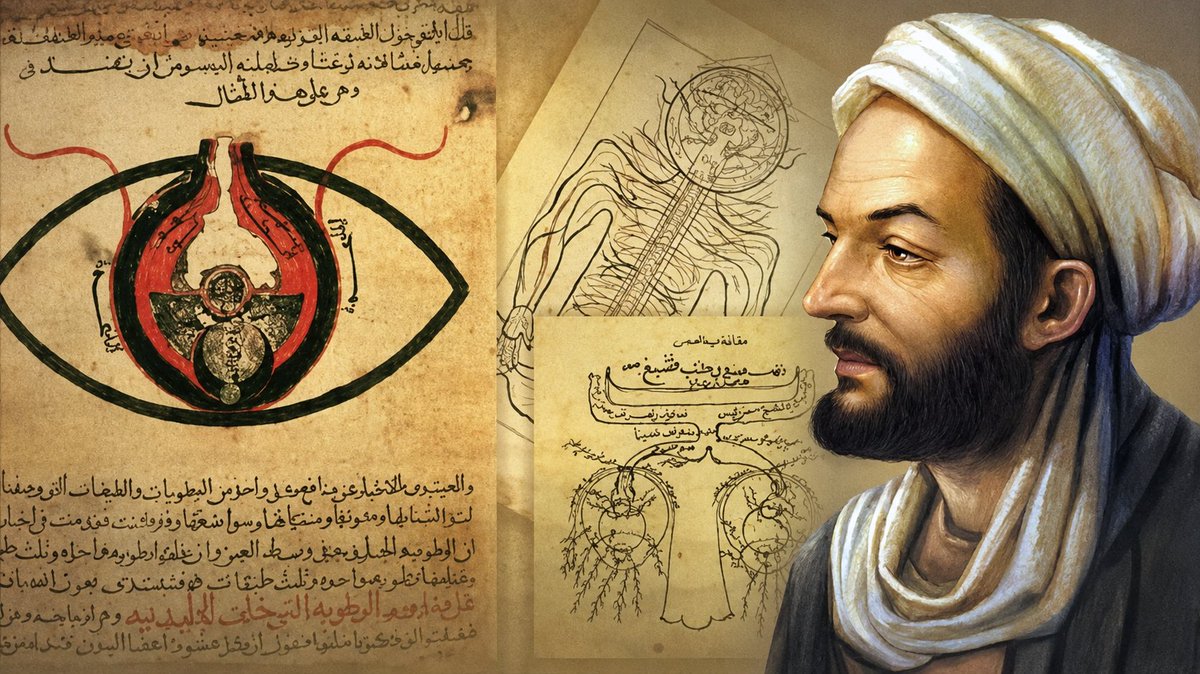
A Persian physician memorized the entire Quran by age 10 and was practicing medicine by age 16. By 18 he had cured a sultan that no other doctor could help. The textbook he wrote in his 30s became the operating manual for every European doctor for the next 600 years.
I started reading about him at midnight and could not believe one teenager had personally built so much of the foundation of modern medicine.
His name was Ibn Sina. The book is called The Canon of Medicine.
Every modern clinical trial. Every evidence-based drug protocol. Every pharmacology textbook. Every medical school curriculum that teaches doctors to observe before they prescribe.
All of it traces back to a Persian teenager who finished his medical education before most modern students finish high school.
Ibn Sina was born in 980 CE near Bukhara, in modern-day Uzbekistan. His father was an Islamic scholar who employed the best tutors money could buy. The tutors started failing to keep up with him almost immediately.
By age 10 he had memorized the entire Quran word for word. By 12 he was correcting his tutors on points of law. By 14 he had outpaced his teacher in mathematics and started learning on his own. By 16 he was treating patients in his neighborhood.
He later wrote, with no false modesty, that medicine was an easy subject and he had mastered it quickly.
He hit a wall around 17. He could not understand Aristotle's Metaphysics. He read the book forty times and still could not grasp it. Then he picked up a commentary on it by Al-Farabi in a Bukhara bookshop for a few coins, read it overnight, and suddenly the entire system of Greek philosophy snapped into place.
He went home and gave alms (money or goods) to the poor in gratitude that he had finally understood.
A year later the news of his medical skill reached the sultan of Bukhara, Nuh ibn Mansur, who was suffering from an illness no doctor in his court could cure. Ibn Sina was called in. He treated the sultan. The sultan recovered. The 18-year-old asked for one thing in payment.
Access to the royal library.
The library of the Samanid sultans in Bukhara was one of the greatest in the Islamic world at that time. Ibn Sina spent the next year inside it reading everything he could find.
He later wrote that by age 21 he had absorbed everything written by every major scholar before him, and that the rest of his career was just refining what he had already understood as a teenager.
He spent the next decade as a wandering physician and political advisor. Empires were collapsing across Persia and Central Asia. He moved from court to court, treating princes, drafting legal documents, escaping invasions, hiding from enemies who wanted to kill him for his association with rival rulers.
He wrote at night while moving between cities by day. He was imprisoned at least once. He kept writing.
In his 30s and 40s he produced The Canon of Medicine. A five volumes book at least a million words. A complete synthesis of every medical tradition he could find. Greek medicine from Galen and Hippocrates. Persian medicine from his own tradition. Indian medicine from Ayurvedic texts. His own clinical observations from thousands of patients.
The Canon was translated into Latin in the 12th century. It was reprinted more than 30 times in the 15th and 16th centuries alone. It was the standard reference text at the University of Paris, the University of Bologna, and Oxford well into the 17th century.
William Osler, one of the founding fathers of modern medicine, called it the most famous medical textbook ever written and said it served as a medical bible for a longer period than any other book in human history.
The part that most people miss is what was actually inside it.
He laid out clear rules for testing whether a drug works rules that still look like modern clinical trials. The drug must be pure, tested on a single condition, and checked against opposite conditions for consistent results. Effects must be seen repeatedly, with timing that matches the treatment. And it has to be tested on humans, since animal results don’t always carry over.
A thousand years before the modern clinical trial existed, he had written its protocol.
He defined medicine itself in a sentence that has never been improved on. Medicine is the science by which we learn the various states of the body in health and when not in health, the means by which health is likely to be lost, and when lost, is likely to be restored.
He insisted that prevention came before treatment. He argued that lifestyle, diet, exercise, and sleep mattered as much as drugs. He was right by a thousand years. He documented hundreds of conditions with such precision that European doctors were still using his diagnostic categories in the 1700s.
He died in 1037 at age 57. He was on a military campaign with one of the rulers he served when he developed colic. He treated himself with what he believed was the correct remedy. The remedy did not work. He died near the city of Hamadan in modern Iran. His tomb is still there.
His own assessment of his life is one of the most honest things any genius has ever written about themselves. He said he had lived a wide life rather than a long one and that he preferred it that way.
The Canon is digitized at the Library of Congress. The original Arabic version is preserved at multiple universities. Free English translations exist online.
The medical textbook that trained every European doctor for half a millennium is sitting one click away from you.
Most modern doctors have never heard the author's full name.
How to build a vertical AI agent cash-flowing startup:
find painful workflow in a boring industry → talk to 10 people who do that workflow every day → map every step, every tool, every spreadsheet, every phone call →
do the workflow manually first → be the agent before you build the agent → find the edge cases that break everything → document them in obsidian as structured markdown →
set up your agent stack → hermes for the harness → obsidian vault as the knowledge base → composio for authentication across apps �� build your first 1-3 skills that solve the core pain →
use claude code or codex to build the product → use agents to set up other agents → use perplexity MCP and context7 for up-to-date docs → let the agent handle the scaffolding while you focus on the workflow logic →
ship the agent to your first 5 customers for free → watch what they actually use it for → they will surprise you → the thing you built for isn't always the thing they need most →
build content around the niche → not "building in public" content → useful content → the tips, the shortcuts, the pain points that only someone who does this workflow would know → become the person for that niche →
charge per outcome not per seat → per lease renewed, per claim processed, per candidate sourced → the ROI conversation takes 10 seconds when it's tied to a result →
set up watchdogs and alerts → your agent emails you when a cron job breaks or a skill fails → the customer should never have to tell you something is broken →
connect to open router → see exact costs per model per task → use GPT 5.5 for tool calls → use open source for lightweight tasks → route the right model to the right job → watch your margins double →
let hermes write to its own memory after every task → the agent compounds → the longer it runs the better it gets → that accumulated memory becomes your moat → a competitor can clone your product but they can't clone 6 months of context →
expand the workflow → you started with one step → add the next → then the next → now you own the entire workflow end to end → you went from a tool to the operating system for that vertical →
stack the agents → one agent is a side project → five agents across five customers is a business → each one runs in its own environment → you check in once a day →
raise only if you need capital not credibility → most agent businesses should never raise → the margins are too good to give away equity → stay lean → stay profitable → repeat
i'm rooting for you
i made an app that feeds you to the sharks if you don't publicly launch your own product in 30 days.
no more of this: "dude i just 100x'ed my workflow with this new AI model"... meanwhile...
0 projects launched
0 revenue
0 users
100 x 0 = still 0.
it's time to go from 0 to 1.
it's time to: https://t.co/UO3UHNNZiR 🏴☠️.
ship a new product every 30 days until one changes your life or...
DIE, in the app, and get kicked from the community forever while being publicly humiliated.
no refunds for those who fail to ship. custom trophies to be collected for those who succeed.
if you DO ship, you also get to remain in a community of people who actually ship things and get users ++ revenue.
sidenote: i'm really excited to see if this can be the push someone needs like how @marclou's shipfast project pushed me and is the entire reason i have a $35K MRR solo operated SaaS now and many other successful mobile apps
GLHF, DON'T DIE, and KEEP GOING!! i've never taken a launch this legit so let's see how it goes :)
Anthropic just paid millions to hire Andrej Karpathy.
He gave you the same knowledge for $0 the same week.
Co-founder of OpenAI. Former head of AI at Tesla. The man who coined vibe coding.
No recruitment fee. No exclusive access. Just a link and 29 minutes.
LLMs are ghosts not animals.
Vibe coding is dead.
Software 3.0 is here.
Watch it.
Then read this.
Because Karpathy tells you what Software 3.0 is.
This shows you how to build one - a software factory with Claude Code that ships features while you sleep.
The full build guide is below.
WAIT. This is actually insane.
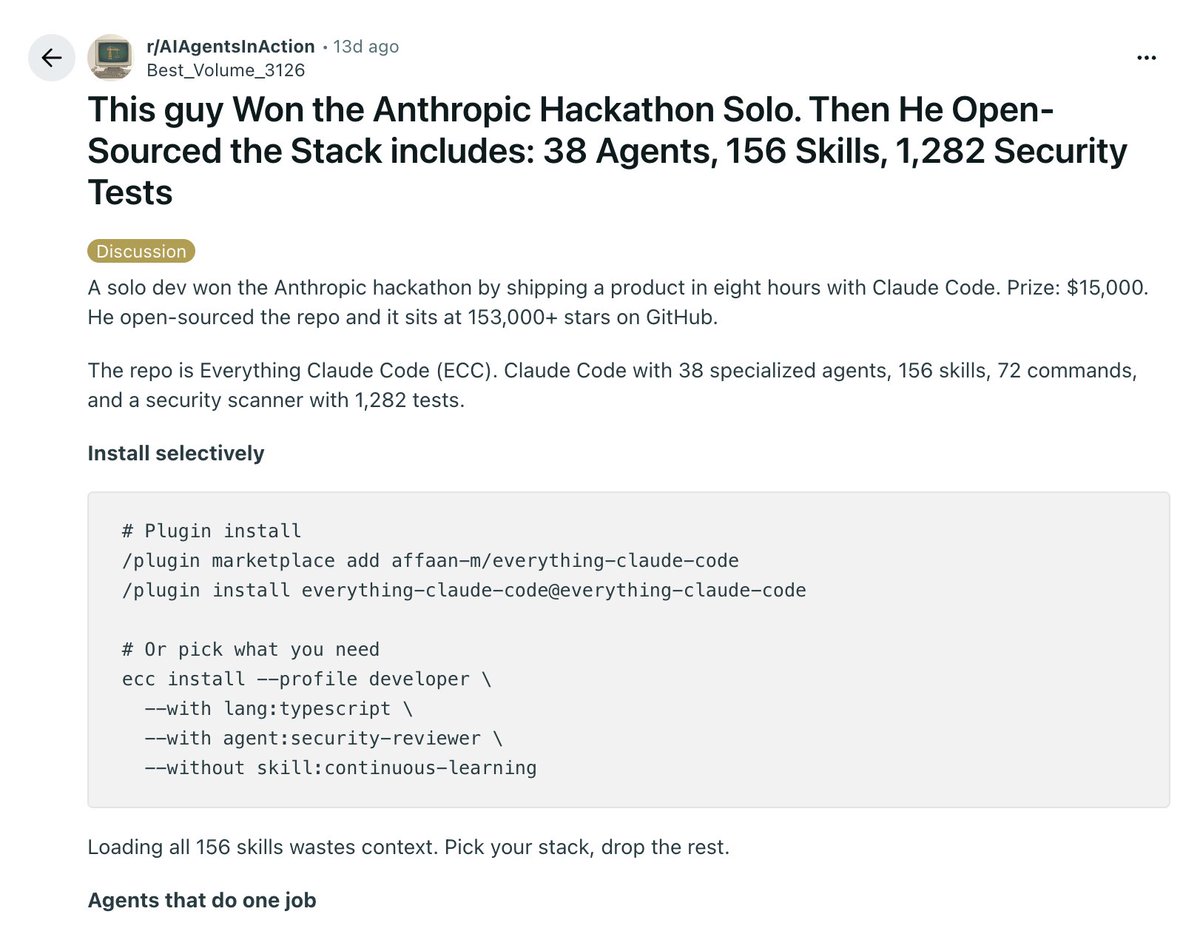
A solo dev just won the Anthropic hackathon, shipped a working product in 8 hours with Claude Code, and walked away with $15,000.
Then he open-sourced the entire stack.
153,000 stars on GitHub. Here's full setup:
→ 38 specialized agents (planner, security reviewer, debugger, code reviewer)
→ 156 skills loaded on demand (/plan, /tdd, /security-scan, /quality-gate)
→ 72 custom slash commands
→ AgentShield: 1,282 security tests across CLAUDE .md, MCP configs, hooks, skills
→ 3 Opus 4.6 agents running red-team pipelines (Attacker, Defender, Auditor)
→ Continuous learning layer that builds confidence across sessions
→ Coverage across 12 language ecosystems
This is what Claude Code looks like when someone treats it like infrastructure instead of a chatbot.
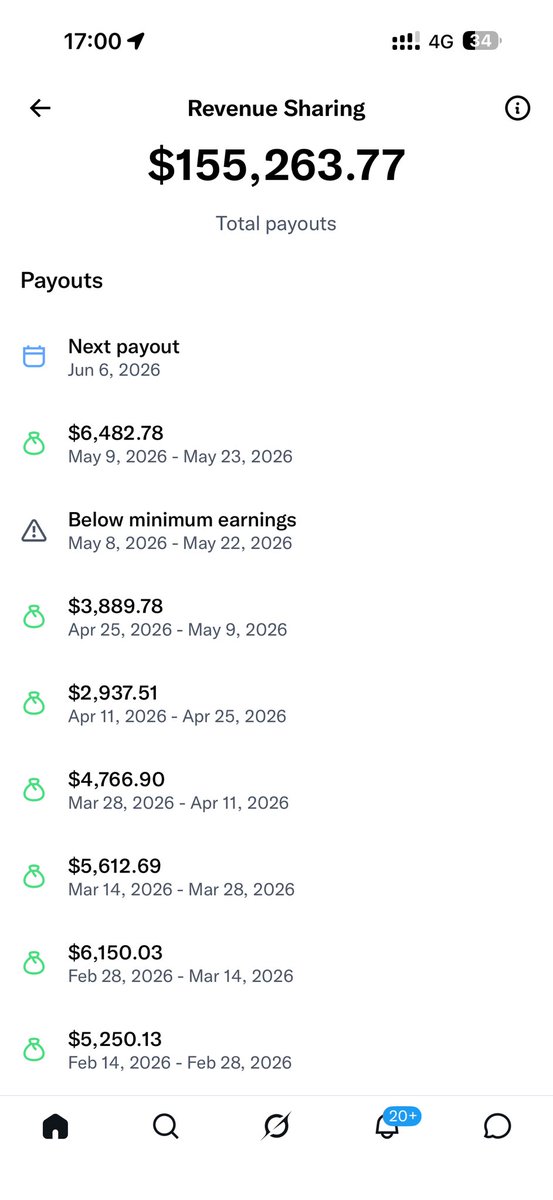
💰My @X revenue is almost $14,000 this month
$6,482 + $3,889 ad rev share
$1,091 + $1,173 sub revenue
(=$12,584 per 28 days)
= $13,707/month
Also my https://t.co/RyXpqGuFM3 merch sold $4,010 this month and my book https://t.co/VEoyhFdCOd $3,562
So together that's $21,279/mo in non-primary-business but more like "influencer" (what a cringe term but ok) revenue which is kinda interesting
And for the first time that influencer revenue is now actually bigger than one of my primary businesses https://t.co/UXK5AFqCaQ which is at about $10K/mo (I made it almost free to sign up so that's why)
This has kinda been my goal since the AI wave started 4 years ago, I knew many things would get replaced by AI (my businesses too) but human authenticity can't be, so I slowly started to focus on that a bit more, writing more fun blog posts here about my travels and things I do with my tech stack
My favorite thing is to make money with businesses though but I have to diversify a bit 😊
A Google Cloud engineer just showed how to build a full app with Claude from scratch
he spent 26 minutes showing exactly what one person with Claude can do, completely free
worth more than any $500 vibe-coding course
here's what he covers:
> raw idea to deployed app in a single session
> using Claude as the entire engineering team
> the exact workflow they use at Google
> no big team, no prior experience needed
the people who figure out what Claude can actually do are building things everyone else thinks requires a team
that's exactly why I put together a guide on Claude features most people have no idea exist
the guide is in the article below