I saw a slide circulating on social media last night while working on a deadline. I didn’t comment immediately because I wanted to understand the full context before speaking. After learning more, I feel compelled to address what I witnessed during an invited talk at NeurIPS 2024 by Professor Rosalind Picard.
I deeply respect Professor Picard’s scholarship and contributions to the field. However, her comments during the talk reflected a deeply troubling and racist view of Chinese scholars. This was not just inappropriate but also profoundly disheartening.
First, it was entirely unnecessary to mention the student’s nationality when discussing an incident of cheating. The point about academic integrity could have been made without emphasizing nationality. Yet, Professor Picard chose to highlight it. This choice perpetuates harmful stereotypes about Chinese scholars and reflects a broader bias against Asians, often rooted in the assumption that we “work hard, avoid conflict, and don’t push back.”
This needs to change. Asians, like everyone else, have the right to speak out and demand accountability when racism occurs. We will ensure that being racist against Asians has consequences, including here, Professor Picard.
What made this incident worse was how it unfolded during the Q&A session. A Chinese attendee asked a professional and thoughtfully articulated question. She began by thanking Professor Picard for her talk and posed this question:
Are you calling out the student’s nationality because you find most Chinese scholars honest, and the fact that the cheating student was Chinese is rare? Is that why you emphasized nationality?
This was a generous and high-EQ question, offering Professor Picard an opportunity to reconsider or clarify her comments. Unfortunately, she doubled down instead.
Professor Picard reinforced her remarks by quoting the student’s excuse —that ethics wasn’t taught in their school—and generalized this as a broader issue with Chinese education. This statement is both factually incorrect and deeply offensive.
There are glaring logical flaws in this argument:
1.If the student cheated, why would their excuse about ethics education be taken at face value? A serious scholar would investigate the claim before making it a central part of their argument.
2.Even if the student’s school didn’t teach ethics (which is false for schools in China), other sources like family and community often instill strong ethical values. Ignoring this nuance is careless and reinforces stereotypes.
What is most heartbreaking is that Professor Picard couldn’t even acknowledge something as simple as: “Most Chinese scholars are honest and upright.” Instead, she focused on the singular exception and added, “Of course, with this one exception in this case” in her response.
I regret that this happened at NeurIPS. I regret that this happened in my research community—a place I have cherished and contributed to for over 14 years. I regret that this happened at MIT, an institution of excellence and aspiration for many Chinese scholars.
Racism has no place in academia, and incidents like this tarnish the principles of inclusion and respect that we, as a global research community, should uphold.
I hope NeurIPS and the broader academic community take this as a wake-up call to address the biases and systemic issues that enable such comments to go unchallenged. We must do better.
@MIT_CSAIL@NeurIPSConf
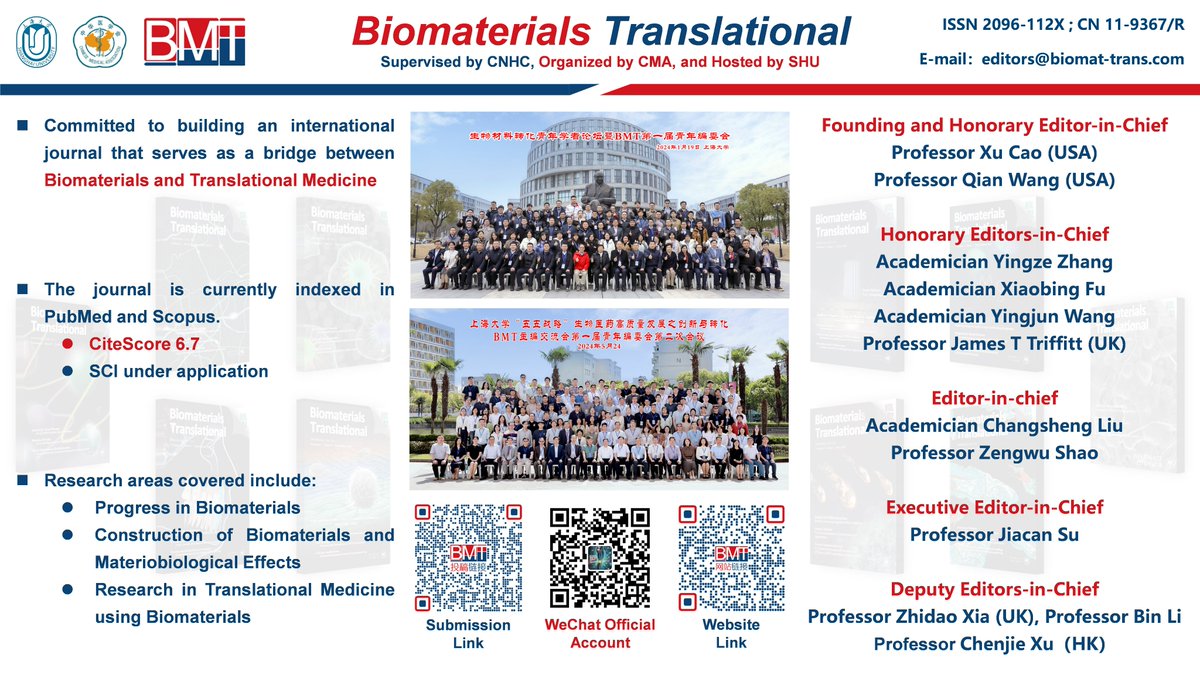
Biomaterials Translational (ISSN: 2096-112X)is an international journal publishing research at the interface of translational medicine, biomaterials science and engineering.
For more details:
https://t.co/V57HHPJDwz
I am honored to be appointed as ARISTOS postdoc fellowship. I am very appreciated to Prof. Jose Luis Pedrez and Prof. Ramalingam for their support and encouragement. Also thanks a lot to @CIBERBBN & @postdocAristos as well as reviewers~
📢 The final results of the first #ARISTOS call are now out! 🎉
Check the final scores and next steps here 👉 https://t.co/W3lLOeEBs7
Congratulations to the selected fellows! We look forward to your groundbreaking research! 🧬🔬
#Biomedicine#HealthSciences#Research
📢 The final results of the first #ARISTOS call are now out! 🎉
Check the final scores and next steps here 👉 https://t.co/W3lLOeEBs7
Congratulations to the selected fellows! We look forward to your groundbreaking research! 🧬🔬
#Biomedicine#HealthSciences#Research
Have you ever wondered how biofabrication can accelerate the path of cultured meat to market? Then read our latest comment in @NatRevMater, a great collaboration with Prof. Petra Kluger's group (@HS_Reutlingen) and @Tillerius 😊🥩🧫
https://t.co/OuvEdXZnru
Are you excited about #bioprinting and looking for a PhD position out of this world 🚀? Then apply now and join us @Medizin_TUD in making 3D bioprinting of a human skin model ready for being printed on the ISS! 🤩⬇️ @tudresden_de@DLR_SpaceAgency
https://t.co/LywcOkRh35
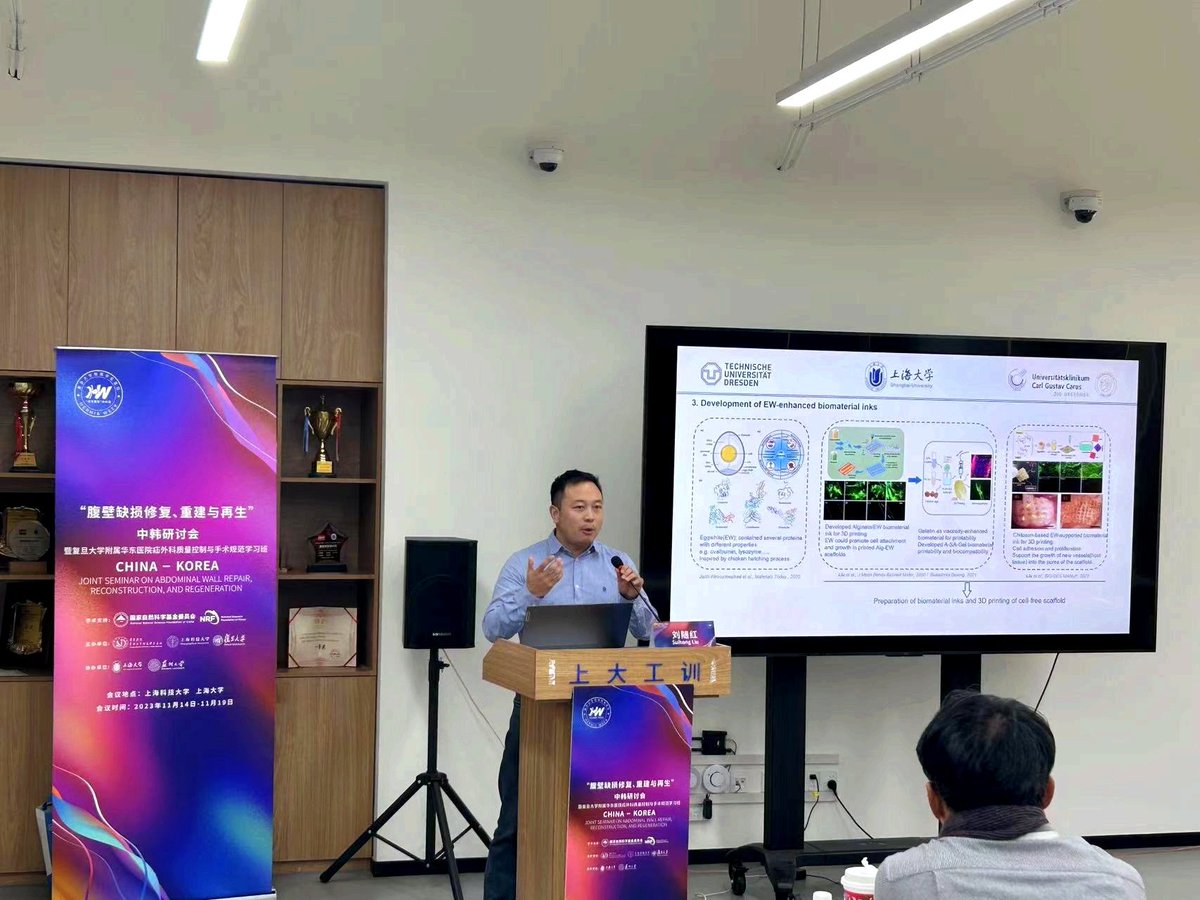
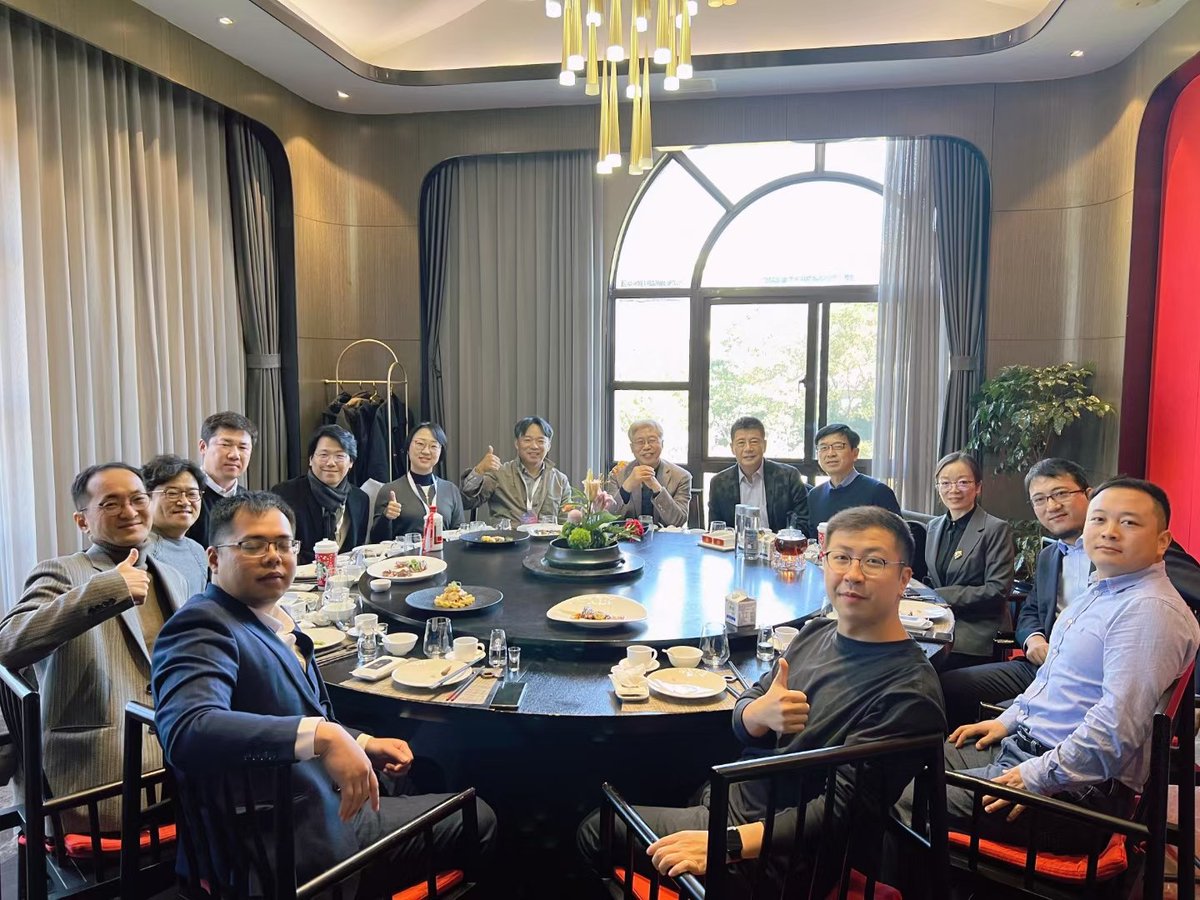
China-Korea Joint Seminar on Abdominal Wall Repair, Reconstruction, and Regeneration was hosted in @ShanghaiTechUni and @SHU19945 last week. I deliveried a talk about our bioink and 3D bioprinting, also met old friends and made new🥂~
Ever wondered how #MeltElectrowriting could be combined with other #3Dprinting techniques to mimic the human eardrum? 👂 Check out our newest publication in @ActaBio
https://t.co/pm3jPF8MRf
@zhigangsuo So sorry to hear your loss,Prof. Suo. Respect and thank you to share such lovely story. My sincere condolence to you and your family (节哀顺变)🙏🏻
😁Excited to share our latest review in @JTissEng , if you are interested in how to construct the volumetric and human-scale functional tissue and organ substitutes, please check it out. #OpenAccess
https://t.co/9u8H5iyI0G
Check out the latest report on our new study on the transportation and storage of ready to use bioinks for use in space @Space_Station ! 🚀🛰️
@Medizin_TUD @tudresden_de
https://t.co/JbZrUMxPw9
Bridging day is new paper day! 🥳 Our team around @SuihongLiu and @killioanDK together with @SHU19945 show how multichannel co-printing of organic and inorganic (bio)inks can create synergies for the generation of hard, mineralized bone tissues.
https://t.co/8FE5hZjmpW
After a long weekend, excited to see our latest paper come out, published in Comp.B Eng.@ElsevierNews@ElsevierConnect.Thanks a lot to our lab @Bioprinting_DD supporting and colleagues' efforts. If you are interested in multichannel 3Dbioprinting and BTE🦴, worth to have a look~
Bridging day is new paper day! 🥳 Our team around @SuihongLiu and @killioanDK together with @SHU19945 show how multichannel co-printing of organic and inorganic (bio)inks can create synergies for the generation of hard, mineralized bone tissues.
https://t.co/8FE5hZjmpW
Do astronauts have to laboriously produce bioinks for Bioprinting In Space themselves or can this already be done on Earth? To find out, @JohnWindisch and colleagues looked at whether bioinks retain their functionality under prolonged cold storage 🚀🧑🚀🧫
https://t.co/r6SyA9tq09