The greatest financial revolution of our lifetime didn’t happen on Wall Street, and it wasn't debated on the floor of Congress. It happened when the United States Federal Reserve quietly assassinated LIBOR.
For half a century, the global economy was held hostage by an interest rate set by a shadow cartel of banks in the City of London. It was the ultimate subversion of American sovereignty, a system designed to extract wealth and export control.
But a silent financial coup has reclaimed the US dollar. Here is the untold story of the death of LIBOR, the weaponization of SOFR, and the explosive, real-time return of the true American System of economics.
The Forgotten American System
To understand what we just won back, you must first understand what was stolen from us. The American Revolution wasn't just a political war; it was an explicit, philosophical rebellion against the British Empire's economic model of free-trade imperialism, speculative finance, and raw material extraction.
Our Founding Fathers, led by Alexander Hamilton, engineered a revolutionary alternative: The American System. This system relied on absolute national sovereignty over banking and the issuance of public credit to fund physical infrastructure, manufacturing, and scientific advancement. Hamilton’s National Bank was the exact opposite of the modern central banking cartel; it was strictly prohibited from monetizing government debt for financial speculation.
Later, Abraham Lincoln revived this system with his Greenback policy to build the transcontinental railroad, proving that human creativity and productive labor—not stockpiled gold or speculative usury—are the true sources of a nation's wealth. The American System was designed to foster human potential, rejecting the British imperial model of parasitic rent-seeking and artificial scarcity.
The Offshore Hijacking
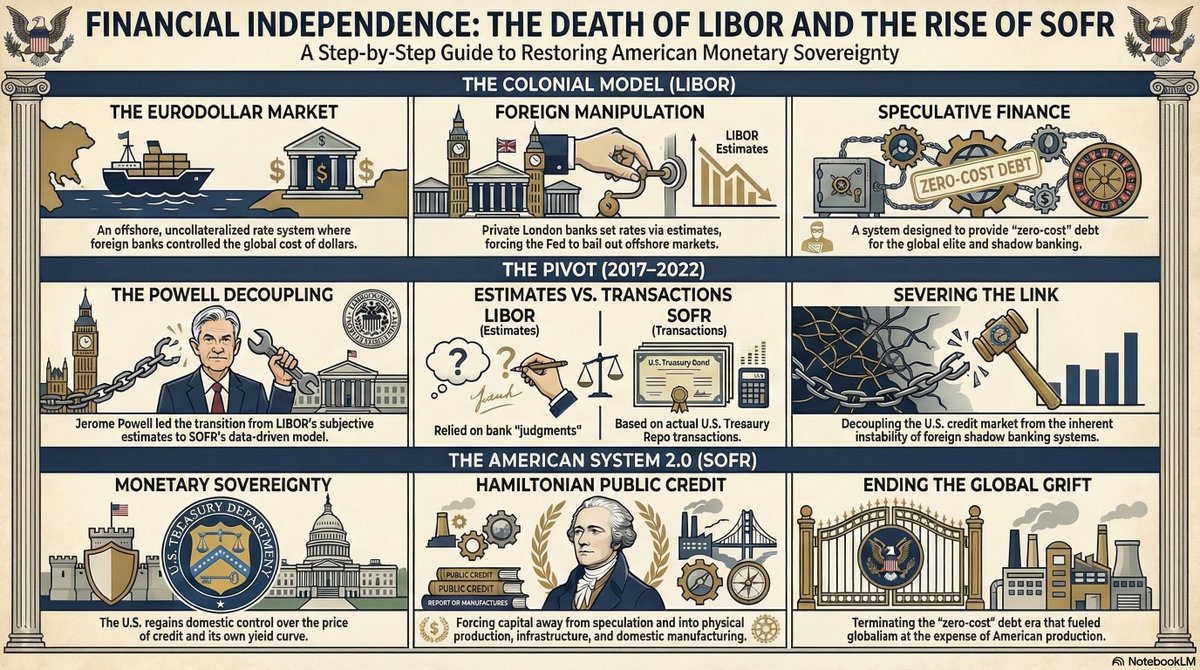
However, over the late 20th century, America surrendered its economic sovereignty to the very financial empire it once defeated. The mechanism of control was the "Eurodollar" market—trillions of US dollars held in offshore foreign bank accounts, operating completely outside the jurisdiction and regulation of the United States.
To regulate this massive, shadow banking system, the London Interbank Offered Rate (LIBOR) was created. By 1986, LIBOR dominated the globe. It dictated the price of global dollar debt, allowing a handful of London banks to skim a massive vig off the world economy while systematically stripping the US Federal Reserve of its power.
Because the entire world's debt was indexed to LIBOR, the Fed became a helpless dog wagged by its offshore tail. US monetary policy was constantly forced to chase offshore rates, bailing out foreign Eurodollar markets whenever they seized up to prevent domestic contagion. This was the ultimate betrayal of Hamilton and Lincoln. It aligned US monetary policy with European globalist objectives, fueling a system that stripped the American middle class of its wealth to subsidize a transnational financial oligarchy.
The Kill Shot: Enter SOFR
The turning point arrived in 2017, when a silent, coordinated effort began to break this colonial blackmail once and for all. Under the Trump administration, FOMC Chair Jerome Powell began the relentless transition away from LIBOR to the Secured Overnight Financing Rate (SOFR).
This was not a mundane bureaucratic update. It was a financial declaration of independence.
Unlike LIBOR, which was an uncollateralized rate manipulated by London banks, SOFR is a market-driven rate based strictly on domestic US repo markets and backed by actual Treasury collateral. By officially sunsetting LIBOR and fully implementing SOFR across US financial markets by 2022, the Federal Reserve achieved the impossible: it fundamentally decoupled onshore US dollars from offshore Eurodollars.
Reclaiming the Republic
The implementation of SOFR severed the direct link that allowed European banking powers to hold US credit markets hostage. Your home equity line of credit, your auto loan, and domestic corporate debt are no longer tied to the derivative books of offshore banks like Deutsche Bank or Barclays; they are tied directly to the Fed's policy rate and local US bank balance sheets.
This single structural shift returned ultimate monetary power to Washington. Because the Fed no longer had to instantly bail out foreign markets to protect domestic lending, Jerome Powell gained the superpower to relentlessly hike interest rates.
By aggressively raising the Fed Funds Rate to 5.5% and holding it there, Powell began starving the highly-leveraged Eurodollar system of vital liquidity. He weaponized the US dollar to crush the offshore shadow banking system that had parasitized American wealth for decades.
The Hamiltonian Revival
We are witnessing the violent, real-time death of the globalist monetary order. The transnational elite—often referred to as the "Davos Crowd"—relied entirely on zero-cost Eurodollars to fund their neo-feudal agendas, enforce global compliance, and dictate terms to sovereign nations. Without the Fed acting as their unconditional lender of last resort, their entire architecture of control is collapsing under the weight of higher interest rates.
The switch from LIBOR to SOFR is the foundational step in reviving the true American System 2.0. By taking back control of the price of the US dollar, the United States has reclaimed its sovereign right to dictate its own economic destiny. We are moving away from a post-industrial era of uncollateralized, speculative debt and returning to a system where capital has a real cost. This forces investment back into physical production, hard assets, infrastructure, and domestic industry.
The era of the offshore empire dictating American prosperity is over. Hamilton’s vision is finally rising from the ashes, and the rebuilding of sovereign public credit has just begun.
It's beyond obvious now that The Senate cannot allow The SAVE ACT to advance even if 100% of American voters (instead of just 80-85%) approve of it BECAUSE many in Congress are NOT elected - they are installed. Anything preventing this crime cannot be approved @ScottPresler@BasedMikeLee
💥 KABOOM 💥🚨
Marco Rubio just said something that’s blowing up online.
He pointed to Americans who worked their entire lives, only to retire on $800–$1,000 a month in Social Security.
Then compared it to claims that some new arrivals receive higher monthly benefits.
Read that again.
Worked your whole life…
Less support.
Just arrived…
More support?
🇺🇸🔥
This is why the debate over benefits, fairness, and government priorities is EXPLODING right now.
People are asking:
Who comes first?
America First — that’s the message.
Watch closely.
One of the most devastating indictments of socialism sits buried in Soviet agricultural statistics: private plots representing just 3% of farmland consistently produced 25-30% of the USSR's total food output. Private ownership generated output that collective ownership could not match, even at vastly smaller scale.
Picture this absurdity. A collective farm worker tends 1,000 acres of state wheat with the enthusiasm of someone filling out tax forms. The same worker then rushes home to lavish attention on his quarter-acre private vegetable patch, working until sunset to coax maximum yield from every square foot. The difference in productivity per acre often reached 10:1 ratios. Sometimes higher.
On collective farms, additional effort generated zero additional reward for the individual worker. Your extra sweat benefited the collective (meaning nobody in particular) while you bore the full cost of that effort. Workers rationally allocated their energy toward their private plots where they captured 100% of marginal returns.
Soviet planners grasped the embarrassing implications and repeatedly restricted private plot sizes and banned certain crops, fearing that obvious productivity comparisons would undermine ideological credibility. The restrictions backfired spectacularly. Every limitation on private plots worsened food shortages and strengthened black market prices.
You can dress up collective ownership in whatever intellectual framework you prefer. You can invoke solidarity, social justice, or the greater good. But you cannot escape the fundamental reality that human beings respond to incentives, and collective ownership systematically destroys the connection between individual effort and individual reward.
The 19th century was history's greatest experiment in minimal government and maximal human flourishing. You had a federal budget that consumed roughly 3% of GDP, zero income tax until 1913, and a monetary system anchored to gold. The results speak louder than any economic theory: America transformed from an agricultural backwater into the world's industrial powerhouse in less than a century.
Consider the numbers. Real wages doubled between 1860 and 1890. Railroad mileage exploded from 30,000 miles in 1860 to 164,000 miles by 1890. Steel production jumped from 77,000 tons in 1870 to over 4 million tons by 1890. No central planning committee orchestrated this transformation. No industrial policy czar allocated resources. Entrepreneurs risked their own capital, succeeded or failed on their own merits, and consumers voted with their wallets.
The government's role was enforcing contracts and protecting property rights. No antitrust lawsuits against successful companies. No bailouts for failed ventures. No regulatory agencies strangling innovation in its cradle. When Jay Gould built his railroad empire, he answered to bondholders and customers, not bureaucrats. When Andrew Carnegie revolutionized steel production, the market rewarded efficiency and punished waste.
Critics love to mention the "robber barons" while ignoring that these men drove down prices and improved quality through relentless competition. Standard Oil reduced kerosene prices by 90% between 1870 and 1897. Carnegie slashed steel prices so dramatically that skyscrapers became economically viable. They got rich by making everyone else better off.
Today's economists worship GDP growth rates of 3% as miraculous achievements. Nineteenth-century America routinely posted growth rates above 4% with no stimulus packages, quantitative easing, or industrial policy. They had economic freedom and sound money.
Imagine you spent 40 years doing the boring, responsible thing.
You opened a 401k at 23. You contributed every paycheck. You ignored the noise. You bought the index because Bogle told you to, because Buffett told you to, because every honest piece of financial advice for 30 years told you the index was the safest, most diversified, most rules-based way to own America.
The whole point was the rules.
The rules said: a company must trade for 12 months before joining the S&P 500. The rules said: it must show four consecutive quarters of GAAP profitability. The rules existed because in 1999 the index quietly bought a lot of stocks at the top, and pensioners paid the bill.
After the dot-com crash, S&P tightened the rules. Nasdaq tightened the rules. FTSE Russell tightened the rules.
For 23 years, those rules held.
Then SpaceX filed for IPO.
And the rules changed.
The S&P 500 waived the profitability requirement. Nasdaq cut its trading-history window from 90 days to 15. FTSE Russell cut its to 5.
Bloomberg Intelligence estimates the major index funds will absorb between 19% and 24% of SpaceX's float within six months. That's over $30 trillion of passive 401k and retirement money, mechanically buying a single newly public company at IPO valuations, because the rules said they had to.
Except the rules used to say they didn't.
Here's the thought exercise:
If you spend 40 years building a system designed to protect ordinary savers from buying overpriced stocks, and then you waive the protections the moment a sufficiently large stock asks you to, what was the system actually protecting?
Most of investing is about understanding what's a rule and what's a guideline.
A rule binds the rule-maker.
A guideline binds the saver.
You're allowed to find out which is which only after the fact.
BlackRock CEO Larry Fink just said the quiet part out loud about the AI boom.
AI models are so incredibly starved for power and data centers that tech giants are hitting a wall. They need trillions of dollars to build the grid.
So what’s the plan? Route your retirement money into it.
He wants to use everyday 401(k)s and pension funds to build the infrastructure tech monopolies need.
If it works, Big Tech wins big. If it fails, it’s your life savings on the line.
They are turning your retirement into the venture capital for their AI grid.
Bro, really unmasked the playbook.
More millionaires will be made in mining and commodities over the next 5 years than in AI.
I know that sounds wild. Hear me out.
AI runs on copper, nickel, lithium, uranium. Every datacenter, every robot, every EV.
The catch: we haven't sanctioned a major copper mine in over a decade. Discovery curves are flat. Discovery to production takes 15+ years.
Exploding demand meeting structurally constrained supply. Textbook setup for a generational commodities bull run.
AI gets the headlines.
The shovels get the returns.
Full conversation: https://t.co/icf4kdliTS
Thomas Sowell breaks down how most intellectuals think:
“The best definition I’ve heard is from Hayek—he says an intellectual is a ‘secondhand dealer in ideas.’”
“The vast majority of intellectuals don’t originate any ideas but they peddle ideas that other people have originated.”
“That gives them a great deal of freedom because ideas and words are so malleable. Reality is not malleable. So they can believe in all sorts of things which have no realistic possibility and which have failed time and again in history.”
“But because they know how to rephrase it and repackage it, they can just keep right on going.”
The debasement of the US dollar has been highly destructive to American society.
We have young people who can't afford a home, gambling and porn ads are being shoved in our face, and a large portion of people are walking around in a state of depression or anxiety.
We went from long-term thinking and strong morals to a population of speculators who can't focus for 5 minutes.
It is all tied back to the dollar's destruction.
🇦🇷 Peter Thiel has temporarily relocated his family to Argentina, purchased a $12 million mansion in one of Buenos Aires’ most exclusive neighborhoods, and enrolled his children in local schools.
🇺🇸 When a state like California starts introducing a wealth tax, it is not because politicians are socialist or stupid.
It’s because they want to drive out the wealthy on purpose and reduce the tax base, deliberately asset-stripping the state for private institutional ownership that can use the tax code to secure exemptions and advantages.
It’s not because politicians are stupid.
It’s not because they are radical left-wing communists.
That’s the narrative that keeps you locked into the belief that the left has the back of the poor, while the right gets to point at the left when the state goes to shit.
It’s because the state is being acquired by the financial-industrial complex, and the resulting civil unrest serves the private prison sector of the military-industrial complex.
At the same time, they install a police and surveillance system that benefits the technological-industrial complex powered by Palantir.
The same one Peter Thiel works for.
It’s a business model.
Anywhere you see a wealth tax, it’s an end-game asset-stripping exercise that gives more power to the wealthy, not less.
They are not coming after billionaires.
They are transferring wealth to billionaires.
By design.
ALL POLITICIANS WORK FOR THEIR CORPORATE LOBBIES.
Stop believing in left-versus-right politics.
It’s a distraction from the reality that you vote with your money.
The Silk Road proves that free markets create order without central planners, connecting civilizations across 4,000 miles of desert, mountain, and steppe for over 1,500 years. No emperor designed this network. No trade ministry coordinated cargo manifests between Chang'an and Constantinople. Merchants simply responded to profit opportunities, and spontaneous order emerged.
You can trace how price signals guided everything. When Romans developed an obsession with Chinese silk in the 1st century AD, prices spiked in Mediterranean markets. Sogdian traders in Samarkand noticed the arbitrage opportunity and organized caravans. They didn't need the Han Dynasty's permission or Byzantium's trade agreements. They needed camels, courage, and capital.
The network's resilience came from decentralization. When the Mongols conquered Central Asia in the 13th century, trade routes adapted instantly. Merchants shifted from the northern routes through Kashgar to southern paths through Khotan. When plague struck one city, caravans rerouted through others. No central authority could possess the distributed knowledge required to manage this flexibility.
Consider the sophistication that emerged organically: standardized weights and measures across cultures, multilingual merchant houses, credit systems spanning continents. The Jewish Radhanites developed letters of credit that worked from Cordoba to Kaifeng. Islamic hawala networks transferred value faster than physical gold could travel. These financial innovations arose from voluntary cooperation, not regulatory mandate.
Modern economists marvel at medieval supply chain complexity. Entrepreneurs created this without a single government coordination meeting. When politicians today claim global trade requires their management, remind them that nomadic horse traders accomplished more economic integration than the UN ever has.
Keynesian stimulus doesn't magically create prosperity from thin air. It redistributes existing wealth from productive citizens to those with the best lobbyists and campaign contributions.
When Congress passes a trillion-dollar "infrastructure" bill, you don't see bulldozers materializing from the ether. The government pulls capital from entrepreneurs who would have built factories, funded startups, or expanded payrolls. Instead, that money flows to Halliburton, Bechtel, and whatever construction firm hired the right former senator as a "consultant." The politically connected get guaranteed profits while you get higher taxes and inflation.
The process works like a sophisticated laundering operation. Politicians promise jobs and growth while funneling taxpayer dollars to their cronies. Boeing gets defense contracts. Goldman Sachs underwrites the debt. Big Tech companies score "green energy" subsidies. Meanwhile, small business owners struggle with regulatory compliance costs and compete for the remaining scraps of capital.
Free market economists identified this wealth transfer mechanism decades ago. Keynesian mythology persists because it serves powerful interests. Politicians love spending other people's money. Corporations love guaranteed returns. Wall Street loves bond issuance fees. The only losers are productive citizens who fund the whole charade.
You can spot this corruption every time politicians claim stimulus will "create jobs." Jobs doing what? Building bridges to nowhere? Manufacturing solar panels that cost more than the energy they'll ever produce? Productive jobs emerge from genuine consumer demand, not political theater. Everything else just moves money from your pocket to theirs.
Once the destructive powers of a Debt Based Global Reserve Currency reaches its final destiny, (i) first Main Street; (ii) followed by Wall Street; and then (iii) US Government in severe Fiscal Dominance…
that’s when the Financial Reset morphs into a foregone conclusion, Wars & Pillage ensues, rampant corruption is normalized and Morality goes to die. Every single time in history ☠️☠️☠️
Every prior time one industry pushed to extreme weight in the S&P 500, the index topped with it. Media & Entertainment hit ~24% in March 2000 — the bell at the dot-com peak. Financial Services reached ~22% in October 2007 — weeks from the cycle high. Energy crested ~16% in mid-2008, before the GFC second leg. Three for three. Chips at ~17% in May 2026 is the fourth setup, and the trajectory — five percent to seventeen in three years — traces Media’s 1998-2000 vertical arc. The slope is the diagnostic, and the composition is sharper still: prior peaks spread across dozens of constituents, today’s ~17% is single-name-heavy, NVDA alone near 7% of the S&P. Vertical expansions are built by concentrated mark-to-market in a handful of leaders absorbing the marginal passive bid; the curve goes parabolic, the unwind mechanical. Every passive dollar — roughly $10T of household savings embedded in pensions, 401(k)s, target-date funds — now carries that chip beta whether the holder consented or not. The pattern is not a forecast. It is a precedent waiting on its catalyst. https://t.co/9ePJiNYuJs
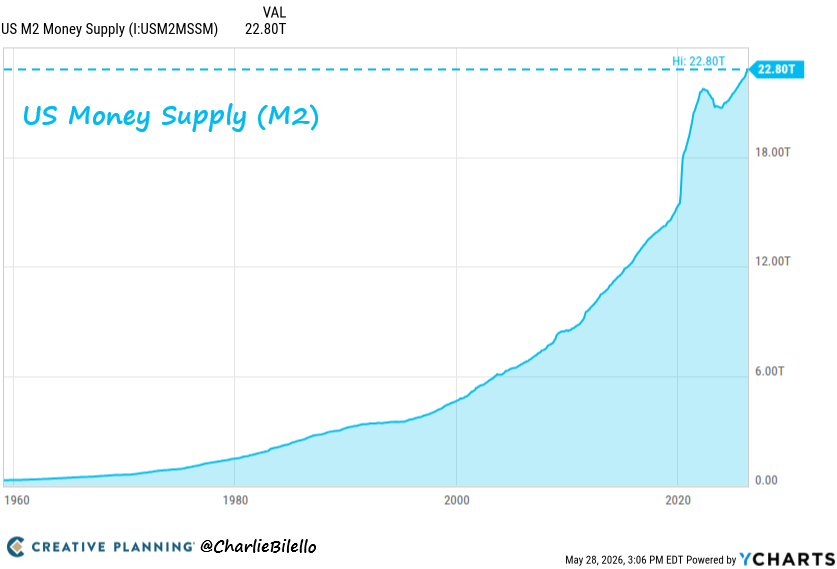
The Fed expanded the money supply by nearly $9 trillion under Powell.
Inflation has averaged >4% per year over the past 6 years.
Powell's explanation? It was nearly all due to rolling “supply shocks" over which the Fed has no control.
The truth: this inflation was made in Washington as it always is - from too much government borrowing/spending and too much government creation of money.
The Mayo Clinic Health System in Minnesota is ending in-person overnight respiratory therapist coverage at three smaller hospital
Albert Lea, Fairmont and Lake Cit starting August 26, 2026
They will be switching to video calls and nurses are whistleblowing
“In Mayo's public statement, they confirmed that overnight advanced airway management and ventilator support will now be handled through video connections.
So this means there's a nurse at the bedside and a respiratory therapist on a screen. The reason Mayo is giving for this is something that you need to hear. The National Clinical Standard names the respiratory therapist as the bedside clinician who should be handling the airway.
But the Mayo Clinic has suddenly decided that this standard of care does not apply to them at night. Video calls can't help intubate. Video calls can't reach the patient.
- The Mayo Clinic is a 501 nonprofit. In 2024, Mayo Clinic reported $19.8 billion in revenue.
- Mayo Clinic CEO is paid $4.88 million
- 42 Mayo Clinic employees make over $1 million a year
Since 2017, the Mayo Clinic has closed 25 clinics in Minnesota. In 2023, the Mayo Clinic lobbied against Minnesota safe staffing laws to give a ratio to nurses of how many patients they could have. They threatened to withdraw billions of dollars if Minnesota passed the safe staffing laws.
Get this, the Minnesota Nurses Association, citing the Minnesota Department of Health adverse health events data, reports that the Mayo Clinic Health System had the highest number of adverse health events in the state last year.”
This is all 100% true I verified it
- Mayo Clinic reported $19.8 billion in revenue for 2024
- CEO Dr. Gianrico Farrugia’s compensation was $4.88 million in 2024 up ~13%
- 42 employees mostly physicians and executives earned over $1 million annually
In 2023 the Mayo lobbied hard against Minnesota’s safe staffing legislation, Keeping Nurses at the Bedside Act, and threatened to pull billions in future investments if strict ratios applied. They secured a carve-out exemption
This is what corruption looks like
Mike Tyson dropped pure wisdom on JRE:
“You don’t have discipline? You ain’t nobody. Nothing.”
Then he hit the killer line Cus D’Amato taught him:
“Discipline is doing what you hate to do, but do it like you love it.”
Joe Rogan nailed the follow-up: master that and you can succeed at anything.
I’ve got plenty of things I know I should do that I straight-up dread. The days I force myself to attack them with energy instead of dragging my feet? Those are the days momentum actually shows up.
Talent and motivation are everywhere. Discipline is what separates the ones who actually make it from the ones who stay “almost there.” In a world full of distractions and easy dopamine, this mindset feels like a cheat code most people never unlock.
What’s one thing you hate doing but know you need to do and how do you trick yourself into loving the process?