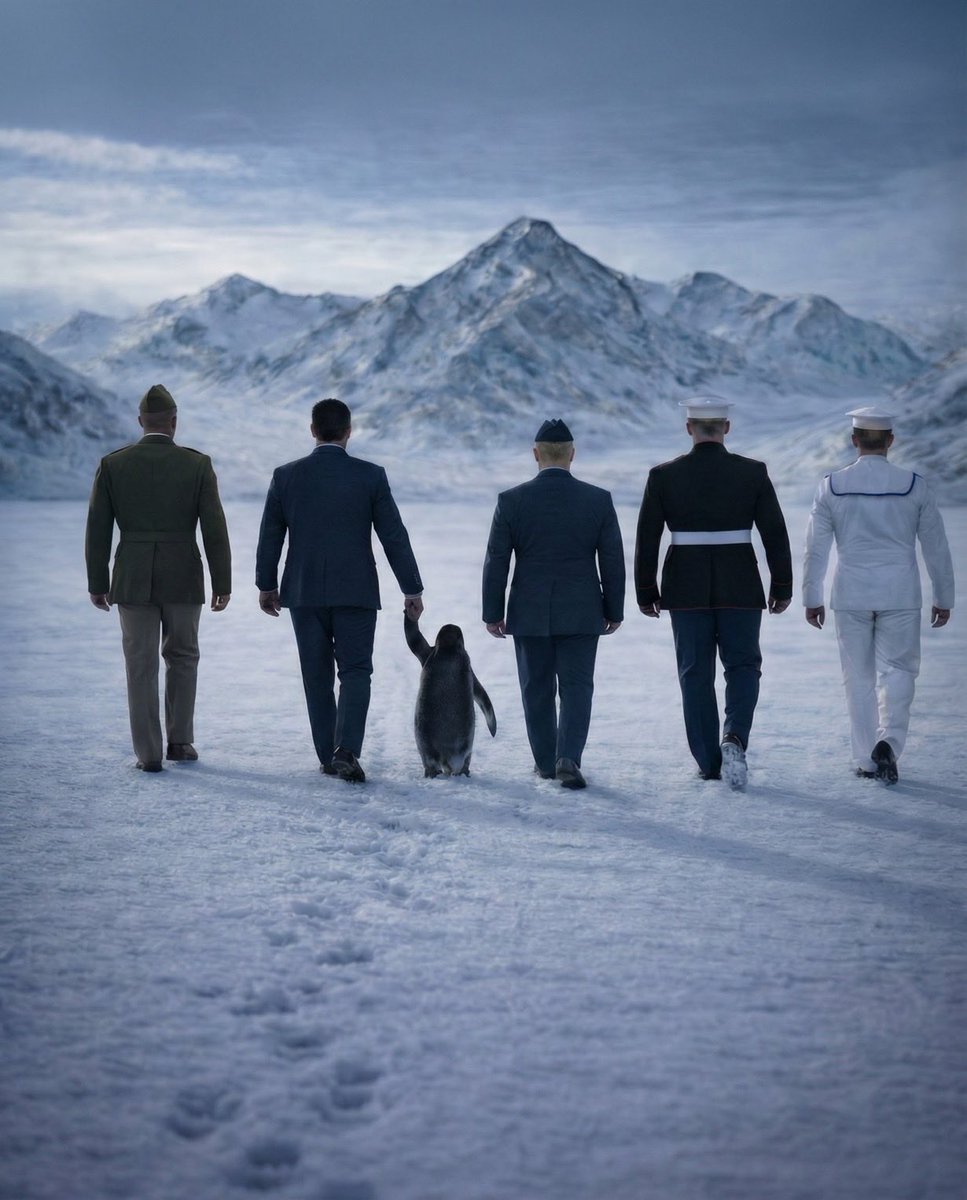
True strength rarely announces itself loudly, and that is exactly what makes this message resonate. The penguin does not argue, explain, or seek approval. It moves forward, indifferent to noise from those who lack either understanding or courage. That posture captures something essential about leadership, ambition, and progress when resistance is loud and confidence is scarce.
History rarely advances because everyone agrees. It advances because someone is willing to keep walking while others mock from the sidelines. The loudest critics are often those least willing to take risk, least willing to act, and least willing to accept responsibility for outcomes. They confuse commentary with contribution and cynicism with intelligence, mistaking hesitation for wisdom.
The American spirit has never been about waiting for permission. It has always been about motion. About stepping into uncertainty with confidence rather than retreating into comfort. Progress comes from doers, not spectators. From people who act first and refine along the way, not from those who demand guarantees before every step. That instinct is rooted in proactive self-reliance, not in fear of being wrong.
There is also an important distinction between understanding and comprehension. Many people understand facts, headlines, and talking points. Far fewer comprehend what it means to build something, to lead under pressure, or to stay the course when results are not immediate. Comprehension requires experience, accountability, and a willingness to be judged by outcomes rather than intentions.
In an age saturated with opinion, outrage, and pessimism disguised as sophistication, forward movement itself becomes an act of defiance. Calm persistence unsettles those who rely on chaos. Quiet confidence frustrates those addicted to reaction. Refusing to be distracted is often more effective than engaging every provocation.
That is why this message resonates beyond symbolism. It reflects a mindset that does not derive legitimacy from consensus but from direction. It acknowledges criticism without being governed by it. It understands that progress rarely looks elegant in real time and that clarity often follows action, not debate.
The penguin keeps walking. The path is not explained. The destination does not need to be justified. Those who cannot comprehend will continue to comment. Those who do comprehend will recognize what matters, step into the arena, and move forward anyway.
RAG vs. CAG, clearly explained!
RAG is great, but it has a major problem:
Every query hits the vector database. Even for static information that hasn't changed in months.
This is expensive, slow, and unnecessary.
Cache-Augmented Generation (CAG) addresses this issue by enabling the model to "remember" static information directly in its key-value (KV) memory.
Even better? You can combine RAG and CAG for the best of both worlds.
Here's how it works:
RAG + CAG splits your knowledge into two layers:
↳ Static data (policies, documentation) gets cached once in the model's KV memory
↳ Dynamic data (recent updates, live documents) gets fetched via retrieval
The result? Faster inference, lower costs, less redundancy.
The trick is being selective about what you cache.
Only cache static, high-value knowledge that rarely changes. If you cache everything, you'll hit context limits. Separating "cold" (cacheable) and "hot" (retrievable) data keeps this system reliable.
You can start today. OpenAI and Anthropic already support prompt caching in their APIs.
I have shared a link to OpenAI's prompt caching guide in the replies.
Have you tried CAG in production yet?
Looking at the ARC-AGI benchmark is a useful way of understanding AI progress.
There are two goals in AI, minimize cost (which is also roughly environmental impact of use) & maximize ability. It is clear you can win one goal by losing the other, GPT-5 seems to be a gain on both.