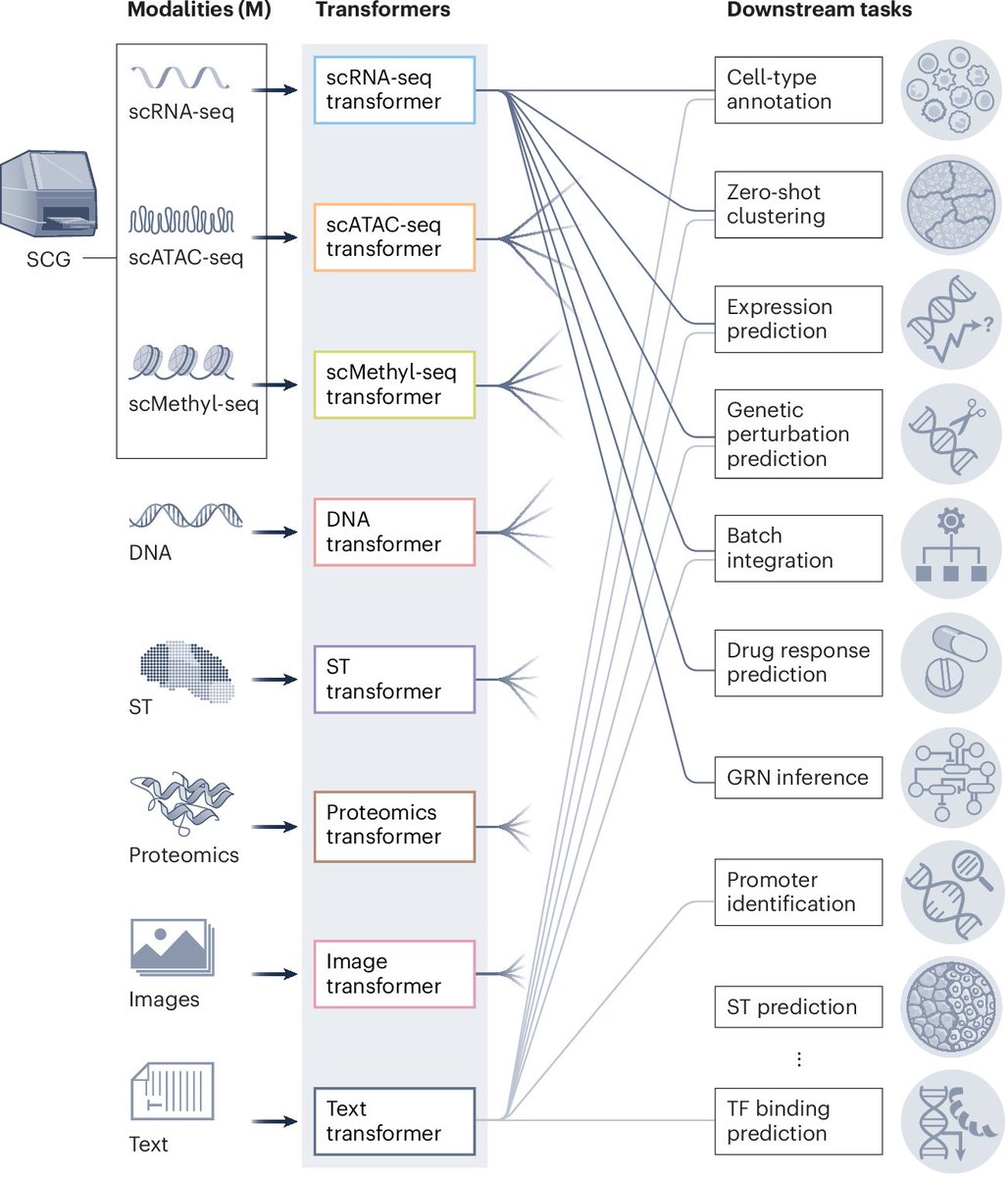
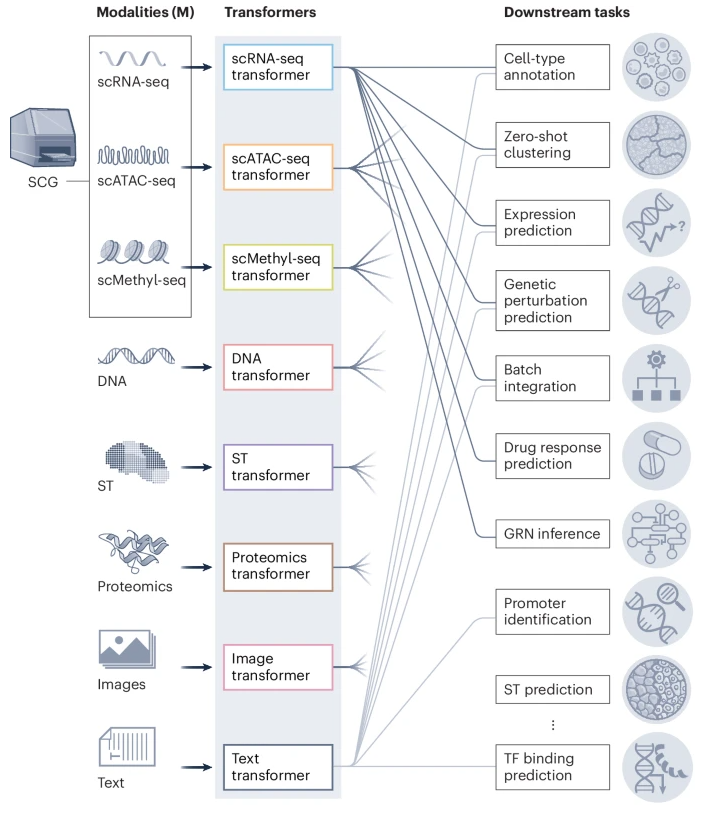
Biology has a data problem — not a shortage, but fragmentation.
A new “super transformer” concept from KAUST aims to unify genomics, imaging & cellular data into one AI model.
From silos → systems thinking.
🔗 https://t.co/LGX2aoOVDR
#AI #BioTech #Bioinformatics @Je@JesperTegner
Predicting how drugs reshape gene expression, cell type by cell type
Most early-stage drug discovery treats cells as interchangeable. A compound either works or it doesn't, measured against a single cell line or a bulk average. But the same molecule can trigger entirely different transcriptional programs depending on which cell type it encounters. Capturing that specificity computationally—without massive experimental data—is one of the harder open problems in the field.
Reem Alsulami and coauthors address it with PrePR-CT. The core idea is an inductive prior: each cell type is encoded as a co-expression network, a graph where nodes are genes and edges connect pairs with correlated expression in the unperturbed state. Graph Attention Networks process these graphs into cell-type-specific feature vectors, which are combined with molecular embeddings from SMILES representations of the perturbing compound. An MLP head then predicts the post-perturbation transcriptional response.
The payoff is clearest in the small-data regime. Across five single-cell RNA sequencing datasets—human PBMCs, multiple cancer cell lines, mouse liver—and one bulk transcriptomics screen, PrePR-CT generalizes to unseen cell types and unseen perturbations, consistently outperforming generative baselines such as scGen and chemCPA, especially on expression variance. The model holds up even when trained on 20% of an already small dataset.
Interpretability is a natural byproduct. Attention weights reveal high-attention genes that overlap only 5% with differentially expressed genes in PBMCs, suggesting GATs capture regulatory signals invisible to standard fold-change analysis. Pathway enrichment recovers known mechanisms, including interferon signaling and T cell activation pathways.
For drug discovery and translational R&D teams, the implication is concrete: cell-type-resolved transcriptional predictions in silico could substantially reduce the experimental burden during lead optimization. In settings where exhaustive single-cell perturbation screens are prohibitively expensive, a model that generalizes from existing cell types rather than demanding new ones is exactly the kind of tool that can move what is computationally feasible closer to what is biologically necessary.
Link to the paper (Alsulami et al., Nature Machine Intelligence (2026) — CC BY-NC-ND 4.0): https://t.co/zxhq6EtyqT
Our Method of the Year 2025 is...drumroll please...EM-based connectomics!!
Our Editorial introduces our choice and highlights six Comments and other related content in this special issue. Please join us in celebrating EM-based connectomics! 🎉🧠🔬
https://t.co/OHbn6WFVHX
Our new paper in Nature Methods is out now.
We explore how foundation transformer models are reshaping genomics - across sequence, single-cell, spatial & multimodal data.
https://t.co/ncElK493Pl
#Genomics#AI4Science@KaustResearch@KAUST_BESE@KAUST_News
#KAUST Ranked Among Top 100 Globally in @timeshighered#THEGlobalImpact Rankings.
A moment of national pride for #SaudiArabia, reflecting our unwavering commitment to addressing the world's most pressing challenges through science and innovation.
https://t.co/npr46nb7Pm
BREAKING NEWS
The Royal Swedish Academy of Sciences has decided to award the 2024 #NobelPrize in Physics to John J. Hopfield and Geoffrey E. Hinton “for foundational discoveries and inventions that enable machine learning with artificial neural networks.”
Introducing Sora, our text-to-video model.
Sora can create videos of up to 60 seconds featuring highly detailed scenes, complex camera motion, and multiple characters with vibrant emotions.
https://t.co/YYpOAcrXQ3
Prompt: “Beautiful, snowy Tokyo city is bustling. The camera moves through the bustling city street, following several people enjoying the beautiful snowy weather and shopping at nearby stalls. Gorgeous sakura petals are flying through the wind along with snowflakes.”