One image → a 3D preview in Unity.
Mugen3D connects image matting, cloud-based 3D generation, model downloads, and Gaussian splat previews in Unity.
Explore the open-source Unity sample below. 👇
Tomorrow at 7 PM ET we're sharing a new Mugen3D demo. No spoilers yet 👀
It's one we've been wanting to show you for a while. What would you most like to see Mugen3D do next?
#Mugen3D#ImageTo3D#3DGS#AI3D
@WitDaBlizzard That prop sword is huge, great con piece! For the ball-jointed OC figures, are you modeling the joints in Blender first, or sculpting the character and cutting joints in after? Print-ready output is something we're still developing at Mugen3D, so curious what's hardest.
@themarkolson 'Call it yourself and ask what Saturday night costs' is the best test for any AI receptionist. People hang up on the ones that can't answer real questions. Does the owner's AI have their actual prices and schedule loaded, or just a generic script?
@Error6982827904 Running Patch 04 fully local is a fun build! How are you driving the avatar's mouth right now: amplitude-based, or visemes from the TTS? For AI VTubers, getting expressions to follow the generated voice is the part we see people tune the most.
@richchetwynd 'Lip sync always goes to the largest face' is such a real multi-character problem. Have you tried assigning each voice line to a character ID before the video step, then masking that face only? Driving each character's mouth from its own audio track tends to stop the swapping.
@hfaria35 Smart use of an AI avatar for a weekly market update, especially bilingual. Do buyers ever reply asking about specific listings? A version of you that answers from your own listings and notes, in both languages, could save a lot of back and forth.
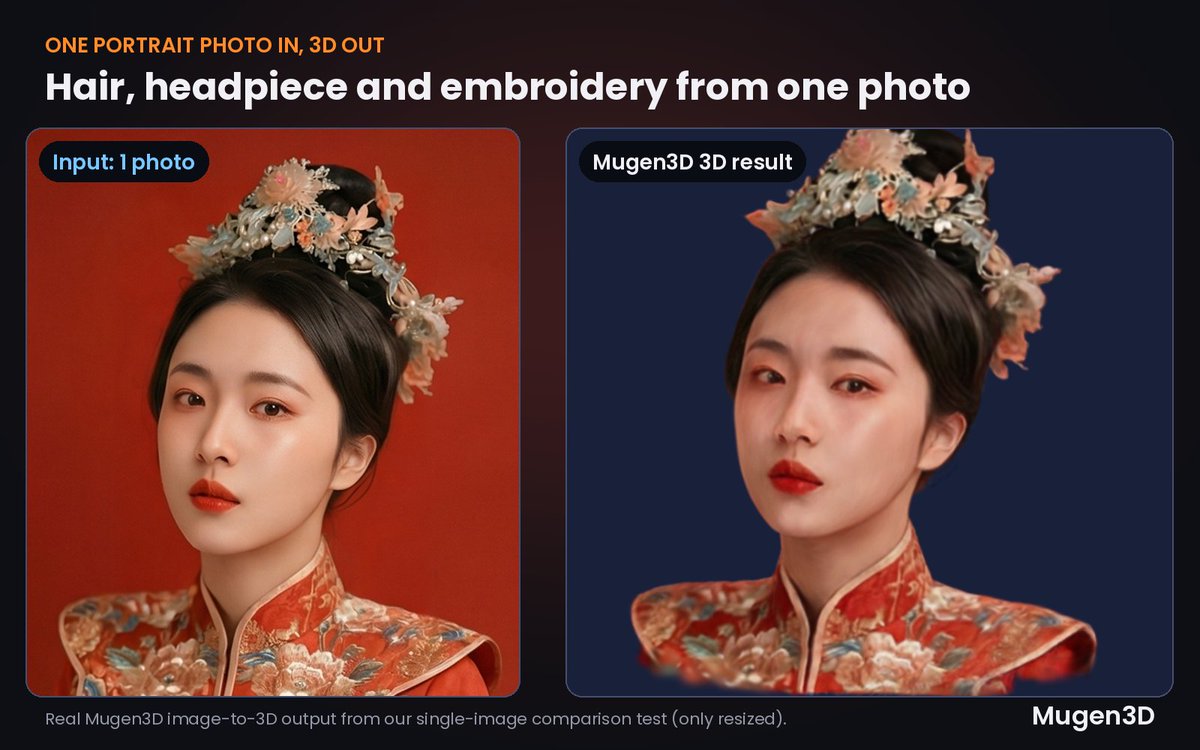
One portrait photo in, a 3D result out. The fun parts: loose strands of hair, a floral headpiece full of tiny beads, and the embroidered collar. Mugen3D keeps them close to the photo.
Portraits, pets or figures: which should we show next?
#Mugen3D#ImageTo3D#3DGS#AI3D
@michaelybecker 73% lower camera-to-sorted-frame latency on Spark Radix is a real win for scrubbing dense WebGPU USD splats. In that workshop scene — does the stage timeline only drive camera Xform + lens, or can you also key ParticleField splat transforms?
@HandzSteve The one-tool plan is solid advice, and fair play for labeling it as your AI voice and AI twin. Do people ever ask your twin follow-up questions in the comments? A twin that could answer from your own reviews seems like the natural next step.
@DamiBenveniste Clear breakdown. One thing worth adding: splats are explicit like meshes but have no connectivity, which is why they render so fast but are tricky to edit, rig or collide. Most of the 'splat vs mesh' debate comes down to that missing topology.
@victormustar Ava fully on-device is impressive. TalkingHead + HeadAudio is a smart choice for in-browser lip-sync. How's the latency from her starting to speak to the mouth moving? We work on audio-to-ARKit-blendshape streaming with MugenMorph and that gap is the one people notice first.
@imDanoush Driving your own car sketches in your own game is the dream! In your tests, which part broke most: symmetry, wheel arches or the panel lines? Sketches are harder than photos for image-to-3D since there's no real lighting to read the shape from.
@Kanazuki0410 Not just you, VTS does that to a lot of people! Put the webcam at eye level or a bit above and add soft front light. Then in VTS, widen the Eye Open input range in the model's parameter settings so your relaxed eyes still read as open. Recalibrate after.
Hair is the hardest part of single-image 3D, so HairDeck is a fun one: one character image in, a haircut out as separate 3D hair cards with bone chains attached, so it sways. GLB or VRM export, Apache 2.0.
VRM folks, would you use it?
#HairDeck#ImageTo3D#VRM#Mugen3D
Finally! Rigged hair cards from a single image.
HairDeck (Tsinghua + CMU + CUHK) takes one character image and builds a stylized haircut as separate 3D hair cards, with bone chains already attached. The hair sways when the head turns.
Exports to GLB, or straight onto a VRM avatar.
Code and weights are open under Apache 2.0. You get geometry and UVs, no textures yet. Local run wants Linux and CUDA.
https://t.co/CgcH4YdUXZ
@Scannerian1@Polycam3D That high-angle pan over Glastonbury — church towers, red roofs, the hill behind — holds up for a 45-min on-device Polycam splat. For a whole town block, do you keep one dense cloud, or LOD/cull far rooftops so near facades stay sharp?
@ai_for_success Local image-to-3D for the assets plus an agent doing the Unity wiring is a fun split. What did the models need before Unity was happy: scale, pivots, colliders? That import step is where most generated assets lose time. We have a Unity C# SDK for exactly that hop.
@LeoKharon The most honest line in the paper is that the scaling law already sits near its data ceiling. 2x params for +7/+20/+6 points says the next gains come from more diverse interaction data. Do you think more embodiments help more than more hours on the same robots?
@NihilSineTheo TRELLIS 2 locally plus Opus retopo in Blender is a neat stack. What tri count are you landing on per asset? For rigging, once the topology is clean, auto-rigging the body is usually fine. Faces and hands are where generated meshes still fight you.