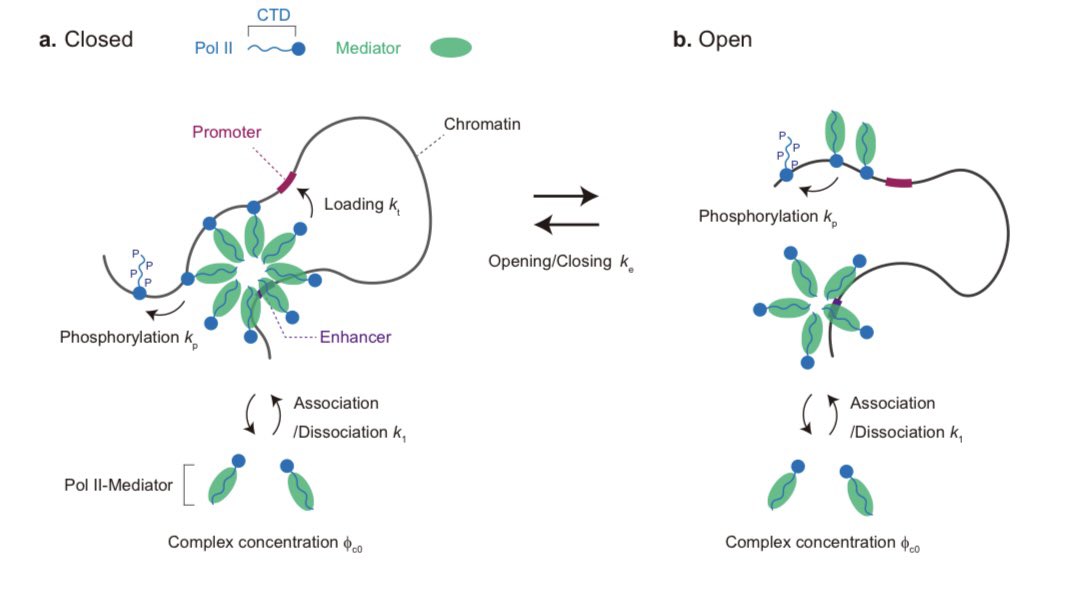
New preprint alert! Together with Tetsuya Yamamoto at Hokkaido University, we propose a “polymer micelle” model of transcriptional bursting. https://t.co/tw2FMdpWuz
BREAKING NEWS
The Royal Swedish Academy of Sciences has decided to award the 2025 #NobelPrize in Chemistry to Susumu Kitagawa, Richard Robson and Omar M. Yaghi “for the development of metal–organic frameworks.”
BREAKING NEWS
The Royal Swedish Academy of Sciences has decided to award the 2025 #NobelPrize in Chemistry to Susumu Kitagawa, Richard Robson and Omar M. Yaghi “for the development of metal–organic frameworks.”
BREAKING NEWS
The 2025 #NobelPrize in Physiology or Medicine has been awarded to Mary E. Brunkow, Fred Ramsdell and Shimon Sakaguchi “for their discoveries concerning peripheral immune tolerance.”
Improving the Catalytic Performance of an Artificial Metalloenzyme by Computational Design | Journal of the American Chemical Society @NobelPrize https://t.co/s65E6TBS2M
Protein NMR Structures Refined with Rosetta Have Higher Accuracy Relative to Corresponding X-ray Crystal Structures | Journal of the American Chemical Society @NobelPrize https://t.co/WXcpJghZdB
The 2024 #NobelPrize laureates in chemistry Demis Hassabis and John Jumper have successfully utilised artificial intelligence to predict the structure of almost all known proteins.
In 2020, Hassabis and Jumper presented an AI model called AlphaFold2. With its help, they have been able to predict the structure of virtually all the 200 million proteins that researchers have identified. Since their breakthrough, AlphaFold2 has been used by more than two million people from 190 countries. Among a myriad of scientific applications, researchers can now better understand antibiotic resistance and create images of enzymes that can decompose plastic.
Read more about their story: https://t.co/nWxcZs6wqC
2.1 and 1.8 Å Average Cα RMSD Structure Predictions on Two Small Proteins, HP-36 and S15 | Journal of the American Chemical Society @NobelPrize https://t.co/G1tZVMSfic
De Novo Determination of Protein Backbone Structure from Residual Dipolar Couplings Using Rosetta | Journal of the American Chemical Society @NobelPrize https://t.co/4GxFvzBxSm
BREAKING NEWS
The Royal Swedish Academy of Sciences has decided to award the 2024 #NobelPrize in Chemistry with one half to David Baker “for computational protein design” and the other half jointly to Demis Hassabis and John M. Jumper “for protein structure prediction.”
In 2003, this year’s chemistry laureate David Baker succeeded in designing a new protein that was unlike any other protein. This was the first step in something that can only be described as an extraordinary development. A few of the many spectacular proteins created in Baker’s laboratory using his computer software Rosetta can be seen in the picture.
He also released the code for Rosetta, so a global research community has continued to develop the software, finding new areas of application.
Baker’s research group has produced one imaginative protein creation after another, including proteins that can be used as pharmaceuticals, vaccines, nanomaterials and tiny sensors.
BREAKING NEWS
The Royal Swedish Academy of Sciences has decided to award the 2024 #NobelPrize in Physics to John J. Hopfield and Geoffrey E. Hinton “for foundational discoveries and inventions that enable machine learning with artificial neural networks.”
2024 physics laureate Geoffrey Hinton used a network developed by his co-laureate John Hopfield as the foundation for a new network: the Boltzmann machine. This can learn to recognise characteristic elements in a given type of data.
The Boltzmann machine can be used to classify images or create new examples of the type of pattern on which it was trained. Hinton has built upon this work, helping initiate the current explosive development of machine learning.
#NobelPrize
BREAKING NEWS
The 2024 #NobelPrize in Physiology or Medicine has been awarded to Victor Ambros and Gary Ruvkun for the discovery of microRNA and its role in post-transcriptional gene regulation.
We are back with the #G4 and beyond webinar series! Starting from June 1 we host 10 webinar days where exciting new science on non-canonical nucleic acids will be presented by 16 outstanding PIs and 8 excellent PhD students. Join us! @PaeschkeL@RichterLabUnipd
Just published @Nature
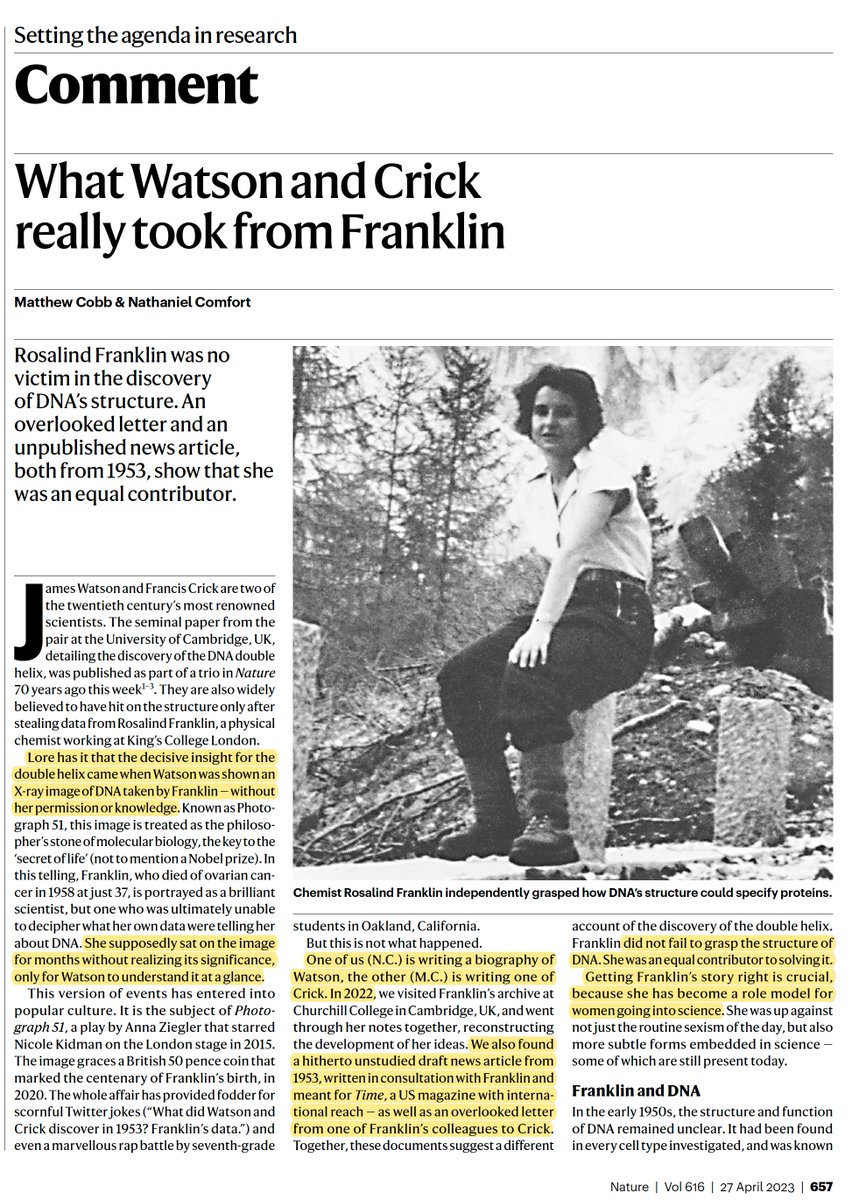
New evidence from 70 years ago: Rosalind Franklin was a co-discoverer of DNA's double-helix structure
by @matthewcobb@nccomfort
https://t.co/MtGnD3mcVc
Received NOA for R00, so lab is officially @NIH-funded! Seeking postdocs interested in the broad areas of chromatin dynamics and transcription regulation. Fully funded positions available immediately. DM/email ([email protected])/ apply now at https://t.co/shYrTtS9m3. Please RT