We have been working on this the last several weeks, mostly in between the October elections. Here's my intro to series.
Supreme Errors: We are naming the worst decisions of the Charter era https://t.co/7tGdDvOsdk
Kudos to the National Post for its journalists' commentary on court decisions and for launching this series, all of which contributes to public understanding of the impacts of judicial power on Canadian democracy.
https://t.co/hmVtB2PTO3
https://t.co/EJ7JXcIH47
Grateful to the @nationalpost editors for the invitation to participate in this important series, which highlights ten problematic decisions from the Supreme Court.
My piece on the Insite judgment and its effect on the judicialisation of policy is published today (links below).
Supreme Errors: A new series from NP Comment where we tell it like it is.
We are naming the worst decisions of the Charter era.
Parliament’s power is being eroded. We spotlight how that happened. 🧵
https://t.co/OkrI4xuIlF
Here the B.C. court, in effect, substituted its view of sufficient ‘denunciation’ for Parliament's. But Parliament is constitutionally entitled to choose and to rebalance criminal sentencing policy, including by imposing a period of parole ineligibility on multiple murderers.
7/7
Madam Justice Brown's reasoning, striking down the exclusion of multiple murderers from the ‘faint hope’ clause, amounts to:
- ‘There are many circumstances in which people commit two murders’ [137];
- ‘Our provisions are significantly harsher than some other countries’ [143].
1/
The B.C. judge who ruled that it is unconstitutional to prohibit multiple murderers from applying for early parole under the "faint hope" clause releases her decision:
https://t.co/jXoatLc9pd
It's telling that the B.C. court seemed to leap from its view that the exclusion went ‘beyond what is necessary to achieve Parliament’s sentencing objectives’ to the conclusion it violated s. 12, without really considering whether the exclusion was grossly disproportionate.
6/
It was just in 2022 (below) that the Supreme Court said that it was constitutionally offensive to put Alexandre Bissonnette in prison for a minimum of 40 years for murdering six people in their mosque. The court said 25 years was the longest he could go without the possibility of parole.
Now in B.C., this judge has declared that even 25 years is too high a guarantee. She considers 15 years to be the appropriate starting point for parole eligibility.
The next frontier of this argument will ask for a 10-year minimum. And so on, and so on.
https://t.co/EJ3ArKvncl
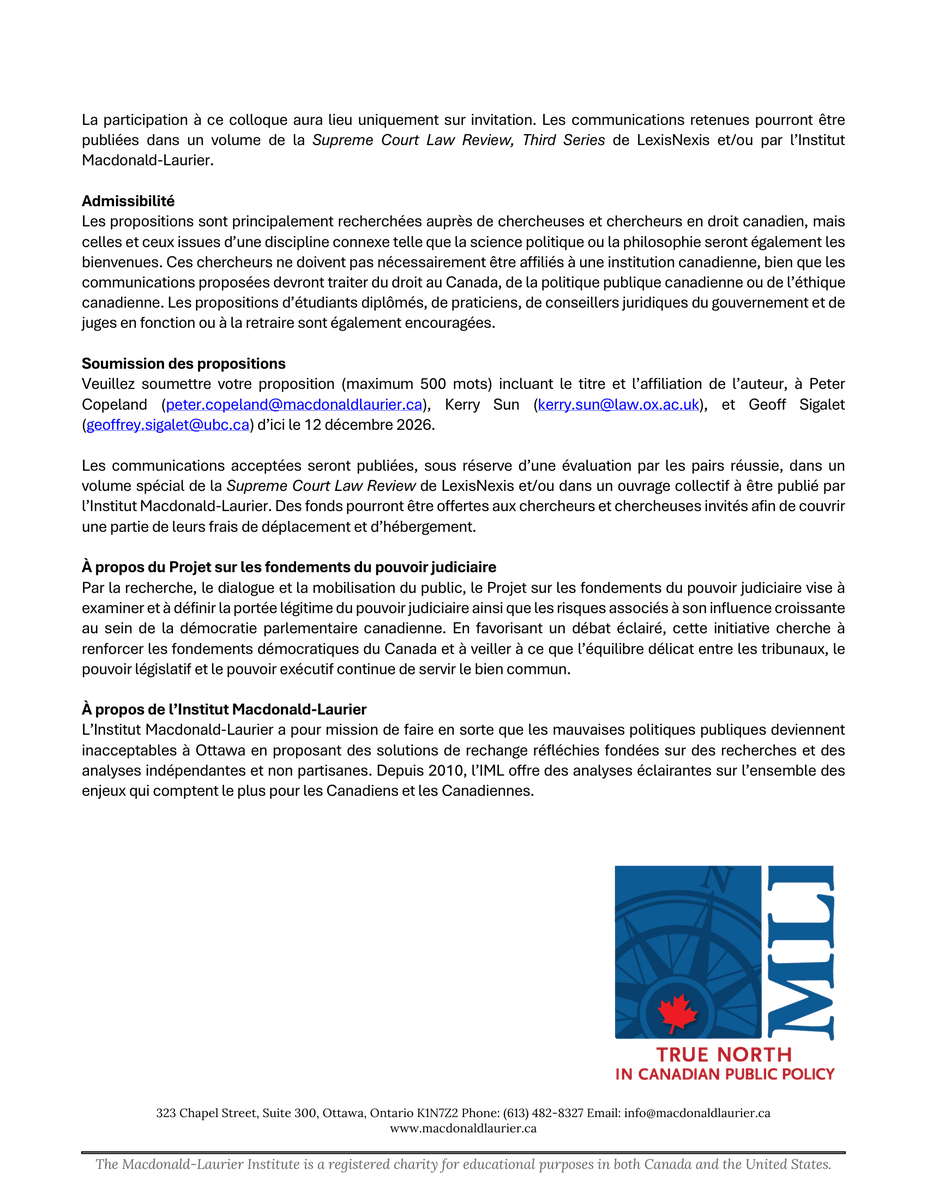
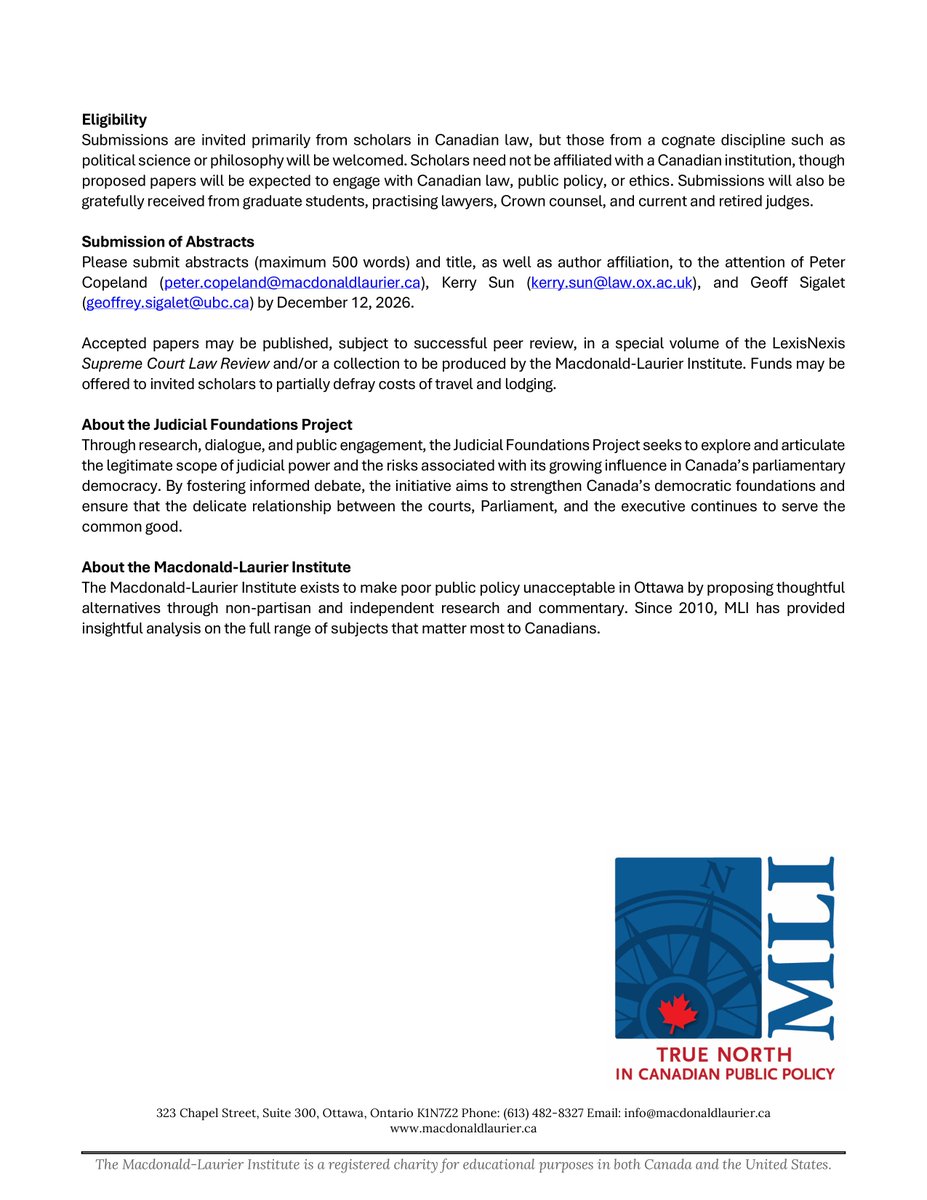
The Macdonald-Laurier Institute’s Judicial Foundations Project is planning a one-day symposium on “Judicial Power and the Canadian Constitution,” tentatively scheduled for February 4, 2027, at Hart House, University of Toronto. We hope to bring together scholars, experts, and practitioners from across Canada, and potentially the wider Commonwealth, to reinvigorate interest in the development, scope, and exercise of judicial power in Canada.
@CopelanPeter@SunKerry@GeoffSigalet
If you want to read one book that will guide you through the arguments that will be made in the very near future about the proper roles of courts and legislatures, this is it! Get @Mark_S_Harding's "Judicializing Everything?" today --in paperback!
Today @thenewdigest: the editors are delighted to publish today a guest essay by Chief Judge Reed O’Connor of the Northern District of Texas, on reason as the life and soul of the law. Judge O’Connor explains the “debt that the American legal tradition owes to the Catholic Christian tradition.”
Enjoy!
https://t.co/ui5ktTOEgR
One your national post colleagues was chewed out by a legal association for criticizing a judicial decision. I’m just calling for the same concern about a piece that criticizes judges for …. Who they studied with.
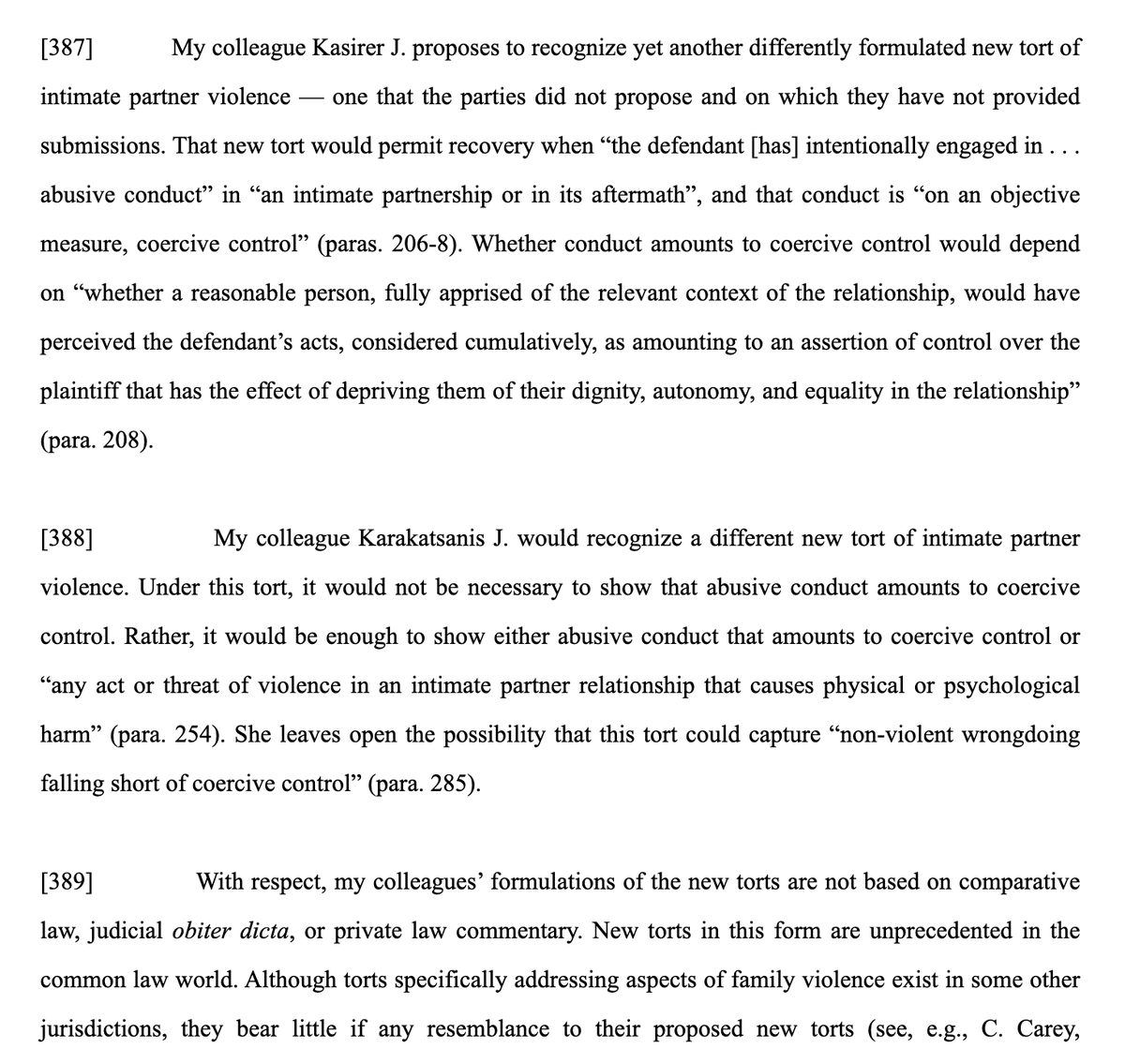
@DavidSc67360929@yuanyi_z@acoyne It was the 'tort of family violence' that was briefed, not the tort of coercive control that the SCC endorsed sans precedent.
And the claim that this is about overturning 'decades of Charter caselaw' is in tension with Wagner CJ's own view that it was a 'largely semantic' issue.
@DavidSc67360929@yuanyi_z@acoyne It must be said, this is hardly a damning point in light of the fact that the Supreme Court of Canada now routinely does things that were not raised or argued at any point of the proceedings, and which are unnecessary to dispose of the appeal—like inventing new torts (Ahluwalia).
The essay in question is offended non-progressive judges have, at times, been appointed to the bench.
It also singles out this terrific Yuan Yi Zhu (@yuanyi_z) column in the Post for criticism. More reason to subscribe to National Post.
https://t.co/UdWDe4kecJ
Pleased to share this call for papers for a symposium on "Judicial Power and the Canadian Constitution", hosted by @MLInstitute's Judicial Foundations Project in Toronto, February 2027.
Feel free to reach out to @CopelanPeter, @GeoffSigalet, @yuanyi_z, or me with any questions!