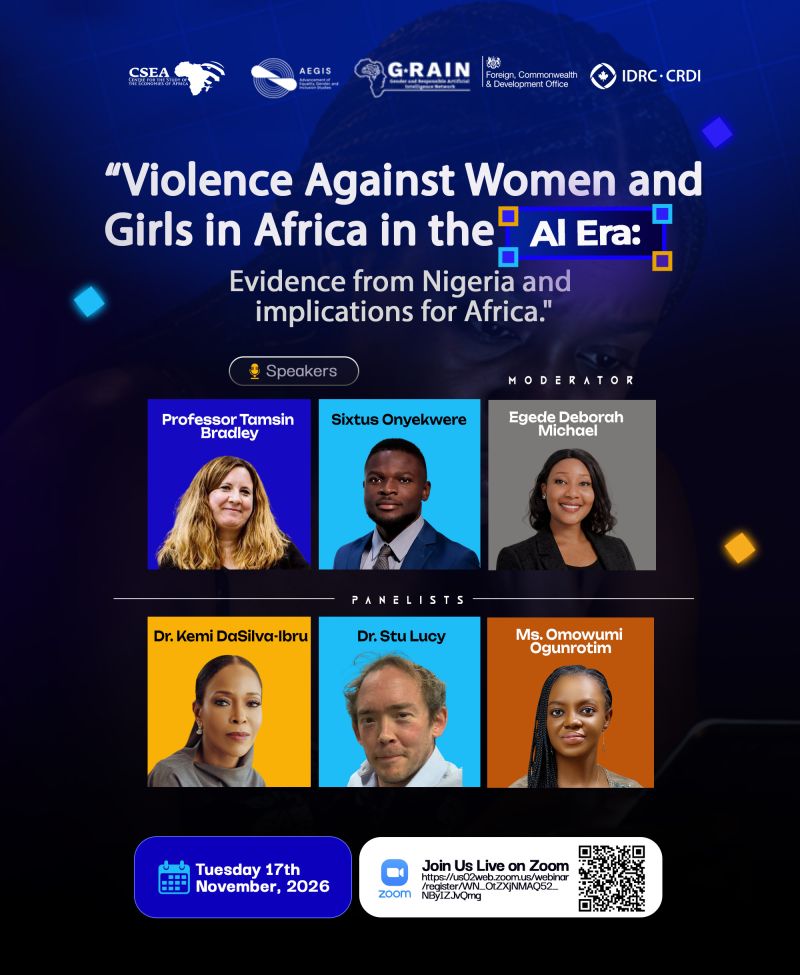
The Centre for the Study of the Economies of Africa (CSEA), in collaboration with the University of Portsmouth (AEGIS programme) and the Gender and Responsible Artificial Intelligence Network (GRAIN Network), invites you to a dissemination webinar titled:
“Violence Against Women and Girls in Africa in the AI Era: Evidence from Nigeria and Implications for Africa.”
The webinar will present key findings from the policy brief “The Digital Literacy Paradox”, which examines technology-facilitated violence against women and girls (TFVAWG).
Date: Tuesday, November 17, 2026
Time: 2:00 PM WAT
Registration: https://t.co/q8A6eI1Gr9
Le Centre for the Study of the Economies of Africa (CSEA), en collaboration avec l’Université de Portsmouth (programme AEGIS) et le Gender and Responsible Artificial Intelligence Network (GRAIN Network), vous invite à un webinaire de restitution intitulé :
« Les violences faites aux femmes et aux filles en Afrique à l’ère de l’intelligence artificielle : données probantes du Nigeria et implications pour l’Afrique ».
Ce webinaire présentera les principales conclusions de la note de politique publique « Le paradoxe de la littératie numérique », consacrée aux violences faites aux femmes et aux filles facilitées par les technologies (TFVAWG).
Date : Mardi 17 novembre 2026
Heure : 14h00 (WAT)
Inscription : https://t.co/q8A6eI1Gr9
We recently joined the Kampala Capital City Authority Kampala Capital City Authority @KCCAUG Environmental Management team in the field to validate the sensors in our noise monitoring pilot against reference sound level meters.
Noise is more than a nuisance. The World Health Organisation links long-term exposure to environmental noise with disturbed sleep, high blood pressure, heart disease and poorer learning in children. Most of that evidence comes from cities outside Africa. In Kampala, there is still little continuous local data on how loud the city gets, where and when.
The pilot is working to fill that gap. Sensors that record around the clock give city authorities a consistent record to plan with, set priorities and track whether interventions are working. It is data for evidence-based governance, generated here, about our own city.
The pilot builds on years of noise work in Kampala and Entebbe. That work produced Urban Noise Uganda 61K, a publicly available dataset of recorded city sounds.
Explore the noise dashboard: https://t.co/daX4va1isO
Read the paper in Scientific Data: https://t.co/EZ42QWjxfb
Explore the dataset: https://t.co/fkDfbNc2vw
#NoisePollution #EnvironmentalHealth #EvidenceBasedGovernance #Kampala #SunbirdAI #AIForSocialGood
@AfrilangAi 2026: Bridging Low-Resource Gaps in African Languages is open.
Most languages spoken across Africa still have little or no support in today’s AI tools. The second AI for African Languages Conference, hosted by Sunbird AI, brings together the people working to change that.
On 10 December in Kampala, researchers, engineers, industry teams and policymakers will come together to share learnings on African language technology from across the continent.
Registration is still open.
If you haven’t signed up yet: https://t.co/BgcWdhcaNe
#AfriLangAI #AIForAfricanLanguages #SunbirdAI
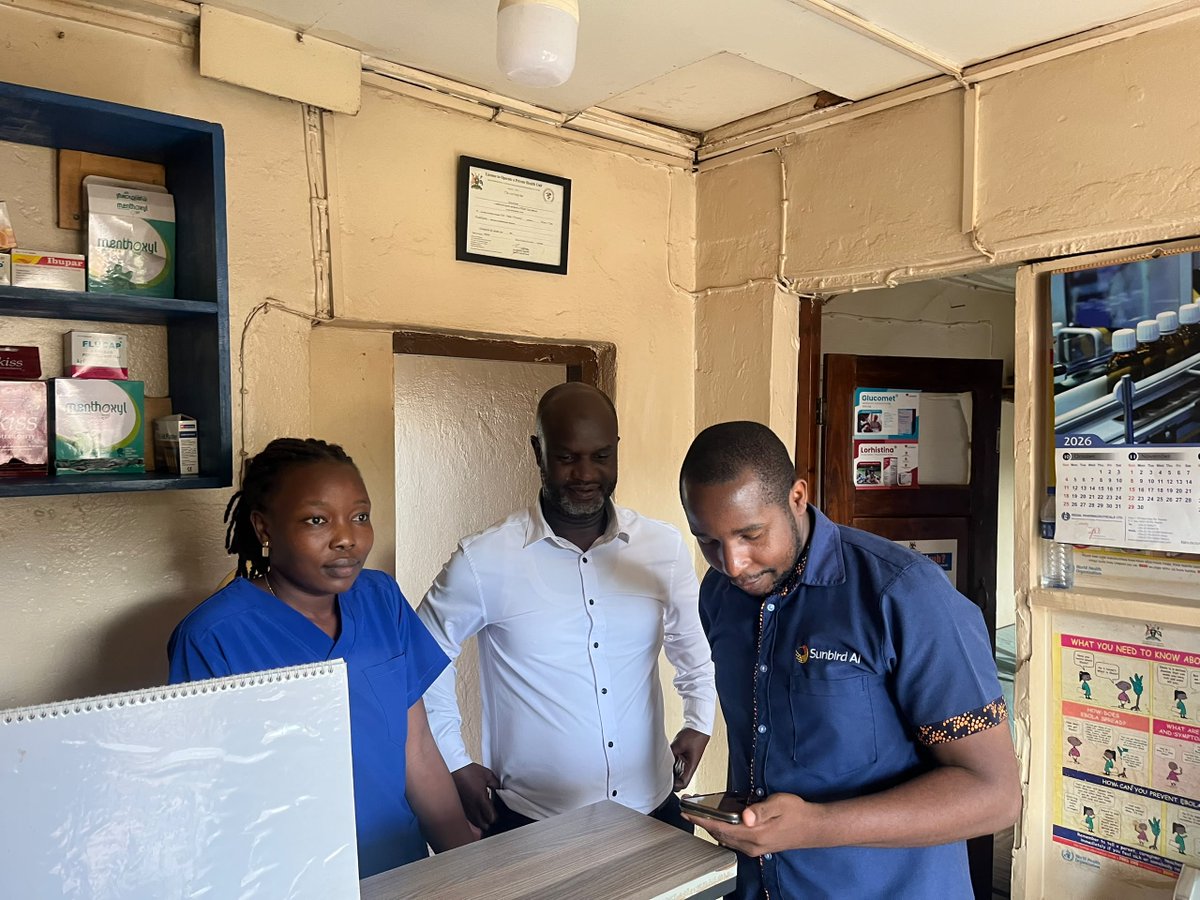
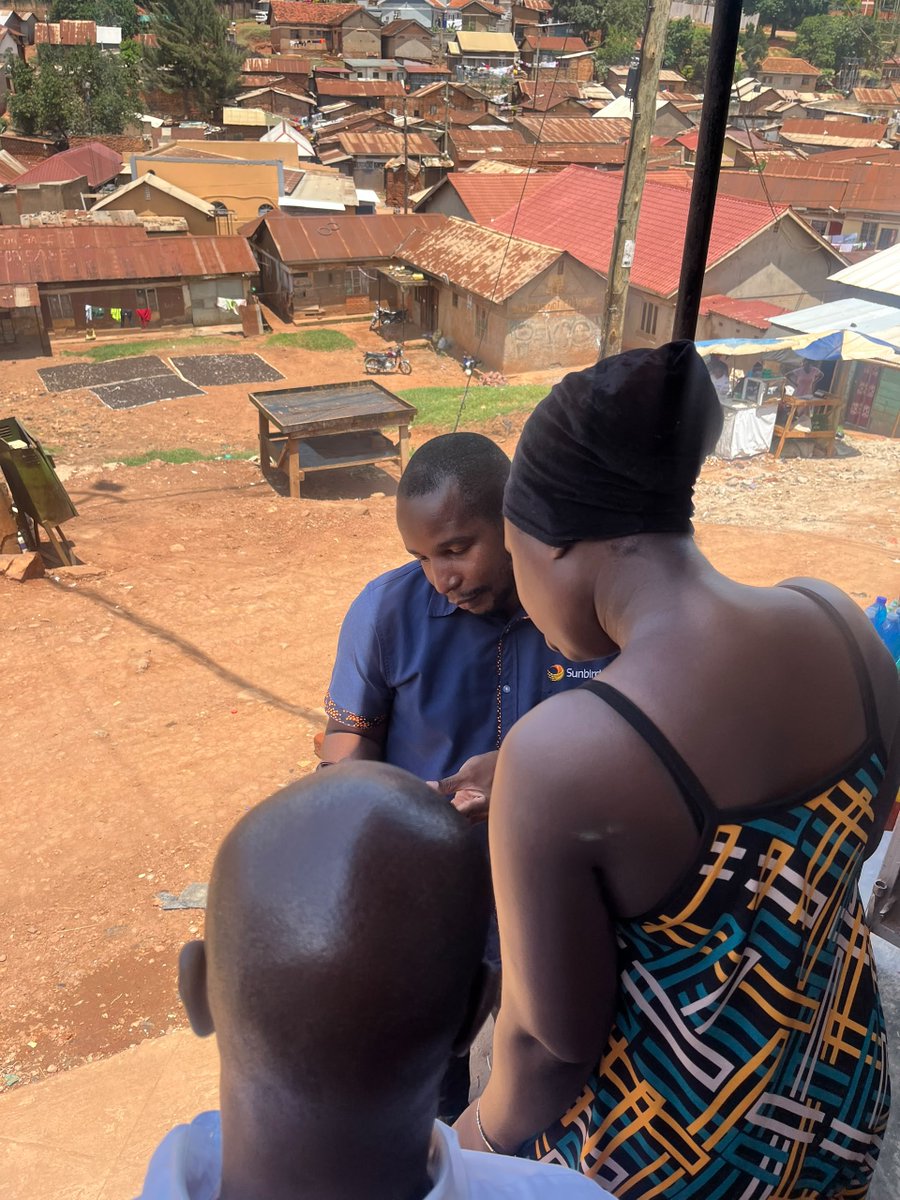
Last week, our team spent the day in Naguru Go-Down, Kampala, putting Sunflower in people’s hands.
Residents tried it the way they would in daily life: asking questions in their own languages, translating messages, speaking to it and listening to it reply.
What we learned goes straight back to our research team and will shape the next round of improvements. Thank you to everyone in Naguru Go-Down who gave us their time and feedback .
Try Sunflower:
Chat and translate in African languages: https://t.co/UMqzewxTsJ
Speak, transcribe and listen: https://t.co/8ag0N3dTQz
Organisations, businesses, public services and developers can also bring local-language translation, speech recognition and voice into their own tools through the Sunbird API.
Sign up for free at https://t.co/yOcrbmr8aO
#AIForSocialGood #ForAfricasManyVoices #SunbirdAI
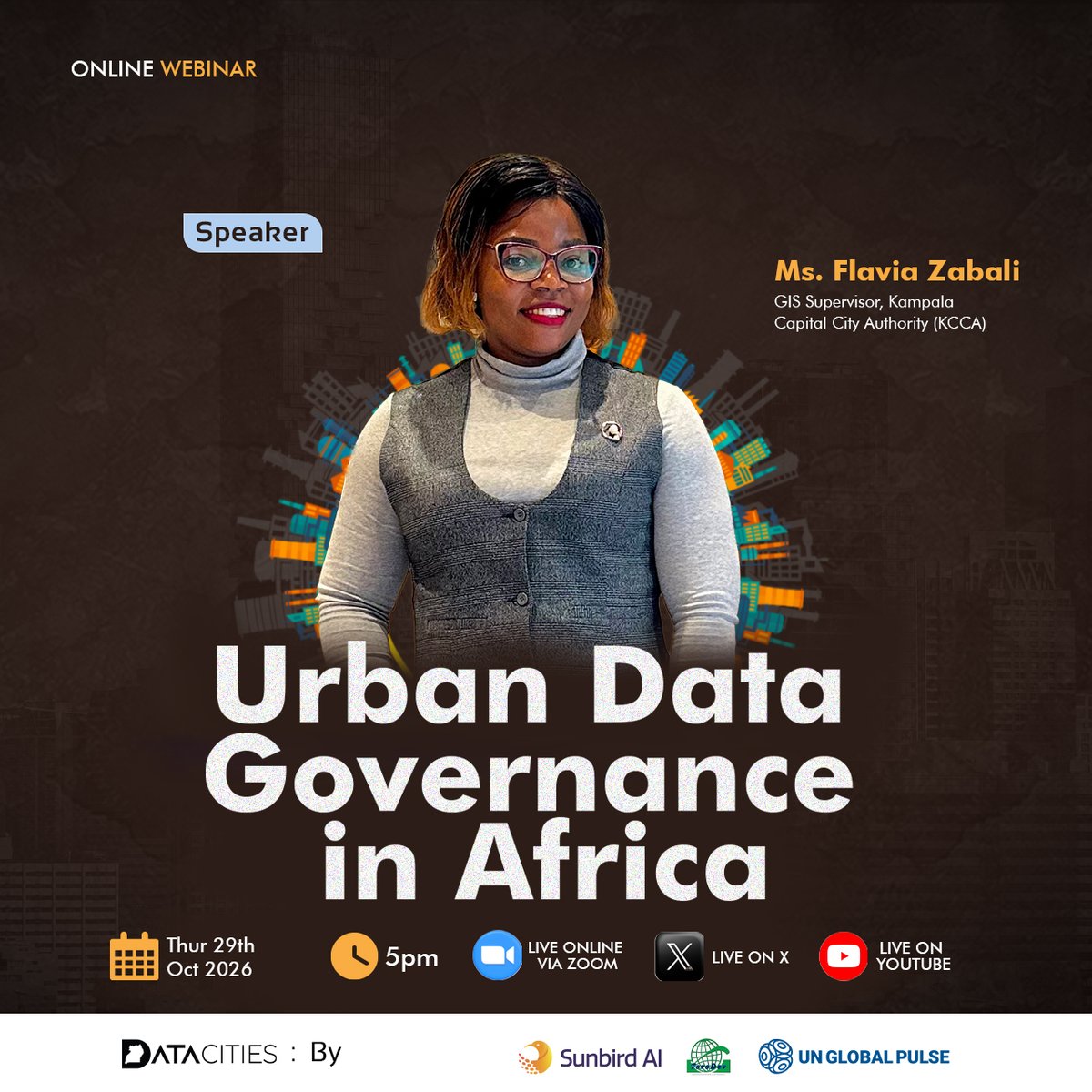
Tomorrow, the @DataCitiesUg Urban Data Dialogue Series returns with Episode 7:
Urban Data Governance in Africa: Local Evidence, Global Lessons.Urban Data Governance in Africa: Local Evidence, Global Lessons
Collecting data is one step. Using it to plan, budget and deliver services is another. This session brings together people working on that problem from city government, GIS and local revenue systems.
Meet the panel:
Prof. Engineer Bainomugisha @iBaino (Host), Principal, College of Computing and Information Sciences, Makerere University
Xaver Schker , Senior Implementation and Advisory Lead, Urban Finance Program, @AfricaUrbanLab
Pauline Okeyo, Senior Solution Engineer, @Esri , Middle East, Africa and Central Asia
Flavia Zabali, GIS Supervisor, Kampala Capital City Authority @KCCAUG
📅 Thursday, 29 October 2026
🕔 5:00 to 6:00 PM EAT
Register: https://t.co/QH1Wen2kjg
@SunbirdAI@UNGlobalPulse@ToroDev
#DataCities #UrbanData #DataGovernance
Meet the panel for Episode 7 of the #UrbanDataDialogues!
Join Xaver Schenker, Pauline Okeyo and @FlaviaZabali
, with Prof. @iBaino as the moderator, for a discussion on Urban Data Governance in Africa: Local Evidence, Global Lessons.
Explore how cities can build trusted, responsible data systems that respond to local needs.
📅 29 October 2026
⏰ 5:00–6:00 PM EAT
📺 Live on X & YouTube
Register here to join the conversation:
https://t.co/QH1Wen2kjg
#DataCities #UrbanDataGovernance
Most of Africa's languages are spoken far more than they are written, yet most digital tools still expect people to read.
Here, Sunbird AI's text-to-speech reads Runyankole aloud in a natural-sounding voice. It now supports 20 languages across Africa.
A bank can answer customers on a helpline in their own language. A publisher can turn local stories and books into audio. A government agency can share audio information and more.
Try it: https://t.co/uJeKRvQcex
API: https://t.co/3iazoMsNLf
Built something with Sunflower or our language tech? Share your feedback and your work at [email protected], we would love to feature it.
Inquiries and collaboration: [email protected]
#AIforSocialGood #AfricanLanguages #SunbirdAI #ForAfricasManyVoices
How can cities move from collecting data to using it to govern better and strengthen local revenue?
Episode 7 of the #UrbanDataDialogues explores the role of data governance, GIS, institutional capacity, and sustainable data systems in improving city decision-making.
📅 29 Oct | 5 PM EAT
📺 Live on X & YouTube
Register here to join the conversation: https://t.co/EV14SevEoj
#DataCitiesug #urbandialogueseries
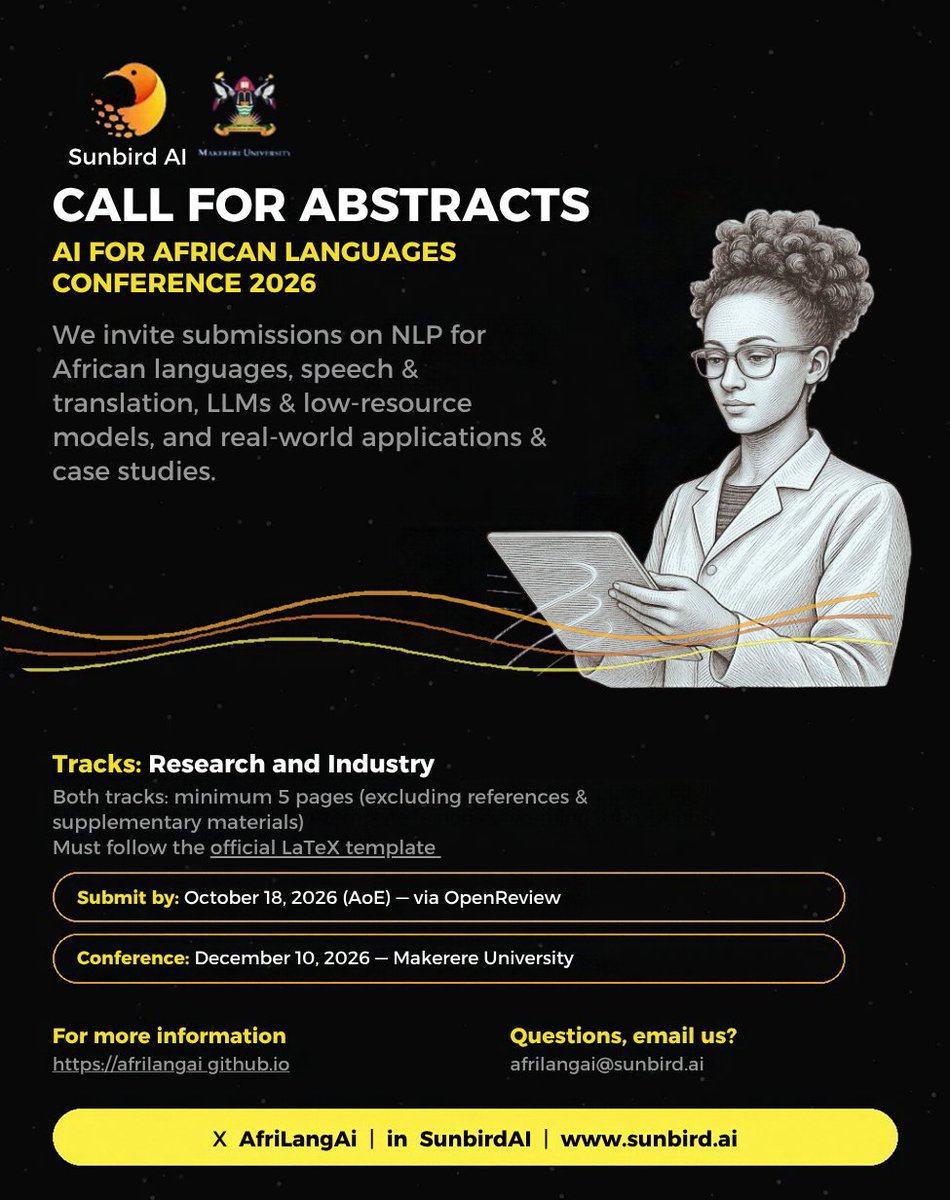
🚨 FINAL CALL: Only 2 Days Left to Submit Your Abstract! 🚨
The extended deadline for @AfrilangAi 2026 is almost here submit your abstract by October 18th, 2026
Sunbird AI invites researchers, practitioners, organizations, and policy leaders to shape the future of African language technology at the second edition of the AI for African Languages Conference.
Whether you're working in Research or Industry, we want to highlight your work in:
computational speech & translation
low-resource language modeling
real-world AI deployments across Africa .
⏰ Deadline: Oct 18, 2026 (AoE) via OpenReview
📍 Conference: Dec 10, 2026 | Kampala, Uganda
🔗 Guidelines & Submission: https://t.co/BgcWdhcaNe
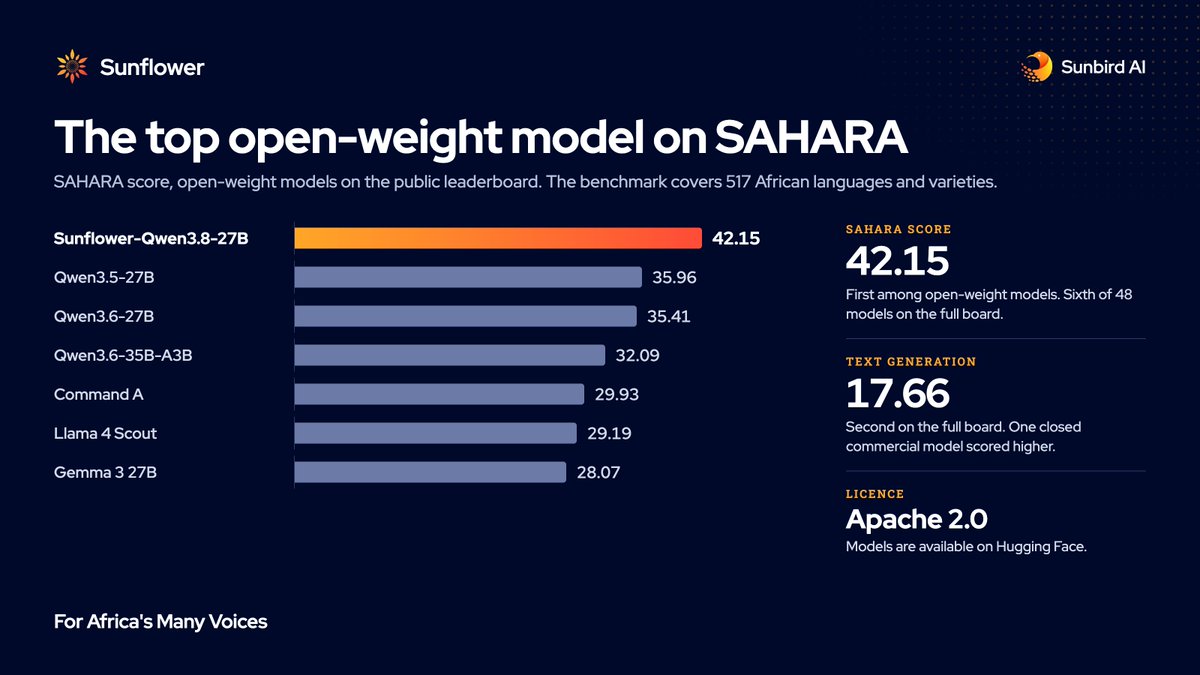
Sunflower is now the top open-weight model on SAHARA, the public benchmark for 517 African languages and varieties, built by @UBC_NLP.
Score: 42.15. Sixth of 48 models overall, and second on text generation, which includes translation.
Read how we built it: https://t.co/Jhw3B5DLEP
Try Sunflower: https://t.co/TPMKiciUBy
See the leaderboard: https://t.co/osV6R05tnb
Models: https://t.co/BMly3TqFjk
#AfricanNLP #ForAfricasManyVoices #AIForSocialGood #SunbirdAI
Call for Abstracts: Deadline Extended
The deadline for @AfrilangAi 2026 abstract submissions is now 18th October 2026.
Sunbird AI invites researchers, practitioners, organisations, and individuals working across research, industry, and policy to submit abstracts for the second edition of the AI for African Languages Conference.
Two tracks are open, Research and Industry, covering NLP, speech and translation, low-resource language modeling, and real-world deployments across the continent.
Submission deadline: 18th October 2026 (AoE), via OpenReview
Conference: 10th December 2026, Kampala,Uganda
Guidelines: https://t.co/laPjbgYFlp
Many classrooms in Uganda have no internet, and most AI tools stop working when the signal does.
With the new release of Sunflower v2, A model in the suite runs on an Android phone, fully offline. A child asks a science question out loud in Luganda and hears the answer in Luganda. No data bundle, no signal.
Read how it works: https://t.co/XhmO7pCBs3
#Sunflower #ForAfricasManyVoices #AIForSocialGood
Call for Abstracts: AfriLang AI 2026
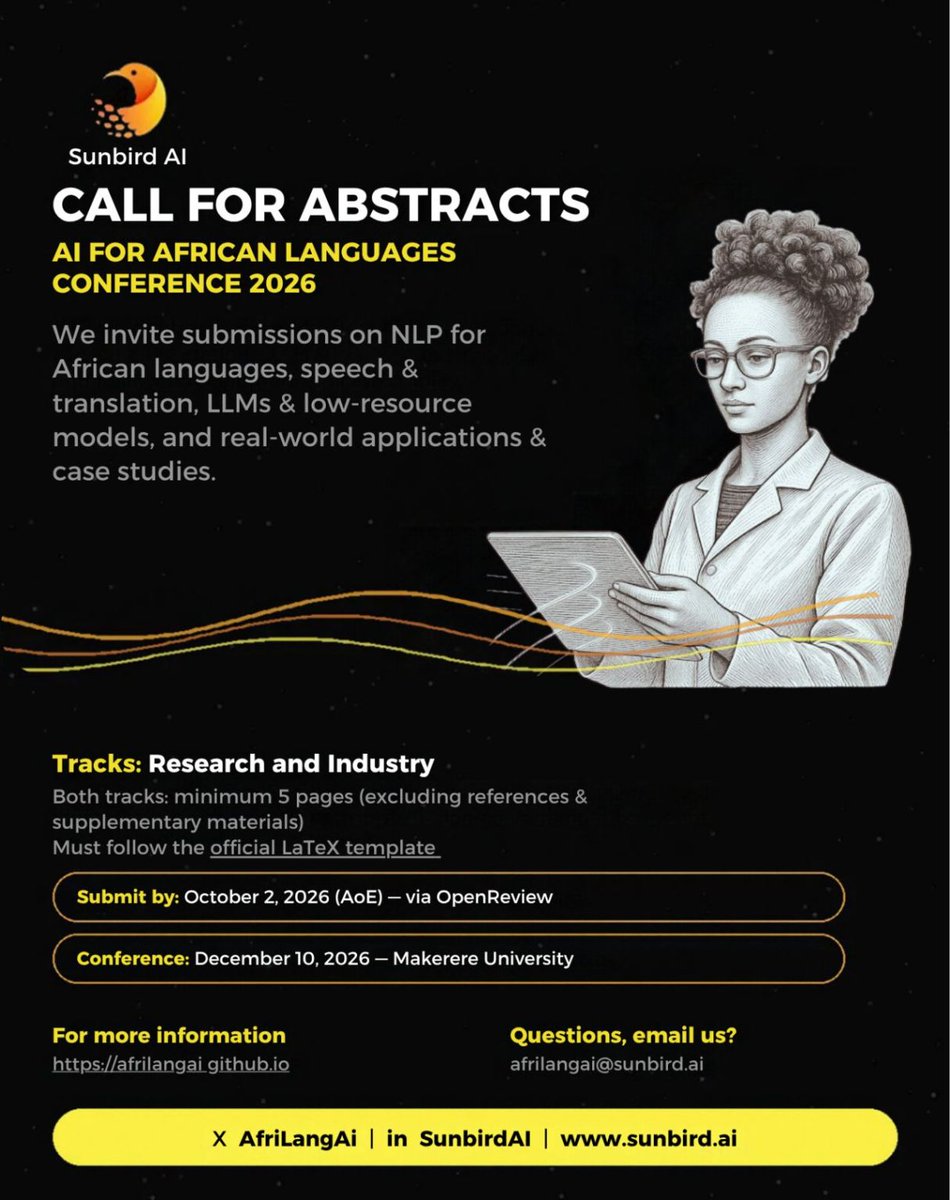
Sunbird AI invites researchers, engineers, practitioners, organizations, and individuals working across research, industry, and policy to submit abstracts for the second edition of the AI for African Languages Conference.
We welcome contributions across two tracks, Research and Industry, covering natural language processing, speech and translation technologies, low-resource language modeling, and deployed solutions addressing real-world challenges across the continent.
This conference aims to strengthen a growing field by showcasing and connecting the work that contributes to the AI ecosystem through African language technology. It brings together industry, research, and policy to collaborate, share ideas, and grow the ecosystem together.
Submission deadline: 2nd October 2026 (AoE), via OpenReview
Conference date: 10th December 2026, Makerere University, Kampala
Full submission guidelines:https://t.co/laPjbgYFlp
Sunflower v2 launched yesterday: five open-source models covering 67 African languages, up from the 31 Ugandan languages in our first release. Today we're publishing the numbers and the methods behind it.
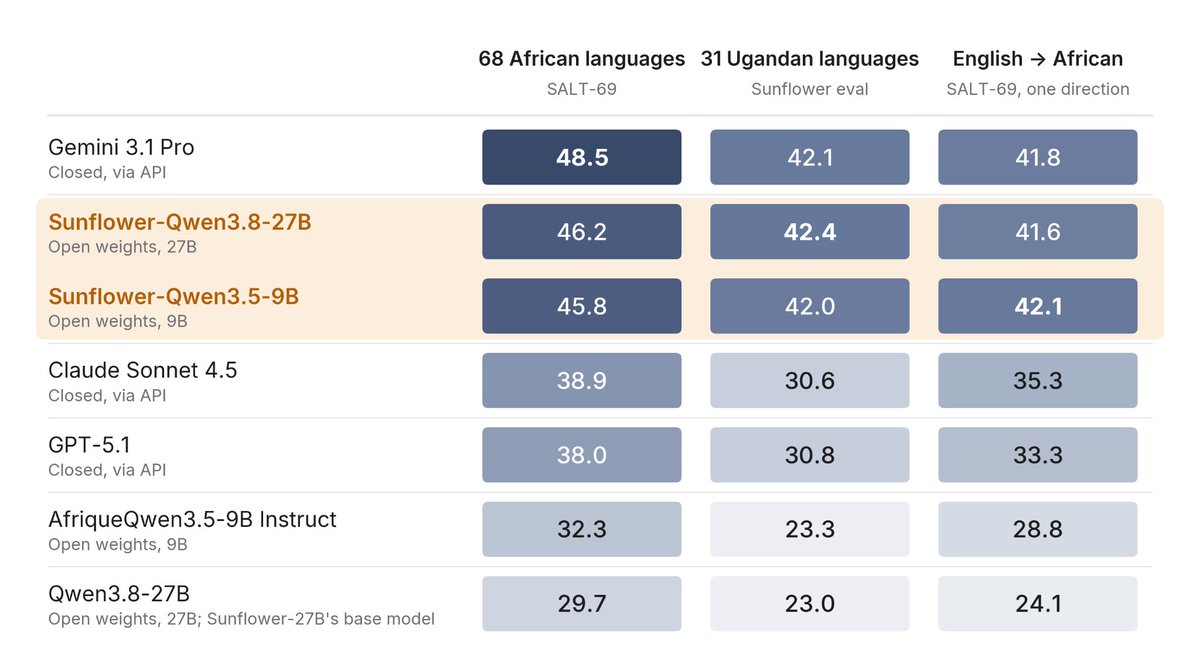
Our largest model, Sunflower-Qwen3.8-27B, matches Gemini 3.1 Pro when translating into African languages, and beats it by more than four points on the 31 Ugandan languages specifically.
Our speech recognition model has the lowest average error rate on AfriVox-v2 and SimbaBench, two independent African-language benchmarks. For Luganda, Sunflower's its word error rate is 16%, against 31.5% for the next best system.
Read it here: https://t.co/Jhw3B5DLEP
#Sunflower #ForAfricasManyVoices #AIForSocialGood #SunbirdAI
From 31 Ugandan languages to 67 across the continent, now with speech.
Sunbird AI's first models set out to test if this worked with far less data than English or French. Outperforming ChatGPT & Gemini 2.5 Pro on translation for 24 languages became the foundation for Sunflower v2.
Today we release 5 open-weight models: translation & reasoning, speech recognition, natural speech, and an offline mobile model.
Live session happening today at 3:00 PM EAT.
Register Here: https://t.co/gNKZUVZ1Nh
Thanks for testing our TTS and sharing this with us. If the numbers are written out in full, the model should be able to pronounce them correctly. Kindly try that and let us know how it goes. We appreciate you testing it and sharing feedback like this. It helps us identify issues and improve the models.
Today we released Sunflower v2, a suite of five open-source models for 67 African languages, up from the 31 Ugandan languages in our first release.
What's in the suite:
Translation, speech recognition in 51 languages, text-to-speech in 20, and a model that runs offline on a phone.
Every model, and the datasets behind them, is published on Hugging Face, free to use, adapt and build on.
"Sunflower v2 is a milestone for African languages. It proves that high-precision text and natural conversational voice are achievable right now, and by releasing it as open infrastructure, we're giving our communities the tools to drive innovation and social impact continent-wide."
Dr. Ernest Mwebaze, Executive Director, Sunbird AI
Read the full press release:https://t.co/85hkFh5fI5