🚨 “WOW!” Joe Rogan Was Absolutely Mind-Blown By This iPhone/iPad Addiction Hack 🔥
His guest, Chase Hughes, dropped the ultimate parental (and personal) life hack:
“I did it on my 2-year-old’s iPad… and nothing is addictive anymore. She won’t sit there and stare at it for more than 3 or 4 minutes anymore.”
Joe’s reaction? A shocked “Whoaa!”
The trick? A simple red color tint filter in your device’s Accessibility settings. It strips away the bright, colorful, dopamine-spiking visuals that keep us (and kids) glued to screens, while also cutting blue light for better sleep.
One quick change. Massive difference in screen time and focus.
Try it yourself:
1Settings → Accessibility → Display & Text Size → Color Filters
2Turn on Color Filters → Color Tint
3Slide Hue all the way to red + max Intensity
Works on iPhone and iPad. You can even set a triple-click shortcut to toggle it instantly.
@Dapper_Det@Roblox so why have Australian gov, if they were so concerned about child's safety, allow under 16's to use Roblox, but banned other platforms
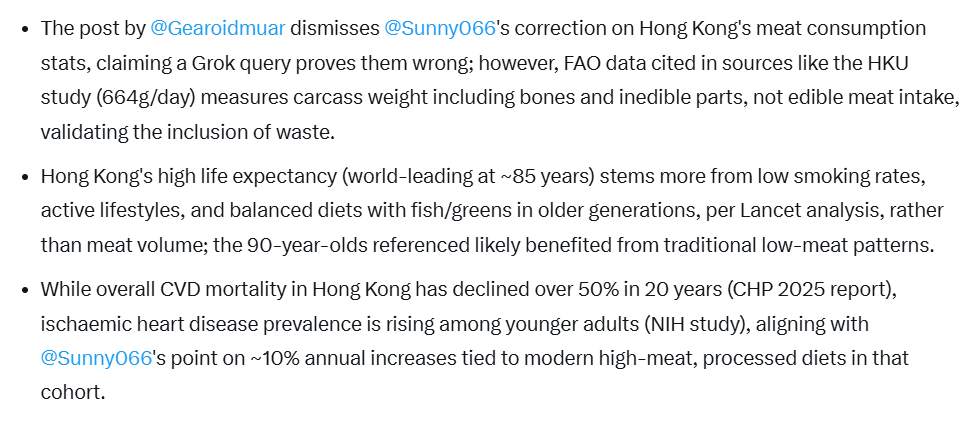
@Gearoidmuar@MetabolicUncle The 664g is a stat that includes bones and soup-waste. The 90-year-olds who set the longevity record grew up on steamed fish and greens. The younger generation, who actually eat the high-meat diet you are quoting, are seeing heart disease rates rise by over 10% a year.
@CrazyWarrior26@MetabolicUncle I didn't say largest consumer, they are the largest spender. They are top 15 globally in terms of fruit eating. The 667 g is from 2018 study, "carcass weight" It includes bones, skin, gristle, and fat that are never eaten. the avg is 200g–250g of meat/fish which is normal
@CrazyWarrior26@MetabolicUncle In Hong Kong they also spend the most (1st if not 2nd) highest on fruits in the world. They also have the highest levels of available fresh vegetable produce and quite high intake of vegetables. Meat consumption based on meat bought, often used for broths.
@AndreJ97721619@MetabolicUncle This is the key point that throws the whole debate upside down that nooone talks about. Its not just a plant based, carnivore, keto thing. When the actual food , no matter what , is different now to what its used to
THE CHANCES OF BECOMING A CENTENARIAN ON A CARNIVORE OR KETO DIET ARE EXTREMELY SLIM
The keto/carnivore internet has a demographic problem. Scroll through enough carnivore testimonials and you'll find plenty of positive testimonials.
People stop eating garbage and instantly improve obesity, inflammation, and other health markers.
Mostly because the decrease in thyroid function wrecks their appetite, which helps them stay in a hypocaloric state that then leads to the observed benefits… at least for a while it works… until it doesn’t work anymore.
What you won’t find, though, is a single example of a centenarian, let alone a population of centenarians, among the carnivore/ketogenic diet crowd.
The populations held up as proof that humans thrive on animal fat and protein don't produce 100-year-olds. They produce robust humans in their twenties and dead men in their fifties.
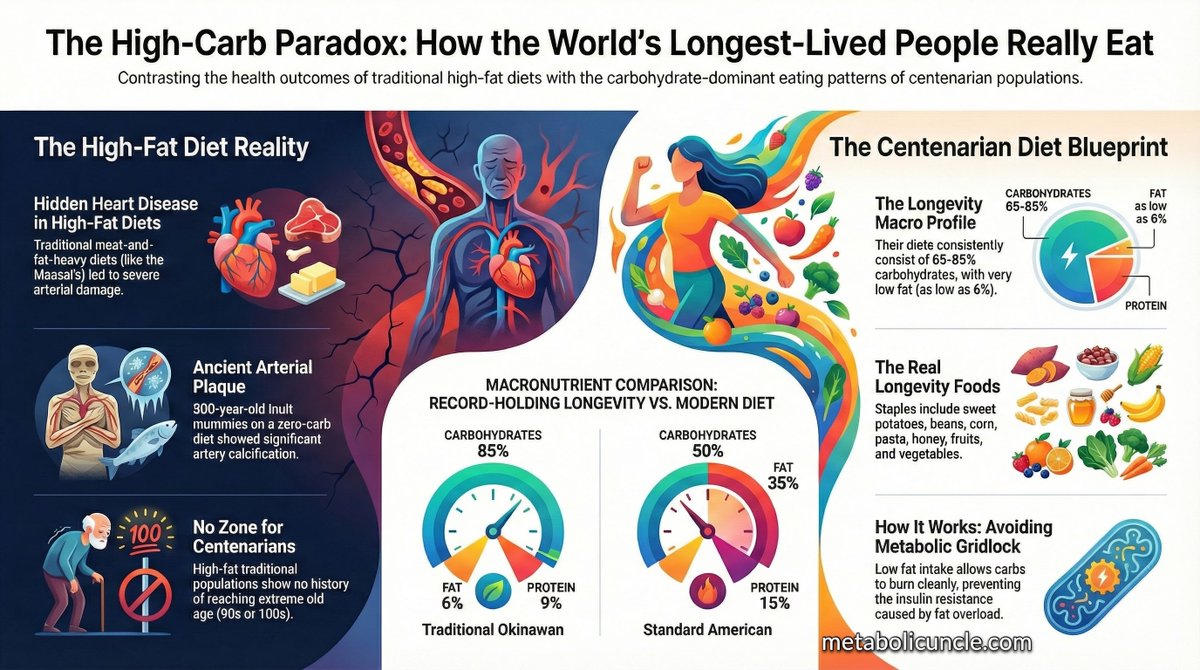
Meanwhile, the populations that do reach extreme old age eat the exact opposite diet. Sixty-five to eighty-five percent carbohydrates. Minimal fat. Protein levels so low they'd horrify a bodybuilding forum.
This is the high-carb paradox. The longest-lived humans in recorded history subsisted on sweet potatoes, sourdough bread, beans, veggies, fruit and rice. Not because they lacked access to meat. Because that's what works.
COUNTING THE SURVIVORS
Demographers track centenarian prevalence with surgical precision. They count people who reach 100 per 100,000 population, using birth records and death certificates to verify age. This metric filters out infant mortality noise and isolates one thing: who survives the diseases of aging.
The answer is geographically specific. The Nuoro province of Sardinia produced 91 centenarians from 18,000 people born between 1880 and 1900. The village of Seulo alone recorded 20 centenarians between 1996 and 2016. On the Greek island of Ikaria, 2.5% of the population reaches 100. That rate makes Western averages look like rounding errors.
Okinawa, before its dietary Westernization, held the global record. The cohort born before 1942 reached centenarian status at rates no industrialized nation has matched. These weren't statistical flukes. They were the predictable output of a specific biological input.
That input was carbohydrates. Lots of them.
THE CARNIVORE VOID
The Maasai eat milk, blood, and meat. Their diet is a ketogenic dream. High fat, high protein, virtually zero carbs. Early observers noted their lean physiques and assumed cardiovascular immunity. George Mann's autopsies in the 1960s told a different story.
Mann examined 50 Maasai men. Over 80% of those past 40 had severe aortic fibrosis. Worse than in Wetern men at the age of 50!
Their coronary arteries showed intimal thickening comparable to elderly Americans with diagnosed heart disease. The reason they weren't dropping dead from heart attacks was anatomical compensation.
Their arteries had dilated, widened to accommodate the progressive thickening of the vessel walls. Blood kept flowing not because the vessels were clean, but because they'd stretched to make room for the damage.
This is not health. This is damage control.
The Maasai also walk 15 to 20 kilometers daily, which likely drives the vessel dilation through shear stress. Remove that variable and the compensation fails.
More importantly, the demographic record shows no cohort of Maasai elders reaching 90 or 100. Average life expectancy hovers in the 40s and 50s, even accounting for infectious disease and trauma. The oldest men are rarities, not norms.
The Inuit present an even starker picture. In 2013, researchers CT-scanned four 500-year-old Inuit mummies found frozen in Greenland. These individuals lived on seal, whale, and fish. Omega-3-rich, zero-carb, ancestrally pure.
Three out of four had calcified atherosclerotic plaques in their carotid arteries and aortas. Some were estimated to be in their twenties when they died.
This predates colonization. It predates sugar, flour, and vegetable oil. It proves that atherosclerosis can be driven by a traditional high-fat animal diet, regardless of omega-3 content.
The Inuit didn't die of heart attacks at Western rates because their blood was too thin to clot easily. Instead, they died of hemorrhagic strokes at four times the rate of other populations. They traded one vascular death for another.
Life expectancy rarely broke 60.
Centenarians were nonexistent.
WHAT THE OLDEST PEOPLE ACTUALLY ATE
Traditional Okinawans consumed 85% of their calories from carbohydrates. The primary source was the purple sweet potato, which accounted for 60% to 70% of total intake. Protein sat at 9%. Fat was 6%, mostly from small amounts of fish or pork consumed during festivals.
This macronutrient profile is extreme by modern standards. It's also the most successful longevity diet in human history.
In Sardinia, the diet was similarly plant-heavy. Barley, fava beans, chickpeas, and sourdough bread made from fermented whole grains. Meat was a Sunday luxury, not a daily staple. The men who lived to 100 were shepherds who walked steep mountains daily, but their fuel was legumes and grains, not lamb.
The Nicoya Peninsula in Costa Rica runs on corn, black beans, and squash. The Mesoamerican triad. The corn is nixtamalized, soaked in lime water, which releases niacin and lowers glycemic impact.
The result is a high-carb, low-fat template that produces centenarians at rates far exceeding the rest of Central America.
Ikaria's elders eat potatoes, wild greens, herbal teas, and honey. Loma Linda's Adventists, who live a decade longer than other Californians, thrive on fruits, vegetables, whole grains, and nuts.
The pattern is universal. High carb. Low fat. Lowish protein. Whole foods.
WHY FAT BLOCKS GLUCOSE
The mechanism that explains this pattern is the Randle Cycle, described by Philip Randle in 1963. Cells can burn glucose or fat, but not both simultaneously at high volumes.
The result is a glucose traffic jam. Sugar backs up in the bloodstream because the cellular machinery is occupied burning fat. This triggers insulin resistance.
The muscle cells, gummed up with intramyocellular lipids, fat droplets inside the muscle, stop responding to insulin's signal. Glucose can't get in. Blood sugar rises. Type 2 diabetes follows.
This is lipotoxicity. It's not caused by eating too many carbs. It's caused by eating too much fat alongside carbs, or by having too much stored body fat that continuously leaks fatty acids into circulation.
The Okinawan diet avoided this trap entirely. With only 6% fat intake, there was no lipid overload. Muscle cells remained exquisitely insulin-sensitive. Even with 85% carbohydrate intake, glucose was escorted into cells immediately and burned for energy. No backup. No resistance. No diabetes.
The Western diet creates metabolic gridlock. The standard American eats 50% carbs and 35% fat. The fat prevents the carbs from being burned. The carbs get stored as more fat. The cycle accelerates.
The carnivore solution is to remove the carbs entirely, forcing the body into ketosis. This works for fat loss in the short term because it eliminates the gridlock. But it doesn't produce centenarians.
The Maasai and Inuit prove that high-fat diets, even without processed carbs, still generate vascular damage. The compensation mechanisms delay clinical events but don't prevent the underlying pathology.
The Blue Zone solution is the opposite. Remove the fat. Keep the carbs. Let the glucose burn cleanly in insulin-sensitive cells.
Another mechanism involves FGF21, fibroblast growth factor 21, a hormone secreted in response to protein restriction. FGF21 enhances insulin sensitivity, increases energy expenditure, and extends lifespan in animal models.
The Okinawan diet, low in protein and high in carbs, maximizes FGF21 secretion. It's a hormonal longevity signal built into the macronutrient structure.
THE WESTERNIZATION EXPERIMENT
Post-1972, Okinawa transitioned. Sweet potato consumption collapsed. White rice, bread and processed pork flooded the diet. Carbohydrate intake dropped from 85% to 58%. Fat rose from 6% to 28%. Protein increased.
The result was catastrophic. Younger Okinawan men, raised on this richer diet, now have Japan's highest obesity rates. The prefecture that once led the nation in longevity dropped to 26th place in male life expectancy by 2000.
This wasn't because they ate more carbs. They ate fewer carbs and more fat. The shift from whole-food, low-fat carbs to processed, high-fat carbs destroyed the metabolic environment that had produced centenarians for generations.
The Inuit experienced a parallel collapse. As Western processed foods entered Arctic communities, rates of obesity and type 2 diabetes exploded. But their traditional diet was never a longevity template. It was a survival adaptation that resulted in early vascular disease. The addition of refined carbs to an already high-fat baseline accelerated the damage.
RECALIBRATING THE MAP
The longevity map has no carnivore territories. It has no ketogenic zones. It has Okinawa, Sardinia, Nicoya, Ikaria, and Loma Linda. Regions where people ate plants, walked daily, and lived to see their great-great-grandchildren.
The path to 100 is paved with sweet potatoes, not ribeyes. The macronutrient architecture is non-negotiable. High carb, low fat, low protein, whole foods. The mechanisms are understood. Avoid lipotoxicity, suppress perpetual mTOR, maximize FGF21, feed the microbiome, prevent oxidative damage with phytonutrients.
The right carbs, in the right context, with the right amount of fat and protein, create a metabolic environment that delays aging. The Blue Zones didn't stumble into this by accident. They lived it because it was all they had.
And it was enough.