𝐓𝐡𝐞 𝐁𝐚𝐧𝐤𝐞𝐫𝐬' 𝐕𝐚𝐮𝐥𝐭 𝟐𝟎𝟐𝟓
Zambia’s banking sector closed 2025 with total deposits at K226bn and gross loans at K104.6bn, a loan-to-deposit ratio of just 46%. Banks are holding more than they are lending. Over five years, deposits grew by K113bn compared to K60.1bn in loan growth. For every K1 added in deposits, less than 50 ngwee was channelled back into the economy as credit. Excess liquidity has largely been finding its way into government securities rather than flowing through private sector credit.
For the first time in recent years, loan growth (+K22.8bn) outpaced deposit growth (+K17.0bn) in a single year, pushing the LDR to its highest level in five years. The intermediation story is turning, with banks showing up for the growth of the Zambian economy.
Analyst: @GeraldHamuyayi
#Banks
#FinancialInsight
#Get2Know
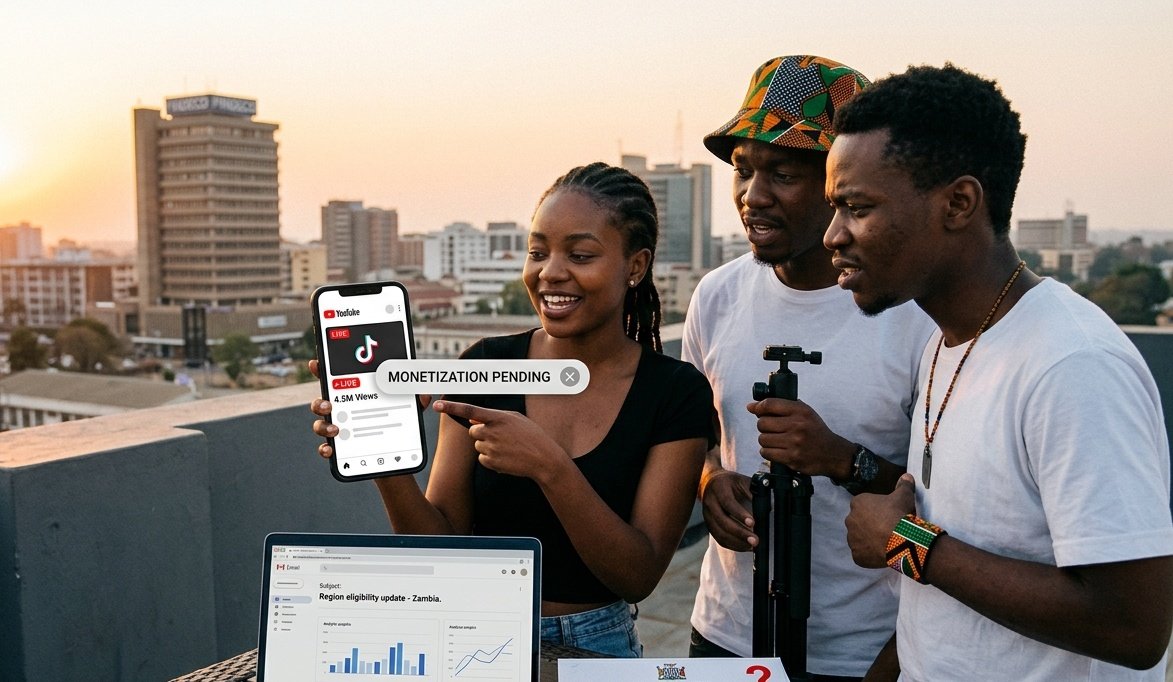
Social Media Monetisation in Zambia
Over the last few years, I have received numerous messages about the need for social media monetisation in Zambia from citizens and we have made efforts towards creating this opportunity. Here is some feedback on findings, highlighting what needs to be done and an honest brief on the challenges that stand in the way.
It is incredibly frustrating for talented creators in Zambia to see peers in countries like Ghana, Zimbabwe, and South Africa earning from their content while they remain locked out. While the desire for monetisation is high, the reality is that Big Tech decisions are driven by hard macroeconomic data, not just creative talent.
Here is an insightful breakdown of why social media monetisation remains limited in Zambia, and the strategic steps required to unlock it.
Why Has Zambia Been Left Behind?
While countries with similar economic challenges have access to monetisation (like Meta, TikTok, or the YouTube Partner Program), Zambia remains in an administrative blind spot. This comes down to three key factors:
1. Market Size & Tech Presence
Platform algorithms favour massive raw populations and regional tech integration. Ghana, for instance, has a much larger population and has positioned itself as a West African tech hub, naturally fast-tracking its monetisation rollouts.
2. The "Diaspora Effect"
Advertisers pay higher Cost Per Mille (CPM) rates for audiences in wealthy Western markets. Zimbabwe shares domestic economic challenges with Zambia, but it has a massive, highly engaged diaspora in high-CPM countries (like the UK and Australia). This foreign viewership makes Zimbabwean creators commercially viable for global advertisers.
3. Staggered Rollouts
Big Tech moves slowly in emerging markets. Many eligible African nations were approved during early expansion waves years ago, something that was missed by the previous government. Since then, global corporate priorities have shifted, causing rollouts to stagnate and leaving Zambia waiting.
4. The Structural Hurdles
To understand the delay, we have to look at the money. Monetisation is fundamentally driven by advertising capital, and Zambia faces several structural roadblocks which include...
Shallow Ad Spend & Low CPM: Payouts come from a share of the revenue generated by companies buying ad space. Because domestic businesses and SMEs aren't spending heavily on digital ads, the revenue pool is shallow. Consequently, the CPM rate for a Zambian audience is too low to yield meaningful financial returns, even for viral content.
Infrastructure Gaps: Scaling monetisation requires robust, internationally integrated payment gateways (like Stripe or fully functional PayPal). Tech giants meticulously evaluate this before launching in a new jurisdiction.
Policy: The Zambian Parliament recently passed a motion to facilitate social media monetisation. While updating laws is a vital first step, governments cannot force private entities like Meta or ByteDance to activate payment features. Platforms ultimately follow market demand.
The Way Forward: Engineering the Market
To truly unlock the digital creator economy, Zambia must shift from purely regulatory approaches to proactive digital diplomacy and market stimulation.
1. Direct Digital Diplomacy
The government is approaching tech platforms as strategic investors. I am part of a team engaging directly with the policy teams at Meta, Google, and Tiktok to showcase commercial data, rising internet penetration, and mobile money adoption.
2. Stimulating the Domestic Ad Market
If local CPM rates are low, the government can help deepen the pool. This could include tax incentives for SMEs that allocate marketing budgets to digital ads, or mandating that a percentage of state PR budgets be spent on digital platforms. This is being addressed.
🧵
Kenneth Kaunda will never die, his spirit lives on in us, his descendants.
Our country will never be short of leadership. It’s a message our Founding Father left, it’s a message we shall never depart from.
From streets of Lusaka, to every African capital, the message is loud !
How to buy /sell shares in Zambia (English version)
Buying shares in Zambia starts with understanding the role of the Lusaka Securities Exchange 📊. This is the formal marketplace where companies list their shares and where investors buy and sell ownership stakes. When you purchase shares, you acquire a portion of a business and gain a claim on its future profits 💼.
To participate in the market, you must work through a licensed stockbroker 🤝. The LuSE operates through an intermediary system, which means individuals cannot trade directly. A broker executes trades on your behalf and provides access to market information. Opening an account is straightforward. You submit identification documents, proof of residence, and complete onboarding forms 📝. Once approved, this account becomes your entry point into equity investing.
The introduction of the LuSE Mobile App 📱 has improved how investors interact with the market. You can monitor share prices in real time, track your portfolio, and stay updated with company announcements. This improves decision making and reduces delays in accessing information. Instead of relying only on your broker, you now have direct visibility of market activity, which is critical in a price driven environment.
After opening your account, you deposit funds 💳. This capital determines your purchasing capacity. At this stage, discipline is important. You are allocating capital, not just buying shares. Before placing any trade, you need to evaluate listed companies 📈. Focus on financial performance, dividend consistency, growth prospects, and sector trends within the Zambian economy. Banking, telecommunications, and mining stocks often dominate activity on the exchange 🏦📡⛏️.
When you are ready to invest, you instruct your broker to place a buy order 📲. You specify the company, the number of shares, and the price you are willing to pay. The order is matched when a seller agrees to your price. Once executed, the shares are transferred into your name through the Central Securities Depository system, and settlement takes a few business days ⏳.
Returns from shares come in two main forms 💰. The first is capital appreciation, where the share price increases over time 📊. The second is dividend income, which is a portion of company profits distributed to shareholders 💵. Not all companies pay dividends, so your investment approach should reflect whether you are targeting income or long term growth.
Costs are part of the investment process ⚖️. Brokerage fees and regulatory charges apply to each transaction. Dividends are subject to withholding tax, while capital gains on listed shares are generally not taxed in Zambia. This creates an incentive for long term participation in the equity market 📌.
Risk remains a central factor ⚠️. Share prices fluctuate due to company performance, economic conditions, and investor sentiment. Diversification helps reduce exposure to individual company risk. A long term perspective is also critical, especially in a market like the LuSE where liquidity can be limited and price movements may not always be immediate ⏱️.
A simple example illustrates the process 📘. If you invest K1,000 in a company trading at K10 per share, you acquire 100 shares. If the price increases to K15, your investment grows to K1,500 📈. If the company pays dividends, you earn additional income while holding the shares 💰. If the price declines, your capital decreases, which reinforces the need for proper analysis before investing.
Starting small is a practical approach 🚀. You build familiarity with how the market operates, how companies report results, and how prices respond to economic developments. Using tools like the LuSE Mobile App strengthens your ability to make informed decisions. Over time, the goal is to develop a disciplined strategy that supports consistent capital growth 📊.
Zambia would be the hardest‑hit country in the world if the Strait of Hormuz remains closed, with a projected welfare loss of -5.6%. The Kiel Institute warns the disruption might trigger not just an energy crisis but a food security shock due to reliance on imports.
I want to congratulate Miami Heat star Bam Adebayo on scoring 83 points last night against the Washington Wizards - the 2nd highest scoring game in NBA history behind Wilt Chamberlain (100 points) and passing Lakers Legend and hero, the beloved Kobe Bryant, who scored 81 points.
Fuel in Angola costs 300 Angolan Kwanza. Per litre, that’s;
a) 6 Zambian Kwacha
b) 3 Bots Pula
c) 5 Namibian Dollar
d) 32 Zim ZiG
e) 5 SA Rands
But as Africans, we buy fuel from Middle East & never thought to build refineries in Angola. Now the Iran war will teach us !!
Ghana 🇬🇭 has set a clear deadline. By 2030, no raw mineral ores will leave the country. This includes manganese, bauxite and iron ore.
President John Mahama stated that all minerals must be processed locally.
The goal is to add value, build stronger manufacturing and create more jobs for young people.
This policy supports industrialization and economic growth in Ghana.
MTN Group has agreed to buy IHS Towers in a $6.2 billion all-cash deal.
Shareholders will receive $8.50 per share, representing a 36% premium.
The transaction will see IHS delisted from the New York Stock Exchange.
MTN says the move strengthens its control over critical digital infrastructure across Africa.
The Zambian Kwacha: A Year of Strength...
Over the last 12 months, the Kwacha has appreciated by 51.9% against the USD (from ~K27.96 to ~K18.47).
This essentially means the local cost of USD-priced imports should have dropped by 33.9% factoring asymmetric scaling and inflation.
It's time for an evaluation of this assumption. What's your take? Do you feel that prices of commodities are responding, and add (with a reasonable explanation) which goods' prices need to come down based on the Kwacha appreciation.
Let's compare their cost over the last 12 months so we can work on needed interventions...
MSU alum Greg Eaton attended his 60th Super Bowl, he’s attended every game since 1967, and I am so happy for him! People may not know he was my first business mentor back in Lansing, Michigan. Lastly, the Seattle Seahawks running back Kenneth Walker III rushed for 135 yards was named Super Bowl MVP!
The IMF Executive Board has approved the final review of the Extended Credit Facility (ECF) for Zambia. This decision enables a final disbursement of $190 million and sets the stage for a successor program. I am sure
Finance and National Planning Minister Dr. Situmbeko Musokotwane views this as the beginning of significant efforts to grow the Zambian economy, build investor confidence, and create much-needed jobs. The focus is on sustainability and ownership!
As I recently mentioned at a meeting organized by the Brookings Institution in Washington, D.C., Zambia should be viewed as a case study for what works and what does not work when implementing an IMF program.