12. Start building something you control. A skill. A business. A body that still works.
13. The older you get, the fewer opinions you need. Keep your circle small and trustworthy.
The reason music gives you chills and what it means:
1. It has a name,Frisson. The chills you feel from music have a scientific name called Frisson. It is a French word meaning aesthetic chills. It causes goosebumps, shivers down your spine and a wave of emotion. All triggered by nothing but sound entering your ears.
2. Not everyone feels it. Only 55% of people on earth experience music chills. The other 45% never feel it at all in their entire life. If you feel it, your brain is literally wired differently from most people around you. It is not dramatic. It is biological.
3. Your brain releases dopamine. When frisson hits, your brain releases dopamine. The same chemical released when you eat your favorite food, when you fall in love with someone, when you win something you worked hard for. Music hijacks the exact same reward system in your brain.
4. It happens at very specific moments in a song. A sudden unexpected key change. When a powerful voice enters out of nowhere. When an instrument joins that you did not expect. When lyrics describe something you personally lived through. Your brain gets surprised and floods you with emotion as a reward for noticing.
5. It is connected to how your brain is built. Scientists at USC discovered that people who feel music chills have more nerve fibers connecting two specific parts of the brain. The auditory cortex which processes sound and the areas that process emotion. More connections between these two areas means deeper and stronger emotional response to music.
6. Sad songs trigger it more than happy songs. Minor chords, slow tempos and falling melodies cause frisson more often than upbeat music. Because your brain processes musical sadness very similarly to real sadness. But in music it feels safe. So your brain allows itself to go deeper into the emotion without fear.
7. Memory makes it stronger. A song you heard during an important moment in your life hits differently forever. Because your brain stores music alongside the emotions you felt when you first heard it. Years later the song plays and the emotion comes back instantly. The music is no longer just sound. It becomes a memory you can hear.
8. Anticipation is more powerful than the moment itself. The chills often begin just before the best part of the song arrives. Not during it. Before it. Your brain predicts the drop, the high note, the key change and rewards itself early just for knowing it is coming. This is called prediction and reward and music is one of the few things that triggers it this strongly.
9. It is directly linked to empathy. In multiple studies, people who experience frisson scored significantly higher in empathy than those who do not. You are not just hearing what the artist made. You are feeling what the artist felt while creating it. Your brain crosses the gap between their emotion and yours through sound alone.
10. It means you have an open personality. Psychologists found that people who feel music chills score extremely high in one specific personality trait called openness to experience. This means deep curiosity about the world, strong imagination, rich inner emotional life and the ability to feel things at a level most people simply cannot access.
11. Live music hits harder than recorded music. The energy of a crowd, the physical vibration of speakers, the presence of the artist. All of these combine to make frisson happen more easily and more intensely at live concerts. Your brain picks up on collective emotion around you and amplifies your own response.
Carl Jung wrote: "The more intelligent and self-aware a person is, the more they suffer from the general unconsciousness of society."
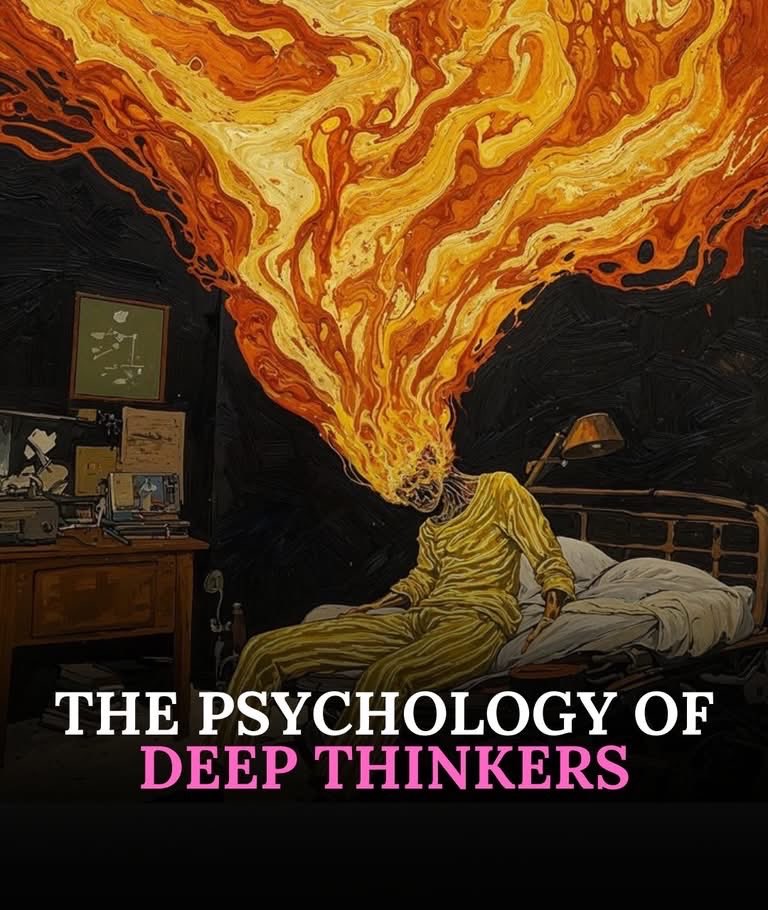
This is not a badge of honor. It is a recognition of the weight carried by those who cannot unsee what they have already seen. This is the psychology of the deep thinker and if you recognize yourself here, this one is for you:
The architecture of alienation. It starts early. The child who asks why adults say one thing and do another. The one whose questions are always labeled as "overthinking." Nietzsche described these people as "free spirits" — essential for progress, but wandering in a wilderness everyone else refuses to enter.
Research by Dr. Elaine Aron suggests approximately 20% of the population processes information more deeply and notices subtleties others completely miss. In a world that rewards speed, this depth can feel like a disability.
The frequency of truth. Deep thinkers operate on a different wavelength, the frequency of truth rather than the frequency of comfort. Most people live without ever questioning the fundamental assumptions of their own existence. But the deep thinker has glimpsed behind the veil.
Like Plato's prisoner who escapes the cave and returns to share what he saw only to be rejected and called a troublemaker—the deep thinker carries the burden of the witness. They see the masks, the exploitation, and the pain that everyone else has agreed to ignore.
The emotional sponge. Deep thinkers do not just observe emotions, they absorb them. They feel the anxiety of a stranger as if it were their own. They perform enormous amounts of invisible emotional labor — checking in on people, listening, supporting, acting as the unofficial therapist of every room they enter. And yet the relationship is almost always asymmetric. They give at a depth most people cannot match. They live with the quiet loneliness of being the strong one, the one everyone leans on, but no one thinks to ask: "Are you okay?"
The mask of normalcy. To survive, many deep thinkers learn to wear a mask, laughing at jokes they do not find funny, feigning interest in conversations that feel hollow, modulating their intensity to avoid being too much. This is not deception. It is survival. But the cost is enormous.
Maintaining the split between the complex private self and the simple public self is exhausting. And the mask, while protective, makes true connection nearly impossible. You cannot be fully known while hiding.
The wounded healer. Jung wrote about this archetype; the person who transforms their own brokenness into a source of healing for others. The wounds of rejection and misunderstanding become sources of deep compassion. The person who has felt most unseen becomes the most gifted at seeing others. But the challenge is learning to give without emptying yourself completely, to love others without losing yourself in the process.
The alchemy of solitude. For deep thinkers, there is a crucial distinction between loneliness and solitude. Loneliness is the pain of disconnection from others. Solitude is the joy of connection with yourself. In solitude, the deep thinker finally breathes. The noise of the world falls away. The internal landscape becomes clear. Isolation transforms into introspection and that is where the real work happens.
The revolutionary act of authenticity. In a world that profits from insecurity, choosing to be genuinely yourself is a radical act. When a deep thinker chooses authenticity over performance, it creates space for others to do the same. It gives people permission to be real in a culture that rewards shallow.
If you recognize yourself in any of this, stop apologizing for your depth. You are not broken. You are not too much. You are not too sensitive. You are awake in a world that prefers to stay asleep. Your sensitivity is a superpower. Your intensity is a strength.
✨🙌🏾💫
"Parasites Are Ubiquitous, They Burrow Deep...Everybody Has Parasites."
Dr Thomas Lodi, MD
"If You Undertreat Them With ONLY Ivermectin Or ONLY Fenbendazole, You Disturb Them."
"They Will Migrate Deep Into Another Organ Like The Pancreas & You Wind Up With Pancreatic Cancer."
Parasites That Are Common & What Organs They Inhabit:
Beef Tapeworm (Taenia saginata)...can inhabit every organ & then migrate to the brain.
Pork Tapeworm (Taenia solium)...every organ can be infected & eventually go to the brain & spinal cord.
Asian Tapeworm (Taenia asiatica)...all organs can be affected.
Opisthorchis viverrini & Clonorchis sinensis (Liver Flukes)...reside in the liver & bile ducts.
Schistosomiasis (Blood Fluke)...reside in the bladder.
Toxoplasmosis...causes ocular tumors, meningioma, leukemia & lymphomas.
Cryptosporidium parvum...reside in the digestive tract, mainly colorectal.
Trichomonas Vaginalis...resides in the cervix & prostate.
Ivermectin & Fenbendazole are fantastic miracle working medications, but they have their limitations. There are parasites that neither anti-parasitic medications eradicate.
Tapeworms, Liver Flukes, Blood Flukes, Adult Filarial Worms & Intestinal Coccidia are not eradicated by Ivermectin & Fenbendazole.
Undertreating will lead to a parasitic migration, burrowing deep into other organs & leading to cancer.
Nature has been providing broad spectrum parasite eradication for 1000s of years. 3 natural compounds that kill & bind every parasite for eradication & removal from the body. Powerful compounds not created in a lab, but found in nature.
Wormwood, Black Walnut Hulls & Clove are the trifecta that targets parasites, inflammation & terrain dysfunction without ever experiencing side effects or pharmaceutical toxicities.
Wormwood: Exact same mechanism as Ivermectin & Fenbendazole for parasites & cancer. Wormwood contains Artemisinin which selectively targets cancer cells while leaving healthy cells unharmed.
Black Walnut Hulls: Exact same mechanism as Ivermectin & Fenbendazole for parasites & cancer. Black Walnut is a natural antiparasitic breaking down biofilms & improving immune function.
Clove: Kills parasitic eggs & dissolves parasitic egg sacs for removal from bodily tissue. Also disrupts hard to kill 2nd stage juvenile parasites, not eradicated by pharmaceutical drugs.
Also equally important is a heavy metal chelation, simultaneously with parasite cleanse, as parasites are attracted to & bind to heavy metals.
Diet is of utmost concern for treatment & future parasitic infections. Eliminating the parasites fuel source, which is sugar. A low carbohydrate animal based diet low in glucose & sucrose...starves the parasites of their preferred fuel.
THESE TRICKS CAN SAVE YOUR LIFE ONE DAY
1. Sudden panic attack – Touch something cold (water, phone, metal). Your brain switches from fear to safety mode.
2. Heart beating too fast – Cough 2–3 times forcefully. It resets your heart rhythm.
3. Can’t breathe properly – Put your hands on top of your head. Your lungs open up instantly.
4. Feeling dizzy – Focus on one spot and tense your legs. Blood rushes back to your brain.
5. Stuffy nose – Hold your breath and nod your head up & down slowly. Open blocked airways.
6. Sudden anxiety – Splash water on your face – it activates the calm reflex.
7. Can’t sleep – Exhale longer than you inhale (4–7 breathing). Your brain goes into sleep mode.
If you want to learn more life-saving tips, turn on notifications.
The vaccine dosage was obviously too high and done too many times.
I had the original Wuhan virus before there was any vaccine and it was much like any other cold/flu. Bad, but not terrible.
But my second vaccine shot almost sent me to the hospital. Felt like I was dying.