SUPRO Vault is officially live. 🚢
Real ships. Real cash flows. Structured onchain.
Deposit USDT on BNB Smart Chain to access maritime private credit.
Launch-period target:
• Up to 15% net annualized yield
+ Referral boost
+ SUPRO Points
A ship is the backdrop. Its charter payments are our focus.
Supro finances the hire owed under a charter contract, with every advance capped against that cash flow. Watch how the structure works.
APY Targets are not guarantees. Withdrawals are not instant.
#RWA#PrivateCredit #SupUSDT #maritime
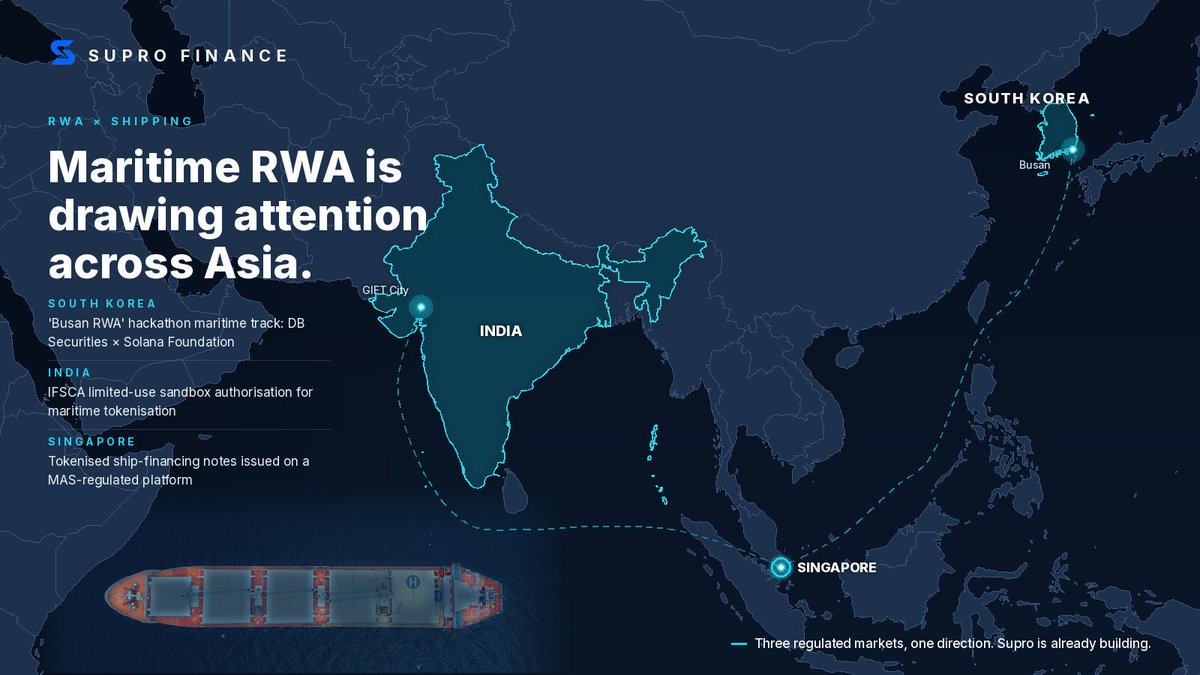
Maritime RWA is drawing attention across Asia. Supro is already building in this space.
The recent signals come from regulated markets:
In Korea, DB Securities and the Solana Foundation announced a "Busan RWA" hackathon track built around the city's maritime, logistics and green industries, and DB Securities is separately reviewing ship carbon-reduction equipment as security tokens.
In India, the GIFT City regulator IFSCA granted a maritime asset tokenisation platform a limited-use authorisation to test within its fintech sandbox.
In Singapore, tokenised ship-financing notes have been issued and closed on a MAS-regulated platform.
Three markets, one direction: maritime assets and maritime cash flows are moving on-chain.
Supro's focus within this space is specific. A time charter sets the hire and its payment schedule in a contract. That contracted charter hire is the receivable Supro finances: loans to a KYB-vetted shipowner, with hire routed through a controlled SPV lockbox account.
Not fractional vessel ownership. No principal guarantees. Real ships, real cash flows.
As maritime RWA grows, Supro will keep building where it started: financing the charter hire that keeps ships working.
#RWA #Shipping #PrivateCredit
Securitize just bought itself a credit origination business.
On November 17, the tokenization platform behind BlackRock's BUIDL fund completed its acquisition of River One, an institutional credit originator. The announcement cites a roughly $6 trillion global private asset-backed finance market, with KKR estimating it could reach $9.2 trillion by 2029.
Beyond token issuance, the acquisition adds the capability to originate credit. That brings the conversation back to what sits behind a token: the underlying business and its cash flows.
For SUPRO, the focus is maritime credit: connecting stablecoin capital with short-duration financing backed by charter-hire and freight receivables. Our USDT vault is live on BNB Chain.
Embark on your maritime private credit journey with us!
#tokenisation #RWA #maritime
What if you put 30% of your salary into SUPRO?
This illustration starts with a simple scenario: a 1,500 USDT monthly income, with 450 USDT contributed to a SUPRO vault each month.
At an assumed 8% annual return, compounded monthly, those contributions would grow to approximately 5,602 USDT after one year, including 5,400 USDT contributed.
Explore maritime private credit with SUPRO.
Illustration only. The 8% assumption is not a promised return. Actual results may differ, and capital is at risk. This is an investment, not a savings account.
#Whatif #RWA #PrivateCredit #maritime
👉 US$42,798. Per day, not per month.
That was the closing level of Baltic Exchange's Capesize 182 5TC earnings benchmark in Week 46. Earlier in the week, it reached US$43,860 per day.
These figures offer a glimpse of the economic activity behind commercial shipping. A vessel is more than a physical asset: its employment can generate a stream of contractual payments, with financing needs around that cash flow.
For us, that is where the opportunity becomes interesting. Beyond owning ships or trading shipping stocks, there is another part of the market to understand financing the receivables generated by shipping operations.
Supro's financing focus includes time charter hire receivables, bringing underwritten shipping cash flows into on-chain private credit vaults.
Our thesis is that connecting this real-world financing activity with on-chain capital is a meaningful opportunity. The starting point is understanding the contracts, counterparties and cash flows behind it.
The benchmark illustrates market conditions, not a specific Supro vessel's income, net profit or promised vault return.
#maritime #income #RWA #Ship
SUPRO WEEKLY REPORT:
RWA x Shipping 🚢
Nov 9-13, 2026
SUPRO vault: approximately $2.07M deposited as of Nov 13.
This week, we covered why shipowners need more financing options and why financing charter hire is different from owning vessel shares.
Across RWA and shipping:
• BUIDL liquidity goes beyond banking hours. Securitize and Ethena launched a 24/7 facility for eligible investors, with $50M initially funded and up to $100M in capacity. Tokenization needs usable liquidity, not only transferable tokens.
• DTCC plans a Solana connection. Eligible DTC-custodied assets are expected to reach Solana in H2 2027. This is an announced expansion, not assets already live on the network.
• Dry bulk finds support. Baltic's Capesize time-charter average finished the week at $42,798/day, with Pacific demand supporting the market. Strength still varies by route and vessel class.
• Container rates soften. Drewry's World Container Index fell 2% to $4,305 per 40ft container. Shipping is not one uniform market.
Our takeaway: better onchain access does not replace credit analysis. In maritime finance, the contract, the payer and the collection path still matter more than a headline freight rate.
SUPRO focuses on financing against charter-hire receivables, not vessel shares. Target returns are not guaranteed. Withdrawals are not instant.
#RWA #maritime
Where Supro's Advantages Come From?
Supro finances charter hire, not vessel shares.
That distinction matters. The focus is on payments owed under a charter contract, rather than selling investors a fraction of a ship.
For shipowners: another route to capital
Contracted charter income can become a basis for financing. This gives owners an alternative to relying only on bank relationships or personal networks, helping connect future receivables with present funding needs.
For LPs: a defined underlying cash flow
The exposure is to charter payments from underwritten time charters. The investment case starts with the contract and the ability of the charterer to pay, rather than token speculation or a loop of leverage.
A real-world asset label is not enough. What matters is what generates the cash, who owes it and how it is collected.
For the structure: clearer separation and visibility
Supro's model uses ring-fenced vaults, NAV-tracked shares and controlled collection arrangements. On-chain vault records provide visibility into the investment structure, while real-world cash collection still depends on the underlying contractual and banking arrangements.
Our experience so far is that charterers have not paid hire late. The account receiving charter hire is jointly controlled by the shipowner and Supro, helping reduce the risk of funds being diverted.
That is our experience and structure, not a guarantee. Contracted income still carries credit and operational risks. Supro does not guarantee principal or returns.
The longer-term opportunity
Fleet expansion, vessel renewal and equipment upgrades create recurring demand for capital. Supro's opportunity is to serve part of that demand through financing backed by real charter cash flows.
Success will depend on disciplined underwriting, reliable collection and earning trust from both shipowners and LPs. Bringing finance on-chain is the starting point. Making the connection work consistently is what matters.
#RWA #maritime #Loan #PrivateCredit
@MarvelStudios Decoded: Trust the process and the market is ready. Believe in faith and trust no one. RWA is the future and offers sustainable profits in DeFi yield.
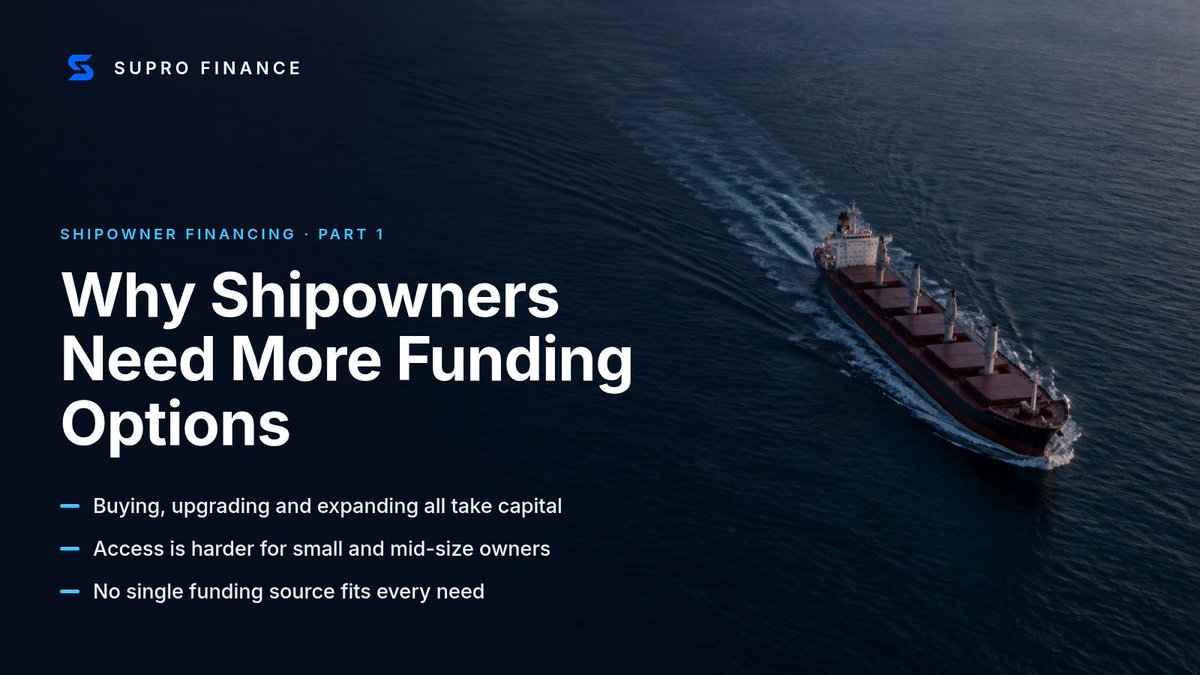
Why SUPRO? And why do shipowners need more funding options?
Shipping needs capital at every stage. Buying another vessel, upgrading equipment or expanding a fleet all require substantial funding.
For small and mid-size shipowners, access to that capital can be harder than it is for the largest shipping groups. Banks are one route, but not always an easy one. Personal networks, friends and family can help, but they are not a complete answer to a growing business's financing needs.
And those needs come in different forms: short-term working capital and longer-term investment in vessels and equipment. One source of funding will not suit every situation.
Fleet investment is also about renewal, not only expansion. UNCTAD's Review of Maritime Transport 2025 counted about 112,500 commercial vessels on 1 January 2025, up 3.4% in a year. As of May 2025, vessels designed to use alternative fuels represented 8% of the active world fleet by gross tonnage, compared with 53% of tonnage on the orderbook.
That shift points to a changing fleet and continued investment needs. It does not mean every shipowner will grow, or that every financing opportunity is attractive.
Shipping remains cyclical. Trade, tariffs, freight markets and geopolitics can change the outlook quickly. More demand for finance does not automatically mean better credit.
The opportunity is to connect genuine funding needs with financing grounded in identifiable cash flows. That is where Supro focuses.
@0xspicexr@maplefinance@aave Institutional credit yield on a loop is still a deposit wrapper.
Underwriting still asks who pays the loan, and on what cycle.
When markets turn volatile, the question for maritime private credit is simple: what supports repayment?
At Supro, we look at payment history, cash-flow controls and the charterer's incentives to keep paying.
1. Payment history
In our experience to date, charterers have never been late on hire payments. That is our track record, not a guarantee of future performance.
2. Cash-flow controls
The account into which the shipowner receives charter hire is jointly controlled with Supro. This reduces the risk of rental income being diverted before it can meet repayment obligations.
3. Commercial incentives
The crew and most personnel aboard are provided by the shipowner, while the charterer's cargo is on the vessel. Stopping hire payments puts the charterer's own trade at risk. Keeping the arrangement running is in its commercial interest.
These safeguards do not eliminate credit risk. They explain how repayment risk is managed beyond simply putting an asset on-chain.
Real-world credit needs real-world controls.
#RWA #maritime #credits