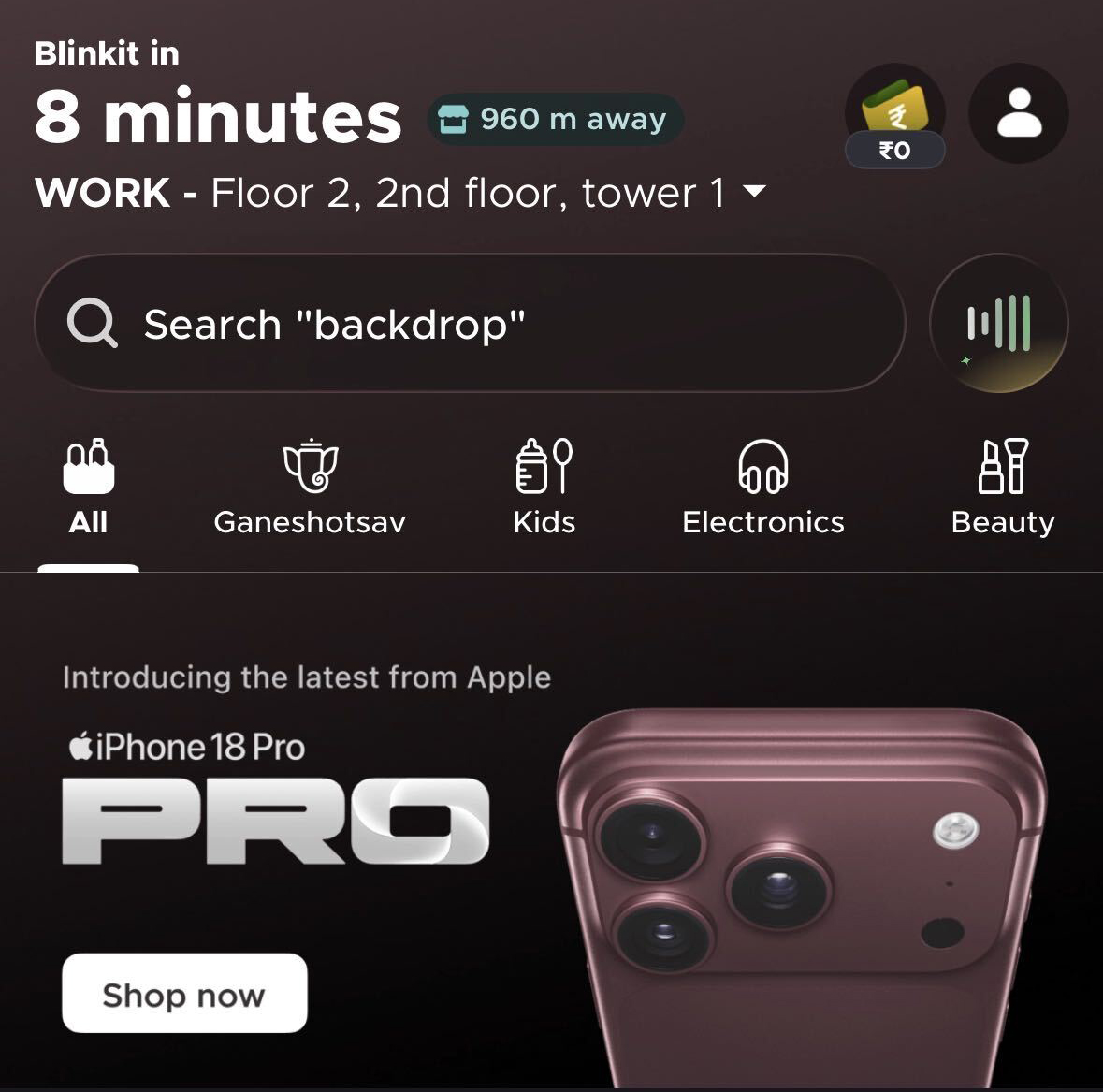
New launch: iPhone 18 Pro is now available on Blinkit (in all 4 colours) ✌️
This year, we’ve also got the new iPhone 18 Pro Max, Apple Watch S12 and Airpods 5. We've partnered with @Apple, bringing their latest products to Blinkit customers in Delhi NCR, Mumbai, Bengaluru, Hyderabad, Chennai, Pune, Kolkata, Ahmedabad, Jaipur and Lucknow (for now) on launch day!
There are discounts available on select credit cards, along with no cost EMI options too.
Temple's first validation study is out.
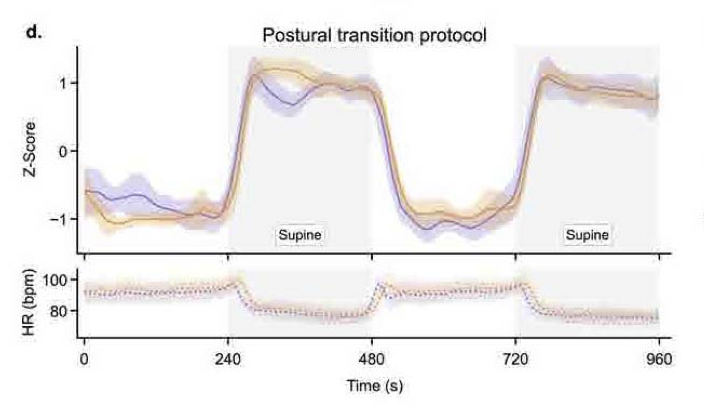
Researchers tested Temple's Brain Flow index head-to-head against Transcranial Doppler (TCD), the gold standard for measuring cerebrovascular function. 23 healthy adults, two challenges: cycling and a standing-to-supine postural shift.
The result that stood out most to me: when participants lay down, their heart rate dropped, but their brain blood flow went up. Temple tracked this accurately, right alongside the Doppler. Any device that only measures heart rate would have gotten this completely wrong.
Across both challenges, Temple's Brain Flow tracked Middle Cerebral Artery velocity (MCAv) with within-subject temporal correlation of r≈0.8 (p<0.001), which is very high even for medical devices.
The paper is posted as a preprint and submitted for peer review. One study, two interventions, healthy adults only, but it's the first step. More validations on Brain Flow, as well as on Entropy with different modalities are underway across the globe. We will keep sharing them as they trickle in.
We encourage researchers to replicate this. We'll happily loan Temples to any qualified researcher who wants to pressure-test any of our metrics independently.
https://t.co/86vUY9YQbV
Cc @agingroy
Today we’re launching Blinkit inside the Mumbai Airport!
Specifically Terminal 2 (Domestic departures) of Chhatrapati Shivaji Maharaj International Airport.
Through our partnership with Adani Airports, travellers can now order from a selection of 2500+ products like phone chargers, books, gifts and more on the Blinkit app. Orders will be delivered within the terminal by our dedicated team of walkers.
This is the first airport in the world to have a service of this kind and we're excited to deliver all the last-minute needs of our customers.
P.S - update your Blinkit app to the latest version to order.
@Adani_One | @AdaniDigital | @CSMIA_Official
Facts below (1/5):
In 2025, average earnings per hour (EPH), excluding tips, for a delivery partner on Zomato were ₹102.
In 2024, this number was ₹92. That’s a ~10.9% year-on-year increase. Over a longer horizon also, EPH has shown steady growth.
Most delivery partners work for a few hours and only a few days in a month. But if someone were to work for 10 hours/day, 26 days/month, this translates to ~₹26,500/month in gross earnings. After accounting for fuel and maintenance (~20%), the net earnings for the partner are ~₹21,000/month.
Note: Earnings per hour are calculated on total hours logged in, including the time when the partner might be waiting to receive an order. Earnings per “busy hour” will be higher but that’s not the right metric to look at.
On top of this - delivery partners earn 100% of tips given by customers. The average tip per hour in 2025 on Zomato was INR 2.6 and in 2024 was INR 2.4 per hour. Tips are transferred instantly, with zero deductions. We absorb the payment gateway processing cost ourselves. About 5% of the orders get tipped on Zomato; 2.5% on Blinkit.
I am all for peaceful protests against anything and everything. But violent protests and stopping others who want to work from working is not okay (proof attached).
Here’s what we know – a number of these protestors were not even our delivery partners. They were agents of political interests, piggybacking on the narrative to gain political mileage.
Last one on this topic, and I have been holding this in myself for a while.
For centuries, class divides kept the labor of the poor invisible to the rich. Factory workers toiled behind walls, farmers in distant fields, domestic help in backrooms. The wealthy consumed the fruits of that labor without ever seeing the faces or the fatigue behind it. No direct encounter, no personal guilt.
The gig economy shattered that invisibility, at unprecedented scale.
Suddenly, the poor aren't hidden away. They're at your doorstep: the delivery partner handing over your ₹1000+ biryani, late-night groceries, or quick-commerce essentials. You see them in the rain, heat, traffic, often on borrowed bikes, working 8–10 hours for earnings that give them sustenance. You see their exhaustion, their polite smile masking frustration with life in general.
This is the first time in history at this scale that the working class and consuming class interact face-to-face, transaction after transaction. And that discomfort with our own selves is why we are uncomfortable about the gig economy. We want these people to look our part, so that the guilt we feel while taking orders from them feels less.
We aren't just debating economics. We are confronting guilt. That ₹800 order might equal their entire day's earnings after fuel, bike rent, and app cuts. We tip awkwardly, or avoid eye contact, because the inequality is no longer abstract. It's personal.
Pre-gig era, the rich could enjoy luxury without moral discomfort. Labor was out of sight. Now, every doorbell ring is a reminder of systemic inequality. That's why debates explode. It's not just policy. It's emotional reckoning. Some defend the system (“they choose it”), others demand change (“this isn't progress, its exploitation”).
And here’s the uncomfortable twist: the unsaid ask of clumsy ‘solutions’ isn’t dignity. It is about returning to invisibility.
Ban gig work and you don’t solve inequality. You remove livelihoods. These jobs don’t magically reappear as formal, protected employment the next day. They disappear, or they get pushed back into the informal economy where there are even fewer protections and even less accountability. Over-regulate it until the model breaks, and you achieve the same outcome through paperwork instead of slogans: the work evaporates, prices rise, demand collapses, and the people we claim to protect are the first to lose income.
And then what happens?
The rich get their old comfort back. Convenience returns without faces. Guilt dissolves. We go back to clean abstractions and moral posturing from a distance. The poor don’t become safer, they become invisible again: back in cash economies, back in backrooms, back in shadows where regulation rarely reaches and dignity isn’t even debated.
The gig economy just exposed the reality of inequality to the people who previously had the luxury of not seeing it. The doorbell is not the problem. The question is what we do after opening the door.
Visibility is the price of progress. We can either use this discomfort to build something better (which we keep doing continuously as delivery partners are our backbone), or we can ban and over-regulate our way back into ignorance. One of those choices improves lives. The other simply helps the consuming class feel virtuous in the dark.
We're celebrating Zomato's (Eternal's) 17th birthday by launching the "Greening India" initiative! 🌳🌳
Over the next year or so, we'll plant more than 25 lakh trees on farmlands, over 10,000 acres – supplementing farmers' income while removing 15 lakh tonnes of CO₂ from the atmosphere over the next three decades.
So far, we've already partnered with 2000+ farmers for plantations on 4500+ acres land across Maharashtra, Uttar Pradesh, and Punjab.
If this succeeds, we'll make this much bigger.
Details – https://t.co/OUYc9II1kK
@Myprotein@Myprotein_CS My brother placed an order in india for protien with id: 616870783. He had received damaged protien powder from you guys and the same was shared by him on your Customers Care.