SQL From Basic to Advanced level
Basic SQL is ONLY 7 commands:
- SELECT
- FROM
- WHERE (also use SQL comparison operators such as =, <=, >=, <> etc.)
- ORDER BY
- Aggregate functions such as SUM, AVERAGE, COUNT etc.
- GROUP BY
- CREATE, INSERT, DELETE, etc.
You can do all this in just one morning.
Once you know these, take the next step and learn commands like:
- LEFT JOIN
- INNER JOIN
- LIKE
- IN
- CASE WHEN
- HAVING (undertstand how it's different from GROUP BY)
- UNION ALL
This should take another day.
Once both basic and intermediate are done, start learning more advanced SQL concepts such as:
- Subqueries (when to use subqueries vs CTE?)
- CTEs (WITH AS)
- Stored Procedures
- Triggers
- Window functions (LEAD, LAG, PARTITION BY, RANK, DENSE RANK)
These can be done in a couple of days.
Learning these concepts is NOT hard at all
- what takes time is practice and knowing what command to use when. How do you master that?
- First, create a basic SQL project
- Then, work on an intermediate SQL project (search online) -
Lastly, create something advanced on SQL with many CTEs, subqueries, stored procedures and triggers etc.
This is ALL you need to become a badass in SQL, and trust me when I say this, it is not rocket science. It's just logic.
Remember that practice is the key here. It will be more clear and perfect with the continous practice
Like this post if it helps 😄❤️
ENJOY LEARNING 👍👍
AWS Lambda (The Core of Serverless Architecture)
If you understand Lambda,
you understand modern cloud development.
Here’s the real breakdown 👇
What AWS Lambda actually is
Lambda = serverless compute service
that runs your code only when triggered.
No servers.
No infrastructure management.
Just code → execution.
How Lambda Works (architecture view)
Event happens →
Lambda triggers →
Code runs →
Returns response →
Stops.
You’re billed only for execution time.
What can trigger Lambda
• API Gateway (HTTP requests)
• S3 (file upload)
• DynamoDB (data change)
• EventBridge (events)
• CloudWatch (scheduled jobs)
Everything is event-driven.
Why Lambda is powerful
• Auto scaling (0 → thousands instantly)
• Pay-per-use
• No server management
• Built-in high availability
• Easy integrations across AWS
This is why serverless is the default in 2026.
Where Lambda is used
• Backend APIs
• Automation scripts
• File processing pipelines
• Event-driven systems
• Microservices
• AI pipelines
Key Concepts You MUST Know
1️⃣ Execution Time
Max ~15 minutes
(Not for long-running tasks)
2️⃣ Memory = Performance
More memory → faster execution
3️⃣ IAM Role
Defines what Lambda can access
4️⃣ Cold Start
First request may be slightly slower
Real Architecture Example
User → API Gateway →
Lambda → DynamoDB →
Response → User
Fully serverless backend.
Common Beginner Mistakes
❌ Using Lambda for long-running jobs
❌ No error handling
❌ Hard-coded secrets
❌ Ignoring timeouts
❌ Not monitoring logs
Lambda vs EC2 (Quick Insight)
Lambda → event-driven, low ops
EC2 → full control, long-running apps
Choose based on workload.
Performance Insight
Lambda scales automatically.
You don’t plan capacity.
That’s a massive shift from traditional systems.
Golden Rule
If your workload is event-driven,
Lambda should be your first choice.
I put a lot of heart into my technical writing, I hope it's useful to you all.
📌 Here's a pinned thread of everything I've written.
(much of this will be posted on the Claude blog soon as well)
🐧 Linux Troubleshooting Cheat Sheet (Save this)
If you work in DevOps, Cloud, or Production Support, sooner or later, you’ll debug a Linux server at 2 AM.
When production breaks, these commands become lifesavers.
🔎 Check CPU usage
top
htop
💾 Check disk usage
df -h
du -sh *
⚙️ Check running processes
ps aux | grep process_name
📜 Monitor logs in real time
tail -f /var/log/syslog
🌐 Check open ports
netstat -tulnp
📡 Check network connectivity
ping hostname
curl http://service-url
🔧 Restart a service
systemctl restart service_name
📊 Check memory usage
free -m
These simple commands help engineers troubleshoot:
✔️High CPU usage
✔️Memory leaks
✔️Disk space issues
✔️Application crashes
✔️Network connectivity problems
Tools change.
Cloud providers change.
But Linux skills stay forever.
If you're a DevOps / Cloud engineer:
👉 Which Linux command do you use the most during troubleshooting?
The best small businesses of the next decade will run on a barbell:
One side: leverage AI for ruthless speed and scale.
The other side: be aggressively, inconveniently human. Show up in person. Send the note. Remember the name. Do the thing that doesn't scale.
The ones who nail BOTH ends will eat everyone else’s lunch.
Recently had several calls with an investor who wanted to make a significant investment in our fund.
He’s been an investor for many decades, had his own successful fund, and is among the most sophisticated investors I’ve ever connected with.
Each call was very comprehensive, and he dug into all aspects of our business.
Finally, on our final call:
“Don, do you fly business class for work?”
And he paused.
My answer.
“I don’t fly business class during the day - but if the circumstances are such that I need to take a redeye, I fly business so I can sleep - but I pay the difference out of pocket.”
He smiled.
“Good. Business class is an absolute waste of money.”
He wrote a big check 🙏
I built 31 automations for clients last year.
Every single business - from solo founders to 50-person teams - needed some version of the same workflows.
So I documented all of them. Every workflow. Every department. And the exact plain-English prompt that builds each one in minutes.
Sales & CRM: lead capture, follow-up sequences, deal tracking, proposal generation, pipeline alerts
Marketing: social scheduling, email sequences, content repurposing, UTM tracking, review requests
Operations: invoice generation, payment reminders, inventory alerts, automated reporting
Customer Success: onboarding emails, NPS surveys, churn detection, support routing
Admin: meeting scheduling, expense tracking, document generation, approval workflows
Each one includes the specific prompt I use to build it - not vague instructions, the actual sentence I type.
Plus which 3 to start with if you want to save 10+ hours/week immediately.
Comment "PLAYBOOK" and I'll DM you the full PDF for free.
Y Combinator’s latest demo day takes place in 4 days!
(and it’s the strongest batch yet)
Discover all 180+ startups 👇👇👇
Take note as some of these will become household names in the future!
LangChain just open-sourced something most devs haven’t noticed yet:
𝗗𝗲𝗲𝗽 𝗔𝗴𝗲𝗻𝘁𝘀.
And it’s a big shift in how agents are built.
Here’s what you’re missing 👇
---
𝗣𝗹𝗮𝗻𝗻𝗶𝗻𝗴
→ Breaks tasks into steps automatically
→ Tracks progress in real time
---
𝗙𝗶𝗹𝗲𝘀𝘆𝘀𝘁𝗲𝗺
→ Read, write, edit files
→ Full control over agent context
---
𝗦𝗵𝗲𝗹𝗹 𝗔𝗰𝗰𝗲𝘀𝘀
→ Run terminal commands directly
→ Sandboxed for safety
---
𝗦𝘂𝗯-𝗔𝗴𝗲𝗻𝘁𝘀
→ Delegate complex work
→ Each agent gets its own context
---
𝗦𝗺𝗮𝗿𝘁 𝗗𝗲𝗳𝗮𝘂𝗹𝘁𝘀
→ Pre-optimized prompts
→ Almost zero setup required
---
𝗖𝗼𝗻𝘁𝗲𝘅𝘁 𝗠𝗮𝗻𝗮𝗴𝗲𝗺𝗲𝗻𝘁
→ Auto-summarizes long threads
→ Saves large outputs to files
---
This is the same direction tools like Claude Code are moving toward.
From:
Chat-based AI
→ to
𝗙𝗨𝗟𝗟 𝗔𝗚𝗘𝗡𝗧 𝗘𝗡𝗩𝗜𝗥𝗢𝗡𝗠𝗘𝗡𝗧𝗦
And now it’s open for everyone.
---
Most people are still prompting.
A few are starting to build systems.
That gap is about to get very real.
---
Save this for later.
Repost ♻️ if you’re building with AI
Check my profile for more AI resources 👋
You don’t need more AI tools.
You need to understand the language of AI.
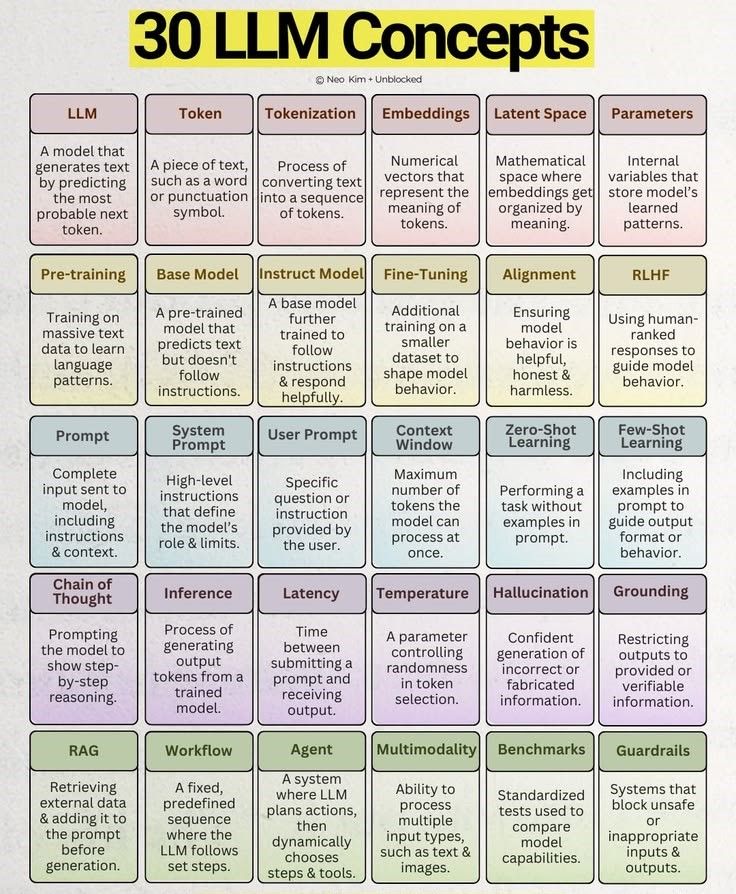
Here are 30 LLM concepts — simplified 👇
🧠 Core building blocks
• LLM → predicts the next word
• Token → small pieces of text
• Tokenization → breaking text into tokens
• Embeddings → text converted into numbers
• Latent Space → where meaning is organized
• Parameters → what the model learns internally
🏗 How models are created
• Pre-training → learning from massive data
• Base Model → raw model (no instructions)
• Instruct Model → trained to follow instructions
• Fine-tuning → adjusting for specific tasks
• Alignment → making AI safe & useful
• RLHF → learning from human feedback
💬 How we talk to AI
• Prompt → full input to the model
• System Prompt → rules for behavior
• User Prompt → your question
• Context Window → how much it can remember
• Zero-shot → no examples
• Few-shot → with examples
🧩 How reasoning works
• Chain of Thought → step-by-step thinking
• Inference → generating output
• Latency → response time
• Temperature → randomness control
• Hallucination → wrong but confident answers
• Grounding → using real data
🚀 Real-world systems
• RAG → connect AI with external data
• Workflow → step-by-step execution
• Agent → AI that plans + acts
• Multimodality → text, image, audio together
• Benchmarks → measuring performance
• Guardrails → safety + control
Simple truth:
If you understand these concepts...
You can understand any AI system.
Tools will change.
Concepts won’t.
📌 Save this — this is your AI vocabulary.
♻️ Repost to help someone learning AI.
#AI #LLM #GenerativeAI #MachineLearning #AIEngineering #DataScience #data #ml #interview
The PM job used to be "figure out what's possible, then plan around it for 6 months."
That assumption worked when the technology underneath your product moved slowly. Cat Wu runs product for Claude Code at Anthropic. She tested every new model by asking it to add a table tool to Excalidraw. Sonnet 3.5 failed. Opus 4 occasionally succeeded. Opus 4.6 does it reliably enough to demo live in front of thousands of developers. That progression happened in 16 months.
METR measures this with time horizons: how long would a task take a human expert that AI can now complete half the time? Sonnet 3.5 (new) in October 2024: 21 minutes. Opus 4.6 in February 2026: roughly 14.5 hours. A 41x jump.
If your roadmap is longer than the gap between model releases, you're planning around constraints that may not exist by the time you ship.
Her team's response is worth studying. They replaced long-term roadmaps with "side quests," short self-directed experiments anyone on the team can run. Claude Code on Desktop, the AskUserQuestion tool, and todo lists all started this way. Someone prototyped it, internal users liked it, they shipped it.
The most telling detail: when they first launched todo lists, the model couldn't reliably check off completed items. They added system prompt hacks to nudge it. Next model generation, the behavior came for free. They deleted the hacks. Their system prompt shrank 20% with Opus 4.6 alone.
This is the part most PMs miss. Every workaround you build to compensate for a model limitation becomes dead weight the moment the next model drops. The simpler your implementation, the faster you absorb the next capability jump.
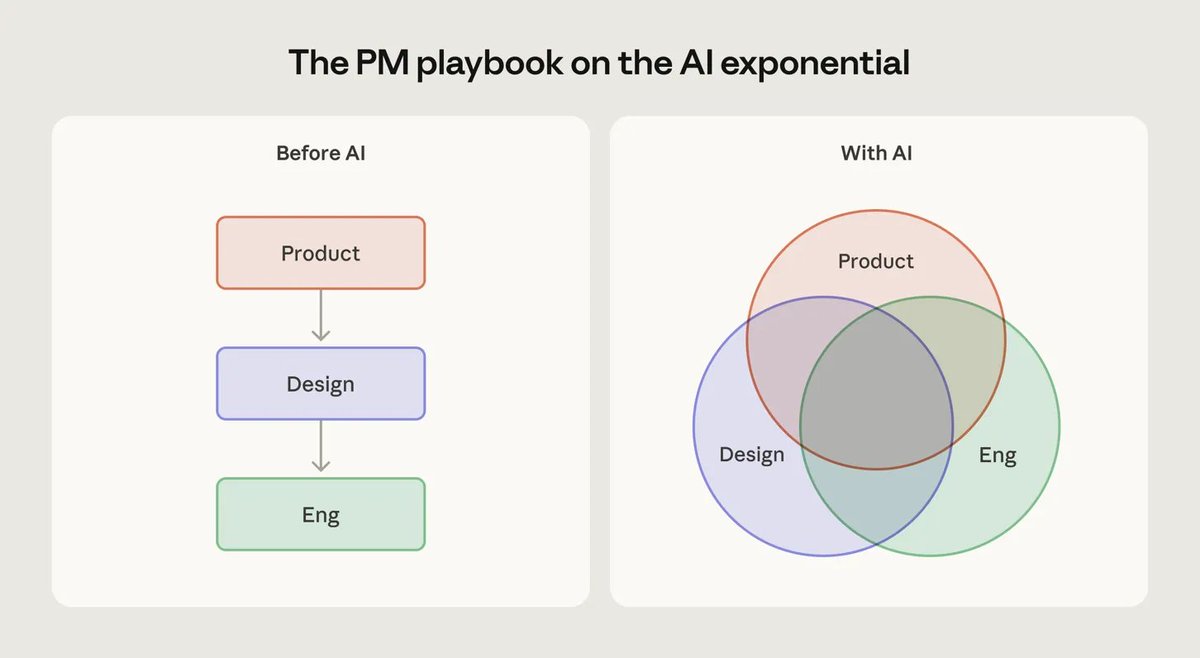
The Venn diagram in the image tells the structural story. Before AI: Product hands to Design hands to Eng, sequential. With AI: all three overlap. Designers ship code. Engineers make product calls. PMs build prototypes. The handoff chain collapses because the cost of building a working demo dropped to an afternoon.
Any PM still writing 30-page PRDs before touching a prototype is optimizing for a world where building is expensive. That world ended about 12 months ago.
Post-sales has always been the second-class citizen in GTM.
Every major tooling wave - Salesforce (CRM), HubSpot (inbound), Gong (intelligence) - was focused for Hunting and not Harvesting.
The AI supercycle is transitioning the SaaS pricing model from per-seat (subscription) to per-task (metered billing)
In this transition, post-sale becomes FAR more important - activation, engagement, expansion - is the ONLY way a company can earn revenue.
Building a true relationship post contract signing is the ONLY way forward.
Chandrika & Tanay have lived through this problem at their previous stints - the Quivly offering is what they wish they had all those years ago!
This team is by-far the most customer obsessed in the @DeVC_Global portfolio!
🚨💣STARTUP INDIA, buckle up for Saturday truth bombs. I’m going to say a few things that Indian founders usually won’t say out loud.
Over the last 2 odd years I’ve been on the ground in India, working very closely with founders from idea stage all the way to Series A/B, and also spending a fair bit of time with funds across the spectrum. I sit in a slightly unusual position in this ecosystem — I’m not a full-time VC, I’m not a founder either. I’ve spent most of my time as an operator, globally, and as someone who enables networks across founders, funds, and companies.
Which basically means I get to see both sides of the table more than most people do.
And more importantly, a lot of founders tell me a lot of things they will never say publicly, because they are scared of VCs, they are worried about access to capital, or they don’t want to burn bridges. I usually try to pass that feedback back to funds in a constructive way, protecting founders where needed.
But I think some of this needs to be said openly, especially for early founders who are just entering the system.
So here goes:
“We invest at paper napkin stage” is one of the most overused lines in this ecosystem. It sounds great, and I’m sure there are a few genuine cases, but in reality most decisions are still supported by proxies — early signals, pedigree, prior affiliations, how you present, and yes, a surprising amount of Excel-based thinking even at stages where that shouldn’t be the primary lens. You’ll be told it’s about conviction, but you’ll still be pushed into projections, assumptions, and frameworks that try to reduce uncertainty as quickly as possible.
I want founders to know that most VCs are structurally designed to say no, that’s NOT the issue. The issue is how that “no” is often delivered — a lot of founders walk away without any real understanding of what didn’t work, because the answer is usually something superfluous like “not enough signal” or “doesn’t fit our thesis”, which in many cases is just uncertainty dressed up as a decision. Very few people will actually tell you where they think your business could break.
Risk aversion in India is very real, it’s just not called that. It shows up in more polite forms — like where you studied, where you’ve worked, how you speak, how you present yourself in a room. Founders from non-traditional paths or Tier 2/3 India feel this immediately, even if nobody explicitly says it.
There is also a lot more FOMO in early-stage investing than people would like to admit. You’ll see funds move quickly when others are already in, you’ll see pressure to get onto cap tables, and sometimes the urgency has less to do with your company and more to do with how the fund wants to position itself or deploy capital.
And this is important — a lot of Indian VCs are not forming independent conviction as often as you would hope. They are watching what’s happening in the US and then mapping that back here. You can literally see waves move — SaaS, edtech, now AI, now “deep tech”, now defense, now robotics — and the same funds will move across these categories over time. There are exceptions, for example imho fintech investing in India did carve out its own path, and quick commerce to some extent as well, but a lot of the rest follows a pattern of observing what’s working elsewhere and then adapting it locally.
The operator gap is something founders need to pay a lot more attention to. If someone is investing in enterprise SaaS, it’s worth asking whether they’ve ever actually sold enterprise software themselves??
If they’re investing in AI, have they built anything meaningful or are they just experimenting at a surface level??
If they’re investing in hardware or robotics, have they seen a deployment go wrong in the real world??
A lot of the time, founders end up spending a significant portion of the conversation explaining their space to the very people evaluating them.
There’s also a very real gap internally within funds that founders don’t see — what partners say at a high level and what analysts evaluate on are not always aligned, which means you can walk out of one conversation feeling strong alignment and then find yourself re-explaining everything in the next. It creates confusion, and most founders just absorb that friction silently.
And please, don’t get overly swayed by the “we’ll take you to Silicon Valley” narrative. This one needs to be said clearly. You don’t need to be necessarily be in San Francisco, you need to be where your customer is. Period. I’ve seen too many founders get excited about Bay Area trips, demo days, and immersion programs, and come back with no real customer insight, no distribution, and no meaningful progress. You are not building a company by attending events and walking around SF. If your customers are in India, stay here and go deeper. If they’re in Southeast Asia, go there. If they’re in the US, figure out where exactly, not just Silicon Valley, it could be the MidWest or Miami. Get the VC to take you there.
Geography should follow customers, not self serving VC narratives.
On capital, especially for early-stage founders, it’s worth rethinking how much you actually need. In software, the cost of getting something off the ground has dropped significantly — as @mcuban pointed out recently on @tbpn , it’s never been easier to build software: ship, test, and start charging. Your first validation can come from customers, not investors.
Dilution is not something you need to rush into if you don’t have to.
Hardware is a different game, of course, capital matters there, but even in hardware I’m seeing founders find alternative paths — working with China, using labs, building in smaller batches, and being more capital efficient than before.
One thing I’ll tell early founders very clearly — don’t get overly impressed by funds that say they’ve done 100+ investments. In many cases, more smaller yet intentional portfolios lead to better attention and support. If a fund is spread too thin, you need to ask yourself how much time they realistically have for you once the cheque is written.
And please, do diligence on your VCs the same way they do on you: Talk to founders they’ve backed, not just the ones they showcase. Ask what actually happened AFTER the investment — did they help you get customers? did they show up when things got difficult? or was it mostly intros, programs, and surface-level engagement.
At the end of the day, VCs are one input. Your customer is the only real signal that matters.
There are good investors in India, I’ve worked with some and continue to do so. But founders need to go in with their eyes open and separate X/LinkedIn narrative from reality.
If you’ve been through this, you already know exactly what I’m talking about.
Engineering your own luck is easy when you understand the following:
• Luck isn't "chance"
• Luck favors those who step beyond the familiar - Into new places, new people, and new experiences.
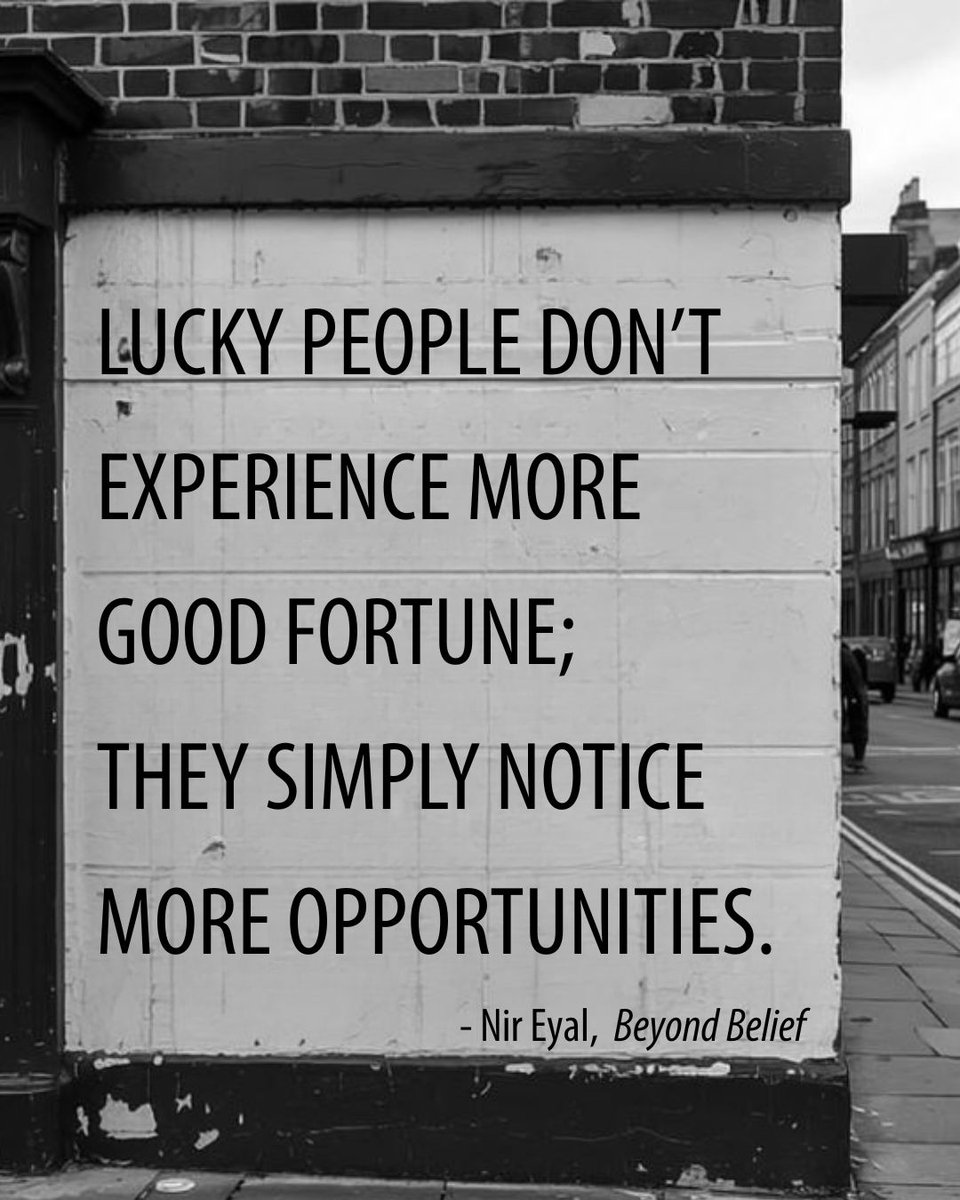
• So‑called lucky individuals don’t actually experience more good fortune; they simply see more of it
• Lucky people consistently disrupt their routines.
Start by asking:
• What beliefs helped you get where you are today?
• Which ones still open doors?
• Which might be quietly closing them?
• Where are you playing it too safe?
• Are you doing enough to “provoke luck”?
To learn more, grab a copy of my new book Beyond Belief today!
https://t.co/zE4t7sPAjs