🚨ULTIMA HORA: Alguien acaba de publicar el curso de 5 horas de Python más completo para IA que existe en internet.
00:00:00 Introducción: Aprende Python para IA
00:01:42 Descripción general del curso
00:03:58 Instalación de Python
00:04:05 Instalar Python en Windows
00:05:10 Instalar Python en Mac
00:06:53 Instalación de VS Code
00:08:34 Configuración de VS Code (Extensiones)
00:12:08 Personalización de VS Code
00:13:31 Crear tu primer proyecto
00:16:18 Crear un espacio de trabajo en VS Code
00:18:02 Tu primer archivo Python (https://t.co/xFvUCVALjP)
00:20:10 Ejecutar código Python
00:26:23 Ejercicio y resumen
00:29:26 Recursos del curso y comunidad
00:31:07 Entender los entornos de Python
00:33:15 Entender los paquetes de Python y Pip
00:34:00 Crear entornos virtuales (venv)
00:37:34 Nota sobre Anaconda
00:38:32 Instalar paquetes de Python (pip install)
00:42:51 Usar paquetes de Python (Import)
00:44:29 Python interactivo con Jupyter
00:48:30 Resumen completo de configuración y ejercicio
00:51:36 ¿Qué es la programación?
00:55:19 Sintaxis de Python y PEP8
00:58:00 Entender y depurar errores
01:01:33 Variables
01:06:03 Comentarios
01:09:48 Introducción a los tipos de datos
01:10:12 Números (enteros y decimales)
01:13:36 Cadenas de texto (Strings)
01:19:39 Formato de cadenas (F strings)
01:21:49 Métodos de cadenas
01:26:35 Booleanos
01:31:02 Operadores (aritméticos, de comparación y lógicos)
01:39:19 Asignaciones abreviadas (+=)
01:40:24 Introducción al flujo de control
01:41:35 Condicionales (if, elif, else)
01:47:11 Bucles (For y range())
01:52:13 Introducción a las estructuras de datos
01:53:32 Listas
01:59:10 Diccionarios
02:00:23 Tuplas
02:01:37 Conjuntos (Sets)
02:05:51 Funciones (definir y llamar)
02:15:02 Parámetros y argumentos de funciones
02:22:42 Alcance de variables (global vs local)
02:28:50 Retornar valores desde funciones
02:37:37 Herramientas externas (módulos y paquetes)
02:40:48 Importar módulos y funciones integradas
02:47:56 Resumen de métodos de importación
02:48:48 Instalar paquetes y requirements.txt
02:56:04 Trabajar con APIs (ejemplo con Requests)
03:06:20 Trabajar con datos (Pandas y Matplotlib)
03:10:46 Leer y guardar archivos de datos
03:14:50 Introducción a Python práctico
03:16:47 Estructura y organización de proyectos
03:22:02 Entender las rutas de archivos
03:26:37 Trabajar con diferentes tipos de archivos
03:34:05 Organizar el código en módulos
03:39:39 Manejo de errores (Try/Except)
03:45:31 Introducción a las clases (POO)
03:49:09 Crear tu primera clase (__init__, self)
03:57:04 Atributos de clase vs instancias
04:00:10 Métodos de clase
04:05:23 Herencia de clases
04:07:32 Cuándo usar clases vs funciones
04:09:44 Introducción a Git y GitHub
04:12:31 Fundamentos de Git
04:15:41 Instalar Git
04:16:46 Flujo de trabajo básico con Git
04:18:41 Crear cuenta en GitHub y autenticación
04:22:37 Clonar repositorios de GitHub
04:28:12 Crear repositorios y .gitignore
04:36:12 Usar Git con la interfaz de VS Code
04:44:05 Variables de entorno y secretos (.env)
04:52:13 Usar el paquete python-dotenv
04:55:03 Introducción a Ruff (linter y formateador)
04:56:13 Configurar Ruff en VS Code
04:57:23 Ruff en acción
05:01:10 Introducción a Uv (gestor de paquetes moderno)
05:02:07 Instalar Uv
05:02:30 Usar Uv (uv init, add, sync)
05:09:01 Ejercicio completo de flujo de trabajo en Python
05:11:13 Cierre del curso y próximos pasos
Desde cero hasta construir agentes con APIs reales, entornos virtuales, Git, clases y manejo de errores.
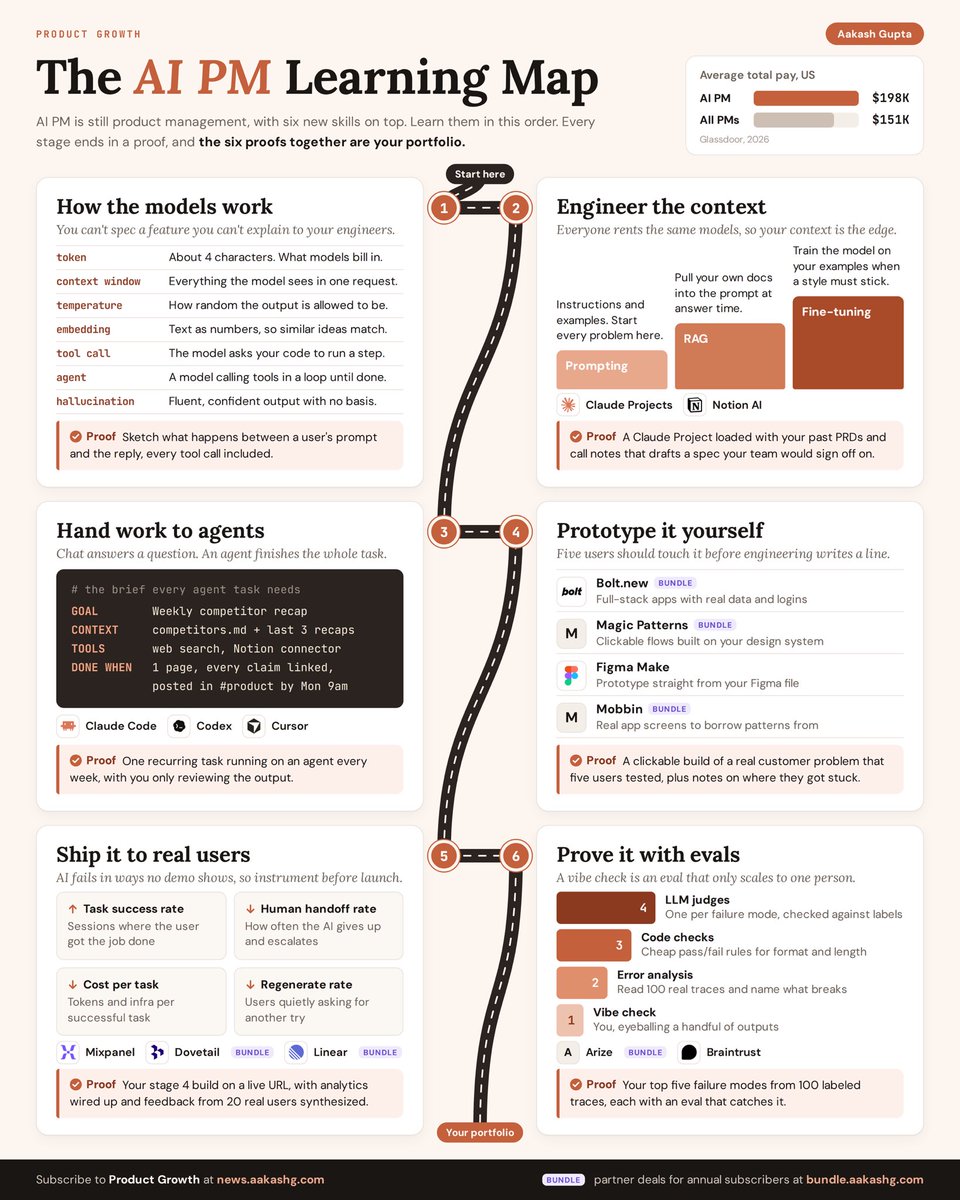
To become an AI PM, you need six skills on top of core PM. Here's the order to learn them.
The pay gap is why it's worth it. Glassdoor puts the average AI PM at $198K in total pay, against about $151K for PMs overall.
Most AI PM learning maps I see are generic PM concepts with "AI" in the title. They skip what hiring managers screen for, which is proof you've done the work.
So in this map, every stage ends in something you can show.
1. Learn how the models work
Tokens, context windows, embeddings, tool calls, agents. You don't need to train a model, but you should be able to sketch everything that happens between a user's prompt and the reply. A PM I coach hit exactly this depth check in technical screens at both Nvidia and Glean.
2. Engineer the context
Everyone rents the same models, so the edge is what you feed them. Climb only as far as you need. Prompting first, RAG when answers depend on your data, fine-tuning when a style has to stick. Your proof is a Claude Project loaded with your past PRDs that drafts a spec your team would sign off on.
3. Hand work to agents
Chat answers a question. An agent finishes the whole task, as long as your brief has a goal, the right context, the tools it can touch and a clear definition of done. Your proof is one recurring task, like a weekly competitor recap, running on Claude Code or Codex while you only review the output.
4. Prototype it yourself
Alex Danilowicz, CEO of Magic Patterns, said on my podcast that the classic mistake is spending two hours debugging a database when all you needed was a clickable mockup to show five customers. Reach for https://t.co/JCwL4Ki6wi when you need real data and logins, and Magic Patterns for flows on your design system.
5. Ship it to real users
AI fails in ways no demo shows. Before launch, instrument task success rate, human handoff rate, cost per successful task and how often users hit regenerate. Then put your prototype on a live URL and synthesize feedback from 20 real users.
6. Prove it with evals
A vibe check is an eval. You're using your own brain as the scoring function, which works right up until you're the bottleneck. Hamel Husain and Shreya Shankar walked me through the sequence I'd copy. Read 100 real traces, name the failure modes, add cheap code checks, then build one LLM judge per failure mode and check it against your own labels.
Your proof is your top five failure modes, each with an eval that catches it.
Stack all six proofs and you have an AI PM portfolio.
A deep dive for each stage
1. AI foundations → https://t.co/BdaH68w3qv
2. Context engineering → https://t.co/WG025YYTBK
3. AI agents → https://t.co/8RM3WE7s1t
4. https://t.co/JCwL4Ki6wi guide → https://t.co/ZmY15YdZ0M
5. AI evals → https://t.co/236NTnMHVB
6. LLM judges → https://t.co/IUhc9yeYUE
7. AI PM portfolio → https://t.co/AFCcmKHifT
Learn the stage. Then ship the proof.
My third conversation with Shopify co-founder and CEO @tobi.
0:00 How Shopify Uses AI
7:18 River: Shopify's Internal AI
8:55 How to Encourage Osmosis Learning
10:52 AI Dreaming and Self-Reflection
11:53 How to Use AI for Strategic Decision Making
14:11 The One Thing AI Cannot Do
16:04 What AI is Making Worse at Shopify
19:46 Predictions: Where AI is Headed Next
21:55 The Future of AI-Powered Software
24:40 Will CEOs Be Replaced with AI?
27:54 Can Superintelligence Be Controlled?
31:13 Critical Skills in AI Age
34:22 Why Complex Solutions are Usually Wrong
36:33 Conditions Needed for True Intuition
38:02 The Best Path Doesn't Have Instant Feedback
44:51 How Affirmations Can Shift Your Behavior
50:44 The Inobvious Thing Hurting Companies
52:37 Relationship Between Beauty and Creation
56:23 How SpaceX Moves Forward By Subtraction
1:00:24 Why Companies Need Refounding Events
1:01:50 Books as Cheat Codes
1:02:39 Three Books to Change Your Thinking
Enjoy!
(Includes paid promotions.)
Anthropic just published its official prompting guide for Opus 5.5.
If you're still writing prompts the way you did for Opus 5, you're paying more and getting less.
Here's what changed 👇
1. Default to medium effort
Medium on 5.5 already outperforms high on Opus 5, at a lower cost. Maxing it out by habit just burns tokens.
2. Drop "think step by step"
Reasoning is built in now. The model decides how much thinking a task needs, so asking it to think harder adds nothing.
3. A check-in isn't a finish line
On long runs, it sends progress updates along the way. If it stops to report, tell it to keep going.
4. Fence off anything you paste
Put emails, docs, and web text in clearly labeled sections or tags. That way it can tell your instructions apart from the material it's working on.
5. Retire your image workarounds
Those custom chart readers and OCR steps you built are probably dead weight. It reads screenshots, diagrams, and charts accurately on its own.
6. For design work, name what you don't want
"Make it unique" gets you generic. "No purple gradients, no centered hero, no emoji icons" gets you something different. It follows specific bans much better than vague direction.
♻️ Repost to save someone a few API bills.
My god this is such a good speech that every SWE needs to hear. You know what? Every person should hear it
Keep the happy memories, eyes on the reality, be excited about the future. That’s the best that anyone can do
Mark Zuckerberg: failure doesn’t matter.
“The question is how much you win, when you win.”
“@WalterIsaacson wrote this biography of Einstein. One of the interesting things were all the theories he had that were wrong.”
“People don’t remember those.”
“We’re all going to get a lot of stuff wrong, what matters are the intellectual and cultural contributions we make that help push stuff forward.”
“We have a resilient company that is not afraid of failure.”
“That allows us to take some big swings and tolerate being ridiculed for long periods of time.”
“If you’re trying to do something that’s really new, people have to think it’s ridiculous. If they didn’t, someone else would’ve already done it.”
“In creation, the upside is infinite.”
“If you build something that hundreds of millions, or billions of people like, then that makes up for a lot of ideas that didn’t end up working.”
Via @Complex
First trailer for ‘Madden’ 🏈
Starring Nicolas Cage, Christian Bale, Kathryn Hahn, Shane Gillis, Sienna Miller, and John Mulaney
Premiering November 18 on Prime Video
If I build my own tools, my own AI tools, to do work, I could get 10 times, 100 times more done
And at the limit, I need to train my own AIs. To do my work
the right way to use model capabilities is not to ship 10x more features to prod
it's to spend more time understanding your users, trying experiments, building prototypes, learning about things you don't understand so that you can ship things that actually work
Saw a tweet saying zuck is the closest thing we have to modern steve jobs and it’s kinda true
Beautiful hardware product and muse is just so user focused instead of model max thinking overkill
Such a shame that Hollywood is tryna make some woke v2 cancel version of the social network again… bro just did the brand glow up