In a stunning convergence of science and nature, our satellite-tagged turtles are helping decode an ancient oceanic map ! As the Southwest Monsoon sets in, several Olive Ridleys have moved towards the southern Bay of Bengal and the waters around Sri Lanka, to seasonal hotspots where warm Bay waters meet cooler Indian Ocean currents. This oceanic mixing fuels a burst of marine productivity, creating rich feeding grounds that turtles have navigated to for millions of years. Long before satellites, they knew exactly where to go. Today, Tamil Nadu Forest Department’s pioneering satellite-tagging project is helping us understand how these remarkable navigators read the ocean and connect distant marine ecosystems Credits- TN Turtle Telemetry Project in partnership with Dr @sureshwii , @wii_india@Aiwcrteofficial & @tnforestdept #TNForest
In Gudalur, in the Nilgiris, one of the most challenging human-elephant conflict landscapes, an AI-enabled Command and Control Centre is helping turn conflict into coexistence. Thermal cameras, AI analytics, drones and real-time alerts track elephant movement and alert. communities .Forest staff, trackers and rapid response teams spend sleepless nights on patrol, following elephant herds through plantations, villages and forest edges, guiding them away from settlements and helping keep both people and elephants safe. Despite their dedication, some tragic incidents still occur, yet every day the system learns, improves and becomes stronger. Behind the technology is a team that is going all out to safeguard both people and the wildlife. This article by @Krish_TNIE is a must read @NewIndianXpress #TNForest . https://t.co/xGqLtwSz9M
Dhaval Lakshmi’s movements haven’t changed much, as it remains in the slow-moving phase in the waters off the Karwar coast. It’s moving southward at a very slow pace, and it’ll be interesting to see how many more days it stays in these waters.
An interesting updates on Alang’s ongoing journey back to her home.
Unlike all the previously tagged Falcons, Alang has been undertaking rather short flights covering, on average, 300 km a day. Alang, passing through West Bengal, reached the Bangladesh border on 24th May and, interestingly, turned back west to reach eastern Bihar. There it stopped over for three days, and on the 28th started flying north to Nepal and, as of last evening, had arrived at the eastern end of Bhutan bordering Assam, where it has stopped over for the night.
This is the first time any of the tagged Amur Falcons have made a stopover in Bhutan. Alang has been making flights depending on the prevailing weather conditions and is likely avoiding flying into heavy rain zones.
@sureshwii
After nearly six months of tracking, Dhaval Lakshmi is moving from the Arabian Sea toward India’s southwestern coast, following patterns seen in turtles tagged in Maharashtra during 2022–2023 and likely heading to the nutrient-rich Malabar upwelling zone.
@MvsNegi@supriyasahuias The final destination is far down the African continent and again far north in Far east Asia where they nest. Somalia and India are countries through which they pass through seasonally. Seasonality and resulting abundant food availability there has shaped this migration.
‘Alang’ the young female Amur falcon, tagged in Manipur in Nov 2025 is returning back to Far-East Asia after spending 4 months time in South Africa. It crossed Arabian Sea flying non-stop for 3300 km in 60 hrs and landed at east of Karachi in Pakistan. After spending a night there it has set off on its journey and expecting to cross over Rajasthan later today.
Via: @sureshwii
And now, it is the turn of the young female Amur falcon Alang to make us speechless 😶
After taking off from the Somalian coast at 7:30 am on 14 May, Alang has been steadily pushing northward across the Arabian Sea on one of the most demanding migratory crossings in the natural world. In just over two days, she has already covered nearly 3,000 km nonstop over open ocean. Based on her present flight path, Alang is expected to land later tonight, either over the Indus River delta or the Kachchh landscape of Gujarat another remarkable chapter unfolding in the extraordinary transcontinental journey of the Amur falcons. As shared by Dr @sureshwii #Amurfalcons
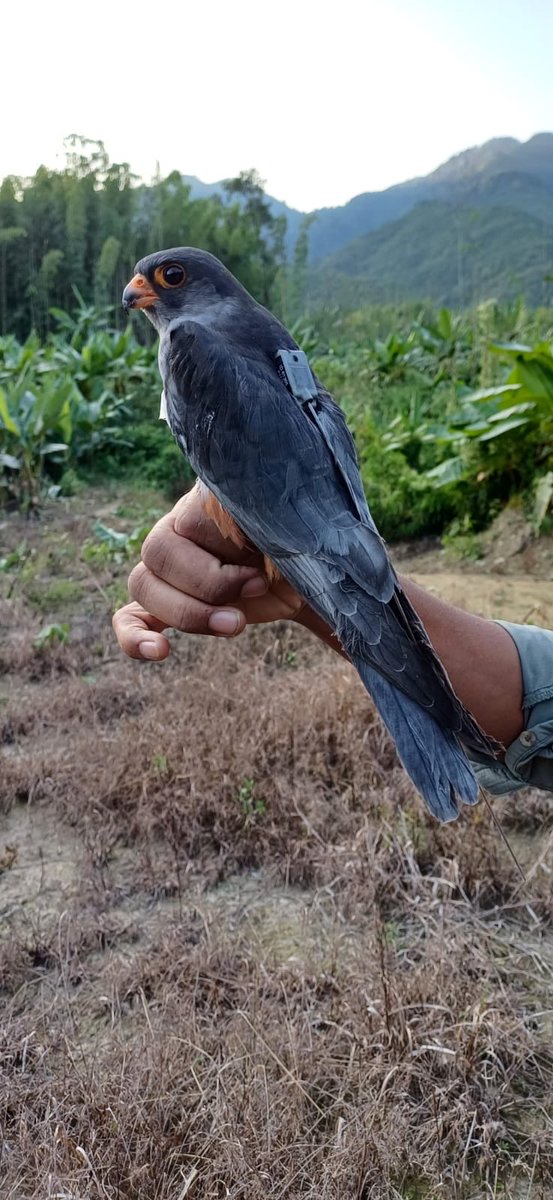
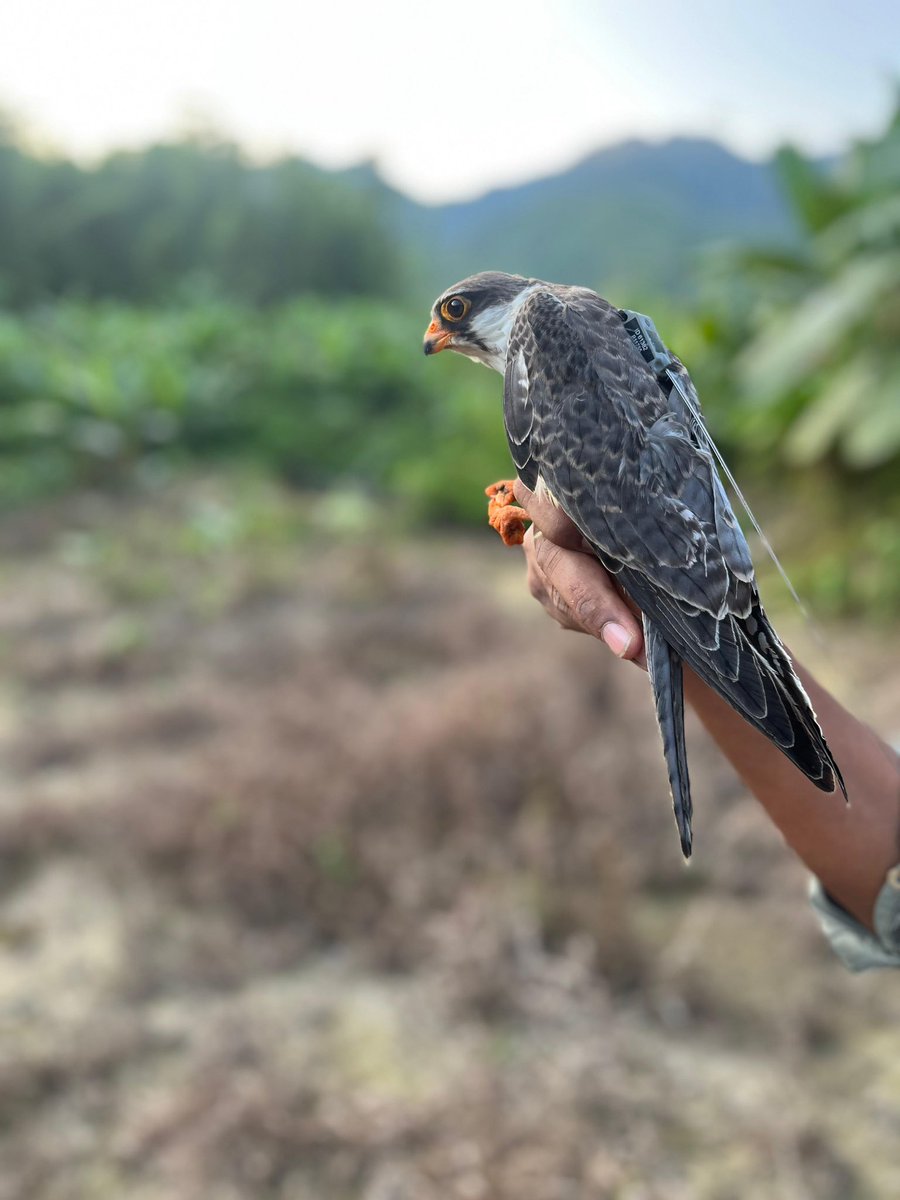
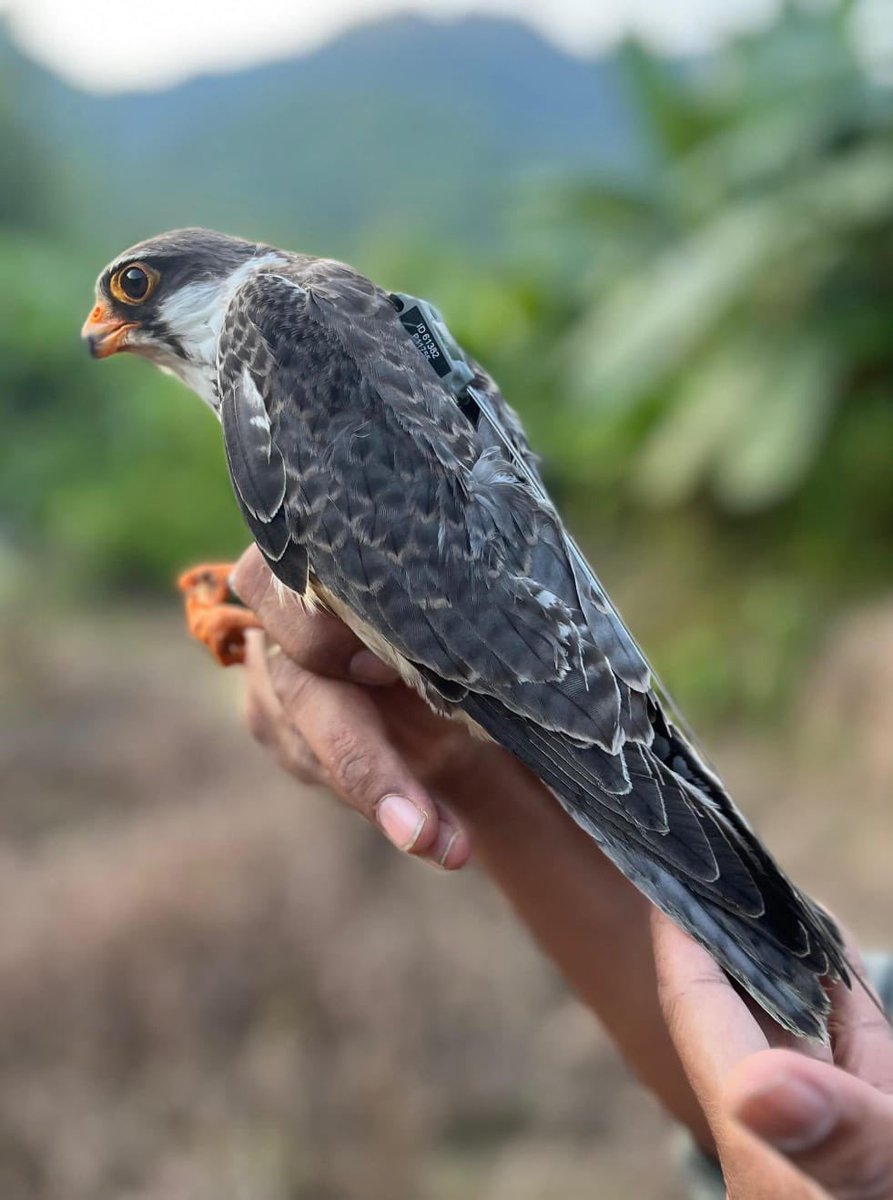
In a continued effort over the last decade for conservation of Amur Falcons in Northeast India, three Amur Falcons were satellite-tagged in their stopover site (Chiuluan) in Tamenglong district of Manipur in November 2025.
Having completed more than four months in their nonbreeding grounds in Southern Africa, two of these Amur Falcons are on their spring migration, returning to their breeding region in Far-East Asia via India. While crossing from Somalia to Northeast India they undertake a nonstop flight of nearly 6000 km in six days.
A tagged young female Amur named ‘Alang’ is currently headed to west coast of India, and is undertaking the Arabian Sea crossing, having started off yesterday early morning from Somalia.
Currently, with favourable tailwinds, the sea crossing will be three-day nonstop. With funding support from @MoEFCC, this project has been one of the successful community-led conservation effort in India.
Alongside, interesting insights on this incredible small raptor, a long distance trans-hemispheric migrant has been generated, guiding management and conservation efforts.
How many of us realise that above our heads exists an ancient living superhighway older than human memory ?
Let that sink in
Every year, the Bar-headed Goose flies from Central Asia to Tamil Nadu across the Himalayas at altitudes above 7,000 metres through air too thin for most living beings to survive.
Often called the “Ballerina of the Skies”, the rare sighting of the Demoiselle Crane arriving from the Eurasian steppes at the Nemmeli Salt Pans in Tamil Nadu marked an important migratory record this year.
Along the same Central Asian Flyway, Osprey return from Europe and coastal Asia, while Montagu’s Harrier travel from Russia and Kazakhstan to South India.
The transcontinental, nonstop journey of three satellite-tagged Amur Falcon, Apapang, Alang and Ahu has filled us with wonder and awe.
No borders. No maps. Yet they return to the same water bodies, grasslands and coasts with astonishing precision every season
On this World Migratory Bird Day, these journeys remind us why protecting migratory habitats matters
#WorldMigratoryBirdDay #CentralAsianFlyway #TamilNadu #MigratoryBirds courtesy @sureshwii Raveendran Natrajan, Karthick Ayappan, Baranidharan S
The satellite tagged turtle 'Dhaval Lakshmi' is continuing its eastward movement at increasing speeds. It is currently located 300 km off Ratnagiri and is expected to enter the continental shelf of the west coast in the coming days.
This is a monarch butterfly migration arriving in the oyamel fir forests of central Mexico. None of these butterflies has ever been here before.
Their great-great-grandmothers left this exact grove in March. By July those grandmothers were dead. The butterflies you're watching are four to five generations downstream, born somewhere between Texas and Ontario, and they just flew up to 3,000 miles to a tree none of their parents ever saw.
The brain doing the navigation is smaller than a grain of rice.
The mechanism is a sun compass time-compensated by a circadian clock running in the antennae. Cut the antennae and the monarch loses orientation within hours. The clock corrects for the sun's position drifting across the sky as the day moves. Add iron-bearing magnetite particles for magnetic field detection on cloudy days, and a 0.5 gram insect is running redundant inertial guidance.
The destination is more specific than the navigation.
They cluster on a few dozen oyamel fir groves in the Sierra Madre at 9,000 to 11,000 feet. The microclimate has to sit between 32 and 41°F. Below freezing kills them. Above 41°F burns the fat reserves they need to survive five months without feeding. The right band exists a few hundred meters thick on a few specific mountains. Outside it, the migration ends.
One generation each year is built differently from the rest. Summer monarchs live two to six weeks. The fall generation lives eight months. It postpones reproduction, fattens up, and carries the entire round trip in a single body.
The map is genetic. Nobody has fully decoded how.
A monarch hatched in a backyard in Toronto in September has never seen a mountain, never smelled a fir, never met an ancestor. It flies south for ten weeks, picks the right peak, and lands on the tree its bloodline has been returning to for tens of thousands of years.
The forest knows the families that come back.
What’s on the menu for Barn Swallows in the Indian Himalaya?🐦
A new study published in Avian Conservation and Ecology investigate the diet and influence of urbanization on the globally declining aerial insectivores in Uttarakhand.
🔗 https://t.co/m7X8t4rdjc
@moefcc@wii_india@amarjeet_kaur10@sureshwii
#Ornithology #Conservation #Himalayas #Diet #BarnSwallow #AerialInsectivores
Mark it ! Apapang has now begun his return flight from Somalia. Based on the established flight patterns, this incredible tiny power house of a bird is expected to undertake a near-continuous 6000 km journey towards the forests along the India Myanmar border, reaffirming the precision, endurance and ecological significance of one of the most extraordinary migratory routes documented in the natural world. As told to @supriyasahuias by Dr @sureshwii #Amurfalcons #epicjourney