I want to thank @astocks92 for Introducing me this.
Recently started learning and watching the $VIX Futures Curve and it's quickly becoming one of my favorite market tools. Most traders only watch price. The VIX curve shows what institutions are pricing for future risk.
Simple example:
🟢 Healthy Market (Contango)
VIX = 18
Month 1 = 19
Month 2 = 20
Month 3 = 21
The market is basically saying: "We're not worried about tomorrow." This is usually where pullbacks get bought and bull markets continue grinding higher.
🔴 Risk-Off Market (Backwardation)
VIX = 20
Month 1 = 35
Month 2 = 32
Month 3 = 28
Now institutions are aggressively buying protection because they're worried about immediate risk. This is the type of structure often seen before or during major corrections and panic events.Right now, Month 1 Contango is around 6.4%, which is fairly healthy. Doesn't mean SPY can't pull back 3-5%, but the volatility market isn't currently pricing a major systemic event.
Think of it like weather forecasting:
Price tells you if it's raining today.The VIX curve tells you whether institutions think a hurricane is coming.
Still learning this indicator myself, but the more I study it, the more I understand why smart money watches volatility as closely as they watch price.
Nick Radge has been trading trend following systems since 1985. When I asked how he identifies a trend, he gave me eight different answers. All of them work.
The eight approaches range from simple to slightly less simple:
- Price channels.
- Rate of change filters.
- Bollinger Band breakouts.
- Relative strength rankings.
- Moving average crossovers.
- High-momentum breakouts.
- The 20% Flipper - buying stocks that have risen 20% from their recent low.
- A few others.
What's interesting is that he doesn't advocate for one above the others.
His view is that simplicity itself is the edge, and many different simple implementations of the same basic idea will produce similar long-run results.
"Simple is more robust than complex. Complex systems have more ways to break."
This isn't what most traders want to hear. There's a persistent belief that successful traders have found some sophisticated, proprietary edge that the rest of the market hasn't discovered yet.
After 30 years of systematic trading, Nick's view is roughly the opposite. The edge in trend following isn't a secret formula. It's the discipline to apply simple rules consistently over long periods, through drawdowns that make most traders abandon the strategy right before it recovers.
The complexity most traders are searching for doesn't add edge.
It adds fragility.
In Feng Shui, the fact that 80% of autistic people are bullied or used by 'friends' is because their mental layout is often an 'open Ming Tang (Bright Hall)'—no scheming, no defenses, straightforward. This extremely pure 'Qi field' easily attracts 'Robbing Wealth Afflictions' (people who plunder under the guise of friendship) and 'Hidden Arrow Afflictions' (betrayals from behind) in complex social Feng Shui. The post's grim data reminds us: 'Water that is too clear has no fish; a layout too open invites thieves.' Autistic individuals don't need to change their inner 'pure water quality,' but they must build a 'Xuan Guan (Spiritual Screen)' at their social boundaries. This screen acts as a 'buffer and filter': making the turbid energy of 'scheming' and 'calculating' detour at the door, allowing only the 'vital Qi' (true friends) tested by time to enter the inner chamber. Remember: Your kindness is expensive; it must have Feng Shui 'edges' and 'thresholds.' Don't let just anyone march straight into your natal layout.
Most traders guess the open. We measured it.
RTH Gap Statistics reads today's opening gap, checks 500 real gaps of the same type, and tells you to fade it, ride it, or skip it, with the numbers behind every call.
The whole system 🧵👇
Nearly nine months into this journal, the metric I'm most satisfied with is max drawdown: just under 7.5%, with 60%+ account growth on my perps/futures account - it’s not flashy but steady honest work - me, against myself, earning the right to scale size.
Prior to May, drawdown stood at just 3.9%, before I began building larger swing positions.
Across nearly 200 trades since sept, the focus has remained the same - cut losses quickly, refine execution and prioritise risk management over win rate.
The most effective adjustment has been initiating a trade with a pilot position and only adding size once a trade begins proving itself, this gives me a better feel for the rhythm of a market - I’ve been working extremely hard on narrowing the variance of trade execution and efficiency.
The key lesson has been that profitability is driven less by being right frequently and more by managing losses well, I’m currently hovering at a 35% win rate due to cutting trades early only to step into the same idea again upon increased probability (timing issue)
It’s a continuous work in progress, but encouraging progress nonetheless. More importantly I understand the pathway to achieve higher levels… all in the process.
Looking forward to what Q2(June) and Q3 bring, I suspect there will be some decent volatility ahead.
I spent over two decades as a full time futures trader and scalper, and I learned your edge isn’t just your strategy. It’s your focus.
It’s the amount of hyperfocus it takes every single day. Blocking everything out, slowing your heart rate down, staying calm, believing in your homework, executing at a high level. Trading has to be your number one focus each day. So if you’re learning to become a successful trader, here are three things you may be focusing on that are working against you.
First, other people’s money. Stop looking at how much everyone else is making. That’s the number one thing you have to look away from. I was around thousands of traders on the floor and I barely remember us talking about money. It was private. The goal was to build a life. It felt blue collar. Today everyone talks about what they make, trying to prove someone wrong about the market. It’s a different place, and a lot harder for a new trader to block the noise out.
Second, the access. Overnight used to just be overnight, where you managed a position if you had one. Set time to start, set time to break, set time to come back. We traded mornings, skipped midday, came back for the close. Now the access never stops, and it’s spread everyone’s focus too thin to stay locked in.
Third, understanding the market environment. We move between environments at a very rapid rate. We go from trending higher with no signs of a pullback, buy the dip and hold on, straight into sell off mode. Trying to guess what those days will be like going into them is very difficult. You have to stay open minded and understand how quickly the tape can change. Last Friday was the perfect example. A market runs higher a lot further than most thought, then unravels all at once. It’s the same psychology we see in traders. They stay in their own trend for only so long, then unravel all at once. If you’re not focused, or you’re clinging too hard to one market environment as you move into the next, you aren’t allowing things to be what they are. You’re fighting them for what they were.
So here’s the simple part. Slow everything down. Survive a game where you pay your bills and stay in long enough to make a living. There will be moments this business really pays you, and you won’t choose them. They choose you. The rest is grinding, surviving, enjoying the process. Arguing with people on social media is a time waster, and the people who do it are usually unhappy in their own lives. Spend your time wisely.
Focus is the whole game. Protect it like your account depends on it, because it does.
Enjoy your life. Have fun. This is the greatest business in the world if you let it be. And it’ll be the worst, and destroy your life, if you let it.
Cheers, DELI
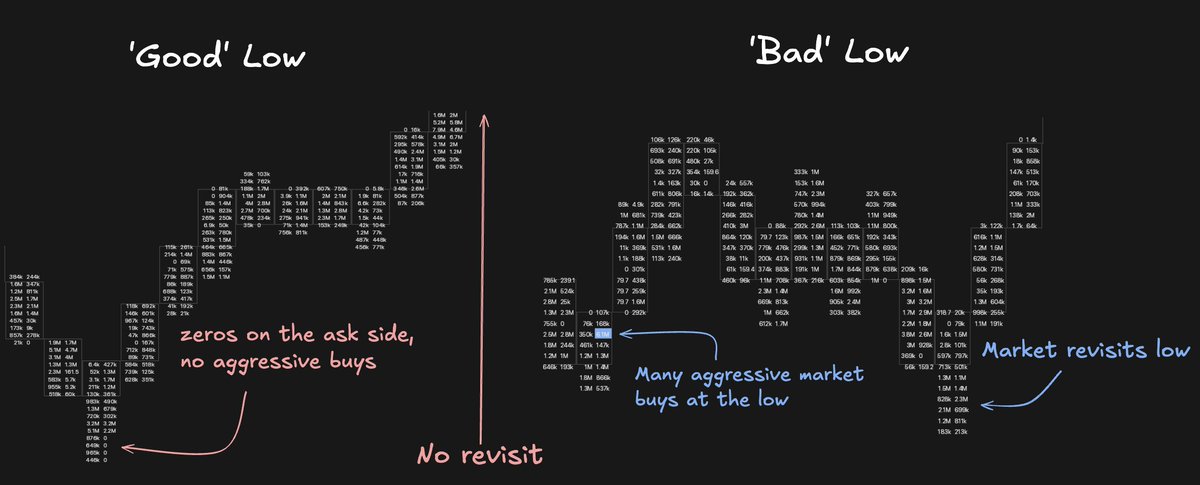
This is one of those 5-sigma event days that wipe out most people that keep blindly trying mean reversion strategies without VOLUME putting in market structure.
Learn to love winning with all your heart. Learn to seek to win all games big or small. Brand yourself a winner in your mind.
Believe it so strongly that no matter the size of the setback, it is just a temporary embarrassment.
Do that, and you can chase anything in this world.
It is a misconception that being highly technical and intelligent is all you need to succeed.
The world is so full of slightly autistic, highly smart, highly technical people that never get what they want out of life.
That is because they fail to express what they want out of life or to bridge their interests with anyone that might be able to get them there.
Being able to communicate well is a rare gift, and is why the top at so many places is unfortunately over-indexed on people with great communication skill as opposed to great technical skill.
From the Dream to the Dreamer
If I asked you, “What is the purpose of a dream?” you would probably laugh.
Maybe it’s to fall in love, build an empire, or create a family.
You would say, “It’s just a dream. In a few hours I’ll wake up, and I probably won’t even remember it.”
Now take that idea one level higher.
What are you trying to achieve in life? What legacy are you trying to build?
In the grand scheme of the universe, eighty years of human life is shorter than a four-hour dream. And that’s assuming time is even real in the way we think it is.
Yet we spend so much energy worrying about success, status, possessions, and the opinions of others.
You won’t remember your achievements.
You may not even remember who you were.
So relax.
Play the game if you enjoy it. Fall in love. Build a business. Create a family. Explore the world.
Just don’t get lost in it.
With a little observation, it becomes clear that experience consists of two things: the perceiver and the perceived.
The perceived is everything you can observe: your body, thoughts, emotions, relationships, and the world itself.
The perceiver is the awareness to which all of it appears.
Most people spend their lives focused on the perceived. Very few investigate the perceiver.
Take a few minutes and contemplate this.
Your thoughts are perceived.
Your emotions are perceived.
Your body is perceived.
Even the sense of “me” is perceived.
What, then, is the perceiver?
Perceiving is effortless. In fact, it is the one thing you cannot stop doing.
Why?
Because awareness is not something you possess. It is what you are.
The objects of awareness are constantly changing, but awareness itself remains.
Don’t answer this intellectually. Just look.
Even a few minutes of sincere contemplation can begin to change the way you view yourself and the world.
Over the last few months, I’ve spent a lot of time studying the Ashtavakra Gita, an ancient text over 2,000 years old. It is a dialogue about the nature of consciousness that points directly to the awareness behind all experience. And almost every sentence can be deeply contemplated for years, the deep contemplation it’s what truly takes you to the next level, not the reading.
Below is a short section from a podcast in which the Ashtavakra Gita is read. Simply listen to it in silence and see if it resonates with you.
The same podcast also contains a reading of the entire Gita, which I highly recommend.
https://t.co/d8njT7x1SG
This is the first episodes, the later ones lead you deeper into awareness.
And if it resonates, consider picking up the book. It’s one of the few books I’ve returned to again and again.
Life is amazing.
How to store billions of market prices in seconds?
ArcticDB.
• DataFrame database
• Proven at petabyte-scale
• Used by Man Group and Bloomberg
And it's free on GitHub:
Here’s the Nasdaq at the peak of the dot com bubble.
“You won’t be able to time the top.”
Sure but there will be signs.
People who act like the stock market cratered 80% overnight are just trying to get engagement and fear monger.
Not only did the stock market not crash 80% overnight, but it was a drawn out process that took over two years to bottom.
There were plenty of signs that something drastic changed.
A few:
- Key weekly moving average breaks in the Nasdaq
- Big red candles on the major indices
- Cycle leaders topping/weakening
This chart shows a clear character change before the big crash that took place in late 2000 into 2001+.
Even if you didn’t sell at the top and sold 15% lower you still missed a 70% drawdown.
There will be signs when the top is in but you don’t need to exit at the exact top.