We are hiring!🥼
Long-term post-doc w/ #ukriflf funding @uclcancer
Help us detect&target preinvasive disease via the immune system
Bespoke T cell omics assays
World-leading multi-disciplinary collaborators
Unique multi-cancer cohorts
@UKRI_News
https://t.co/NILKDVJNW6
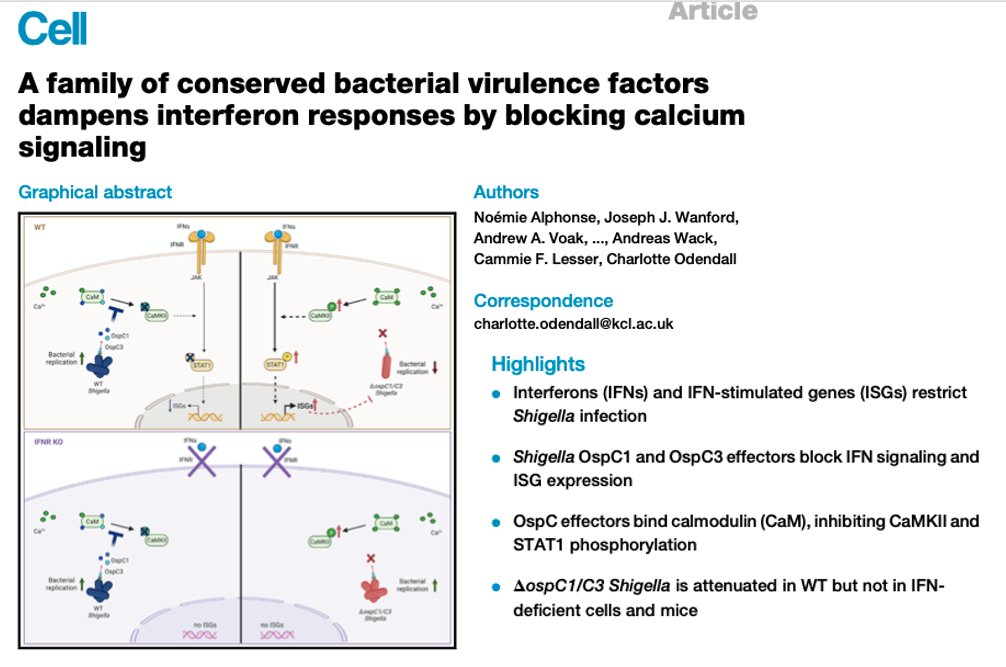
Thrilled to share our lab’s first paper out now in @cellcellpress. We identify how a conserved family of Shigella virulence factors inhibits interferon by blocking calcium signalling, promoting virulence
https://t.co/eMyY4REm0O
The @castello_lab is seeking for a motivated postdoc at Research associate or assistant level . Our work aims to understand how cellular RNA-binding proteins regulate virus infection. Application here: https://t.co/i6igilFwzj Ref 074888. Closing date 12th Jan.
When ZAP emerged in tetrapods, KHNYN acquired the final two residues of the nuclear export signal. Therefore, we speculate that KHNYN co-evolved with ZAP to allow their interaction in the cytoplasm to restrict viral replication. 7/7
Our new paper on KHNYN antiviral activity is available as a preprint. This was another excellent collaboration with @stuartjdneil and Ian Taylor's lab. Great work by @MariaJoseLista2 and all of the team. 1/7
https://t.co/qwj8iGRWdM
We hypothesized that KHNYN co-evolved with ZAP and analyzed the nuclear export signal sequence in a variety of species. In bony fish, which do not have ZAP orthologs, KHNYN does not contain two of the five residues required for the nuclear export signal. 6/7
I am grateful to @The_MRC for suporting @stuartjdneil and my lab's research for 3 more years. Also thank you to Irati, Helin, @MattiaFicarelli, @DorotaKmiec, @MariaJoseLista2, Clement, Harry and Rui for their great work, without them there would be no grant!
Thank you to all of the authors for their great work on our paper showing that, despite lentiviral vectors containing a much higher CpG abundance than HIV-1, the CpGs do not appear to sensitise the core lentiviral vector platform to restriction by ZAP.
https://t.co/UHx7z6eH4r
This supports our idea that high CpG dinucleotide abundance is not sufficient for ZAP to target an RNA. One of our goals is to figure out the design principles for ZAP-response elements to either enrich or supress them in specific RNAs, but we still don't know the rules.
zippity-ZAP⚡️! Our new paper is out @PLOSBiology! I might be biased, but so is the dinucleotide composition of the mammalian interferome 😁, thanks in part to ZAP!
https://t.co/0sCBIvraxR
Congrats fellow co-first authors @VirusMuser & @NardusMollentze & members of @WilsonLabCVR!
@ProfAmbrose@MattiaFicarelli Also, long-read sequencing makes it much easier to figure out how specific sequences in the vector genome affect their splicing profile. We used Oxford Nanopore sequencing for this paper, and liked how you can visualise splicing in the context of near full-length transcripts.
A great collaboration with GSK. Helin Sertkaya, @MattiaFicarelli, et al analysed which viral sequences could be removed from a lentiviral vector to reduce the amount of foreign DNA transferred to a target cell. https://t.co/XFdh1wuAI9
@ProfAmbrose@MattiaFicarelli I think so. The vector systems were not originally developed to have the minimal amount of viral sequence required for transduction efficiency and gene expression. I think ease of cloning affected the sequences present in the vector genomes.