A Software Engineer by profession, a Photographer by Choice,a vocal person by nature, & a dreamer 4 lifetime.
Learning to Learn and seeking Maturity ;)
Android's openness distinguished it from iPhone for 17 years. Google is now requiring mandatory developer registration for all apps, including those distributed outside the Play Store. https://t.co/wxNntUkQx2 #KeepAndroidOpen
Aufgrund eines Verkehrsunfalls sind der Innsbrucker Ring in südlicher Fahrtrichtung sowie die Zufahrt zur Ottobrunner Straße aktuell gesperrt.
Wir bitten diesen Bereich wenn möglich zu umfahren.
This is an unbelievable piece of work by Sarthak and something that requires amplification.
Let me explain what he found, in simple terms.
Sarthak is a Class 12 student from the 2025-26 batch, one of the 17 lakh students whose answer sheets went through CBSE's new On-Screen Marking system.
He spent days reading through CBSE's evaluation tenders, scraped all 576 tenders CBSE has issued, and tracked how the rules changed across three versions of the same tender.
The core finding is that the company that won the contract to scan and grade 17 lakh students' answer sheets is Coempt Eduteck.
Coempt used to be called Globarena Technologies. Globarena was the company behind the 2019 Telangana intermediate exam disaster, where software failures led to 3.8 lakh students getting wrong or missing marks, and 23 students died by suicide.
A government committee found systemic failure and negligence. Six months later, Globarena rebranded to Coempt Eduteck.
So a company with that track record won a contract to handle 17 lakh CBSE students. Sarthak's investigation is about how the rules were rewritten to let that happen.
The tender was issued three times.
> First tender, February 2025. It existed, then disappeared from the public GeM portal. Sarthak scraped all 576 CBSE tenders and this one was missing from the archive entirely.
> Second tender, May 2025. Four companies applied including TCS and Coempt. All four failed the technical evaluation. Cancelled.
> Third tender, August 2025. Coempt won. Between the second and third tender, a series of rule changes happened, and every single one made it easier for Coempt to qualify.
Here is what changed, one by one.
01. The old rules disqualified any company with a history of abandoning work, failing to complete contracts, or financial weakness. The new rules deleted this clause entirely. Coempt's Telangana history stopped being a barrier.
02. The old rules disqualified any company that was "blacklisted earlier." The new rules changed this to "currently blacklisted." Because Globarena rebranded after Telangana, removing the word "earlier" effectively erased their past.
03. The rules required Rs 50 crore average turnover over three years. Coempt's exact average came to Rs 50.86 crore. They cleared the bar by less than 1%. Earlier, a smaller company had asked CBSE to lower the bar to Rs 30 crore for fairer competition. CBSE refused. So the bar was kept high enough to block small players, but sat exactly low enough for Coempt to scrape through.
04. Software maturity is measured on the CMMI scale, 1 to 5. The old rules required Level 5. The new rules dropped it to Level 3. Coempt is a Level 3 company.
05. The cooling-off period for engaging retired CBSE officials was cut from two years to one. This makes it easier to use recently retired insiders to influence the process.
06. The old rules required experience with large projects of at least 5 lakh students each. The new rules removed the student count and counted cumulative answer-book volume across small projects instead. Coempt has many small fragmented university contracts. This helped Coempt and hurt TCS.
07. The old rules required bidders to own their own data centre and disaster recovery centre on Indian soil. The new rules allowed third-party MeitY-empanelled cloud hosting. Coempt runs on AWS and Azure. This helped Coempt and hurt TCS, which owns its own data centres. It also means student data is no longer on sovereign, Indian infrastructure.
08. The old rules required the bidder to own or control the complete source code of its software. The new rules deleted this. Coempt's platform runs on Microsoft's proprietary IIS, which they don't own.
09. A last-minute corrigendum, issued right before bid submission, removed CBSE's own power to blacklist the firm if its software failed catastrophically. So even a Telangana-scale failure couldn't get Coempt banned from future government tenders.
10. The penalty structure shifted from punishing mistakes to punishing delays. The old rules fined the vendor for wrong scanning, merged pages, and unscanned books. The new rules dropped those and instead levied Rs 50,000 per day for delays. This incentivises rushed scanning over accurate scanning.
11. The old rules had a hard accuracy threshold, error rate not to exceed 0.5%. The new rules removed this number entirely.
12. The old rules specified proper book and robotics scanners. The new rules just say "sufficient scanners." The definition was vague enough that, as Sarthak notes, the scanning could be done with a phone on a stand.
13. On the security side, the contract required a VAPT (vulnerability and penetration test) certified by CERT-In before go-live, and a restricted beta phase before launch. The system clearly wasn't restricted, because the other researcher, Nisarga, was able to access it and find vulnerabilities four days before go-live. So the mandatory security audit appears to have been bypassed.
These are more than a dozen rule changes, all between the failed tender and the winning tender, all pushing in the same direction, all benefiting the one company with the worst track record in the field.
The security holes Nisarga found last week now have an explanation. The system was built by a vendor that was specifically allowed to skip the security certification, the source code ownership, the data sovereignty, and the quality thresholds the original rules demanded.
Following things need to happen immediately;
1. An immediate CAG audit of the tender process.
2. A parliamentary debate on the topic.
3. An independent investigation into
> Why the first tender vanished?
> Why the disqualification clauses were deleted?
> Why the turnover bar was held exactly where it was?
> Why the security level was dropped?
> Why the blacklisting power was removed at the last moment?
Sarthak, this is genuinely exceptional investigative work. Far better than most journalists with full resources ever manage. Take a bow. :)
@DHLPaket Ich habe auch versucht, Ihren Kundenservice per Chat und E-Mail ohne Feedback zu kontaktieren.
Bitte sagen Sie, wie kann ich mein Paket mit 50 kg + ohne Auto auswählen. Der Grund, warum ich mich dafür entschieden habe, es einzukaufen.Dies ist absolut unprofessionell
@DHLPaket Ich habe eine ernsthafte Beschwerde bezüglich meiner letzten 3 Pakete.
Alle drei wurden mir nicht zugestellt und die Statusnachricht sagt betrügerisch, dass ich nicht zu Hause war. Ich habe den Beweis, dass ich zu Hause war und auf das Paket wartete
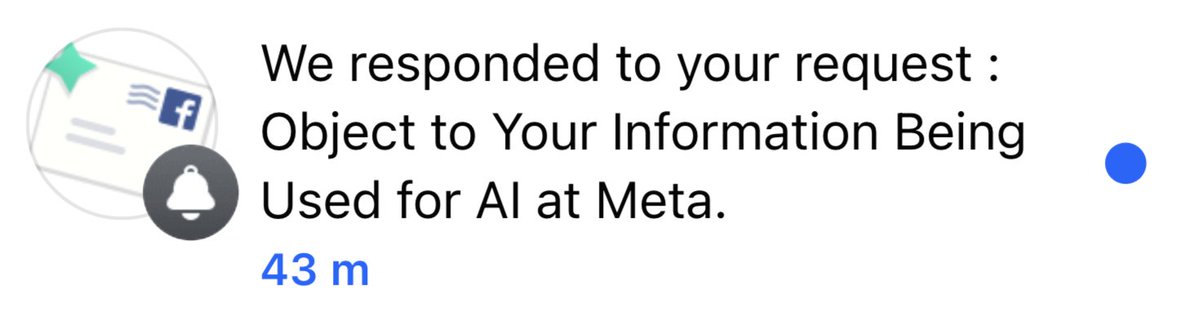
11. I later received an email letting me know that they would honour my objection.
I should mention that one of my friends who also objected got an error! I then checked out a Reddit thread which verified that many people also got this same error. Classic FB sloppiness.
1. I'm legit shocked by the design of @Meta's new notification informing us they want to use the content we post to train their AI models. It's intentionally designed to be highly awkward in order to minimise the number of users who will object to it. Let me break it down.
@_baconwrangler_ On top of it, the statement
“Because every time a customer buys a printer, it’s an investment for us. We’re investing [in] that customer, and if this customer doesn’t print enough or doesn’t use our supplies, it’s a bad investment.”
As if you get money to buy an HP Printer
@intellibogan@FrameworkPuter Canon is equally bad and has poor support as well.
Even if you print B/W, color ink gets consumed, doesn't matter what setting you try
Fascinating article about miniaturization of chips, and how the demise of Moore's law may impact global geopolitics. "gap is narrower than it ever has been between Intel and SMIC, China’s top chipmaker" https://t.co/j8AeDzFzA2
@bookingcom I have had one of the worst customer care monent with your executive named Natalia.
She was stubborn,not willing to listen and not at all helpful.
My Parents are struggling with a fraudulent hotel on your site who 1st declined booking and charged cash for booking.
@bookingcom Not to mention that no tangible efforts happened to reimburse the wrongly charged amount.
Every time one of your numerous executives asked for bank details for reimbursement.
How difficult is it to return money to the original mode of payment.
@bookingcom The Damage is already done.
Too little too late.
My parents really suffered a lot due to you mishaps.
The hotel which I booked from your portal, with payment and with confirmation said they are not affiliated to https://t.co/uf7TCMoo6H and finally your staff acknowledged it.
And even after sharing all the payment details, the https://t.co/8xDJ3KKlBq and Hotel both are stating Hotel did not charge any cash.
Please help sort this out, and kindly train your staff better.