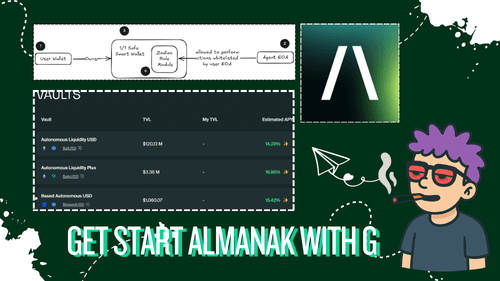
One of the most anticipated TGEs in December is @almanak. And here's what you should know.
@almanak is building an AI agent for yields and vibe coding in DeFi.
"Did I hear it right?"
Yes, it helps you design, test, and deploy financial strategies that can adapt to changing market conditions.
It goes beyond a static DeFi bot, using data-driven reasoning and automation to manage risk, capture yield, and react like a human strategist.
"Hmm..."
Thanks to @almanak's Strategy Builder, all you need to do is connect your wallet, choose a strategy template, tell it what you want to achieve, and it builds the strategy for you.
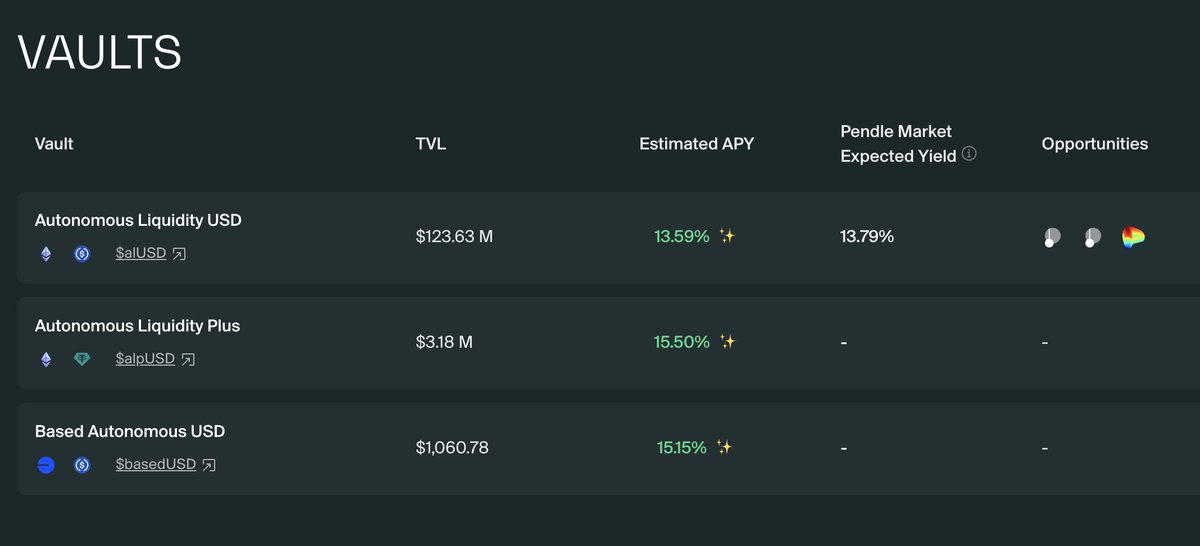
You can also put your stablecoins into existing vaults (up to 15.5% APY) and earn points as well.
A guide on farming is coming.
😉
Almanak is changing how people use DeFi.
Before, building a trading strategy required coding skills, quant knowledge, and a lot of time.
Now, with @Almanak, anyone can create a DeFi strategy by simply describing their idea in plain English.
Just your idea → built into an automated strategy.
Let's dive in ↓
I’ve been playing with a lot of “AI + DeFi” platforms lately and most of them share the same problem: send funds then hope the bot doesn’t rug..
Luckily, @almanak stood out because it flips that model completely 👌
This post is a breakdown of what I've learned about what Almanak is actually trying to build, how the wallet system works and why this structure might matter more than any “AI narrative” headline.
◢ What Almanak really is ⁉️
Forget the buzzwords for a second. What Almanak is building is an AI agent layer for DeFi, for ez interaction:
▸Automated strategies
▸Able to execute 24/7
▸Adapting to market conditions
▸While you, not the bot, remain the owner of the funds
They're trying to make DeFi feel less like juggling tabs, farms, and gas fees.. and more like setting a system in motion, then letting it run.
Just in short, rn Almanak gives you:
▸Deployments: automated execution
▸Strategies: decision logic
▸Vaults: turn strategies into investable products
▸Wallets: full control without giving up custody
➥ The AI layer is still growing, but the foundation is already in place, and that’s the part most people overlook.
◢ How to create your Almanak Wallet ⁉️
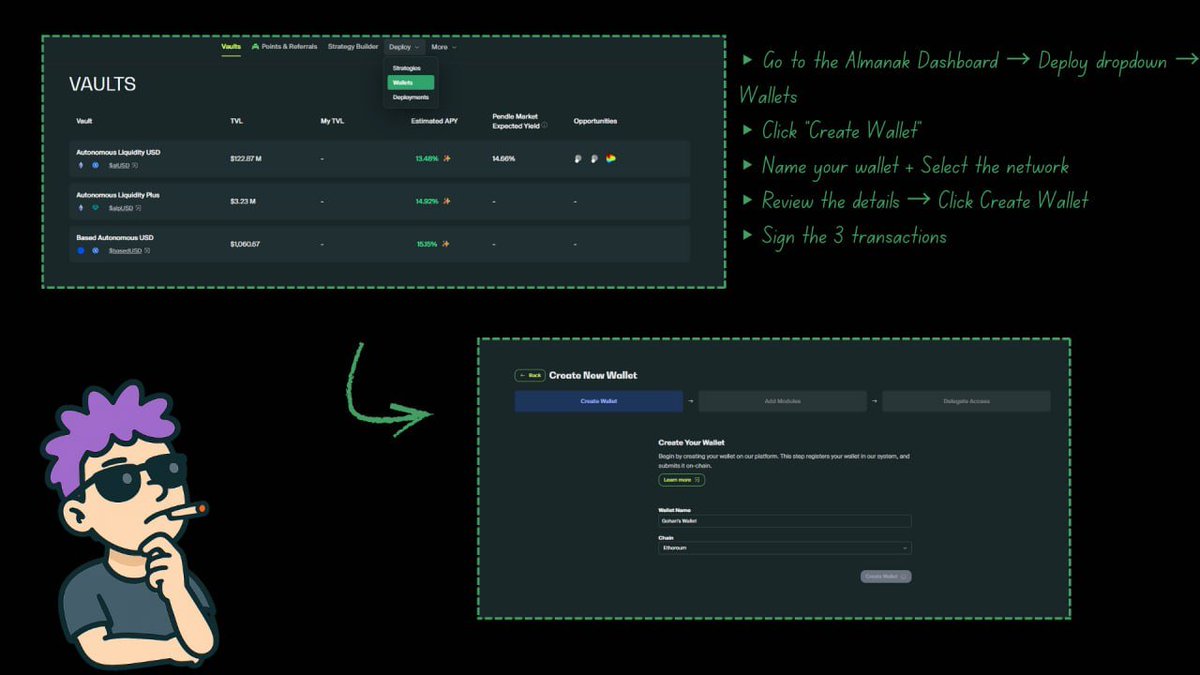
Step-by-step (the real flow):
▸ Go to the Almanak Dashboard → Deploy dropdown → Wallets
▸ Click “Create Wallet”
▸ Name your wallet + Select the network
Pick a chain where you have at least $5 of native gas.
I chose $ETH but ofc ETH may require more, then you could choose BNB instead
▸ Review the details → Click Create Wallet
▸ Sign the 3 transactions: Create Wallet - Add Modules - Delegate Access
These set up your Safe and permission framework.
▸ Top up fees. It costs not too much, gas fees cannot be withdrawn btw
▸ Fund the wallet with the assets your strategy needs
Done. You now have a fully functional Almanak Wallet, and ready for Deployments to use safely.
It takes a few minutes because the wallet is fully on-chain and built with Safe infrastructure.
◢ So, how the wallet works ⁉️
Here’s the part that won me over. Most “automation platforms” work like this:
You deposit funds -> bot controls them -> you hope it doesn’t rug. Like gambling..
→ Almanak flips it. The architecture is basically:
🟢 You own the wallet: You can revoke access at any time.
🟢 The agent helps you grant permissions to run only what YOU whitelist
🟢 If something breaks, you still own the vault
➥ That’s the difference between running automation and surrendering custody. It sounds nerdy, but I think this model will become the default.
Almanak is one of the first platforms I’ve seen designing around that reality instead of ignoring it.
Most people still think of DeFi yield as a static number.
A rate you chase from protocol to protocol, hoping you’re early… and praying you’re not exit liquidity.
But what if yield didn’t have to be hunted?
What if it was engineered?
Not through hand-coded automation.
Not through one-off farming strategies.
But through a network of AI agents running quant logic, and structuring yield the way professional desks do. Dynamically, continuously, and without emotion.
This is the mental shift behind @almanak :
A Permissionless AI Yield Layer where anyone can deposit into vaults that are managed like on-chain quant funds.
This post breaks it down cleanly:
1. What Almanak vaults actually are
2. Why they’re different from every “yield vault” you know
3. Where the real yield comes from
4.Why this matters for the future of DeFi
Let’s go deeper.
1. WHAT ALMANAK VAULTS ARE
At surface level, a vault is simple:
Deposit USDC → receive a vault share token (like alUSD) → watch its value rise over time as strategies earn.
But that simplicity hides the real unlock.
Behind every Almanak vault is a strategy brain.
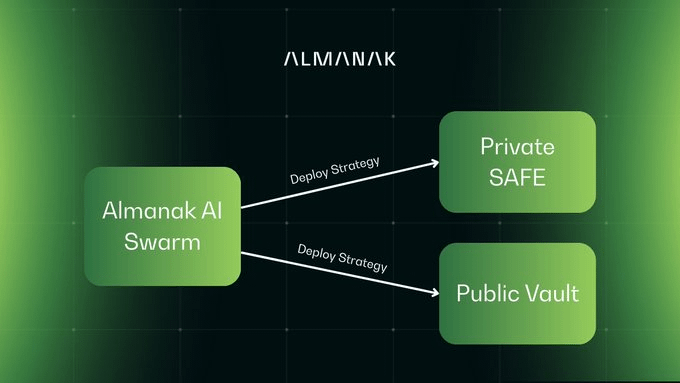
Behind that brain is an AI Swarm of agents that can design, test, optimize, and deploy automated strategies across multiple protocols and chains.
Under the hood, each vault is built on:
• Lagoon’s audited ERC-7540 vault infra
• Safe-based smart accounts with Zodiac permissioning
• Strategy engines written in Python state machines
• Deployments that push transactions live on-chain
The vault contract issues share tokens.
The Safe holds the capital.
The strategy logic rotates your funds.
And the vault share (alUSD) reflects the net asset value of the entire pool.
Your tokens never leave your custody.
Agents only receive permissioned, function-level access, nothing more.
2. WHAT MAKES THEM DIFFERENT
Most yield products in DeFi fall into one of these buckets:
→ Static yield strategies (unchanged for months)
→ Single-protocol auto-compounders
→ Manual LPing bundles
→ Operator-run funds with opaque risks
@almanak breaks completely out of this mold.
2.1 AI Swarm, not manual farming
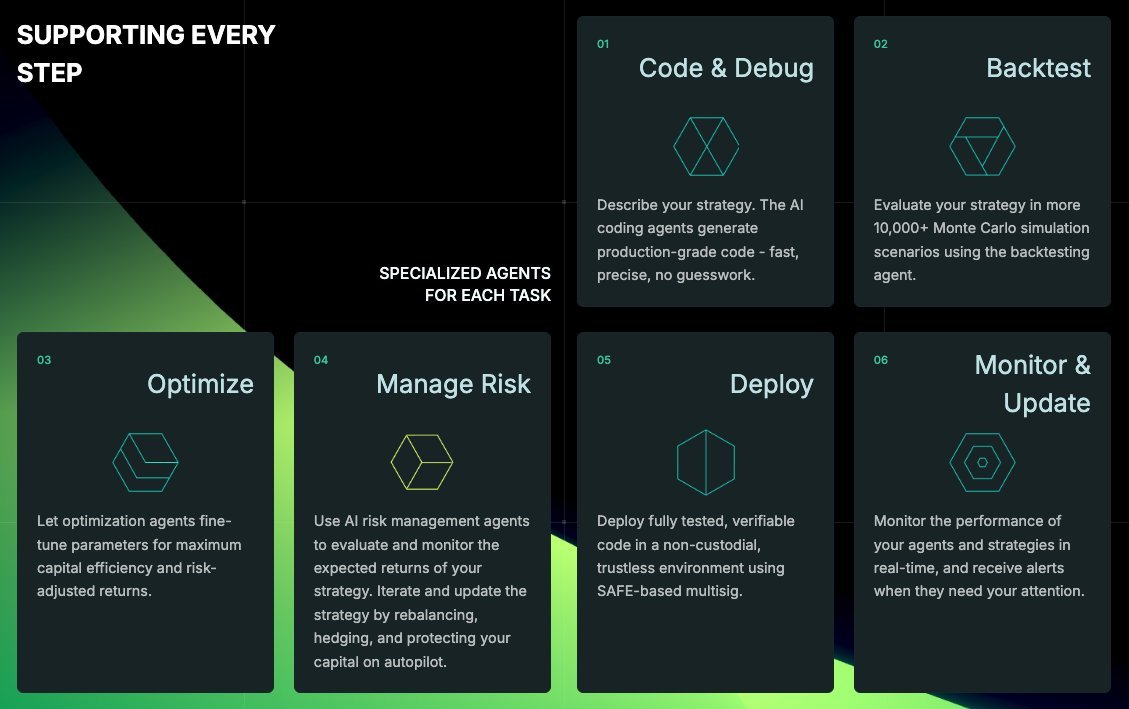
The core engine behind Almanak is a multi-agent AI system, research agent, coding agent, testing agent, optimization agent, monitoring agent, working together like an automated quant desk.
Strategies aren’t fixed.
They adapt.
They rebalance.
They optimize for risk-adjusted return, not vanity APY.
This is the difference between:
“move USDC to Aave and autopilot it” vs
“dynamically allocate capital across lending, LS yield, Pendle markets, structured products, and incentives, based on real-time conditions.”
2.2 ERC-7540 standardization
Most vaults run on custom code.
You’re trusting an entire new implementation every time.
Almanak instead builds on Lagoon Finance’s standardized ERC-7540 vault architecture, which is:
• battle-tested
• audited
• composable by design
This eliminates the engineering inconsistency that plagues legacy yield products.
2.3 Non-custodial by default
Vault capital lives in Safe smart accounts.
You remain the owner (1/1 multisig).
Agents only get Zodiac role-permissions, tightly scoped, transaction-limited access that can’t rug you.
This is radically different from aggregated yield farms that sweep deposits into a shared protocol wallet.
2.4 Vaults as “Quant Products”
The most underrated feature:
Anyone can create a vault, apply a strategy, and monetize it through management and performance fees.
This makes Almanak a permissionless multi-manager platform, the on-chain equivalent of:
→ a quant fund factory
→ a structured yield marketplace
→ a place where strategies become investable products
It’s DeFi-native BlackRock, but run by AI.
3. WHERE THE YIELD COMES FROM
Here’s the important part: Almanak’s yield is real, explainable, and diversified.
No circular ponzinomics.
No inflationary emissions printed from thin air.
No “high APY until people deposit.”
Yield flows from four real sources:
3.1 Base DeFi Yield
Vaults allocate into a diversified basket across the safest and most liquid venues on-chain:
► Lending (Aave, Compound, etc.)
► Liquid staking variants
► Stablecoin money markets
► Liquidity pools (Curve, Uniswap)
► Yield-bearing wrappers
This is your “core yield.”
Interest, fees, funding, staking rewards. The things DeFi actually produces.
3.2 Yield Structuring & @pendle_fi Markets
This is where Almanak steps into quant territory.
Some strategies take advantage of:
► Pendle YT (yield tokens)
► SY (standardized yield wrappers)
► Discounted future yield markets
► Structured positions that amplify base return
Example:
Buying YT on assets with known yield schedules can outperform simple lending by multiples during quiet markets.
Most users can’t (or won’t) do this themselves.
AI-powered strategies can.
3.3 Incentives & Partner Rewards
When vaults allocate into:
• @pendle_fi pools
• @CurveFinance pools
• Other yield AMMs
You earn:
• trading fees
• protocol incentives
• boosted reward structures
This adds a second layer of yield on top of the base APY.
3.4 Almanak Points (future upside)
While not “APY,” Almanak Points are an explicit economic layer.
Many vaults, especially alUSD comes with points multipliers when used in:
► Pendle LP
► Curve LP
► Staked vault positions
► Cross-protocol integrations
This turns @almanak vaults into yield + incentives + meta-yield engines.
If Almanak continues to scale, points become one of the highest upside components of the entire stack.
4. WHY THIS MATTERS
The real story isn’t “Almanak has yield vaults.”
It’s that Almanak is building the first AI-native asset management layer in DeFi.
Legacy yield systems are brittle:
▸ fixed strategies
▸ manually updated
▸ protocol-fragmented
▸ slow to adapt
▸ high operational overhead
Almanak’s approach is:
▸ composable
▸ standardized
▸ adaptive
▸ agent-driven
▸ permissionless
A future where:
▸ strategies are designed by AI
▸ executed by AI
▸ monitored by AI
▸ and tokenized into vaults anybody can enter
…is a future where yield becomes a digital commodity, not a scavenger hunt.
This is the beginning of modular, AI-native asset management, the same way L2s were the beginning of modular blockchains.
That's a wrap!
The Almanak Ecosystem isn't what you think it is
alUSD, alpUSD, and basedUSD are not stablecoins
They are vault tokens that represent yield-bearing shares in automated vaults running delta-neutral strategies
The yield accrues directly to the token's value
Ex. 1 alUSD might redeem for more than 1 USDC over time as the vault performs
Let's break these down
1/ alUSD (Autonomous Liquidity USD): The flagship vault.
Automatically rotates through safe, high-yield opportunities like lending, liquidity provision, and hedging.
Done across Aave v3, Compound v3, Fluid, Euler v2, Morpho Blue Vaults, Yearn v3
Designed for steady, low-volatility growth
Current APY: ~13.5% (9.6% of this is estimated in ALMANAK points value assuming 100M FDV at TGE)
TVL: $~124M
Exposure options:
YT alUSD on Pendle = 5x Almanak Points
LP alUSD on Pendle = 1.5× points (for the SY-alUSD portion)
LP on Curve = 3x Almanak Points (Staked LP positions do NOT earn points)
Vault deposits = 1× points/default amount
All earned points convert to $ALMANAK at TGE
2/ alpUSD (Autonomous Liquidity Plus USD): A step up in intensity.
Similar mechanics, but with "Plus" strategies that might include slightly higher-risk plays for better returns
Ex. optimized leverage or broader DeFi integrations
It's for those wanting a bit more juice without going full degen
APY: ~15%
TVL: $~3.2M
Exposure options: Vault deposits = 1× points/default amount
3/ basedUSD = Tailored for the Base chain
Leverages Base's low fees for efficient yield farming
APY: ~15%, TVL: ~$1K (not yet public yet thus low TVL)
The team @YieldNest is back with their second Incentra campaign.
This time: LP rewards for the new ynRWAx/USDT pool on @PancakeSwap (BNB Chain).
3,000 USDT in rewards over 14 days. All ZK-verified. 🧵
Today we're releasing the Brevis ProverNet whitepaper.
The first decentralized marketplace for ZK proof generation, built from our experience after 250M+ production proofs across PancakeSwap, Uniswap, Euler, Linea, MetaMask, and so much more.
Read the whitepaper here: https://t.co/Xokl3bCP0d
🧵
The Brevis Yapper Leaderboard is LIVE on @KaitoAI!
This isn't your typical "post about us, get tokens" setup. You get that too, but it's more!
Let's take a look at how Brevis just innovated the world of InfoFi.
The Brevis Proving Grounds are now live!
https://t.co/Xa9WZRrnnc
We've built an arena showcasing every protocol and application that Brevis ZK technology has enhanced. Step inside and experience what intelligent smart contracts actually feel like.
Your mission: explore the ecosystem, become part of the ZK community, and stack as many Brevis Sparks points as possible.
Start proving yourself today. 🧵