Michael Mauboussin on the 2 drivers of ROIC
1. High margins and low invested capital turnover = differentiation ( $MSFT, $ORCL, $META, $MA, $GOOGL)
2. Low margins and high invested capital turnover = cost leaders ( $WMT, $AMZN, $HD)
Aswath Damodaran on $AMZN
"If you're any other company in that business, I will guarantee you will now lose money.
So whatever business you're in, every night get down on your knees and say, "Please God, don't let Amazon come into my business," because they will destroy your business and leave nothing there."
Aswath Damodaran on valuing mature companies
"With mature companies, it's the numbers that drive your valuation, because it's like being in chapter 34 of a 35-chapter book. I can't reinvent the characters.
So if I'm valuing Coca-Cola, I can't make you a young tech company and give you all these neat things.
The older a company gets, the more the numbers drive the valuation."
I finally understand how large language models actually work
After reading the 2025 textbook “Foundations of LLMs”
It blew my mind and cleared up years of confusion
Here’s everything i learned (in plain english):
While what valuation offers MoS is up for debates, tech driven capital market players have a long way to go. They will have their own cyclicality but longevity is huge.
Take the advantage of volatility. Here is a quick and dirty comparison of KFin and CAMS with their global peers.
These peers are not apples-to-apples in terms of services offered, but could still give us an idea of the road ahead!
holy sh*t… Gemini 2.5 Pro is basically a Wall Street analyst
But most people don't know how to use it.
Here’s an exact mega prompt I use for stock research and investments:
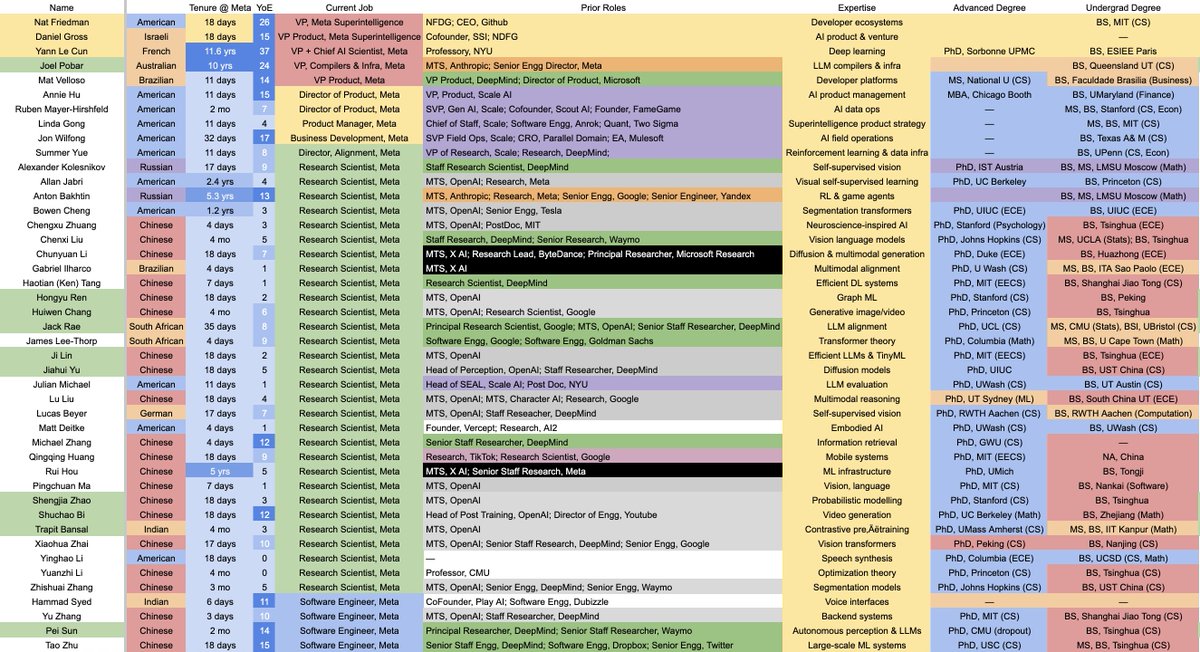
🚨 BREAKING: Detailed list of all 44 people in Meta's Superintelligence team.
— 50% from China
— 75% have PhDs, 70% Researchers
— 40% from OpenAI, 20% DeepMind, 15% Scale
— 20% L8+ level
— 75% 1st gen immigrants
Each of these people are likely getting paid $10-$100M/yr.
AI will move 5x faster than the internet.
With 3x the impact.
By 2030, 70% of Fortune 500 companies could disappear if they fail to adapt.
This isn't just another tech trend. It's a reinvention of business leadership.
Here's the proof:
Bill Ackman thoughtfully shared his investment criteria and what he thinks the best companies are, in a recent interview
Here's what he had to say:
"The best business, I believe, is one that doesn't have to put up or invest capital, but earns a perpetuity growth annuity.
Asset management is a great business. If you can invest the assets well, then you can get paid a fee off a base of assets of other people's money, but there are other businesses that meet that model.
Tim Hortons is a franchise restaurateur. They have a brand, they have a system, and then the franchisees put up the capital, and they get a royalty on every coffee and donuts that's sold at Tim Hortons.
Universal Music is a royalty on people listening to music.
Hilton is a royalty on people staying in hotels.
They own a brand. Other people put up the capital. So most of the companies we invest in can be thought of as annuities or growth royalties. And the key is predicting which of these royalties will endure. And that's a more complicated question.
I think Uber is precisely that. They don't pay for the cars and they don't do the driving?
They have a system. They've got a platform, they've got a user interface, and they aggregate all that demand, and then they get a royalty — let's call it 20% of the ride — in exchange for delivering the demand.
That's an amazing business. Again, if you can have confidence that the Uber platform will be the platform a decade from now and two decades from now.
[In terms of valuation] people use kind of a rubric for valuing businesses The P-E ratio is kind of a very simple way to think about a business.
But a stock can be expensive at 10 times earnings, and it can be cheap at 50 times earnings. What matters is not next year's earnings. What matters is the present value of the cash over the life of the business.
At the time we bought Chipotle, they had a food safety crisis. Sales were getting crushed.
People thought the company was going out of business, and it didn't look cheap. But if you believed you could change the course of Chipotle's history, fix the food safety issues, it was extremely cheap.
And the stock is up, probably ninefold from the time we bought it."