New in SJORANM 🫀
Extensive aortitis with Stanford type B intramural hematoma and renal arteritis: a nuclear medicine perspective on infectious vs inflammatory aortitis.
Open access · Peer reviewed
https://t.co/KA83hZyxiW
#Radiology#NuclearMedicine
Extensive Aortitis with Stanford Type B Intramural Hematoma and Renal Arteritis: A Nuclear Medicine Perspective on Infectious versus Inflammatory Aortitis | Swiss Journal of Radiology and Nuclear Medicine https://t.co/KA83hZxZto
Inside an intact lymphatic vessel: a 3D journey through lymphatic flow. Lipiodol — beyond diagnosis and toward theranostics. Read the review: https://t.co/l4tXIzji7r #Radiology#NuclearMedicine
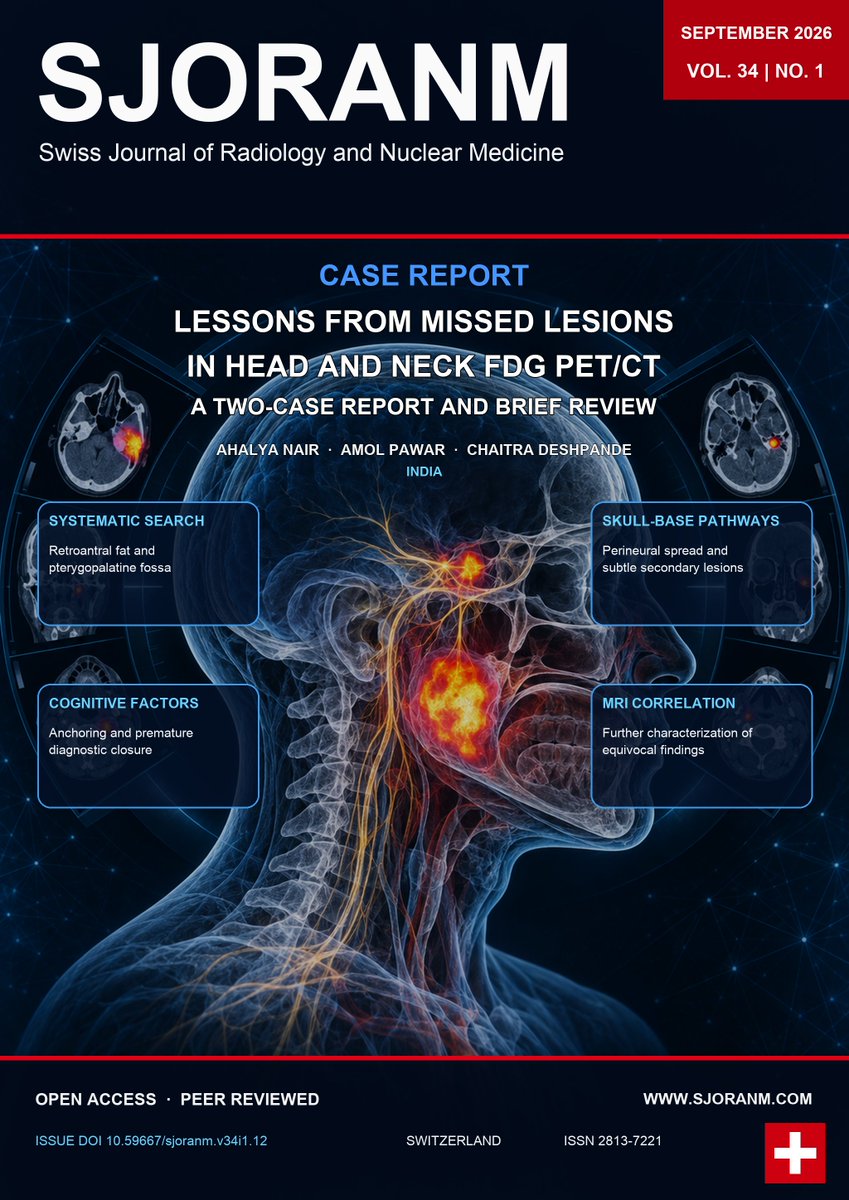
Lessons from Missed Lesions in Head and Neck FDG PET/CT: A Two-Case Report and Brief Review | Swiss Journal of Radiology and Nuclear Medicine https://t.co/dxT21zxyL7
Diagnostic Lymphangiography with Therapeutic Effect:: Since more than 70 years Lipiodol is used as an off-label standard of care for chylothorax - why not convert to on-label use? | Swiss Journal of Radiology and Nuclear Medicine https://t.co/Oh2pfhvFj2
A Dual-time-point 18F-FDG PET/CT Imaging Unveiled Occult Hepatic Metastasis of Breast Cancer with Neuroendocrine Differentiation: A Case Report | Swiss Journal of Radiology and Nuclear Medicine https://t.co/sBWAmKETa2
The Copper-beaten Skull Aspect in Children : Is It Always Pathological? - Age-Related Distribution of the Copper-Beaten Skull Appearance on Pediatric Cephalometric Radiographs: A Retrospective Single-Center Study | Swiss Journal of… https://t.co/fWmbjIJpuf
From an Interesting Patient to a Publishable Paper : A Step-by-Step Guide to High-Quality Radiological Case Reports | Swiss Journal of Radiology and Nuclear Medicine https://t.co/H76QKQaZ9E
From an Interesting Patient to a Publishable Paper : A Step-by-Step Guide to High-Quality Radiological Case Reports | Swiss Journal of Radiology and Nuclear Medicine https://t.co/H76QKQaZ9E
Obituary Prof. Dr. med. Werner Wichmann, MD: Professor Dr. med. Werner Wichmann passed away on 26.01.2023 | Swiss Journal of Radiology and Nuclear Medicine https://t.co/RW5LgNeUym
🌍 SPECIAL SJORANM PERSPECTIVE
Two papers. Two different approaches. One remarkably similar question:
WHO SHOULD SCIENTIFIC PUBLISHING ACTUALLY SERVE?
A thought-provoking paper by Fernanda Beigel, Dan Brockington, Paolo Crosetto and colleagues — “The Drain of Scientific Publishing” — describes a four-fold drain of the current system:
💰 MONEY
⏳ TIME
🤝 TRUST
🔑 CONTROL
The authors argue that commercial publishing is draining resources from research and call for a “re-communalisation” of scholarly publishing — bringing scientific communication back under stronger academic and community control.
🔗 The Drain of Scientific Publishing
https://t.co/PqaQcNptQq
Reading this paper immediately reminded me of another four-part concept — our recently proposed:
THE FOUR-LAYER MODEL OF OPEN SCIENTIFIC COMMUNICATION
Instead of starting with what is being lost, our model asks:
How could scientific communication evolve from here?
🔵 LAYER 1 — THE SCIENTIST
Intellectual honesty, self-criticism, reproducibility and the willingness to challenge one’s own conclusions.
🟢 LAYER 2 — THE JOURNAL / SCIENTIFIC COMMUNITY
Independent peer review, editorial responsibility, methodological scrutiny, ethical oversight and permanent archiving.
🟣 LAYER 3 — OPEN SCIENTIFIC DISCUSSION
Transparent and decentralized platforms for continuous discussion, replication and post-publication evaluation.
🟠 LAYER 4 — THE SCIENTIST’S OWN CHANNEL
Direct communication with the global scientific community — supported by AI, open infrastructures and continuous scientific dialogue.
🔗 Four-Layer Model of Open Scientific Communication
Frank Mosler, Gerd Nöldge & Keivan Daneshvar
https://t.co/PTlGKeudjt
What I find fascinating is that these are NOT the same model — and they were not developed together.
Yet they appear to describe two sides of the same transformation.
THE DRAIN identifies what the present system is losing:
Money. Time. Trust. Control.
THE FOUR-LAYER MODEL asks how scientific communication might rebuild:
Integrity. Independent evaluation. Open discourse. Scientific autonomy.
Perhaps the future of scientific publishing will not primarily be about replacing journals.
Perhaps it will be about changing WHO controls scientific communication, WHERE scientific credibility originates, and HOW scientific reputation is earned.
Journals may remain.
Peer review may remain.
But the centre of gravity could move:
From publishers → toward scientific communities.
From journal prestige → toward scientific credibility.
From publication as an endpoint → toward continuous scientific discussion.
And that may ultimately be the real meaning of Open Science.
💎 SJORANM supports Diamond Open Access:
No paywalls. No APCs. Open science without borders.
SJORANM Swiss J. Radiol. Nucl. Med. DOAJ Swiss Library Service Platform (SLSP)
Consortium of Swiss Academic Libraries
🌍 SPECIAL SJORANM PERSPECTIVE
Two papers. Two different approaches. One remarkably similar question:
WHO SHOULD SCIENTIFIC PUBLISHING ACTUALLY SERVE?
A thought-provoking paper by Fernanda Beigel, Dan Brockington, Paolo Crosetto and colleagues — “The Drain of Scientific Publishing” — describes a four-fold drain of the current system:
💰 MONEY
⏳ TIME
🤝 TRUST
🔑 CONTROL
The authors argue that commercial publishing is draining resources from research and call for a “re-communalisation” of scholarly publishing — bringing scientific communication back under stronger academic and community control.
🔗 The Drain of Scientific Publishing
https://t.co/PqaQcNptQq
Reading this paper immediately reminded me of another four-part concept — our recently proposed:
THE FOUR-LAYER MODEL OF OPEN SCIENTIFIC COMMUNICATION
Instead of starting with what is being lost, our model asks:
How could scientific communication evolve from here?
🔵 LAYER 1 — THE SCIENTIST
Intellectual honesty, self-criticism, reproducibility and the willingness to challenge one’s own conclusions.
🟢 LAYER 2 — THE JOURNAL / SCIENTIFIC COMMUNITY
Independent peer review, editorial responsibility, methodological scrutiny, ethical oversight and permanent archiving.
🟣 LAYER 3 — OPEN SCIENTIFIC DISCUSSION
Transparent and decentralized platforms for continuous discussion, replication and post-publication evaluation.
🟠 LAYER 4 — THE SCIENTIST’S OWN CHANNEL
Direct communication with the global scientific community — supported by AI, open infrastructures and continuous scientific dialogue.
🔗 Four-Layer Model of Open Scientific Communication
Frank Mosler, Gerd Nöldge & Keivan Daneshvar
https://t.co/PTlGKeudjt
What I find fascinating is that these are NOT the same model — and they were not developed together.
Yet they appear to describe two sides of the same transformation.
THE DRAIN identifies what the present system is losing:
Money. Time. Trust. Control.
THE FOUR-LAYER MODEL asks how scientific communication might rebuild:
Integrity. Independent evaluation. Open discourse. Scientific autonomy.
Perhaps the future of scientific publishing will not primarily be about replacing journals.
Perhaps it will be about changing WHO controls scientific communication, WHERE scientific credibility originates, and HOW scientific reputation is earned.
Journals may remain.
Peer review may remain.
But the centre of gravity could move:
From publishers → toward scientific communities.
From journal prestige → toward scientific credibility.
From publication as an endpoint → toward continuous scientific discussion.
And that may ultimately be the real meaning of Open Science.
💎 SJORANM supports Diamond Open Access:
No paywalls. No APCs. Open science without borders.
SJORANM Swiss J. Radiol. Nucl. Med. DOAJ Swiss Library Service Platform (SLSP)
Consortium of Swiss Academic Libraries
🌍 SJORANM COMMUNITY SPOTLIGHT #002
Today, the Swiss Journal of Radiology and Nuclear Medicine (SJORANM) is pleased to highlight another member of our growing international community:
👩⚕️ Amal Guensi, MD
Head of Nuclear Medicine Department
Ibn Rochd University Hospital / Hassan II University
📍 Casablanca, Morocco 🇲🇦
Dr. Guensi is an experienced nuclear medicine physician whose clinical and scientific work spans several key areas of contemporary molecular imaging:
🔹 PET/CT and molecular imaging
🔹 Theranostics and radionuclide therapy
🔹 Conventional nuclear medicine and scintigraphy
🔹 Thyroid cancer imaging and management
🔹 Oncological and hybrid imaging
A particular focus of her scientific work is the role of nuclear medicine in differentiated thyroid carcinoma, including therapeutic outcomes and the long-term management of patients with thyroid malignancies.
Her scientific activities reflect the rapidly evolving role of nuclear medicine in precision oncology — bringing together advanced molecular imaging, targeted therapy and individualized patient management.
At SJORANM, we believe that a scientific journal is more than its Editorial Board and its published articles.
It is a community.
And that community is built by physicians, scientists, researchers, technologists and readers from around the world who follow our work, exchange ideas and help make scientific knowledge visible.
Dear Dr. Guensi — thank you for being part of the international SJORANM community. We are very pleased to have you with us. 🇨🇭🤝🇲🇦
💎 SJORANM supports Diamond Open Access.
No paywalls. No APCs. Open science without borders.
🌐 https://t.co/PJCRzsLliw
SJORANM Swiss J. Radiol. Nucl. Med. Society of Nuclear Medicine and Molecular Imaging (SNMMI) European Society for Molecular Imaging - ESMI PET-CT Academy Radiopharmaceutiques, Imagerie, Théranostics et Multimodalité (RITM) American Thyroid Association, Inc. (ATA) Medical Image Computing (MIC) @DKFZ German Cancer Research Center Open Science NL The Open University DOAJ 🔗 Further information & educational resources:
📍 Casablanca
https://t.co/zGG3BGoIZb
🔹 PET/CT & Molecular Imaging
https://t.co/5cWC5m1upw
🔹 Theranostics & Radionuclide Therapy
https://t.co/qX0ONkuPKh
🔹 Nuclear Medicine & Scintigraphy
https://t.co/JlSSqNQZD6
🔹 Thyroid Cancer
https://t.co/BL50EOPC9C
🌐 Swiss Journal of Radiology and Nuclear Medicine
https://t.co/PJCRzsLliw