Students who took notes by hand scored ~28% higher on conceptual questions than laptop note-takers.
Writing forces your brain to process and compress ideas instead of copying them.
"If you want your children to be intelligent, read them fairy tales. If you want them to be very intelligent, read them more fairy tales."
On Einstein's birthday, his delightful advice on education: https://t.co/Bvsu80aPWl
@sharononeill3@MaryLouMcDonald@NormaFoleyTD1 The question is WHY is there such a difference in the value placed on one group over another doing the same job. TWO months before a child with additional needs joins junior infants they were in preschool/daycare. Needs did not develop during the transition. WHY the difference.
@SharonT547313@sharononeill3@MaryLouMcDonald@NormaFoleyTD1 Totally agree. Public support for SNAs has been amazing and well deserved. This is the type of support Early Childhood Professionals also need while navigating day to day Early Interventions in the best way they can despite inadequate support structures and funding.
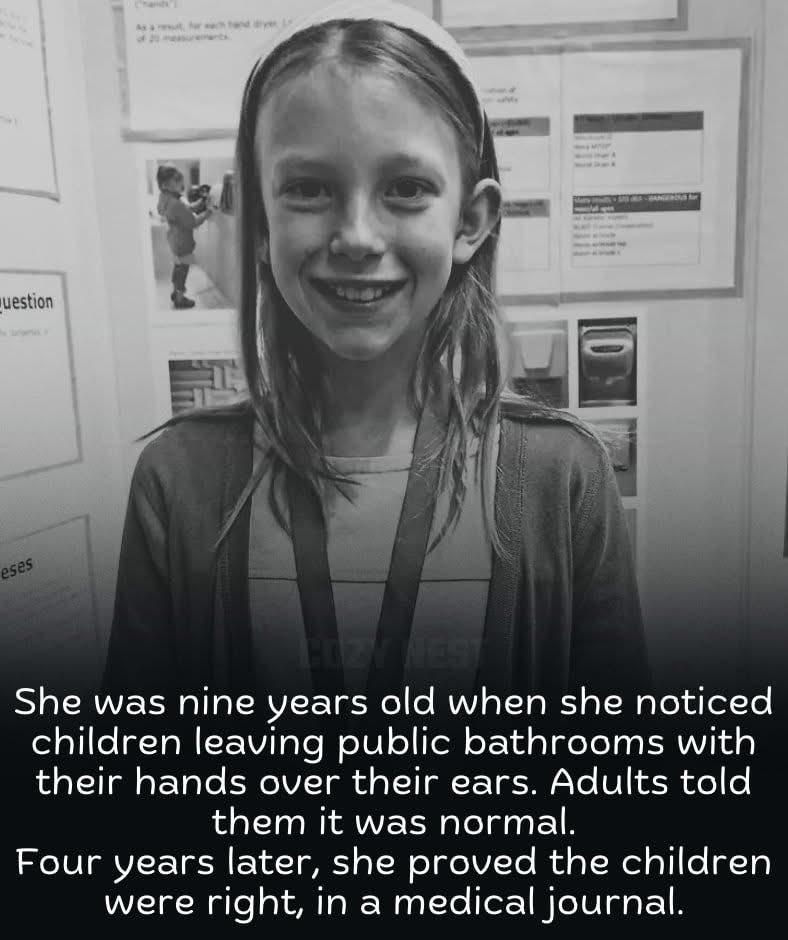
Nora Keegan was not trying to change public health policy. She was just paying attention.
In elementary school in Calgary, she noticed something adults kept dismissing. Children rushing out of public restrooms. Hands clamped over their ears. Faces tense. Complaints whispered between friends. It hurts my ears.
She felt it too. After using hand dryers, her ears rang. The sound lingered. Adults brushed it off. They are just loud. That is what machines do.
But Nora kept wondering why children reacted so strongly. And more importantly, why no one was measuring it.
In fifth grade, she decided to find out.
With the help of her parents, both physicians, she turned curiosity into research. She borrowed professional sound equipment. She designed an experiment. And then she went where the problem lived.
Public bathrooms.
Over two years, she visited forty four restrooms across Alberta. Libraries. Restaurants. Schools. She took eight hundred and eighty measurements. She measured at adult height. Then she crouched to measure at child height. She tested distance. Position. Airflow. Again and again.
What she found was impossible to ignore.
Many high speed hand dryers exceeded one hundred decibels at a child’s ear level. Some reached levels comparable to emergency sirens. Levels that medical authorities already prohibit in children’s toys because of the risk of hearing damage.
Children were not imagining the pain. They were standing closer to the source. Their ears were smaller. And the sound hitting them was stronger than what adults experienced.
Manufacturers claimed their machines were safe. Nora’s data showed real world conditions told a different story.
And she did not stop there.
Still in middle school, she began designing a noise reduction filter. A simple modification that lowered sound output by more than ten decibels. Proof that the problem was not inevitable.
Then she did something most adults never do. She wrote a scientific paper.
Her first submission was rejected. So she revised. She corrected. She tried again.
In June 2019, Paediatrics and Child Health published her study. Its title was direct and impossible to dismiss. Children who say hand dryers hurt my ears are correct.
She was thirteen years old.
Health professionals paid attention. Researchers cited her work. Parents shared it. Manufacturers requested meetings. All because a child trusted her own experience enough to test it.
Nora did not raise her voice. She measured. She documented. She proved.
And in doing so, she reminded the world of something simple and easily forgotten.
Sometimes the smallest voices are describing the biggest problems. You just have to listen.
“You don't start out writing good stuff. You start out writing crap and thinking it's good stuff, and then gradually you get better at it. That's why I say one of the most valuable traits is persistence.”
― Octavia E. Butler
#AcWri#AmWriting
6 years ago different factions of our profession came together to demand the government respect our profession and service. There was so much optimism for lasting positive change but today I despair with our staffing crisis and services struggling with sustainability/ pressures.
New figures obtained by RTÉ News show that up to August this year, children in Dublin were waiting up to 13 years to be seen by a primary care psychologist. - Aisling Kenny
The Primary Care Psychology Service is the first step for children after they present to their GP with mild to moderate mental health issues
https://t.co/CWmIJpWnBS
Last week, we took our 6-year-old son, River, to the Clarks Village outlet store in Street to get him fitted for school shoes. Since River is autistic, he finds it really tough to handle crowds, long lines, and noisy places. The store was packed!
I knew he wouldn’t manage well in that environment, so I shared our situation with a staff member. Aaran quickly stepped in and led us away from the noise and crowds to a staff room, putting a Do Not Disturb sign on the door. He showed so much patience with River, who was feeling anxious, and brought out a bunch of different shoes for him to try on.
We left with a fantastic pair of shoes, a very happy boy, and Aaran even gave us the store number and offered to set up an appointment for us before the store opens to keep it quiet.
This is what autism acceptance looks like!
Thank you, Clarks in Street, and a huge shoutout to Aaran Daniels for all his help! 👍
Credit : Charleston Estos
A message from a Kindergarten teacher:
After forty years in the classroom, my career ended with one small sentence from a six-year-old:
“My dad says people like you don’t matter anymore.”
No sneer. No malice. Just quiet honesty — the kind that cuts deeper because it’s innocent. He blinked, then added, “You don’t even have a TikTok.”
My name is Mrs. Clara Holt, and for four decades, I taught kindergarten in a small Denver suburb. Today, I stacked the last box on my desk and locked the door behind me.
When I started teaching in the early 1980s, it felt like a promise — a shared belief that what we did mattered. We weren’t rich, but we were valued. Parents brought warm cookies to parent nights. Kids gave you handmade cards with hearts that didn’t quite line up. Watching a child sound out their first sentence felt like magic.
But that world slowly slipped away. The job I once knew has been replaced by exhaustion, red tape, and a kind of loneliness I can’t quite describe.
My evenings used to be filled with construction paper, glitter, and glue sticks. Now they’re spent filling out digital reports to protect myself from angry emails or lawsuits. I’ve been yelled at by parents in front of twenty-five children — one filming me with his phone while I tried to calm another child mid-meltdown.
And the kids… they’ve changed too. Not by choice.
They arrive tired, anxious, overstimulated. Their tiny fingers know how to swipe a screen before they can hold a crayon. Some can’t make eye contact or wait in line. We’re expected to fix all of it — to patch the gaps, heal the trauma, teach the curriculum, and document every move — in six hours a day, with resources that barely fill a drawer.
The little reading corner I once built, full of soft beanbags and paper stars, was replaced by data charts and “learning metrics.” A young principal once told me, “Clara, maybe you’re too nurturing. The district wants measurable results.”
As if kindness were a weakness.
Still, I stayed. Because of the small, holy moments that no spreadsheet could measure —
a whisper of, “You remind me of my grandma.”
a shaky note that read, “I feel safe here.”
a quiet boy finally meeting my eyes and saying, “I read the whole page.”
Those tiny sparks were my reason to keep showing up.
But this last year broke something in me.
The aggression grew sharper. The laughter in the staff room turned to silence. The light went out of so many eyes. I watched brilliant teachers — my friends — vanish under the weight of burnout, their joy replaced by survival.
I felt myself fading too, like chalk on a board that’s been wiped one too many times.
So today, I began my goodbye. I pulled faded art off the walls and tucked thirty years of handmade cards into a single box. In the back of a drawer, I found a letter from a student from 1998:
“Thank you for loving me when I was hard to love.”
I sat on the floor and cried.
No party. No applause. Just a handshake from a young principal who called me “Ma’am” while checking his notifications.
I left my rocking chair behind, and my sticker box too. What I carried with me were the memories — the faces of hundreds of children who once trusted me enough to reach out their hands and learn. That can’t be uploaded. It can’t be measured. It can’t be replaced.
I miss when teachers were partners, not targets. When parents and educators worked side by side, not in opposition. When schools cared more about wonder than numbers.
So if you know a teacher — any teacher — thank them. Not with a mug or a gift card, but with your words. With your respect. With your understanding that behind every test score is a heart that cared enough to try.
Because in a world that often overlooks them, teachers are the ones who never forget our children.
🗣️ “Bold leadership starts in the earliest years.”
@GovWesMoore just took the stage at the LEARN Conference 2025 with a powerful welcome, recognizing your impact, lifting your voice and charging this field with what comes next.
#LEARNwithZTT
How to Get Your Research Paper Published
Want your research paper published? Most academics get this wrong.
They submit to journals without doing homework first, then wonder why they get rejected.
Here's the step-by-step process that actually works 🧵👇
The same issue as 2024. Early Childhood Education does not feature on the list of degrees on qualifax. Instead it is listed as 'childcare.' Not withstanding the rigorous QAB process, ECEC is still not recognised as a profession. #Educators#ECECprofession
📢 Our new paper on inclusive education incorporating the @Autistic_SPACE framework is published just in time for the new school year. With @ElaineMcGoldri6 @AoifeMunroe@CarinaByrn96583 & Rachel Ferguson. Please share widely
@ncseirl@MICLimerick
https://t.co/BtKRbT33vH
My fear is that Govt plans to ‘reform’ AON (the only legal right that #Disabled Citizens have in Ireland) will be to remove the legal right toAON. I’ve heard Minister Naughten express view that the right to an AON (routine in every other EU jurisdiction) is the ‘Problem’ #Ableism
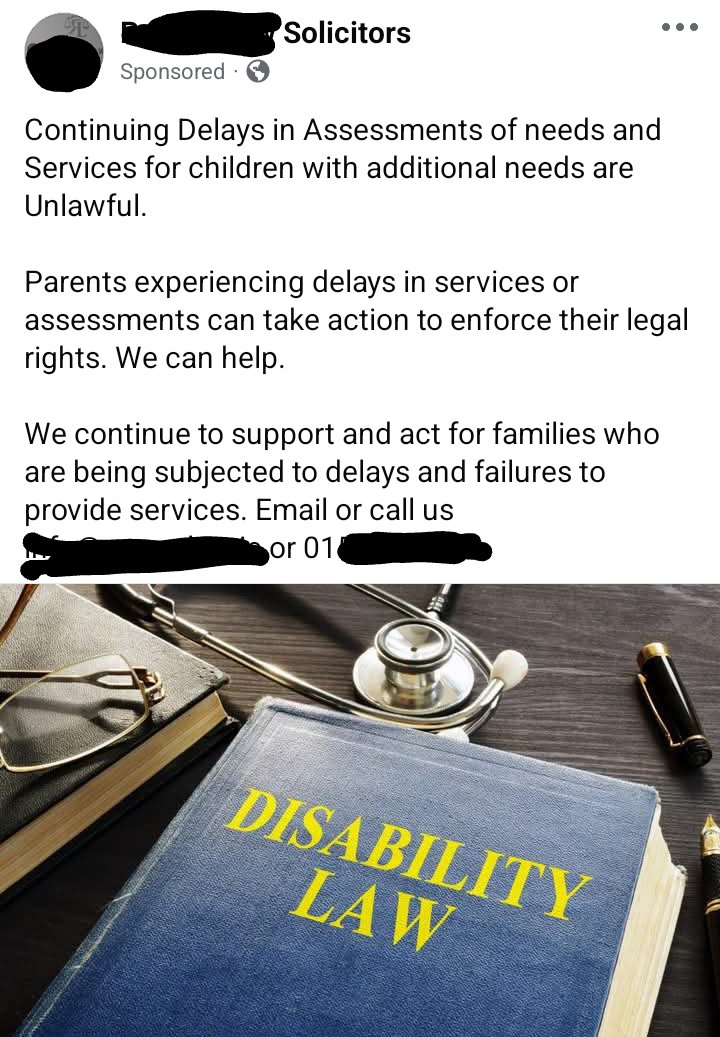
This keeps popping up on my newsfeed lately. After years of underfunding and political incompetence the only way many parents are getting AON is by taking legal action. How much is this costing the exchequer as opposed to funding/ staffing the services properly first time round